Wednesday, June 3, 2020

Notes from the Key West Library

President Lucy Burdette aka Roberta Isleib, Librarian/Administrator Michael Nelson, Treasurer Tom Clements

LUCY BURDETTE: One of the organizations I have been involved with for the past number of years in Key West is the Friends of the Key West library. And I am delighted to say that this year I will be serving as the president. The Friends is an active organization which holds used book sales during the high season, along with a lecture series and a number of other events.  All of the money raised by the friends goes directly to the library to purchase things that they wouldn’t otherwise be able to afford, including books! 

Michael Nelson is our new library administrator and librarian and he agreed to visit with us today. He’s a huge reader and music lover and has been providing an amazing lineup of speakers for a small library.  Welcome Michael!

 It’s been such an impossible spring in every way, but I think this group of readers would be interested to hear about what the library has been able to provide even though it’s closed, and what services have been most popular?

MICHAEL NELSON: I don’t imagine it will surprise anyone that our digital content became increasingly popular as the “safer at home” mandate closed the library doors to in-person visits. We immediately put extra funding into building our eBook and eAudiobook collections. Our streaming service, Kanopy, which features independent films, world cinema, classic movies, and documentaries, also saw a marked surge in usage. Similar increases occurred with the library’s learning languages software and digital access to the New York Times and other papers and magazines. We made it possible for our patrons to register for a library card online and staff has remained available for questions and assistance via the phone, online chat, and email ever since the doors closed. It was our “more library, less public” initiative, and we tried to be as useful as possible. Like many libraries across the country, we began virtual programming, which has included multiple story times and easy crafting to a NASA Ambassador presenting a talk on the possibility of living on Mars. (Side note: I am not going).  We’ve also stocked various tax and unemployment forms on our outside shelving and continue to stock free books for patrons to take. For the last two weeks, we’ve starting allowing patrons to pickup materials placed on hold (then placed outside) at an appointed time. As I’m writing this, we’re planning to reopen in June with new safety measures in place. It’s an evolving process.

LUCY: In some ways all libraries are alike, but in others not so much. I’m thinking of how the KW library serves a diverse population ranging from snowbirds to homeless. I wonder if you could talk a bit about the special challenges of running a library in Key West.


MICHAEL: Well, we do have a library rooster. He doesn’t come in, but he does admire his reflection in the front doors on a daily basis. (Or maybe he’s just getting a little cool air seeping out from under the entrance, but I prefer to think he’s just wildly vain. The staff call him, “Red,” but I call him “Warren Beatty Bird.”) Libraries, by their nature, are welcoming places and why I love these institutions, wherever they may be, but Key West is certainly a great locale and a destination for people of all backgrounds and income-levels. It’s also a library that’s had Tennessee Williams and Shel Silverstein as patrons. Thomas McGuane wrote a book or two in the library and Jimmy Buffett hung out here for the air-conditioning in the 70’s. Judy Blume did research for her most recent novel at our library and Meg Cabot talked to a full auditorium of fifth-graders about graphic novels. And I’m being completely honest when I say that I could list another two dozen or so extraordinary writers who’ve stopped in or been long-time patrons.

LUCY: One of the special things about the Key West library is our Florida history collection. I thought you would like to hear something about that and also how you can access some of these wonderful photos.

MICHAEL: Key West has a remarkable Florida History Department. The library’s archival vault holds the original order from Commodore David Porter that formally established Key West in 1823. It also has a galley proof of To Have and Have Not with Hemingway’s notes in the margins as well as a vast collection of local historical documents from maps to diaries to photographic images. Many of these photographic images have been scanned and can be found here. Earlier this year, the photographic archive surpassed thirty million views. You can find out more about our Florida History Department at this address, including some recent visual recordings of our venerable historian, Tom Hambright, talking about various aspects of Keys history from wrecking and salvage to the cigar industry in Key West. (Note from Lucy: Tom Hambright is such a treasure--do not miss a chance to hear him talk about the history of Key West!)

LUCY: All writers I think are curious about what makes a book land on the to-be-ordered list for a library. Can you tell us how you go about making these choices?

MICHAEL
: We do have a lot of resources for selecting books, but I particularly enjoy the Indiebound Next List, which spotlights recommended titles and reviews from independent booksellers from around the country. You’ll always find solid recommendations there. Publishers Weekly, of course, is an excellent resource and the starred reviews usually end up on our list to order. I’m also quite fond of the New York Times Book Review, and of course, patrons are constantly bringing in clippings from the paper and requesting titles they’ve read about. I will say, and I don’t know if it usually works or not with bigger library systems, but I do see a lot of new authors using the “purchase suggestion” option on our website and recommend their own work. Many times, it’s independently published and our primary vendor doesn’t carry it, but once in a great while, I’ve purchased it if it has some connection to the Keys.

LUCY: What have you read recently and what are you looking forward to?


MICHAEL: I just finished, “Here We Are: My Friendship with Philip Roth” by Benjamin Taylor. Taylor's love of Roth's work and the man himself makes this slender remembrance of the legendary author a complete charmer. The book covers late-stage Roth, retiring and then dying, but Taylor's vivid portrait makes us see a man who never lost his immense intelligence and wit and talent. Taylor was lucky to be Roth's friend, and Roth was lucky to be his.


LUCY: And finally this is just a nosy question, but I wondered how you decided to become a librarian and when you knew this was your career path?

MICHAEL: I started volunteering at the public library in high school. Later, at the University of Florida, I worked in their Special Collections library as a student worker. I think that experience stayed in the back of mind and later sparked my interest in collecting books (rare and signed). After getting a Communications degree, and a little later an English degree, library school seemed like the next best step. I was lucky to get my first librarian position in Daytona Beach and a few years later, got into library management at the New Smyrna Beach branch. Like Key West, New Smyrna is a small beach town with a big cultural scene, including the Atlantic Center for the Arts, which brought in artists, authors and musicians from all over the country. Programming quickly became the most rewarding part of my job. A little over five years ago, I got the exceptional opportunity to join the staff at the Key West Library and then took over as Administrator in March of 2019. 


LUCY: Aren't we lucky to have Michael in Key West? He'll be stopping in today to look for questions. And if you'd like to become a Friend of the Key West library, all are warmly welcome!

Tuesday, June 2, 2020

Leaving a Little Mystery in the Mystery by Victoria Gilbert


 LUCY BURDETTE: Today's guest, Victoria Gilbert, is one of my author pals at Crooked Lane Books. Booked for Death, the first in her book lovers B & B mystery series, will be published on August 11. Welcome Vicki!

VICTORIA GILBERT: I’m thrilled to have been invited to be a guest on the Jungle Red Writers blog, and have thought long and hard about an appropriate topic. I finally decided that I should write about something close to my heart—my love of unsolved mysteries.

Not just the real-life variety, although I am fascinated by those, but also the mysteries that authors leave unsolved in their stories. I admit I’m obsessed with novels that leave me thinking and puzzling long after I finish the book.

I know this practice drives some readers up the wall. I think you can guarantee that at least fifty percent of those who read Tana French’s IN THE WOODS will throw the book across the room when they reach the end. But I love its ambiguous ending, just like I love Henry James’s masterpiece, THE TURN OF THE SCREW, or the more recent, but equally enigmatic ghost story, THE WOMAN IN BLACK by Susan Hill.  (The film versions are sadly, not true to the novel).

In each of these books, the author allows at least one mystery to remain unsolved at the end, forcing the reader to make up their own mind about what happened and why. In the case of IN THE WOODS, French has her detectives solve the central crime, but leaves the mystery of what happened in childhood to one of her main characters open-ended. I enjoyed this, although I was in the minority when discussing this book with my book club. Many felt that French shouldn’t have left what happened in the past unexplained. I can understand this desire to know everything, but for me, leaving this mysterious event mysterious enhanced the book. Perhaps it’s because I feel there are so many unexplained aspects of life that this gave the story a veracity and impact it might have otherwise lacked.

THE TURN OF THE SCREW and THE WOMAN IN BLACK use a different technique to achieve their ambiguity—not an unexplained event, but rather a questioning of the veracity of their first-person narrator or protagonist. Of course, the unreliable narrator is popular today, but these stories handle this technique with a subtly that is often missing in recent novels. They don’t just have a “twist;” they force us to question central aspects of the story. Are the ghosts real, or are they the products of the protagonist’s imagination, or even derangement? Both books are so brilliantly written that they can be read either way or, indeed, in multiple ways. Which, to me, makes them worth reading over and over again.

I’ve tried to incorporate a touch of this technique in my own cozy mysteries, including the newest, Booked for Death. Now, I’m not claiming I do it as well as the above referenced authors, but I have included some things that can be read in alternate ways. If you believe in ghosts or the fae or other aspects of the supernatural, you can view certain events and scenes in my books as real instances of paranormal activity. But if you are a skeptic, you can also read them as coincidences or random occurrences. I don’t come down explicitly on either side in the books—different characters express varying opinions—because I don’t want to make up the reader’s mind for them. Just like in life, where strange and inexplicable happenings do occur, I like to leave such things open to interpretation.

How do you feel about leaving a few mysteries unexplained, or some unanswered questions in a book, especially if the main mystery IS explained? And—do you believe in ghosts or other aspects of paranormal activity, or are you a skeptic? (There are no wrong answers to this!). Victoria will be giving away a copy of Booked to Death (in August!) to one lucky commenter...

About Booked for Death: A book lover's B&B in the idyllic waterfront village of Beaufort, NC becomes the scene of a brutal murder. Chapters Bed-and-Breakfast is a reader's paradise, hosting special events celebrating books, genres, and authors. It's the perfect literary retreat--until a rare book dealer turns up dead during a celebration of Golden Age mystery author Josephine Tey.

About Victoria: Raised in a historic small town near the Blue Ridge Mountains, Victoria Gilbert turned her early obsession with books into a dual career as an author and librarian. Victoria writes the Blue Ridge Library Mystery series and the Book Lover’s B&B series for Crooked Lane Books. A member of Mystery Writers of America, International Thriller Writers, and Sisters in Crime, Victoria is represented by Frances Black at Literary Counsel. She lives near Winston-Salem, NC with her husband, son, and some very spoiled cats.

Check out her website for more information on her books and links to all her social media accounts.

You can find buy links for all her currently published books here (and order via indie bookstores!) 

Monday, June 1, 2020

How We Live When the World Goes Mad


LUCY BURDETTE: Gosh this has been a hard week in our country. It's hard to stay positive when the bad news and bad behavior keeps piling up from all directions. Rather than sink lower with our collective despair and worry this morning, I decided to try a different direction.

Several things have happened lately that have made me wonder about whether there’s anything positive to learn from this downtime during the pandemic. I’ve heard rumors that some people are using this enforced down time to figure out whether life has meaning as it stands, or whether the activities and priorities we used to have need reevaluation. While we were still in Key West I noticed this beautiful Volkswagen. It reminded me of how I had planned to travel everywhere in a VW van after high school. I spent a lot of time designing the inside of the van with built-ins, including a bed and a miniature kitchen. I never did own a VW van, and I really don’t want one now. But I am eager to get back to traveling. We had a wonderful trip to Paris and Ireland planned, and I’m just as excited as ever to reschedule (sometime!) I still want to see New Zealand (maybe more than ever) and some other places. And we will desperately miss our time with kids and grandkids, though we are doing a yeoman’s job of staying in close touch over Facetime.


Last week, our Key West minister (also my dear friend and character Steve Torrence) asked this question in his message a week ago: Is this crisis an opportunity to see what we’re really made of? And another similar thought, that might be either jarring or reassuring: “Look around, this is how you live when the world falls apart.“


And finally, Ali Beale, the yoga teacher whom I love and have been following online since the world’s been shut down, asked a similar question: Are there things you’ve learned you are happy to do without during the pandemic? Or maybe other activities or dedications to take up?


There you have it, questions for the day: Is this horrible crisis causing you to rethink your life? Appreciate exactly what you have? Plan major changes? Simply carry on? (IMHO, this has been a horribly difficult time so there are no wrong answers!)


JULIA SPENCER-FLEMING: I think my brain has been working on this question subconsciously, Lucy. I had a half-awake dream a while back where I was given the chance to go back in time and re-do things. I woke up with four ideas of what I would have done: be more proactive about health (there was a lot in the dream about me yelling at Ross to wear sunscreen…) have better and more consistent writing habits, tackle the small needs-to-be-repaired issues in my old house before they became big issues, and save for retirement (Ross took care of that while he was alive, but now I have to carry on.) 


Then, of course, I realized these were all goals I can and should focus on right here and now. I knew that, but having them float up into my head from the bottom of my brain made it feel like a revelation. I suspect this pandemic is giving a lot of us time to work on our issues, whether we realize it or not.


RHYS BOWEN: Definitely appreciate my life and my husband. We hug each other and he says “I’m so glad I have you.”  He would never say things like that in a normal world! He’s British and not a great expresser of emotion. I also find that I can appreciate my situation, with enough space around me so we are not on top of each other, lovely views, enough to eat, not to have to worry about money… and realize how many people are desperate. I try to help where I can--food bank etc.


The thing I’m finding hardest is not being able to plan. Usually by this time we have our summer trip to Europe all lined up, a couple of conventions for the fall, my book tour in August...and now an empty calendar. I’m supposed to be co-guest of honor at Malice next year with Julia and who knows if that will happen? I am being very good at social distancing now but can I keep it up for six months? A year? Five years? These are things that haunt me at night. When will I crack and go into Macy’s? (if Macy’s still exists?)


Actually one thing I find I can do without is shopping. I open emails from Chicos and all the other places I have shopped in the past and I think “why bother. I have enough.”  Will that continue, I wonder, or will I go on an insane buying spree at the end of this--throwing out all my old clothes and buying an entirely new wardrobe. 


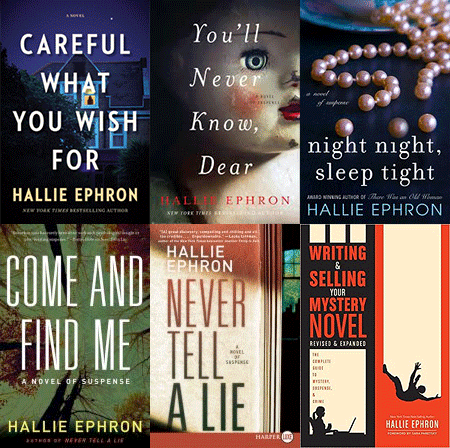
HALLIE EPHRON: So funny because the one thing I find I truly miss is shopping! We have a Marshall’s nearby and my escape when wit’s end is in sight, is to go see what’s new there. They have new merchandise daily. I rarely buy, but the diversion is welcome.


Like Rhys, I am so appreciating my husband and grateful that I’m home-bound with someone whose company I truly enjoy and who adores my cooking. It helps that he’s good at jigsaw puzzles. We’re on our 6th. 


At the end of the day, I’m surprised at how contented I am NOT to be traveling. My husband and I have traveled since we were first married, all through having babies and on to teenagers and after. I’ve been to the places I felt I *needed* to go, and being home is o-kay… for now. 


As I say, most of all I feel fortunate and grateful. It helps that I can look forward to my daughter Molly living in a rental nearby for the month of July. Plus a ton of ‘virtual’ events. And though I don’t think it will be soon, there’s a glimmer of an end in sight with treatment (first) and eventually a vaccine. In the meanwhile I look forward to becoming an expert ZOOMer.


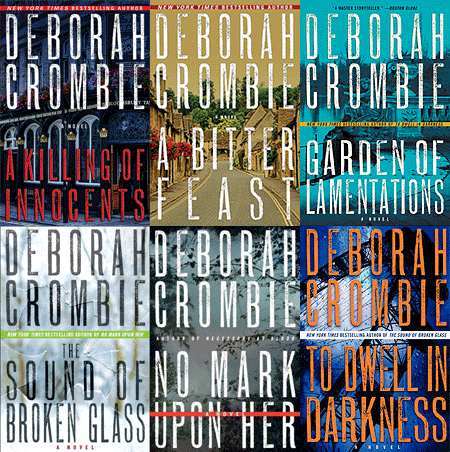
DEBORAH CROMBIE: I'm definitely appreciating my life and my husband. I'm appreciating the fact that I can see my daughter and granddaughter over the fence--but I really really miss being able to hug them. That's the hardest thing for me. Otherwise, I have to admit I kind of like the peacefulness of not rushing around all the time. I've always had a hard time sticking to a schedule, so the fewer interruptions, the better, as far as my writing goes. And as I have a book due in a few months, I'm really seeing this lockdown as a blessing in disguise.


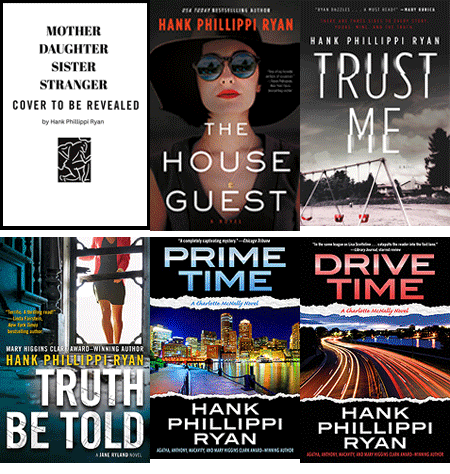
HANK PHILLIPPI RYAN: Debs, I am so envious.  I was truly off my game for about a month...staying up really late, and then waking up early. I kept thinking--save food, save food. I couldn’t read, and certainly couldn’t write. I was doing my reporter work from home, which is hurray, safer, but extremely complicated.  I’m better now, or on the way to being.  I have never worked this much, ever--with zooms and everything else, and I love love love that we can do it, but I have not had a day “off” for 78 days.


SO differences: I look at my clothes and shoes, suitable for a lifetime of on-air and in-person appearances, and have two thoughts. One--What did I need all those for? And two--I miss the fun of wearing them. Shopping? No. I don’t need one more thing, ever.  I wonder whether that change will stick. I hope I get the chance to find out. I looked at my book tour suitcases this morning, all in a closet. Don’t need those, either. And, I realize, I’m truly okay with that. 


Jonathan and I are in a fine place, with a back and front yard, and a lot of room, and we have a tiny herb and vegetable garden, now, besides all the flowers, and we take walks. We have always been very careful and respectful and caring of each other, but that, for both of us, is greatly increased. It’s very sweet, and we are both aware of it, but really don’t discuss it. He’s incredible about things like emptying the dishwasher, and vacuuming. Without a complaint or any martyrdom. He says he’s happy to be in “our safety bubble.”  (Which, like Rhys’s John, is not a typical Jonathan thing to say.) 


We have not set foot out of our yard. 


So I am trying to write now, and trust the future. I pretend my deadline is still my deadline. I pretend everything will get better. I do a lot of pretending. 

LUCY: Your turn now Reds...What have you learned while the world goes mad?