
Friday, March 23, 2012

Katherine Neville interviews M.J. Rose

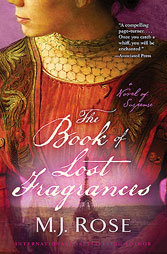
JULIA SPENCER-FLEMING: Usually, when we have an interview here on Jungle Red Writers, one of the Reds asks the questions. But when you have someone of the stature of Katherine Neville--we'll happily step aside. Katherine is the New York Times bestselling author of The Eight, one of the most well-loved and influential thrillers of the past thirty years. International bestseller M.J. Rose mixes genres the way a master perfumier mixes scent: contemporary thriller, historical fiction, romance, mystery, erotica; all combined in her intricately plotted novels. We hope you enjoy their discussion on writing, strong women, and The Book of Lost Fragrances.


Katherine Neville: I have to confess that part of why I was so drawn to THE BOOK OF LOST FRAGRANCES is that you and I share a fascination with telling stories that interweave multiple themes--romance, history, science, esoteric, mystery, etc. What do you feel is the challenge and great payoff of stepping off the edge like that?

M.J. Rose: I think it’s the ultimate challenge of any book, really-- to make every one of those themes and elements you describe strike notes that feel true and surprising and human. But I guess the added challenge—and also the reward, if you’ve done it right—of ‘stepping off the edge’ with all those pieces in play is the hope that the notes work together to form a rich and resonant and emotionally satisfying chord by the time the book’s done. Even though this is a suspsense novel, a lot of my friends have told me that the ending of BOOK OF LOST FRAGRANCES made them cry—to me that’s the ultimate compliment!

Katherine Neville: It's often said that our sense of smell is our earliest memory. The earliest smell I could recall was ice on the branch of a tree, which may explain why I’ve always been captivated by stories like Hans Christian Anderson's Snow Queen and the snow scenes and music in Tchaikovsky's Nutcracker Suite.

Tell me about your own earliest recollections of scent, and how perhaps they motivated you to write THE BOOK OF LOST FRAGRANCES?

M.J. Rose: My mother wore only one perfume her whole life, Shalimar. And that fragrance, and the way it embodied my mother, figures in so many of my earliest memories. I was a very shy child, and when I first started school I always had a hard time when she got ready to leave. We had a routine. I’d cry. She’d take a handkerchief out of her pocketbook and give it to me to dry my tears. And then she’d go. But I’d still have that fragrant handkerchief. And I could still smell her. I suppose it felt that, as long as I had something that smelled of her, she was never too far away, and would always come back.
Despite the fact that my books are labled suspense, at heart I think I’m a very emotional writer. I think there’s magic in how something as simple as my mother’s perfume on a white linen cloth could give me so much comfort. I believe you find a character’s heart when you discover what sight or sound or smell or taste moves them, or frightens them or makes them feel safe in the dark.

Katherine Neville: You and I both write what might be called Quest novels: the quest being the earliest tradition of literature. But in our books, instead of Parsifal questing after the Holy Grail or Jason seeking the Golden Fleece, or even Indiana Jones looking for the Lost Ark - we have female protagonists who are hunting for a mysterious object of universal power.

What do you feel are the drawbacks, the difficulties, or ultimately the advantages, of having a female protagonist in what was traditionally, until very recently, a "male genre?"

M.J. Rose: I’m not sure it ever occurred to me that I was challenging the status quo, to be honest! For instance, in this book, it seemed totally natural that Jac L’Etoile would take up the search for a 2000 year old fragrance and have as great a chance of finding her holy grail as her brother or any man would.

From first to twelfth grade I went to an all girl’s school. When there are no boys around it’s very liberating. It’s never about “only boys should do this” or “only girls should do this.” Instead it’s just, what are you interested in, what do you care about? So when I started writing I never questioned the role I was assigning to my female protagonist--I wish I could say I was taking a stand, but really it just felt very natural to me.

Katherine Neville: On a more personal level, PERFUME: I cannot wear it because it "pops" on me about 3:00 in the afternoon However, I collect it because I love the aromas, and I have my favorites that I love to smell, for various reasons. I have a collection, each reminds me of different phases of my life…

What are your favorites? Do you wear them or keep them to relish privately? How does your relationship with these scents connect with Jac, the protagonist in the new book, and the way her 'destiny' plays itself out in the course of the story?

M.J. Rose: Many of my favorites are vintage scents that are no longer available but of those that are, I’m partial to Vol de Nuit by Guerlain, Citrine by Olivier Durbano, Coromandel by Chanel, Musc Ravageur by Frederic Malle… But the one that’s become the most special for me is Âmes Soeurs, the soul mates. It was created by the amazing Frederick Bouchardy of Joya Studios and was actually inspired by this novel!
Jac wouldn’t exist if not for my love of scent, and (to go back to that idea of “quest” you mentioned earlier) a search I started about ten years ago to find my own “signature scent.” This led me deep into the fascinating world of fragrances, how they’re created, and I became obsessed with the idea of a woman so attuned to scent that she could be haunted by it.


Katherine Neville is the author of The Eight, The Magic Circle (a USA Today bestseller), and A Calculated Risk (a New York Times Notable Book). The Eight has been translated into more than thirty languages. In a national poll in Spain by the noted journal El País, The Eight was voted one of the top ten books of all time. Neville lives in Virginia and Washington, D.C.Link

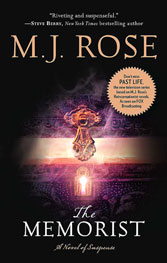
M.J. Rose, is the international bestselling author of a dozen novels including The Reincarnationist, The Memorist and The Hypnotist. The Fox TV show Past Life, which premiered Feb 9th, was based on her Reincarnationist series.

Rose is also the co-author with with Doug Clegg of Buzz Your Book. She is a founding member of International Thriller Writers and the founder of the first marketing company for authors: AuthorBuzz.com. She runs the popular blog; Buzz, Balls & Hype.


Thursday, March 22, 2012

A Lady and a Princess: a guest blog by Linda Rodriguez

JULIA SPENCER-FLEMING: Linda Rodriguez is one of those honorary Reds who regularly brighten the back blog with their funny, thoughtful and informative comments.

We followed her from aspiring author working hard at her craft, to entrant in the St. Martin's/Malice Domestic writing contest, to winning the award and landing a contract with Minotaur! (I can assure you that winning the Malice Domestic award is the very pinnacle of writerly achievement.)
Yes, I did get the Malice Domestic Award myself. Shut up! I'm being totally objective!

Now, Linda's debut is almost here!


Half-Cherokee Marquitta “Skeet” Bannion thought she was leaving her troubles behind when she fled the stress of being the highest-ranking woman in the Kansas City Police Department, a jealous cop ex-husband, and a disgraced alcoholic ex-cop father. Moving to a small town to be chief of a college’s campus police force, she builds a life outside of her work. She might even begin a new relationship with the amiable Brewster police chief.

All of this is threatened when the student editor of the school newspaper is found murdered on campus. Skeet must track down the killer, following trails that lead to some of the most powerful people in the university. In the midst of her investigation, Skeet assumes responsibility for a vulnerable teenager when her ex-husband and seriously ailing father wind up back on her hands. Time is running out and college administrators demand she conceal all college involvement in the murder, but Skeet will not stop until she’s unraveled every last secret.


Today, Linda's going to tell us about a very personal inspiration for one of the characters in Every Last Secret.


In Every Last Secret, my mystery novel that will be released on April 24, the protagonist, Skeet Bannion, has a dog, a collie named Lady. Lady plays a quietly important role in the book. By taking Lady into her new home, Skeet is making a statement that her life will be different from what it’s been, more settled, more stable, and as tragedy hits her neighbors, Lady, along with Skeet’s cat, provides a lifeline to a grieving and troubled teenager. The truth, however, is that Lady is in this book and the next two in the series because she was in my life first.

When I was ten years old, we moved to a small town in Oklahoma close to where my father’s family lived on a small farm that went back generations. I didn’t realize it at that time, but my wildly dysfunctional parents were in even more trouble than usual, so those years with my five younger siblings in that tiny town would pile more adult responsibilities on my skinny shoulders than I was already carrying—and my parents had turned to me at age ten to make the decision of where we would settle for the next several years, near my mother’s parents in Oklahoma City or near my father’s family in rural Oklahoma.

Shortly after we moved in, my mother’s parents in Oklahoma City brought me a collie. I was collie-crazy. I’d been reading and re-reading Albert Payson Terhune’s books about Lassie for years. And what a gorgeous collie they brought me! Princess was a former show champion, who’d been bred too early and too often until she could no longer bear living pups. Her owners were going to put her to sleep until my grandparents asked for her. Princess and I took one look at each other and fell deeply in love. She slept at the foot of my bed in the uninsulated attic room where I slept. My own choice, it was the only way I could have a room of my own since no one wanted to share it with me. When it got too cold, Princess would climb in bed with me, and I’d sleep as warmly as anyone could want.

After leaving us in Oklahoma, my Navy father went overseas, and my mother fell apart and often was not in our home or even our town for days at a time. When she was at home, she was often sleeping or hung-over. Fortunately, we lived right across the street from the school (K-12), and I could get younger brothers and sister off to school and go myself, dashing across the street to check on the baby at every class change and recess and lunchtime.

As my baby brother grew more mobile, this balancing act became harder and harder to manage. He began to take off in the afternoons and wander the town in his diaper. The school would get calls for me to leave class and come get him—because Princess would accompany him and guard him. She refused to let him into the street if a car were coming, and no one could touch him with her around, not even the local police officers. So I would leave school, pick the baby up blocks from our house, and carry him home with Princess walking at my side.

Princess loved to eat the apricots that fell from the tree in our backyard and had a constant battle with the wasps who wanted them all for themselves. Several times she alerted me to rattlesnakes in hedges of the yard when one of the kids was heading in that direction. Old as she was, she could at times be as playful as a young pup, and whenever she felt there was danger near, her years fell off her immediately.


Those were scary years and scarier to look back on now, aware of dangers I wasn’t aware of then. We all made it through them safely, in large part because of Princess, my aging collie. I always felt that Princess was an angel in disguise sent down from heaven to help me take care of and protect my little brothers and sisters. Finally, my mother actually moved across the state, and after a couple of weeks alone, my father’s family came and took us to live with them on the farm. We were now safe, and I think it was no coincidence that Princess slipped away in her sleep soon after that.

Princess, the dog I could never forget, morphed into Lady for the Skeet Bannion series. Do you have a childhood pet you will always remember? What was your favorite childhood dog?

You can find out more about Linda and read an excerpt of Every Last Secret at her website. You can friend her on Facebook and follow her on Twitter.

Wednesday, March 21, 2012

The Utility (or Futility) of Subgenres: a guest blog by Chris F. Holm

JULIA SPENCER-FLEMING: Being a resident of the great state of Maine, it always gives me pleasure to discover a new author scribbling away up here in Vacationland (formerly the Pine Tree State, until the marketing people reclassified it.) Then I found out Chris Holm was an ex-pat from Syracuse, NY (like me!) who was pursuing a graduate degree in Virginia (I did that, too!) and who married a Mainer (yep) who lured him north. (At this point, I can only conclude that Chris Holm and I are the same person.)

I sent off an email to Chris' publisher, Angry Robot Books, and they kindly sent me a review copy of his debut,
Dead Harvest. I was tickled by the cover, which appears for all the world to be a well-read golden-age pulp paperback complete with scratches, smudges and the marks of many fingerprints. I was even more impressed by what was inside.

Sam Thornton collects souls. The souls of the damned, to be precise. Once taken himself, he’s now doomed to ferry souls to hell for all eternity, in service of a debt he can never repay. But when he’s dispatched to retrieve the soul of a girl he believes is innocent of the horrific crime for which she’s been damned, Sam does something no Collector has ever done before: he refuses.
It was a hell of a read. The only problem was: what was it? Pulp fiction? Paranormal? Noir detective? Horror? Paradise Lost fanfiction? (Seriously, that would be awesome.) I couldn't tell. And clearly, I'm not the only one.


First off, thanks to Julia and the rest of the Jungle Reds for letting me tarnish their otherwise stellar blog. ’Tis truly an honor, particularly for a lowly debut novelist such as I.

One thing I’m discovering now that I’ve got a book out is that folks (be they fellow writers, reviewers, or random family members) seem more curious what sort of books I write than what my book is actually about. And given that DEAD HARVEST is the first in a series that recasts the battle between heaven and hell as Golden Era crime pulp, I don’t always know what to tell them. Do I say that I write urban fantasy? Fantastical noir? Gonzo crime-fic? Cross-genre horror-tinged fantasy-pulp? Science fiction, since despite the fact there’s not a hint of science in my book, that’s where it always winds up shelved?

Yeah, sometimes, I guess I do say that. It’s what they want to hear, after all. I know, because I see it echoed in reviews and interviews that reference my work. The only problem is, I don’t mean it.

As far as I’m concerned, I write mysteries. Mysteries are the sole through-line in my work, the thread that ties together everything I’ve ever written. Whether fantastical, horrific, science-fictional, or quiet and literary, my stories are all just mysteries at heart.

Fact is, when I first started writing toward publication, I hadn’t the faintest notion of the morass of subgenres into which I was ignorantly wading; I just wrote what I wrote. It was only when I started submitting my stories that I realized how fractured along genre lines the publishing industry truly was.

The first short I ever published – and quite possibly the best I’ve ever written – appeared in Ellery Queen’s Mystery Magazine. I was elated. My next few tales were perhaps a little darker, a little nastier, and wound up in grittier online magazines such as Demolition, Beat to a Pulp, and Thuglit. To me, the only difference between those markets was in flavor, not quality, so imagine my surprise when I discovered plenty of folks from the grittier camp held Ellery Queen in disdain. Why, I’ve no idea. Lord knows I don’t shy away from violence and F-bombs when called for (a fact to which I’m certain Julia could attest), but good writing is good writing, and bad writing can’t be saved by striking fashionable literary poses. Ellery Queen, to my mind, falls solidly in the former camp.

I was a kid when I first fell in love with mysteries, and back then, I didn’t delineate along subgenre lines. Whether it was the Hardy Boys or Nancy Drew, Christie or Poe or Doyle, or even THE MIXED-UP FILES OF MRS. BASIL E. FRANKWEILER, they were all of a piece to me. And to this day, the writers I most admire didn’t chain themselves to reductive ideas about what one should and should not write. Donald Westlake wrote one of the bleakest series of all time in his Parker books, but he also wrote marvelous comic capers featuring career thief John Dortmunder. Lawrence Block writes the hard-bitten tales of unlicensed PI Matthew Scudder, but also light mysteries featuring bookstore-owner-cum-cat-burglar Bernie Rhodenbarr. Michael Crichton got his start writing pulp, and went on to dabble in historical-, techno-, medical-, and espionage-thrillers, to name a few.

It seems to me readers and writers both benefit by eschewing a myopic, reductive genre worldview – and I’m pretty sure I’m not alone. On Julia’s site, you’ll find a section titled “Are my books cozies?” in which she expounds far more eloquently than I on the topic of the limited utility of subgenres. I was fortunate enough to catch Rosemary’s so-called cozy panel at Bouchercon, in which she described her own work as suburban noir, no doubt earning new readers in the process. And when my wife described Julie Hyzy’s White House Chef novels as cozy/thriller hybrids in a recent (glowing) review, it seemed far closer to the truth than either one of those labels on their own.

My point isn’t that authors should strive to straddle fences and break down boundaries; as advice goes, that’s every bit as silly as telling writers never to. All I’m saying is, it seems to me the best writers read widely and go where their muse takes them, and leave it to the booksellers to sort out where to shelve it. God knows I’d rather read ten great novels outside the narrow slice of real estate I’ve staked out in my own fiction, than ten lousy ones that fall within my wheelhouse.

Which reminds me, there’s this Julia Spencer-Fleming novel on my Kindle I’ve been dying to get to…


Well, dear reader, what do you think about genres, sub-genres, blended genres and bent genres? Are you a purist, or an anything-goes sort? Do you think genre-mixing is the wave of the future? Or not?

Chris F. Holm was born in Syracuse, New York, the grandson of a cop who passed along his passion for crime fiction. His work has appeared in such publications as Ellery Queen’s Mystery Magazine, Alfred Hitchcock’s Mystery Magazine, and THE BEST AMERICAN MYSTERY STORIES 2011. He’s been an Anthony Award nominee, a Derringer Award finalist, and a Spinetingler Award winner. His first novel, DEAD HARVEST (Angry Robot Books, February 2012), is a supernatural thriller that recasts the battle between heaven and hell as Golden Era crime pulp. You can find out more at Chris’ website, friend him on Facebook, or follow him on Twitter.






