Friday, July 22, 2022

When We Knew We Were Writers

Monique's typewriter JE Theriot


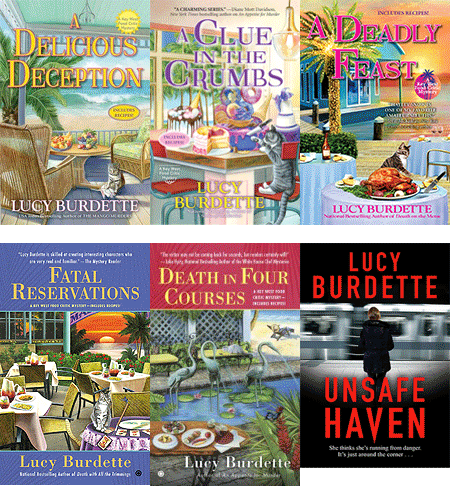
LUCY BURDETTE: Being a writer is such a huge part of my identity now. But looking back to me as a girl, even though I read a lot, I don’t think it ever occurred to me to consider becoming a writer. In eighth grade, I wrote my first short story featuring a jilted teenager. She runs to the top of a lighthouse to nurse her heartbreak, and finds Micky Dolenz, who consoles her with a kiss. (Hey, hey, we’re the Monkees…remember?) The story was rock-bottom awful and I can’t blame anyone for failing to encourage me…


I went on to become a clinical psychologist, and had a private practice for a number of years. I remember the moment when I first imagined writing. I was obsessed with learning to play golf, because the man I’d fallen for was a golfer (and is now my husband of 30 years.) We’d spent the day in New York City with family and friends. On the train back to Connecticut, I was talking to a dear friend about how difficult it was to get freelance articles related to the psychology of golf published. She asked the question “why not write a mystery?” The light switch was tripped! (This is another version of the Madeleine question we talked about Monday, isn’t it?)


How about you, Reds, when did you have the first definite inkling you’d become a writer?


HALLIE EPHRON: Oh, Lucy, I’d love to read that story. Why a lighthouse?? It’d make a terrific movie.


I was determined NOT to be a writer. See: two screenwriter parents and three successful writing sisters. I was determined to be a teacher: aka NOTAWRITER. And for many years I taught.

One turning point came when I got a call from a freelance writer who wanted to write a piece about me. Why? I asked her. Her answer: “Because you’re the only one who doesn’t write.” Nuts to that, I thought, and began working on a very personal memoir/novel which has never seen the light of day. Writing a mystery came later still.


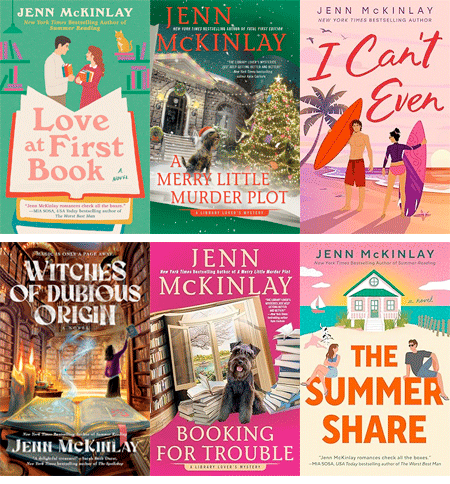
JENN McKINLAY: I remember it clearly, my dad took my brother and me to see Romancing the Stone (post divorce, he was trying to bond), and I remember snarfing my popcorn, watching Kathleen Turner in her sweet apartment in New York, WRITING FOR A LIVING. I was a book junkie but it had never occurred to me that this was a job, like an actual paying occupation, that a person could choose. It took another six years before I started writing but once the idea took hold (could be that I really just wanted to be Kathleen Turner, but whatever) it was impossible to not picture myself as an author. I was all in!


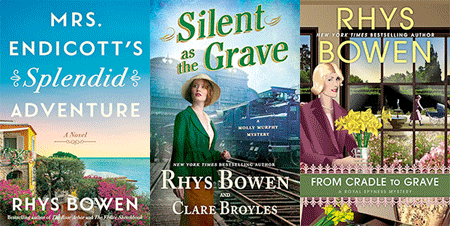
RHYS BOWEN:  I have written all my life but it was just something I did. I didn’t think of writer as career. In fact I wanted to be a movie star and as a teenager I wrote movie scripts for me to star in. It was only when I was working in the drama department at the BBC that I found myself rewriting plays we were doing in my head. So I wrote my own, took it to the head of drama and was called into his office to say that they liked it and were going to produce it! I’ve been a professional writer ever since! 


DEBORAH CROMBIE: When I was about fourteen I started writing poetry. I was smitten with putting words on paper, with trying to get just the right image and the rhythm of the language. But I didn't really dream of being a WRITER, as a career, especially as I grew up hearing my writer uncle (journalist, novelist, poet) say that no one could make a living at it (although he did.) (Years later, he was enormously encouraging to me.) Then, when I was a couple of years shy of forty, I had an idea for a book and thought I would just give it a try. That was the first Kincaid/James, A SHARE IN DEATH. 


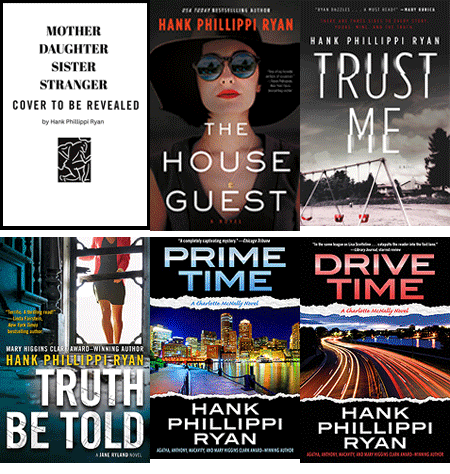
HANK PHILLIPPI RYAN: I love this question (and MIckey Dolenz),but the question is impossible to answer. I remember as a 10-year-old and thereabouts looking at books in the library and stores--libraries, mostly--and wondering about the people who wrote them.  And I remember wanting to BE Agatha Christie. But did that mean writing books? I'm not sure.  I have to say...the reality might have hit me when I read the book A CIVIL ACTION.

I thought--that's a TV story I covered, and now it's a non-fiction book that reads like a novel. Hmm. I loved In Cold Blood.  And both books seemed so reporter-centric that it nudged my brain a bit. Then one day, I just had a good idea. Boom . I know it was a good idea for a book. No further thought. Except for:  I'm doing this. ( I was 55.)

I was so naive--after 30 years of being a reporter it never crossed my mind that I couldn't do it.

(HA! Right?)

But that turned out to be Prime Time. And et cetera.

Then one day, maybe 7 years ago? I was in New York, and a person came up to me and asked "Are you Hank Philippi Ryan, the writer?"

And I stopped in my tracks.

And there was the moment to own it. "Yes," I said. 

I will never forget that. 


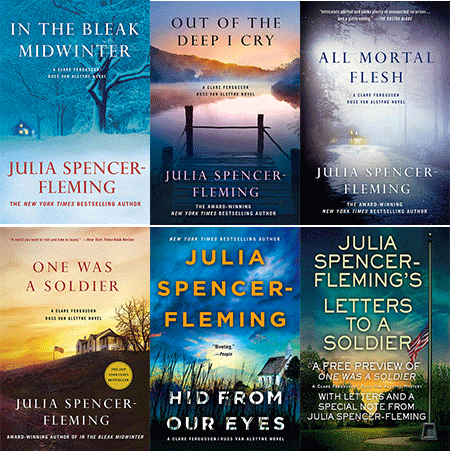
JULIA SPENCER-FLEMING: I was told I was a writer. I was going through a “what do I do with myself now?” funk when, after five years as a stay at home mom, both my kids were in school full time (Youngest was still a pipedream at that point.) I had my JD and bar membership, but I had only become a lawyer so I could afford to buy a car - and Ross had already gotten me a car, so problem solved.


One Sunday my then-priest preached on discerning God’s will. He had a definite therapy-oriented bend, because his advice was to pose your question to four people who knew you well. Hmmm. I didn’t ask Ross, because I knew what he would say - he had paid for my law degree :-) Instead, I asked my mother, my sister, my best friend from high school and my college roommate.


And my mother said, “You should be a writer.”

And my sister said, “You should be a writer.”

And my best friend from high school said, “You should be a writer.”

And my college roommate said, “You should be a writer.”


Reds, I know better than to argue with a sign like that.


Over to you Reds and Red readers. When did you figure out what you were meant to be?

Thursday, July 21, 2022

Shoes, Leggings and Puzzling Notebook Entries by Pat Kennedy

LUCY BURDETTE: It's always a treat when our friend Pat Kennedy says "I think I have a blog for you!" I bet lots of you will be able to relate to her dilemma. Thanks for visiting Pat!

PAT KENNEDY: I am a reasonably tidy person. Not obnoxiously orderly, but on a scale of 1-10, I’d be a 7.5 – about 70% of the time. There is one major exception – the stubborn piles that sit there day after day never getting much bigger but not diminishing either. They silently taunt me, “When are you ever going to take care of this?”  


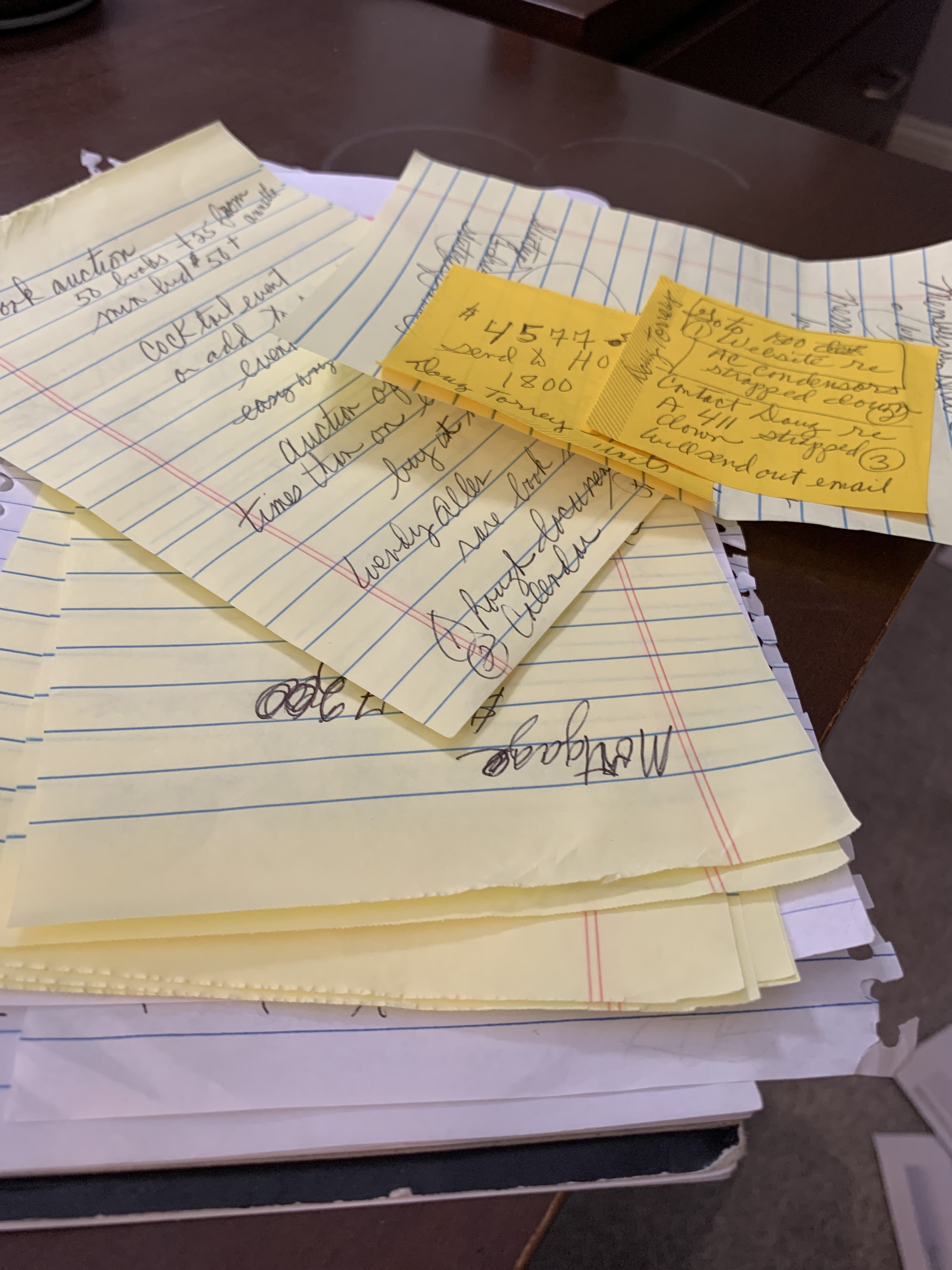
Paper piles are the most annoying with “curated collections” all over the floor of my office – all “to be filed.”  I did a major paper discard several years ago but there remain two small notebooks and a yellow-lined pad that have resided on my desk for at least two years. One page reminds me to make a dentist appointment for my late husband – with a check mark and the date Feb 22, 2019.  I can probably discard that now. But a little note at the bottom of that page has “cancel the WSJ online account.”  Did I do that already? I think I better keep that page until I investigate again next week or sometime anyway. Pages have cryptic scribbled notes such as “homestead…Fla…Monroe…property appraisers.”  What does that refer to?  Because it has sat on my desk for so long surely means that it is very important. Right?  Even more compelling is a whole page written in big block letters “GEORGE, roving mike!” 


Another pile is on the floor of my closet which has about 10 pairs of black leggings. I keep promising myself to sort them by season and level of decomposition. Some of them are so worn that they are see-through in all the wrong places. The legging pile has been occupying valuable closet floor space for more than a year – which was when we moved into this house.  

And shoes!  I have plenty of my own which tend to collect in the living room by my reading chair but since I have grandsons in residence for the summer, there is a pile of shoes by the front door which drifts out into the hallway becoming an ever-growing trip hazard. 


I think I’ll add a line to the yellow-lined pad. “Make boys move shoes.”  In about a year, I’ll wonder what that cryptic note meant, of course, and will once again decide to keep the pad on my desk.

And you, dear readers, are you a hoarder of paper, leggings and shoes?  Or are you disciplined about stuff and keep a tidy environment 100% of the time?


Ps from Lucy, I've been to Pat's house and didn't notice any of these issues--but maybe that says more about me than her??

Patricia Kennedy is a retired marketing communications professional who runs a bed and breakfast at Long Pond, Massachusetts and Key West, Florida for grandchildren and other relatives and  friends. Rooms are fully booked for the foreseeable future. 


Wednesday, July 20, 2022

Thistle Make You Hungry @LeslieKarst

LUCY BURDETTE: I loved Leslie Karst's Sally Solari mystery series, and was sad to hear no more would be published. But luckily for us, Severn House picked up the series and a brand new one is coming. Welcome Leslie!


LESLIE KARST: You may notice that the cover of my newest Sally Solari mystery, The Fragrance of Death—which releases on August 2nd—depicts artichokes. No, it’s not the murder weapon (though that’s there, too), but the noble thistle does play an important part in the story. 

Because I adore artichokes. I love plucking off the leaves one by one, dunking them in melted garlic butter, then scraping off the tender flesh with my teeth; and I love the way they cause everything you eat or drink them with taste surprisingly sweet. Given my love affair with artichokes, I decided it would be fun to include them in my new book, which revolves around both an artichoke cook-off as well as an artichoke farm up the coast from Santa Cruz, where the series is set. 


I come by this passion honestly, through both nature and nurture. As for the nurture part, I’m a second-generation Californian (almost third, as my grandparents all moved to Los Angeles in the 1920s when they were in their twenties), and artichokes could be considered the unofficial state vegetable of California. 

Artichokes are thought to be one of the oldest foods, and the plant likely originated in the Mediterranean region. Historians believe they were cultivated by North African Moors beginning about 800 A.D. and that the Saracens then introduced the plant to Italy. This would explain how the Arabic al-qarshuf—meaning “thistle”—became articiocco in Italian and eventually “artichoke” in English. They were first brought to California by the Italians (such as the Solari family featured in my books) who emigrated to the Golden State back in the late 1800s.

In 1922, Andrew Molera, a landowner in the Salinas Valley, decided to lease to Italian farmers the land he’d previously dedicated to growing sugar beets, encouraging them to try growing this “new” vegetable—the artichoke. His reasons were economic, as artichokes were fetching high prices and farmers could pay him triple what the sugar company did for the same land. And it paid off.

Now, one hundred years later, Central California, with its Mediterranean-like climate, produces virtually 100% of the artichokes sold in the US, and of that, more than 80 percent come from Castroville, the self-proclaimed “artichoke center of the world.” (Fun fact: Marilyn Monroe was crowned the very first “Artichoke Queen” of Castroville at age 22 in 1948, two years before she hit the big time with All About Eve and Asphalt Jungle.)


So artichokes are a big deal in California. And they’re also far less expensive here than in other locales. It’s not uncommon to see those baby artichokes on sale for as little as twenty-five cents each at roadside stands. 

As for the “nature” part of my artichoke obsession, this comes from my mother, who was born and raised in Pasadena, California. Till her dying day, Mom was passionate about artichokes, and even at age 91 when I’d bring them to her at her assisted care facility—steamed with a side of mayonnaise, another one of her passions—she would devour them greedily. 

Mom loved to tell a fun story about artichokes. My older brother was born at the Ohio State University hospital, during my father’s tenure as a law professor at OSU. As was the norm back in 1954, Mom stayed the night at the hospital, even though the birth was uneventful. That evening, the hospital cafeteria for some bizarre reason had steamed artichokes on the menu for dinner, and all the new mothers were presented with half of a large artichoke, over which melted butter had been poured. 


Now, this is most certainly not the proper way to serve artichokes (one pulls off the leaves and dips them in a separate bowl of butter), and the Midwestern women were unanimously repelled by the strange, ugly, and messy vegetables they had been presented with for dinner. 

Except Mom—the home-sick Californian who hadn’t set eyes on an artichoke for years. The other women gladly gave all theirs to her, and my mother forever claimed that she ate every single artichoke served in the maternity ward that evening, gorging herself until she nearly popped. 

Readers: Are you a fan of artichokes? When was the first time you tried one of the noble thistles, and what did you think? Leave a comment to be entered in the drawing for Leslie's first book, DYING FOR A TASTE.

About The Fragrance of Death: Restaurateur Sally Solari is a champion, both in the kitchen and on the case, but after getting mixed up in one too many murders, her nonna’s friends have taken to crossing themselves every time they meet. Sally’s determined to stay out of trouble and focus on her cooking. It’s too bad the food scene in Santa Cruz is cut-throat—sometimes literally.

When a head cold knocks out Sally’s sense of taste and smell, at the same time her old acquaintance Neil Lerici is murdered at the annual Artichoke Cook-Off, her powers of investigation are once again called into action. Could Neil have been killed by the local restaurant owner who took his winning spot at the competition? Or maybe by one of his siblings, who were desperate to sell the family farm to a real estate developer?

Sally plunges headfirst into the case, risking alienating everyone she knows – including the handsome Detective Vargas, who finds her sleuthing both infuriating and endearing. And soon it’s not just her restaurant and her tentative new relationship that are on the line—it’s her life . . .


About Leslie: 
Leslie Karst is the author of the Lefty Award-nominated Sally Solari culinary mystery series. The daughter of a law professor and a potter, she waited tables and sang in a new wave rock band before deciding she was ready for a “real” job and ending up at Stanford Law School. It was during her career as a research and appellate attorney in Santa Cruz, California, that Leslie rediscovered her youthful passion for food and cooking and once more returned to school—this time to earn a degree in culinary arts. Now retired from the law, Leslie spends her time cooking, cycling, gardening, singing alto in her local community chorus, and of course writing. She and her wife and their Jack Russell mix split their time between Santa Cruz and Hilo, Hawai‘i.