Thursday, August 25, 2022

Katherine Fast's debut novel and her wellspring of ideas


HALLIE EPHRON: Whether it’s a short story of a novel, each begins with an idea that comes bubbling up out of somewhere within the author. It’s a form of alchemy.

Today I’m thrilled to host Katherine Fast, a fellow New England author who’s a crackerjack alchemist. She’s published more than 25 short and flash fiction stories, and now she’s stepping up to the plate with a debut novel, The Drinking Gourd, and she has another novel in the pipeline. And no doubt another one noodling around in her head.

Kate confessed to me that one of her favorite questions that readers ask is “Where do you get your ideas?” Her answers are as good as her tales…

KATHERINE FAST: Sometimes, I look at a story I’ve written and wonder where such a dastardly idea came from, given that I’m such a gentle, loving soul!

So where do my plots originate? Mostly, from some personal experience that triggers a response––I begin to play with possibilities. That’s when What if… kicks in.

Here are a few examples.


At Christmastime, in Pacific Grove, California, folks along “Candy-Cane Lane” try to outdo their neighbors with over-the-top holiday displays. Seeing this reminded me of driving around Oberlin, Ohio, with my mother, evaluating Christmas decorations on a tackiness scale, one to ten, with a “ten” the most outrageous. I remember being drawn to an old creche scene in which Balthazar and Joseph were propped up and patched with duct tape and Mary had been repainted. In Ohio, one could get away with this repair job if it were covered with snow… or ice from sprayed water. Hmmm, “material.”

How about creche with a realistic “Mary” hosed down by a vengeful, cuckolded husband? What if, at the end of the story, the frozen “Mary” blinks!*


At a family gathering, I overheard a man talking about “… a full body, ripe and velvety … soft and supple … racy, yet refined with a long, elegant finish.” Naughty imagination. My cousin, a wine snob, was bragging about a prized bottle of wine. He would ask dinner guests to sign the labels of his most spectacular wines after which he’d affix labels, like trophies, across a varnished coffee table. Hmmm, “material”?

Later that evening, another man commented, “Wine ages well. Women, not so much.” Pig. I morphed that jerk into an insufferable psychopath who wined and dined young beauties, matching their characteristics with features of fine wine and music. Of course, the lovelies wouldn’t survive the evenings, although they would be immortalized in the signed labels affixed to his coffee table, “trophies” never to be ruined by age and familiarity.

One more. When some people learn that I’m a handwriting expert, they shove their signatures across the table for an instant reading. My response: “The truth costs money.” When a friend demanded I identify which of three sales candidates would be the most aggressive closer, I demurred until he became really obnoxious. Therein lies a fictional golden nugget. He wanted to know about a single trait. But what about all of the other nasty traits in the writing?

Free Advice? Hah, he’s gonna to pay!

So where do I get my ideas? Mostly by association and by playing with What if ...

Many of the themes in my debut novel stem from personal experience. I’ve done most everything Casey does in The Drinking Gourd except go to prison for dealing cocaine.

Now, tell me all about yourself. I welcome fresh material!

Wednesday, August 24, 2022

Cold Dish for a Hot Night


HALLIE EPHRON: As I’m typing this, my weather app is predicting 90+ degrees. And I’m looking at a food-stained page I tore out of a McCALL'S (remember when there were magazines in the dentist office?) a VERY long time ago.


I usually haul this clipping from my SOUPS folder in the heat of summer, and remind myself how to make GAZPACHO. Especially good at this time of year when fresh tomatoes and green peppers and basil are readily available from our farmer’s market.

And no cooking needed. No fancy ingredients. Just a contraption to zhuzz it all up in.

The blender I once used to make gazpacho in is long deceased, but a food processor or smoothie blender work fine, though you might have to puree in batches.

Here’s my adaptation of the recipe…

PILE these ingredients into your food processor (or blender or smoothie maker) and puree (OR blend in batches)--

  • 1 large tomato chopped
  • 1/2 large cucumber pared and cut into chunks
  • 1/2 medium onion peeled and quartered
  • 1/4 medium green pepper, quartered and seeded
  • 2 cloves of garlic, coarsely chopped
  • 1/2 cup fresh basil leaves
  • 1/2 cup of V-8 juice

Pour the puree into a large bowl and mix in…
  • 2 1/2 cups more of V-8 juice
  • 1/4 cup more of light olive oil
  • 1/3 cup balsamic vinegar
  • 1/8 tsp siracha (or Tabasco)
  • 1 1/2 tsp salt
  • Pepper to taste

REFRIGERATE until well chilled.

CHOP additional veggies and mix them into the puree:
  • 1 tomato
  • 1/2 green pepper
  • 1/2 onion
  • 1/2 cucumber)


Ladle into serving bowls and top each serving with a sprinkling of  

  • chopped fresh chives and basil.


Serve with homemade croutons if you can stand to make them.

PS you can substitute tomato juice for V8.

What are your go-to cold dishes for hot nights?

Tuesday, August 23, 2022

Cookbooks as Inspiration for Fiction @LucyBurdette

 LUCY BURDETTE: First, I must thank the entire Jungle Red community for celebrating the  publication of A DISH TO DIE FOR—while I was on vacation. This is so not recommended! However the pandemic that will not end uprooted our plans to go to Scotland several times and I had to grab the chance when it arrived. Thank you so much my friends for celebrating without me here on the page!


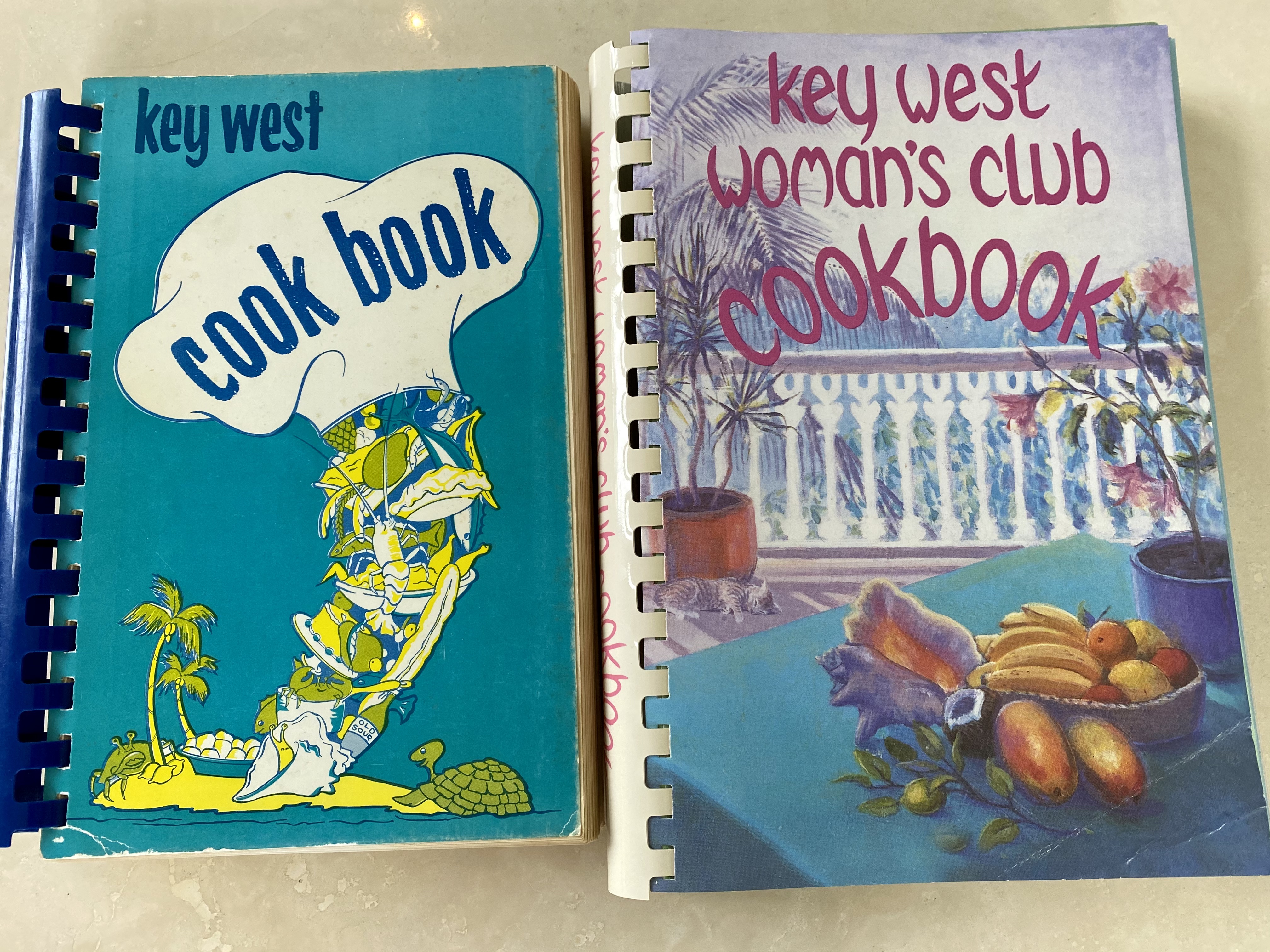
Before I left on vacation, I was busy writing blogs to help get the word out about the new book, including an article for CrimeReads. The assignment was to write something that would tie into the book without being overly focused on self-promoting. The topic I chose was the use of cookbooks in novels. You might remember that one of the important plot strands in A DISH TO DIE FOR is about an old Key West Woman’s Club cookbook that Hayley finds in a pile of library donations. (In fact, I have two of those to give away today—one is the 1949 edition, and the other from 1988, so do leave a comment!) It turns out I am not the only writer who’s thought of this angle. Mystery writers Ellen Byron, Kate Carlisle, and Daryl Wood Gerber have all used cookbooks as part of the plots and settings in their mysteries. I’ve also mentioned recently a book I really enjoyed called Miss Cecily’s Recipes for Exceptional Ladies, in which the two main characters slowly connect through their mutual love of food, and through the pages of a mysterious cookbook wedged on a shelf in Miss Cecily’s bedroom.

In Recipe for a Perfect Wife by Karma Brown, the protagonist discovers an old cookbook from the fifties in the basement of their old home, but soon learns that it harbors darker secrets than the recipes for fancy 1950’s dinners. In The Secret French Recipes of Sophie Valraux by Samantha Verant, the mysteries are not of the murderous kind, but instead the secrets of complicated families, after a chef finds handwritten recipes from her grandmother’s collection.

What is it about a cookbook that attracts a fiction writer’s interest? I don’t think it could be the list of recipes, or even their content. The best of these cookbooks showcase the writers’ voice. Often descriptions introducing the recipe reveal a lot about the writer, as well as the times in which it was written. 

In the case of Dish, Hayley learns about Key West in the 1940's and the psychology of women in those older times. The discovery of an early version of the first cookbook adds fire to her rumination about a current day murder. Here’s an example from that first cookbook that shows what I mean about voice:

“Make your appetizers small, pretty, zippy, and easy to handle-for it is very very hard to greet an admiral with decorum when involved with a limp piece of celery overstuffed with soft cheese, and practically impossible to exchange witticisms with the suave novelist when one’s whole being is concentrated on the problem of what to do with olive pits!” From the Key West cookbook 1949

For me, old cookbooks turn out to be a perfect inspiration for fiction, both the plot and the voice. I am now on alert for new ideas—consider the article sent by a friend from a cookbook published in 1926 by the Ways and Means Committee of the Ladies' Benevolent Society of the Westville Congregational Church in Connecticut. The title of the piece? Recipe for Cooking Husbands. 


Do you have a favorite old cookbook that would be fodder for a novel? Can you add another novel to my list? Leave a comment of any sort to be entered in the drawing for the two Key West cookbooks. I will choose winners on Friday!

PS Here are the book discussion questions for Dish that I cooked up, in case you missed them...