Showing posts with label CSA. Show all posts

Sunday, June 14, 2015

Everything-and-the-Kitchen-Sink Salad

JULIA SPENCER-FLEMING: So I told you all about my extra-local organic farm and their wonderful produce; now I'm going to give you two easy-as-dirt recipes (cause let's face it, that's the only kind of recipe I do) for using a staggering amount and variety of greens.

In the last CSA box, we had spicy garden lettuce (they plant it with mustard seed! And it sprouts pre-spiced!) mixed salad greens, pea shoots (or sprouts) and spinach. Also kale, but I'm still working on integrating that into our diet.


Anyway, Ross made two amazing dinner salads with this bounty over the weekend: BLT salad and Steak and Potatos salad. But you can mix and match to your hearts content, tossing in everything and the kitchen sink.


The base: Mixed greens. Ours were VERY mixed! Also grape tomatoes and slivered red peppers - basically any veg you might like to add to a salad.


BLT salad: Saute 1/4 to 1/2 pound bacon with onion rounds until bacon is crispy and onion is soft. Dice cheese of your choice - we use cheddar, since we always have a block of it around. Toss into the greens and add dressing - I put on Creamy Caesar because my kids would eat a 2x4 plank of wood if it had Creamy Caesar on it. Eat while the bacon is still hot!

Steak and potato salad. Ross bought steak tips from the store and marinated them fro an hour in the frig. Then he broiled them until they were medium-well done. Meanwhile, he boiled a package of gnocchi we had stuffed in the back of the freezer and hadn't known what to do with, since it was way too small a helping to feed five.


We tossed the steak tips and gnocchi with the greens and I added my homemade honey mustard dressing: one egg, 1 T spicy mustard, 1T honey and 1 t oil, beaten together. (I actually made more than that, but those are the proportions.) Eat it while the steak is still hot. 

It was great! Who would have thought to put gnocchi on a salad? My husband, that's who.

Friday, June 12, 2015

The Farm Next Door

JULIA SPENCER-FLEMING: Last year, my dear friend and next door neighbor (Hi, Roxanne!) decided to up stakes after seventeen years in Maine and return to her native Colorado, based on some totally bogus "reason" like being closer to her grandchildren and aging parents, as opposed to me, her friend, ha. 

Anyway, it turned out it was not a good time to put an 1837 house in an historic district on the market. Months ticked by, no one made a credible bid, and so Roxanne and her husband made a fateful decision that directly resulted in my delicious dinner last night: they rented their house. To a foursome of young farmers looking for a place to live with arable land attached. Which is how our neighborhood got a farm, over a century after the last commercial agriculture happened here.

New farms or revived old ones have been cropping up in Maine these past few years. I've seen it in upstate New York, too, decades after giant agribusiness drove scores of small family farms out of business. The desire of consumers to eat locally-sourced and organic foods, to have a wider array of meats, vegetables and alcohol than show up in the typical supermarket, has made previously unsupportable plots of land potentially profitable.

Which brings us to our new neighbors, Bumbleroot Organic Farm. The kids (as Ross and I call them, because we are SO OLD) came in with a plan for a viable business using three acres of land, which sounded unbelievable to me until I actually saw it planted. They lease a little less than an acre from us (I've had to tell Ross no, they aren't tenant farmers and he is not now Lord of the Manse) the same from the folks on the other side of them, and the rest from Roxanne's formerly unused back field. 

Folks, I have never seen a farm so Instagrammable in my life. The young farmers are cute, the growing plants in their orderly rows are lovely, the tiny farm stand at end of their drive is marked by a chalk sign and everything seems to be continually bathed in soft Maine sunshine that's like God's Own Filter.

And OMG the produce. I've long been interested in trying a CSA (Community Supported Agriculture) share, but most of the area farms and fishermen distribute theirs in Portland, which is less-than convenient for me. Plus, I'm cheap, and balancing my desire for fresh and organic against the undeniably higher cost usually resulted in me going for the lower priced carrots.  But I have to tell you, after receiving the first two of our CSA boxes, I am sold and will never go back.

First, the stuff really tastes better. Not to dis all the hardworking folks out picking lettuce in California, but the greens we've been eating (this early in Maine's season, our share is mostly leafy greens) are so...flavorful. It's like the difference between eating fish sticks and fresh fish.

Second, the types of produce in the weekly box are not necessarily the veggies I would have selected at a market. We've had two types a kale, for instance, a green that I have so far used more as the punchline of a joke than as a part of dinner. (Have you heard of the Brooklyn mom who named her children Quinoa and Kale?) (For reals, there are probably kids with those names running around. Dressed in organic, cruelty-free cotton rompers.)  

At any rate, getting kale and Hakurai turnips and broccolini forces me to try new recipes and find new ways of using fresh vegetables in our family meals. Which, frankly, I haven't done well with in the past. (I admit to a lot of canned peas. I'm sorry.) The results have been delicious. I feel a bit like I did as a young person when I got introduced to the then-new concept of microbrewing. All it took was a couple of bottles to know there was no way I'd ever go back to drinking Schlitz. (I'm not sure it it was actually Schlitz. But it was certainly whatever mass-produced stuff was around.)

In other words, having a CSA share is fantastic, and I plan to get one next year, and the year after that, providing the kids farmers do well. Bumbleroot is off to a great start - along with the farmstand, they are selling at the Kittery Community Market and the Saco Farmers Market. They're sourcing for a cool new restaurant, MK Kitchen, in Gorham and best of all, they sold out their entire offering of CSA shares before the first veggies came out of the ground.

The moral of the story is: support local farming. The food is demonstrably tastier (and of great variety) than the boring selection in the supermarket, the farming methods are healthier for the environment, and - as I can personally attest - community life is enriched by having small farms as part of the mix.

Thursday, March 6, 2014

The Food Coop


LUCY BURDETTE: You've all met our Jungle Red friend Pat Kennedy before. She garnered a lot of press for her post on Bad Boyfriends. A couple of weeks ago we were chatting online and the subject of food coops came up. I remembered carving up giant blocks of cheese in a member's garage after the delivery. Pat remembered--well I'll let her tell it!

PAT KENNEDY: Food Co-ops.  Remember them?  Back in the 1970s, a food co-op suggested more than just a whiff of “hippie-dippy” oddity.  Except perhaps the Milton Food Co-op, founded and run by a group of solidly middle-aged suburbanites.  I don’t think that any of the women wore a head-bandana, or love beads, or fringed vests.  And not one of the guys had a scraggly beard grown down to tickle his navel.

Our co-op members worked together to bring in wonderful produce from the Chelsea Markets in Boston, “whole foods” in bulk like rice, beans, dried fruits and more (all before there was a Whole Foods food chain).  We had cheese and spices and fish too! I like to think that the food co-op movement kick-started the foodie culture in this country.
Food co-ops were gentle rebellions against what was available at that time in local grocery stores. “We should be eating fresher, ‘healthier’ foods – and have more options.”  At least that’s what our leaders told me.

As a young mom – and one from the Midwest at that – I had had a very vanilla relationship with the world of food up to that point.  Until I moved to New England, I had never eaten squash, nor any kind of cheese other than Velveeta, the Parmesan-shake-powder put out by Kraft, and possibly Cheeze Whiz (can’t remember when it was first marketed).  Don’t even ask about seafood.  But I did have a sense of culinary adventure, trying out a Julia Child recipe every week from her early TV shows, buying exotic spices  for those recipes (tarragon!) and was eager to taste and experience new foods. 


Imagine my surprise at Swiss chard – big fat, black-green bunches of it.  “What do you do with this?”  And hunks of Emmenthaler cheese!  I was even amazed at the different types of potatoes, and more surprised at all those squash varieties.

Now “food co-op” engenders a time and place that has vanished.  I suppose that people who are interested in food co-op-ing now belong to a CSA and get their produce directly from the growers.  Today, I could only find two food co-ops in the Boston area where I live (Jamaica Plain and Cambridge, naturally).   Here’s a link to a directory of food co-ops across the country.

But still I wonder if there are still young folks who never enjoyed an acorn squash baked with butter and brown sugar, or had shreds of kale floating in a soup, or had a luscious crust of melted Gruyere over Julia Child’s Potato and Sausage Casserole.

So dear Reds and other friends, did you ever belong to a food co-op?  And when did you give up the  toasted Velveeta cheese sandwich (on Wonder Bread, of course) for a grilled cheddar and Granny Smith apple on whole grain bread?   


Patricia Kennedy is a marketing consultant for healthcare organizations. She lives in Boston with her husband Joe, both wonderful and adventurous cooks.  For more information on Pat, www.PKCBoston.com.


Friday, July 18, 2008

Awash in Kale


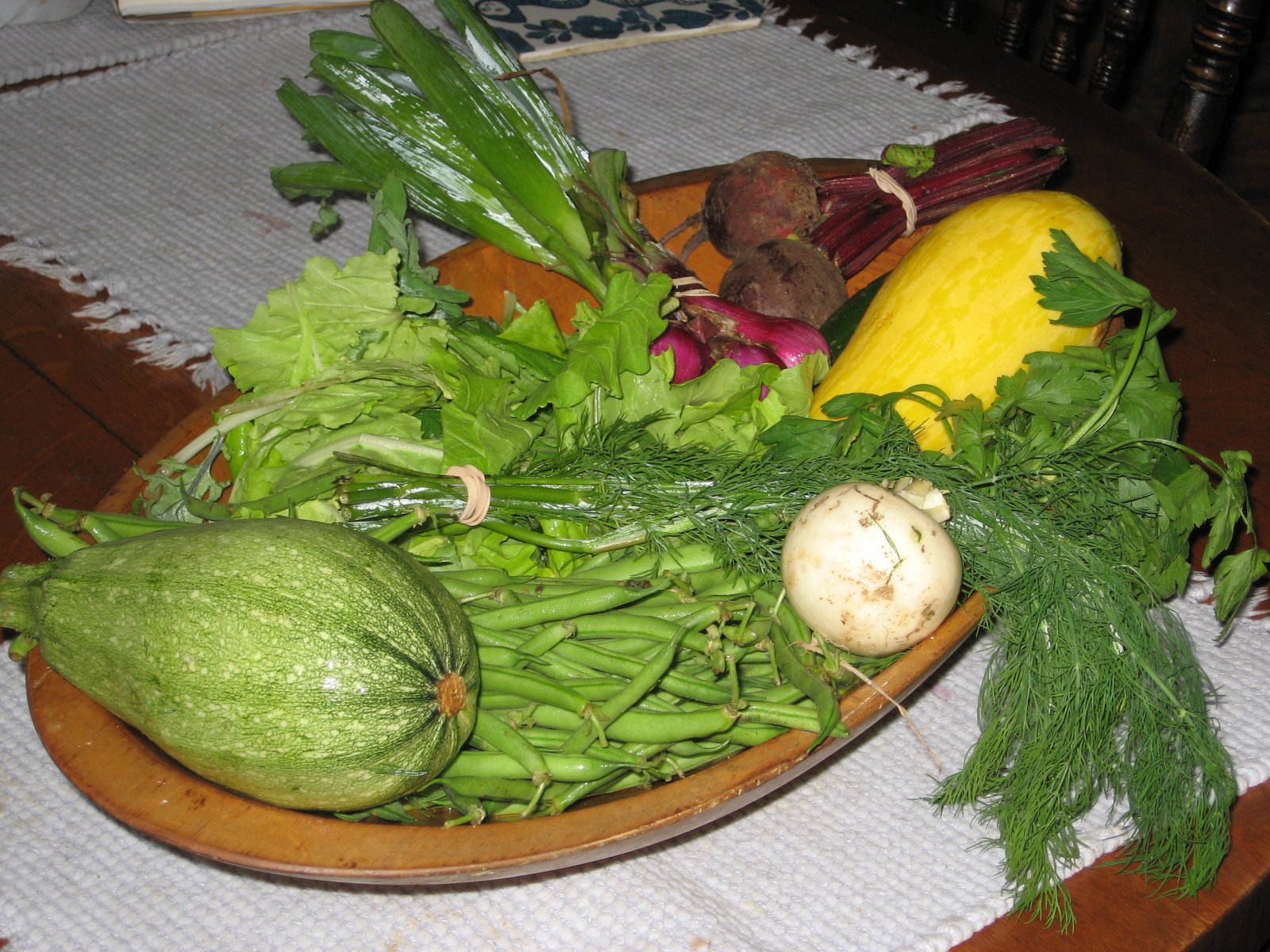
HALLIE: This bowl contains our glorious weekly share of organic produce from the Farm School CSA (community support agriculture ).

Mesclun greens. Check.
Green beans. Check.
Onions. Check.
White radishes. Check. Parsley and dill. Check check.
Carrots and cucumbers and squash and beets. Check check check check.

This bounty is just 1/3-share--we split a single share with two other families—and this week Michelle and Donna graciously took all the kale. The farm is in Western Massachusetts, the season runs from June until November, and this 1/3-share costs us about $10 a week (plus gas to get to the drop-off point in Watertown).

The down side is there’s no choice—we get what they’re growing. I’ll be happy about this once the tomatoes come in. But how many ways are there to cook the kale and swiss chard that I usually enjoy in winter with white beans and chorizo? And one box of the most delicious strawberries you’ve ever tasted, split three ways, amounts to a meager eight berries a family.

The most amazing part is how fresh it is. Even after a week of sitting in my refrigerator, the lettuce and greens remain crisp. Guess that's what happens when they don't travel halfway around the world to get to my fridge.

No, we don’t work the farm, though there are CSAs where you can do that. All we have to do is pick the stuff up when it arrives in single-share box loads in Watertown.
A story about CSAs was recently featured on the front page of the New York Times . In the early 1990s, the article says, there were fewer than 100 such farms. Today there are close to 1,500.

It’s awfully nice to be on the cutting edge of a trend that's in the right direction. Eat healthy. Save gas. Support small farms. It’s the old win win win. And in case you, too, are awash in kale, here’s a my very own, invented out of necessity, summer kale soup recipe:

Hallie's Cold Summer Kale Soup…

3 small peeled potatoes, cut into 1/2-inch pieces
2 cups of broth (chicken or vegetable)
1 bunch of kale leaves, washed, the stems removed
1 medium onion, chopped
1-2 cups Buttermilk
Olive oil

Simmer the potatoes in the broth until fork tender.

Meanwhile
Sautee the onions in oil until transluscent
Add the kale and cook until limp
Cover the pan and lower the heat and continue cooking for about 20 minutes.

Let everything cool.

Dump the potatoes/broth and the cooked kale/onions into a blender (in batches if need be) and blend until smooth.
Pour the blended mixture into a serving bowl and stir in buttermilk (add less or more until it’s the thickness you like)
Salt and pepper to taste.

Serve chilled.
(Optional: garnish each serving with chopped scallions or chives or chopped sage)
(Optional: swirl a spoonful of Greek yogurt into to each serving)