HANK PHILLIPPI RYAN: The crazed promo person in my brain is insisting I call this Guy-Day Friday! But that’s so silly. So I won’t do it.
But what a wonderful guest we have today: The truly brilliant Charles Salzberg not only brings us the power of his positive thinking, but a positively wonderful event that emerged and bloomed from the pandemic – – yes, a good thing!
Here’s how, with a little help from his friends, Charles found a silver lining in the pandemic. And the friends did too. And as the pandemic wanes (we hope)-- these fab “five guys“ are only beginning their adventures.
(And he has a new book! Keep reading. Because there's a giveaway! )
How the Pandemic Saved My Life (Kind of…)
by Charles Salzberg
When the pandemic hit two years ago and we were ordered to shelter at home, most people became anxious, wondering how they could, in this new world order, shelter in place, day after day, night after night.
Not me.
As a writer, staying home not only wasn’t a problem, it was a gift from the gods. And so, when friends asked, “how are you doing?” My guilt-ridden answer was, “fine.” But in truth, it was way better than fine. It was giving me permission to do something I’d been rehearsing for all my life.
When I was in my 20s, knowing I wanted to be a writer but struggling to decide how I was going to make a living, I scored a job at New York magazine, working in the mailroom. I loved magazines and despite not knowing what editors actually did all day, I thought I could put the only marketable skill I had to good use by becoming a magazine editor. And this, I was told, was a good to start from. But after a week or so of stamping, sorting and delivering mail, I didn’t see my future sitting in an office all day. And so, after a mere three months, I did something that in hindsight was not only downright foolish, but irresponsible. Without having any idea how I would pay the rent, and put food on the table, I quit, and declared myself, without having sold a word, a “freelance writer.”
Fortunately, the dumb luck of the stupid kicked in. Almost immediately after quitting, I sold two articles. One to New York magazine, the other to The Daily News Sunday Magazine. It wasn’t much, totaling a little more than $1,000, but it was enough to make me think I could make it living the life of a freelance writer which, as the winter weather became worse and worse, became more and more appealing. I’d never have to wear a tie and jacket. I wouldn’t have to go out in bad weather unless I wanted to. I could rise whenever I wanted. I could sleep whenever I wanted. No longer would I suffer the “Sunday night blues,” anticipating I’d have to go to work the next day. No nine to five for me, baby. That was for suckers. Instead, I could work whenever I wanted, morning, afternoon, or night.
How the Pandemic Saved My Life (Kind of…)
by Charles Salzberg

When the pandemic hit two years ago and we were ordered to shelter at home, most people became anxious, wondering how they could, in this new world order, shelter in place, day after day, night after night.
Not me.
As a writer, staying home not only wasn’t a problem, it was a gift from the gods. And so, when friends asked, “how are you doing?” My guilt-ridden answer was, “fine.” But in truth, it was way better than fine. It was giving me permission to do something I’d been rehearsing for all my life.
When I was in my 20s, knowing I wanted to be a writer but struggling to decide how I was going to make a living, I scored a job at New York magazine, working in the mailroom. I loved magazines and despite not knowing what editors actually did all day, I thought I could put the only marketable skill I had to good use by becoming a magazine editor. And this, I was told, was a good to start from. But after a week or so of stamping, sorting and delivering mail, I didn’t see my future sitting in an office all day. And so, after a mere three months, I did something that in hindsight was not only downright foolish, but irresponsible. Without having any idea how I would pay the rent, and put food on the table, I quit, and declared myself, without having sold a word, a “freelance writer.”
Fortunately, the dumb luck of the stupid kicked in. Almost immediately after quitting, I sold two articles. One to New York magazine, the other to The Daily News Sunday Magazine. It wasn’t much, totaling a little more than $1,000, but it was enough to make me think I could make it living the life of a freelance writer which, as the winter weather became worse and worse, became more and more appealing. I’d never have to wear a tie and jacket. I wouldn’t have to go out in bad weather unless I wanted to. I could rise whenever I wanted. I could sleep whenever I wanted. No longer would I suffer the “Sunday night blues,” anticipating I’d have to go to work the next day. No nine to five for me, baby. That was for suckers. Instead, I could work whenever I wanted, morning, afternoon, or night.
Then, because of the pandemic, I was ordered to stay home. Was I bored? Absolutely not. Almost forty years of practice gave me a pretty good head start on the rest of you.
There was plenty to keep me busy. Netflix, HBO-Max, Prime, Hulu, Apple-TV, and a host of other streaming services. I discovered true crime podcasts. I read at least a couple books a week. I took long walks with friends. I even Zoomed my weekly lunches with my good friend, Ross Klavan. Instead of having to travel to where I taught writing classes, I Zoomed my classes from my dining room table, revealing other perks: I didn’t have to wear pants. Or shoes. The travel time to work was cut from 20 minutes to as long as it took me to get from my living room to my dining area. And when class was over, no problem. I was already home.
Let’s face it, I was living la bella vita.

As if that wasn’t good enough, there was one other unanticipated bonus that came from those many months of social isolation. Every Monday night I Zoomed (a noun became a verb) with four other crime writers: Reed Farrel Coleman (center of photo), Tom Straw, Matt Goldman (left) and Michael Wiley. And even though we were spread out across the country—I’m in New York City, Reed in the outer reaches of Long Island, Mike in Florida, Tom in Connecticut, and Matt in Minneapolis. But for an hour and a half every Monday night, we were in the same room.
Every Monday night, a few minutes before 7 p.m., I’d set up shop in front of my dining table and for the next hour and a half, I had the time of my life. After all, these guys weren’t just crime writers. They’d all lived very interesting lives. Tom and Matt are also very successful sitcom writers. Matt worked on Seinfeld, The New Adventures of Old Christine and a bunch of other hit shows; Tom worked on Night Court, the Craig Ferguson Show, Grace Under Fire, and Nurse Jackie, and others. Reed has held a number of interesting jobs, while my background as a magazine journalist and nonfiction book writer, dovetailed very nicely with this diverse group.
The conversation ranged all over the map. What we were reading. What we were writing. What we were watching. Anecdotes from our past lives. Whatever happened to be in the news, other than the pandemic and politics. After all, we were there to have fun, to make human connections in troubled times, not deal with the news which seemed to get worse and worse.

As if that wasn’t good enough, there was one other unanticipated bonus that came from those many months of social isolation. Every Monday night I Zoomed (a noun became a verb) with four other crime writers: Reed Farrel Coleman (center of photo), Tom Straw, Matt Goldman (left) and Michael Wiley. And even though we were spread out across the country—I’m in New York City, Reed in the outer reaches of Long Island, Mike in Florida, Tom in Connecticut, and Matt in Minneapolis. But for an hour and a half every Monday night, we were in the same room.
Every Monday night, a few minutes before 7 p.m., I’d set up shop in front of my dining table and for the next hour and a half, I had the time of my life. After all, these guys weren’t just crime writers. They’d all lived very interesting lives. Tom and Matt are also very successful sitcom writers. Matt worked on Seinfeld, The New Adventures of Old Christine and a bunch of other hit shows; Tom worked on Night Court, the Craig Ferguson Show, Grace Under Fire, and Nurse Jackie, and others. Reed has held a number of interesting jobs, while my background as a magazine journalist and nonfiction book writer, dovetailed very nicely with this diverse group.
The conversation ranged all over the map. What we were reading. What we were writing. What we were watching. Anecdotes from our past lives. Whatever happened to be in the news, other than the pandemic and politics. After all, we were there to have fun, to make human connections in troubled times, not deal with the news which seemed to get worse and worse.
And fun we had. In fact, we got along so well that we promised ourselves that when we’d all been vaccinated, we’d take a trip together.
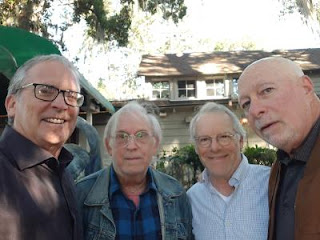
So, last May, after we’d all had our second dose of the vaccine, the Monday Night Zoom Boys rented a villa down in Hilton Head and four of us (Tom preferred to stay home because he didn’t want to put his elderly mother-in-law in jeopardy) spent five days (and nights) together. We got along swimmingly and that ranks as one of the best vacations I’ve ever had.

So, last May, after we’d all had our second dose of the vaccine, the Monday Night Zoom Boys rented a villa down in Hilton Head and four of us (Tom preferred to stay home because he didn’t want to put his elderly mother-in-law in jeopardy) spent five days (and nights) together. We got along swimmingly and that ranks as one of the best vacations I’ve ever had.

(Here's Tom, gallantly at home.)
Last summer, as the pandemic waned, and the vaccine freed us from captivity, we all mourned the inevitable passing of our Monday night ritual. But wait. Not so fast. Instead of totally abandoning our Monday night meetups, we decided instead to cut back to every other Monday night. And so, our Zoom calls continue to this day.
It’s a close bond that wouldn’t have been possible before Covid hit. In fact, our close relationship has only grown, as evidenced by the fact that four of us are attending Left Coast Crime, where we’ll be able to hang out together in person. And in September, there’ll be Bouchercon in Minneapolis, Matt’s home turf.
So, now that we seem to be approaching a return to “normal” pre-pandemic life, I can’t help but be grateful to a deadly virus for bringing us together.
HANK: Isn’t this great?
And oh, see below for more of Charles' brand new book, CANARY IN THE COAL MINE. Doesn’t it sound amazing? I’m giving a copy to one lucky commenter!
Funnily, my fellow Career Authors bloggers (Dana Isaacson Dana Isaacson, Jessica Strawser, Paula Munier, Brian Andrews and I) meet every Monday morning at 10, on zoom, with coffee and Monday brains, and we’ve been doing it from the very beginning. It is such a joy and reassurance. And ooh, we are doing something together in real life, too – – the first ever in person MIT Endicott House Career Authors Weekend Writers retreat! (Click here for more info. Space is limited.)
How about you, Reds and Readers? Dare I ask…did you discover anything good in the pandemic? (I can tell you, also, I swore I would put the books on my bookshelves in alphabetical order. But nope. Didn’t happen.)
And remember, comment to be entered to win! (This week's winners will all be announced Saturday!)

CANARY IN THE COAL MINE

Charles Salzberg is a former magazine journalist and nonfiction book writer (From Set Shot to Slam Dunk, an Oral History of the NBA and Soupy Sez: My Zany Life and Times). He’s twice nominated for the Shamus Award for Swann’s Last Song, the first in the series, and Second Story Man (also winner of the Beverly Hills Book Award). Devil in the Hole was named one of the Best Crime Novels of 2013 by Suspense magazine.
He lives in New York City and teaches writing for New York Writers Workshop, where he is a Founding Member.