Showing posts with label France. Show all posts

Thursday, March 21, 2024

SUSAN SHEA AT A CROSSROADS.

 RHYS BOWEN:  I've just released book Twenty in my Molly Murphy series and I've found myself wondering when it might be time to walk away. Oh, don't get me wrong, I'm still enjoying her, and Lady Georgie, but there must come a time when a series comes to a logical end, mustn't there?

Anyway, this is what my guest today is pondering at the moment. Susan Shea is a dear friend and neighbor, allowing me to share plenty of cups of coffee or fish and chips while we mull over books and the publishing world. So I'll let you tell her about it...

SUSAN SHEA: Hi Reds, It’s such a treat to be back visiting some of my absolute favorite authors! My newest book, MURDER AND THE MISSING DOG, has just launched. It’s the fourth one set in the rural towns of the Yonne region of Burgundy, largely off the tourist path, but brimming with small pleasures, great food – and mysteries, of course!


I’m right now deciding if I’ll continue to write about my cast of ex-pats and their neighbors or veer in a new direction. I already had to say goodbye to Dani O’Rourke, the smart professional woman at the heart of that three-book series, and it made me sad. Now, it could be au revoir to Ariel Shepard and her friends as well as their quirky French hosts. It’s a big decision.

 Some of the Reds write stand-alones. Others write series. Have you ever contemplated giving your series characters a grand send-off, or letting them drift into the fog? And if you’re a wizard with stand-alones, do you ever think that staying with your characters as they move past one crisis might be intriguing? What do readers want?

 Info about the book:

 MURDER AND THE MISSING DOG is the second book in a series set in and around a modest, dilapidated château in Burgundy. American Ariel Shepard inherited it from her romantic husband, who secretly bought it after they visited the grounds on their honeymoon. He died suddenly before he could have it restored. She has moved to the rural town and taken on the challenge, making friends and finding a collection of off-beat local workers. She’s also found trouble, in this case the body of an eccentric old woman from the town crumpled on the doorstep of her friend Katherine’s little shop. The gendarmes are on the scene almost immediately and she and her two friends, who became entangled in a former homicide investigation, are warned not to get involved. But the police aren’t interested in the missing dog, which was Madame Toussaint’s constant companion. Ariel, Katherine, and their young English friend Pippa see no harm in looking for the dog, but of course that leads them right into the heart of the bigger mystery.

 Bio:

 Susan says she’s been writing since she was old enough to read. She left a career in non-profits to write crime fiction because it looked like more fun. She’s written three highly praised murder mystery series all of which are available in one or more formats: The Dani O’Rourke Mysteries; two Burgundy novels; and the French Château series that takes place in the same neighborhood as the first Burgundy novels. The newest château novel was published March 5. They’re all traditional-cozy style, laced with humor. Susan is past president of the Norcal Sisters in Crime chapter, and served five years on the SinC national board. She lives with two cats, blogs with some dynamite authors at 7CriminalMinds, and has an author page on Facebook. www.susancshea.com .

RHYS: Who could resist a book with a dog on the cover AND lovely French houses AND sunshine!

Susan will be giving away a signed copy to one of today's commenters!

Wednesday, July 19, 2023

Rhys gets ready...

 RHYS BOWEN: Well, I actually am writing something new. Clare and I have started our new Molly book. This one is set in the fledgling movie industry in New York (and the rival Edison studio across the river in New Jersey) but today my thoughts are focused on the upcoming release of THE PARIS ASSIGNMENT. 

Most of my writing at this very moment is blog posts, interviews for the new book. I'm excited to share it with the world as I think it is a special story, with plenty of danger, heartbreak and an ultimately satisfying ending. I decided to share a snippet with you today:


They made for the ferns and lay down amongst them. Madeleine tried to sleep, but every nerve was taut, and every stirring of the night breeze jerked her awake. An owl hooted as it sat in a nearby tree. At last there was a hint of dawn in the night sky. They could make out the vague shapes of trees.

“We should get moving.” She nudged Annie.

Annie stirred, opening her eyes. “Is it morning?”

“You were asleep?”

“What else was there to do?” Annie sat up and smoothed down her hair. “I’d welcome a cup of coffee, wouldn’t you?”

“Not me. I don’t like it black, and remember, there’s no milk in cafés these days.”

They were about to get to their feet when they heard sounds. A dog barking.

“Get down.” Madeleine pulled Annie back into the ferns. To her horror she heard the sounds coming closer. The barking louder. And suddenly the dog was standing over them. They could feel its warm breath on them, its panting loud in their ears.

“What’s this, then?” said a man’s voice. A French voice.

They sat up, staring up at a man with a gun and a large hound.

“Oh monsieur, you terrified us,” Annie said, sitting up. “My sister and I had to leave Paris because where we were living was so dangerous, and we’re making for our aunt’s house in Moret-sur-Loing—do you know it? Have we still far to go?”

“You came on foot?” he asked. Now they could see he was an older man, still strong and upright but with a grey mustache and bags under his eyes.

“We started in the train, but there were German soldiers in our compartment, and they were fresh with us, so we got out at Bois-le-Roi and decided to walk the rest of the way,” Annie said. “But we got lost and it got dark, so we felt safer here. Now we’ll go back to the Bois-le-Roi station and continue our journey, hopefully in safety.”

“Those damned Germans. Always making trouble of one sort or another,” he growled. “Well, at least you have not strayed too far from the station. There is the good path up ahead. I’d invite you back to my house for something to eat, but I don’t think you want to go in the wrong direction. And my dog is anxious to get to work.”

“What work does he do?” Annie asked.

“We’re out hunting rabbits,” the old man said. “How else does one get meat these days? And old Louis here, he has a good nose for finding game. Rabbits, squirrels. Anything for the pot so my wife can make a stew.”

“We wish you good hunting, monsieur,” Annie said.

“And you too, ladies.” He tipped his old felt hat to them and whistled for the dog to follow him.

The two women got to their feet. “You were amazing,” Madeleine said. “I can see you’re going to be good at this. You think on your feet. So convincing.”

Annie grinned. “I was good at lying when I was a kid. I could make my mother believe anything. Who thought it would come in handy in later life? But I don’t think he was fooled for a minute. He knew who we are.”

“He did?”

“When I wished him good hunting, he replied, ‘You too,’ didn’t he? He suspected we were Resistance of some sort, but he was on our side.” She brushed down her coat. “Well, we’ve had good luck so far. Let’s hope it holds up. Ready to make for the station?”

RHYS: It was hard to find a snippet that was not a spoiler, but I think this gives you a feel of what the young women were up against during the war.

If you want to pre-order here is the link

And I'll give away a copy to one of today's commenters.  Enjoy.


Wednesday, March 9, 2022

Rhys muses on the tranquil life of a writer.

 RHYS BOWEN: We all know what the writer's life is like, don't we? After a leisurely breakfast I mount the stairs to my office, admire the view then sit and stare out of the window until the muse flutters to my shoulder and I type a few meaningful words before stopping for coffee and a stroll in the garden.

Right?

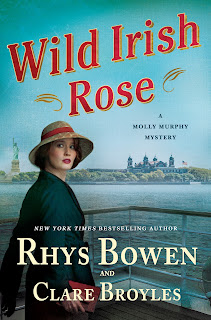
If anyone believes a writer does not need stamina I suggest you look at the life of the Reds. Last week we celebrated the launch of WILD IRISH ROSE with a Zoom event and then on Saturday a live event at Poisoned Pen, which was also streamed and has had over 2200 views to date! Brilliant.


But also over the weekend Clare and I had to do the edits on the next Molly book, tentatively called ALL THAT IS HIDDEN.  They went off to the editor today AND I completed an interview I had promised

AND

I wrote the five pages of my current work that I have to do in order to finish to my deadline. Only this time they are extremely hard pages to write. When I'm in Royal Spyness mode I skip merrily along, chuckling as my characters say witty and silly things. This is the most harrowing book I have written: It's also set in WWII and involves a woman who loses husband and child and volunteers to. be dropped into enemy-occupied France as a courier. (In actuality the survival rate of a courier was twenty five percent) She has to deliver messages between the resistance and a British radio operator under the nose of the Germans and of course she's going to be betrayed and it's going to get really awful... I'm putting off that part because I know how awful it's going to get. 

But just coming downstairs to unwind after writing some of those intense and harrowing scenes--well, it's not easy. I know it's going to be a really good story and I know I can do it, but just getting through this middle part of the book is emotionally draining.

It's called ISLAND OF LOST BOYS, because... well, one of the characters is a lost boy, but I can't tell you more. Oh, and it involves Australia, after the war, but again I can't tell you more about it.

Can I give you a little feel for it?

okay

Later that week Madeleine was sound asleep in the middle of the night when she was woken with a crash. Bright light shone in her face. Shadowy figures stood over her.

                “Aufwachen! Aufstehen!. Raus mit dir!” screamed a voice as she was dragged to her feet. Men in Nazi uniform grabbed her and dragged her down the hall, shoving her into what seemed to be a cupboard. The light continued to shine in her face. “Name?” a voice barked.

“What is your name?” He repeated in French.

“M—Minette Giron,” Madeleine realized how she had almost given herself away.

“Do you speak German?”

“No, Monsieur.”

“What about English?”

“No, Monsieur, only French.”

“And what are you doing here? Why did you come to this town?”

“My husband was killed. I was afraid to be in Paris alone,” she said. “I used to have a relative here so I know this place. It seemed safe. I thought I could get a job here.”

“As what?”

“I used to work in a bookshop, but now I deliver shoes for the shoe-mender.”

“And sometimes you deliver other things too?”

“Yes, monsieur. Sometimes I deliver flowers,  or even pastries a couple of times.”

“You know what I mean. I mean messages. From the enemy.”

“No, monsieur. Not true. I am a simple woman. I just want to be left alone, that’s all.”

“ We will search your room and if we find anything, it will be very bad for you. But I can make it easy on you, if you just tell us what we want to know…”

“I have nothing to tell, monsieur. On my honor, I have nothing…”

“Enough,” said one of the men in English now. He took off the German cap. “Well done, Minette. You handled it well. But I presume you realized we were only acting.”

“Not at first. I wasn’t fully awake. But then I did realize… That didn’t make it any less frightening.”

“No. So stay alert. Practice bracing yourself mentally. What will you say if this happens? Think of ways to wriggle out of it. Practice saying them, over and over. Because the next time it will be real.”

Still shaking, Madeleine went back to bed.


And this is one of the easier scenes. Why did I ever think this story was a good idea?

And in the coming week I have several other Zoom interviews/talks all of which take effort. Wine is needed, I think. 

What do you do to unwind when you've been caught up in something so emotionally intense?


Friday, September 28, 2018

Back from France, and Yes, I Brought You Chocolates


LUCY BURDETTE: My first trip to Paris and Provence was during my junior year in college. I have always regretted that I felt too homesick and shy to really take advantage of the experience. So I embrace any chance for a do-over. 

And last week, I was very fortunate to travel to France for a trip focusing on food in Paris and Bordeaux. The week was curated and led by David Lebovitz, who writes a blog about food in Paris and also tries to translate the unusual customs of France for Americans. For many years David was the pastry chef at Chez Panisse, the restaurant founded by Alice Waters in Berkeley, CA. So he knows food.


My friend Carol and I decided we better get to Paris a couple days early so we’d be acclimated to the time change and not miss a trick. We spent those two days walking the city and also visited two museums that I had not been to before – the Picasso museum and the Musee d’Orsay. It was utterly astonishing to stand in front of works of art in person that I had only seen in books.


Picasso's goat


Vincent van Gogh's Bedroom


For the next five days, we made the rounds of chocolatiers, bakers, grocers, sommeliers, and cheese mongers in Paris and later in the week, Bordeaux. I won’t describe everything I saw and learned – you’d be here until next Friday with eyes glazed over. But I’ll show you some of the highlights, and yes I brought enough chocolate home for all of you!


This is one of the more famous bakeries in Paris, called Poilaine. We were invited downstairs to see the bread baking in a massive wood-fired oven that’s been in service since 1932.


Next, on to visit artisanal chocolatier, Jean Charles Rochoux, famous for his chocolate figurines.


Fabulous lunch at Cafe Nemrod, for me a croque madame complet...


That night, more food and wine: Here was the opening salvo of a six-course tasting dinner at Verjus. I could’ve made a meal out of the appetizers, including this exquisite chickpea pancake stuffed with fresh herbs.


You can see it was a good thing we walked a lot, because the next morning brought more chocolate demonstrations at Fouquet.


Lucy with David and chocolatier Frederic

Lunch involved a wine tasting and tapas at O Chateau. We learned that wine and food are deeply affected by terroir, meaning the exact climate and soil where the beans or wheat or grapes are grown.


I also made a lovely new friend who welcomed me to her houseboat on the Seine...maybe Hayley Snow will visit?


The next morning, we took the high-speed train to Bordeaux... where we joined Jean-Pierre Moulle, executive chef at Chez Panisse for thirty years. First we enjoyed the chocolates made at Saunion. This woman adored her job!


The chocolates were followed by a visit to the cheese cave of Jean d'Alos...


Then we were invited to dinner at a country farmhouse, hosted by Jean-Pierre and his lovely wife, Denise


I wondered what made the potatoes so exquisite. The answer, they are simmered in duck fat.


During our last day, we went to the farmer's market, where we watched Jean-Pierre choose ingredients for our lunch. The lunch took place at Chateau La Louviere, belonging to Denise's family, still actively producing wine.


Jean-Pierre working on a pear clafoutis with tips from David

an amazing salade Nicoise with fresh tuna and anchovies

France under any circumstance feels wondrous to me, but meeting these artisans, including David, and hearing about their love for food and their work was very, very special. 

I could wax on and on, but I'm off to ditch some chocolate calories with a high-speed walk. And maybe puzzle out how I might use some of this in another book...

I'll leave you with another famous chocolate shop scene...


Thursday, August 23, 2018

James Benn discusses The Wild Purge

INGRID THOFT

One of the wonderful things about Jungle Reds is the knowledge our guests impart to us about experiences, people, and places we might otherwise miss.  James R. Benn joins us today to discuss his latest novel, "Solemn Graves," the 13th novel in his Billy Boyle WWII mystery series, which will be published on September 4th.  I am woefully ignorant when it comes to WWII and D-Day, so thank you, James, for educating me about the days immediately following D-Day and the historical context in which "Solemn Graves" is set.

The Wild Purge
During the period between D-Day (June 6, 1944) and the Liberation of Paris (August 25, 1944) those areas in France no longer under German control were—ironically—quite lawless. General de Gaulle refused to permit the installation of the usual Allied Military Government, on the basis that France was an ally, not a nation to be occupied. But he didn’t have the clout to establish his own government, not until after Paris was freed.

But that’s a story for another day.
This is the story of The Wild Purge, the épuration sauvage, carried out immediately following the collapse of the German occupation and before de Gaulle’s provisional government was in place. The French Resistance had been armed from London and by weapons taken from the Germans. The ranks of the Resistance fighters, known as the Forces Françaises de l'Intérieur, or FFI (called fifis by Americans who invariably came up with their own ways to pronounce French names) grew tremendously in each town and region as the allies drew closer. Many French men and women had been part of the movement for years. Some joined in June or July 1944 at the very last minute.

Scores of young men had fled to the hills to escape the forced roundup for slave labor in Germany. They became known famously as the Maquis, after the scrub brush common in the countryside. But others joined only when it was certain they would emerge on the winning side. Some had their own collaborationist past and hoped that a furious patriotism would erase any memory of previous misdeeds.

A frenzy of killing took place in those weeks. Historians estimate these extrajudicial executions totaled over 10,500 deaths. Many of these were French fascists and collaborators who had hunted and tortured their own. No one can be sure that in the enthusiasm of Liberation, those scores had anything to do with the war, or that the death penalty was warranted. No one with any legal authority was present to stop the killings, and in some cases, old scores certainly were settled.

The wild purge included not only killings, but a wave of violence against women. It is estimated that over 20,000 women had their heads shaved as punishment for having relations with the Germans. Other abuse, including tar and feathers, was sometimes applied, along with beating, stoning, and public humiliation. Some of these women were prostitutes, and others had willing affairs with Germans. These were the women accused of collaboration "horizontale." Prostitutes were doing nothing that thousands of Frenchmen had not done in shops and cafes everywhere; take money for services rendered from German soldiers.

Of course, there were women who willingly obliged the Germans with their company. Coco Chanel, the famous French designer, lived through the war at the Ritz hotel in the company of her German lovers, while scheming to take over a perfume company owned by Jews. Her hair was never touched.

Some women were the targets of personal revenge, and it took only a whiff of suspicion for the application of the coiffure ’44 to be applied. This happened to a funeral wreath maker in the city of Toulouse. As she was working next to an open window, a German soldier strolled up and began talking to her. Their entire conversation took place at the window, and the soldier moved on. After Liberation, she was denounced for this simple exchange. A mob came for her, stripping off her clothing and shearing her hair as her daughter watched.


Looking at these pictures, I see a savagery in the air that makes me wonder if the humiliation felt by men defeated in 1940, long repressed during the Occupation, found an outlet in the treatment of these women. The sneering smiles and superior faces of the men especially are terrifying. I do wonder how many of them had taken action against the Germans.

Women who were shaved became known as "the tondues" – the shorn
Women played a huge role in the French Resistance from the beginning. One reason was that young French men were often rounded up on sight for slave labor work and sent to Germany. It was easier for women to move about and not attract attention. I wonder how much of the rage released onto Frenchwomen was a result of the emasculation of French men, forced into a powerless state by the German occupiers for four long years.Yes, French women were also traitors and informers, as were French men. Perhaps the woman in the image below is one. Was her crime one of passion, survival, avarice, or simple business? We don’t know. But we know those faces. The faces of a mob.


Although I had seen these pictures before, it was only after reading "Les Parisiennes" by Anne Sebba that I began to understand the ugly motivations behind the treatment of women during the épuration sauvage. This is a terrific book, well-written, and gives us a new way to look at this historical period. Highly recommended.

Once de Gaulle’s government was installed following the Liberation of Paris, a “legal purge,” or épuration légale, replaced the wild purge. A series of trials were held from 1944 to 1949, meting out justice to collaborators and officials of the Vichy regime. Nearly seven thousand people were sentenced to death, but in the end, less than eight hundred sentences were carried out.

The myth of wide-spread participation in the Resistance quickly took hold, and the collaboration with the Germans and the Vichy regime became buried in the collective unconscious. The men of the Resistance were glorified and the women, for the most part, forgotten. After the war, Charles de Gaulle awarded 1,038 Resistance members with the coveted medal “Compagnons de la Libération”.

Only six went to women.

Do you have questions for James?  He'll be joining us today so fire away!


Solemn Graves
US Army detective Billy Boyle is called to investigate a mysterious murder in a Normandy farmhouse that threatens Allied operations.

July, 1944, a full month after D-Day. Billy, Kaz, and Big Mike are assigned to investigate a murder close to the front lines in Normandy. An American officer has been found dead in a manor house serving as an advance headquarters outside the town of Trévières. Major Jerome was far from his own unit, arrived unexpectedly, and was murdered in the dark of night.

The investigation is shrouded in secrecy, due to the highly confidential nature of the American unit headquartered nearby in the Norman hedgerow country: the 23rd Headquarters Special Troops, aka, the Ghost Army. This vague name covers
a thousand-man unit with a unique mission within the US Army: to impersonate other US Army units by creating deceptions using radio traffic, dummy inflatable vehicles, and sound effects, causing the enemy to think they are facing large formations. Not even the units adjacent to their positions know what they are doing. But there are German spies and informants everywhere, and Billy must tread carefully, unmasking the murder while safeguarding the secret of the Ghost Army—a secret which, if discovered, could turn the tide of war decisively against the Allies.

James R. Benn
I divide my time between the Gulf Coast of Florida and Connecticut, with my wife Deborah Mandel, a psychotherapist who offers many insights into the motivations of my characters, a good critical read, and much else. We have two sons, Jeff and Ben, and seven grandchildren (Camille, Claudia, Emma, Luke, Nathaniel, Noah, Oliver).

I'm a graduate of the University of Connecticut and received my MLS degree from Southern Connecticut State University. I am a member of the Mystery Writers of America, and the Author's Guild. I've worked in the library and information technology fields for over thirty-five years and quit the day job routine in 2011 to write full-time.

I've learned two valuable lessons since I started writing which have helped me greatly. The first is a quote from Oscar Wilde, who said "The art of writing is the art of applying the seat of one's pants to a chair." The second is from novelist Rachel Basch, who told me "the story has to move down, as well as forward." Both sound simple. Neither is.

Thursday, May 3, 2018

Dressing Up with Susan Shea

INGRID THOFT

Wouldn't you love to take a trip to the French countryside?  Visit with the locals.  Dine on cheese and wine while admiring the landscape.  You can with the added bonus of a cracking mystery if you read "Dressed for Death in Burgundy," the latest from Susan Shea.  Her main character, Katherine Goff, is an expat living in the small town of Reigny-sur-Canne in this second installment of her French countryside series.

Susan is here to give you the scoop on her new book!


SS: I don’t know about you, dear JRWs, but I rarely have an opportunity these days to dress up: long dress, serious jewelry, high heels. I miss it. Used to be, my sweetie and I would dress (he rocked a tux) at least a few times a year and I loved those evenings. These days “dressing up” means leaving the jeans and trainers at home.

But what I miss most is the over-the-top parties where we were invited – no, instructed – to come in costume, and I don’t mean Hallowe’en vampire teeth or Stars Wars outfits. I’m talking about full Elizabethan lady-in-waiting attire with swishing satin skirts and pearl headdresses, or flimsy 1920’s Flapper chemises, page boy bobs, and long cigarette holders.

Have you had the fun of going to a costume shop (do they still exist, I am just wondering?) to browse through Marie Antoinette’s bustiers or try on a Russian Empress’s furs? Practice using a fan with the flirtatiousness of a geisha, or look in the mirror at Paul Revere’s wife with her mobcap? The last time I went full costume was at a party that must have been 15 years ago and, yes, I went as an Elizabethan Lady, my sweetie as a rough character who might have been her stable boy.
All this was on my mind when I visited the Musee du Costume in Avallon, France for the first time and had the inspiration for the murder at the heart of my second French village mystery, "Dressed for Death in Burgundy." The proprietor, whom I fictionalized in the story, has spent decades scouring French flea markets and antique stores to gather thousands of articles of clothing, accessories, and costume-focused art.

The Museum occupies a multi-storied town house on a quiet side street in the town, and Madame has so many costumes that she and her two grown daughters rotate the entire house’s exhibits at least once a year.  She’s getting older, she apologizes, and since she turned 90, it’s a bit harder to showcase a different era. As I explored the salons and display cases, I longed for an excuse to wear a slimming Edwardian dress (think Downton Abbey), or the sheer black stockings with the spiders traveling neatly up the back of the leg, or the elbow length, pale blue kidskin gloves…I mean, really! Too gorgeous, so evocative of a more glamorous time.


Maybe we should plan a full-out costume party
, a chance to be anyone from a masked Venetian countess to a woman pirate. We could rent a ballroom, hire a small orchestra, and dance with equally attired gentlemen ‘til dawn. Who would you choose to be for that evening? I have dibs on Veronica Lake in the shimmering, silvery gown.


Do tell, Reds and Readers:  Do you have occasion to dress up?  Have a favorite fancy outfit in the depths of your closet?

Susan is giving away a copy of her latest to one lucky reader!  Just comment to enter.

"Dressed for Death in Burgundy"
After finding herself mixed up in a murder investigation the previous summer, Katherine Goff’s life simply has not been the same. Her husband has been in the U.S. recording a new album, the Burgundy region locals are finally starting to see her as a real neighbor, and Katherine has even started helping out with “tourist” excursions. It seems she’s finally found her place in the small community of Reigny-sur-Canne.
But when Katherine stumbles across a body in the local museum during a tour, she finds herself caught up once again in a whirlwind of gossip and speculation. When the police zero in on her friend Pippa as a suspect, Pippa and Katherine team up to find the real killer and clear her name.

However, the more clues they discover, the more the real killer wants them off the trail. When Katherine and Pippa start receiving threats, they must decide what they are more afraid of―the police getting it wrong, or possibly becoming the killer’s next targets.

Find out what happens next in the second installment in the French countryside murder mystery series the New York Times calls “a pleasant getaway.”

DRESSED FOR DEATH IN BURGUNDY is Susan Shea's fifth mystery and the second in her French village mysteries. Her first series featured a San Francisco professional woman drawn into art-related misdeeds. Susan is on the national board of Sisters in Crime and is a member of Mystery Writers of America. She spent twenty-five years in the not-for-profit world before beginning to write full time. She lives in Novato.


Friday, May 5, 2017

Parley Vous Murder? A guest post from Susan Shea

RHYS: Have you ever had any horrible language mix-ups when you are abroad? I've had my share. I think the funniest was when John had a bout of tourist tummy in France once. We were staying with his cousin and the doctor was called to the house. John prepared for this visit by checking with the dictionary and announced to the doctor that something was wrong with his stool. ONLY... the word he used meant the wooden, three-legged kind of stool, not the other one. The doctor was quite amused.
 My guest today is my good friend Susan Shea who is launching a new series set it Burgandy, France. Think wine, food, old chateaux and a body or two. Perfect combination, right? So welcome, Susan. 

SUSAN SHEA : Hi Jungle Reds…although that conjures up some of my favorite writers decked out in leopard skins and red wigs, so maybe it’s not the best way for a guest to greet you all.


Rhys and I were having lunch and laughing about the trouble you can get in when you know just a little bit of another language. She told me about going into an Italian butcher shop and proudly ordering “pollo.” When she unwrapped it at her vacation house, it was, indeed, a dead chicken, complete with head and feet! She found out later, if you want it dressed, you must say something different. My first foray to France a few decades ago was delightful as long as we wanted to eat “cent grams” of pâté every day. I had no idea how to order less. One hundred grams worth is nice for one full meal, but it doesn’t leave much room for any of the hundred cheeses at the shop next door, never mind the confections at the patisserie.

You might infer that since I’ve just written two novels about an American couple who have moved to a tiny French town and are learning to cope, my French is much better now. Don’t. After more years than I care to remember of school French, after six trips, after language tapes and short immersions, I am still struggling to communicate beyond ordering food, begging people’s pardon, and explaining in halting French that I am not at the Gendarmerie to report a murder, I am there to ask a question for my fictional story about murder. “J’ecris meutres et mysteres.” Of course I say this so s-l-o-w-l-y that the bright eyed woman at the desk shoots me looks that suggest I have already overstayed my welcome.

Language is such a tricky thing. That theme runs through Love & Death in Burgundy and the follow-up book that will come out next year. In real life, two things trip me up all the time. The French speak quickly, well, actually at warp speed. Even if I figure out the first part of the sentence, I’m playing catch-up for the rest and frequently miss the point. The French also, like everyone in every language, use idioms, so even if by some lucky chance I’m doing really well, I go off the rails when someone says she makes “les doights dans le nez.” I understand these simple words: fingers in the nose. Why would someone brag about that? Ah, because it’s one of several idioms that means whatever she was talking about was easy to do.

I was thinking about American English idioms that probably make as much sense as the nose reference does…
Easy as pie
Knock on wood
Twisting my arm
Fat chance

RHYS: You'll notice Susan used the expression "Off the rails!"
What language mix-ups and triumphs have you had? What languages have you mastered? There’s comfort in not being alone, so share, please!

And Susan has let me know that she has a signed copy of Love and Death in Burgundy to give away to one lucky commenter!

Tuesday, June 7, 2016

Beaucoup de Packing Tips! Merci, Cara Black!

Before we start: CLICK HERE for a fabulous offer. Just saying. Then come back.


HANK PHILLIPPI RYAN: Bonjour, Rouges de la Jungle! Aujourd hui, notre amie celebre, la fabulouse (made that up I think) Cara Black. Et aussi, quelle excitement, elle est en Le Booktour! Mais, je pense qu’il voudrait tres dificile, um, to pack.  Mais, who better to tell us comment de faire cela than la fashioniste extraordinaire?

(I know, I know, it’s pitiful, but it’s supposed to be FUNNY.)
  
CARA BLACK: Oh la la, packing for a three week book tour in le roller bag!

Bonjour Reds, Thanks for inviting me back! Hank asked me to share tips on packing for a book tour. You’d think I’d have it down to a science by now, right?

Murder on the Quai comes out next week - the 16th Aimée Leduc investigation. Yet packing still feels like alchemy - how in the world will I concoct the mixture and do this? Certainly not with smoke and mirrors. 

Trial and error has shown me it’s all about stripping down to essentials and fitting everything - and I mean toutes - in one roller bag. One roller bag, three weeks and 27 book events. Sucking in breath here. The added challenge on this three week book tour is not only packing for multi temperatures from rainy Seattle to muggy Houston and Ann Arbor and parts East but ending up at my editor’s July wedding in Massachusetts.

A wedding outfit? Mission Impossible?

My book tour wardrobe is simple, black on black and nightly washouts. Scarfs for color, an Eileen Fisher knock off swingy wrap. 

Fabrics - I keep to cotton, silk, linen to make it lightweight and easy to layer up for cold planes. This year presents a new packing challenge, June and July in the midwest, South and East coast. Isn’t that muggy and humid? I’m going for a linen tunic - the little wrinkle linen type, alternating my staple black cotton tunic with leggings and silk shell to layer over for evenings.

But what in the world to wear to my editors wedding that will bear up for three weeks on the road? Suggestions Reds? The wedding outfit stymies me.

Now to footwear - whatever covers my feet presents the biggest space challenge. Right, Hank? How in the world to fit boots apart from wearing them non-stop. At least this time I don’t need them. 

For 15 years every March I’ve toured when Aimée’s next investigation came out which presented winter packing challenges - below zero in Minnesota, sleet, down coats and soggy footwear. Not to mention March madness and snow closing the airport in Detroit. So this time it’s Skeecher’s super comfy ballet flats for hiking through the airport, low platform espadrilles for events and flip flops for driving.

Voilà.

My rule of thumb has been to go with a staple outfit - which becomes my uniform - always black, washable and without buckles and metal straps to hold up the line at TSA.

Let’s talk toiletries. Cleanser, astringent goes in little plastic bottles, perfume samples from Nordstrom - you know those tiny capsules that offer an amazing spritz and take no room, makeup (they have great travel sized at Sephora) fits in the Baggie or it STAYS home.

Electric toothbrush? Not any more just a toothbrush 6-pack easy to break off and stick in a pocket, use and discard. Three pairs of undies and leggings washed out at night, a paperback to read in case I’m on a runway three hours. An extra charger. Oh and the heaviest thing - bookmarks for 27 events! That’s all due to dear Rhys but that’s another story.

The book tour packing isn’t so different from what I pack for Paris - everything must fit in one roller bag - or le rollaire as the man at the shop in Belleville calls it where I get the best price on his newest model. Last month he sold me on the hardshell four wheeler lightweight swivel special that fits into the European sized overhead.
I discovered the hard way that our overhead requirements are different from European and had to pay extra on the runway in Easy Jet. 

Don’t call it cheating, but over my shoulder I sling a hardback-book-sized super light weight nylon rucksack that expands and holds the ipad, chargers, medications, and tiny wallet - my new find from Galleries Lafayette - carrying essential ID. The small rucksack is a shapeshifter - easypeasey - and scrunches into a pocket. 

Have you ever seen the tips for packing videos? I recommend them. One changed my life - rolling up everything i.e. all your T-shirts into thin little rolls like sausages, even jeans, and presto life fits.

go for the cigarettes in a box approach.

Here’s a great slide show ten days in a carry on

I would love to see you if I’m in your ‘ood

Thank you, Reds and appreciate any tips for a lightweight outfit for my editors wedding!
Cara

HANK PHILLIPPI RYAN: I tried the rolled-up-thing method. I gave up, because I bring jackets, and they..don’t roll.  And I swear by tissue paper.

And I so agree--if it doesn't fit in le rollaire--I will never think of it another way--it STAYS home.

And I ship my bookmarks ahead, and they (usually) meet me at the hotel.

So, chere Rouges, any packing tips? And are you heading anywhere this summer?


And--speaking of AIR TIME--don't forget to CLICK HERE! (It's re-pub day!) Especially if you're traveling this summer! I'd love to send you some limited edition gifts!