Showing posts with label J.K. Rowling. Show all posts

Saturday, June 10, 2017

Pen names, Pseudonyms, or Nom de Plumes.

Jenn McKinlay: There are probably as many reasons to have a pen name as there are pen names in use. So why do some authors write under different names?

     A quick study of famous authors and their pseudonyms reveals that Stephen King wrote under the name Richard Bachman so that he wasn’t constrained by the publishing belief at the time that an author was limited to one book per year. He also wanted to discover for himself if his success was due to talent or luck. Unfortunately, he was outed as Bachman fairly early on and never did satisfy that question to his liking, much like another famous author J.K. Rowling.

     Rowling used her initials instead of her first name Joanne, because her publisher felt that her reader demographic (tween boys) wouldn’t respond to a female author. In fact, Rowling didn’t have a middle name and had to borrow the K from her grandmother’s name Kathleen. After the success of Harry Potter, she wanted to try her hand at mysteries and wrote under the name Robert Galbraith to take the new work as far away from herself as possible. Like King, her true identity was revealed too soon for her to discover how her books would have fared had readers not discovered Galbraith’s true identity.

     Other authors have used pseudonyms to allow them to try out different genres. Dame Agatha Christie wrote romances under the name Mary Westmacott. She said the mysteries were her day job but the romances were for fun! In a flip on this, romance author Nora Roberts writes futuristic police procedurals under the name J.D. Robb. Ann Rice, also used a penname when she wrote two erotic novels under the name Anne Rampling. Of course, Ann Rice is actually a nom de plume with her maiden name being Howard Allen Frances O’Brien. And then, there is Dean Koontz who is said to have as many as ten pen names, because like Stephen King, he wrote so many books that his publisher couldn’t keep up. Also, in an interview he said there was no way he could earn a livable wage writing just one book per year. Some of his names include David Axton, Richard Paige, Anthony North, and his gothic-romance pseudonym Deanna Dwyer.

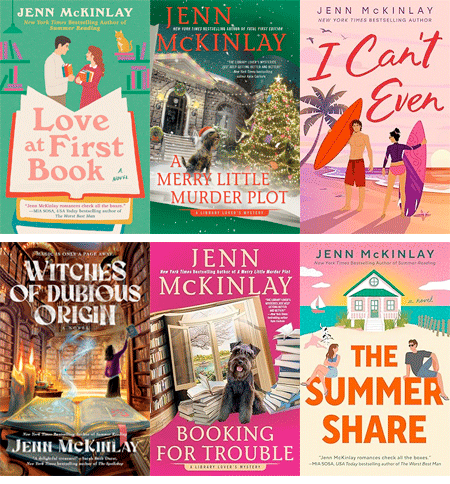
     There are other reasons that authors use pen names, for me, it was because my first mystery was actually a writer for hire work. Having had FISH FOOD -- my dead strip club owner found being eaten by the fish in his saltwater tank mystery -- soundly rejected, I was willing to give it a go when a publisher asked my agent to ask me if I’d consider writing one of their in house ideas. Because while they weren’t keen on my book -- at all -- they did like my voice. Um…thanks?


     Turned out, they wanted a mystery series about decoupage. Decou-what? Yeah, whatever. Of course, I said yes! Suspecting this would be a short-lived series, I made up a pen name that consisted of my dog (Lucy) and my grandmother (Lawrence). And then an interesting thing happened, I discovered I liked writing under a pen name. It was liberating in ways I hadn’t expected so when the opportunity arose to take on another series while maintaining the two series I’d begun since the decoupage books tanked (shocker!), I took the job and wrote a bargain hunters series under the name Josie Belle (another grandmother name mash-up).

     Would I ever write under a pen name again? In a heartbeat. Truly, there was something very freeing about writing as someone else. Although, next time, I’m going to be a dude.

     How about you, Reds? Any nom de plumes in action out there? If not, what is the pen name you would write under if you had the chance?


For Fun:
 QUIZ: Match the author to the pen name 
(I scored 8 out of 10, if we’re sharing!)

Thursday, July 10, 2014

J.K. Rowling, Fan Fiction, and Everything Authors Leave Out of Their Books; a guest blog by Paul Doiron


Kathy Reel is the winner of Anna Lee Huber's A Grave Matter! Kathy, please contact Anna at annaleehuber dot com.


JULIA SPENCER-FLEMING:  I don't have to say too much to introduce Paul Doiron, do I? He burst onto the mystery scene four years ago with The Poacher's Son, which introduced Maine Game Warden Mike Bowditch and nabbed a brace of prestigious nominations and awards, including the Edgar and the Nero.  

Fast forward to today. The fifth Mike Bowditch novel, The Bone Orchard, launches next Tuesday to rave pre-pub reviews (I can add mine to them; Paul slipped me an ARC last month and I read it in one sitting. Really good stuff.) What's Paul going to talk about? Moose? Maine state parks? 

How about J.K. Rowling and fanfiction?


Like most authors, I probably think as much about the things I don’t put into my novels, as the things I do. My new book, The Bone Orchard, is the fifth in my series about headstrong but big-hearted Maine game warden Mike Bowditch, so I’ve come to know a lot about him, not all of which has yet made it into the stories themselves. With each new novel, I fill in a little more of Mike’s unwritten history. 


So for instance, in The Bone Orchard I flash back to his first year as a warden to give him a friend I’d never mentioned before—a young man Jimmy Gammon, who is on his way to Afghanistan as an MP with the Maine National Guard. He returns home badly wounded and suicidal (a very real crisis among our returning vets), and the violent confrontation he provokes at the beginning of the book is the catalyst that triggers everything that follows in the story.


In my notes about Mike, I have many details about his past, but no matter how many more books I write, I know I’ll never fill in all the gaps in his back story. And that’s the way it is with every fictional character. A single author can only write so much. 


The emergence of fan fiction is an organic response to this problem. Readers want more Bella and Edward and so they tell stories about them set in an alternate dimension of Stephanie Meyer’s Twilight universe (and some of them get quite rich doing so). The same thing happens with movies (Star Wars) and TV shows (Star Trek). If you want to bring on a case of the vapors, Google “Kirk and Spock sex scene”—or better yet don’t. Poor Gene Roddenberry is already rolling in his grave. 


I’ve been thinking about fan fiction this week because of J.K. Rowling. Unless you’ve been holed up in a cabin deep in the Maine woods (and if so, I envy you), you’ve probably heard that the richest woman in England has come out with a new Harry Potter story. Like most sentient beings I am a Rowling fan (No, I won’t apologize for reading the Potter books as an adult. Nor will I begrudge Rowling’s recent forays into crime fiction under the pen name of Robert Galbreith.) The story itself — set sixteen years after The Deathly Hallows—didn’t do much for me, it was fun but forgettable, but I’ve been struck by the media response to it.


While many reviewers found it delightful, others responded with a collective “meh.” A few, including, Esther Breger writing for the New Republic, saw the story as part of an off-putting pattern of behavior with Rowling, in which she can’t help herself from continuing to fill in the holes she left in the original books:


Since ending the series, shes revealed that Dumbledore was gay, that Harry and his cousin Dudley reconciled, and that Harry and Voldemort were related by blood. You dont have to be a Barthesian grad student to chafe at Rowlings impulse to clarify the words on the page. When writers adopt the paratextual world of fanfic as their own, they both diminish their booksliterary authority and interfere with the freewheeling spirit of fan writing.”


The language in that paragraph takes me back to my comp-lit days at Yale, but I think it roughly translates to: “Rowling should either put this stuff in a new book or keep her mouth zipped because it’s confusing for readers to learn about a beloved character’s unexpected sexual orientation from an author’s offhand comment.”


Put another way: “This new story reads more like fan fiction than the work of the genius who created Hogwarts.”


What do you think about J.K. Rowling’s decision to keep adding back stories to the characters in her books? Should she leave more to the imagination of her readers, or are you grateful for any new tidbit about the world of Harry Potter? Do you think writers should keep explaining their books by filling in information that never made it onto the page? Or should they leave these holes to be filled in by the readers’ imaginations?


And for the Reds and my fellow authors out there: have you had anyone write fan fiction about your characters and if so, how did you feel about it?


No one has written fanfic about Mike Bowditch yet (that I know of, at least). If they ever do, I’m curious how I’ll respond to it. Will I feel possessive: like the fictional world I’ve created belongs entirely to me as the author? Or will I be open to letting my readers flesh it out with their own imaginings? I doubt I’ll know the answers myself until some fan writes a scene where Mike Bowditch and his beefy blond friend Billy Cronk get it on.


Gulp. 


Paul will be giving a signed copy of The Bone Orchard to the commenter who provides the juiciest answer.


You can read more about the Mike Bowditch series, including excerpts from the books, at Paul’s website. Like his page on Facebook or follow him @pauldoiron on Twitter.