
Showing posts with label James R. Benn. Show all posts

Saturday, February 25, 2023

Too Long? James R. Benn Goes Short

LUCY BURDETTE: We always love having Jim (aka James R.) Benn visiting to talk about his Billy Boyle series, but I promise you'll love this blog about short stories. It may even bring a tear to your eye, so read on...


JIM BENN: I never thought I’d be a short story writer. As an author, I tend to write long. I don’t mind taking my characters in the Billy Boyle series off on a tangential hunt, as long as I return them safely to the story line. In a world where a “standard” novel runs to eighty thousand words, mine routinely exceed one hundred thousand. I’ve always said I like to give my readers a good bang for their buck, but in truth I do blather on.

And it’s nothing new. In 1963, when I was a freshman in high school, Mr. Gillan — fifth-period English class — thought so too. I recently unearthed a folder of short stories I wrote in his memorable course. What was the first comment I saw, a full sixty years later?

TOO LONG


The saving grace was his next comment: “good description” accompanied by a check. I don’t recall if that was the best mark or if I missed a double check, but I certainly learned the lesson that a good description can overcome excessive length. I also learned a good bit, at the age of fourteen, about movie tie-ins. The Great Escape, the classic WWII prison break film, had premiered that summer. I enjoyed it, and I figured Mr. Gillan would, therefore, enjoy my POW escape story.

Dodging the searchlight, he clambered over the wall . . .

GOOD

In red pencil. I was on to something.

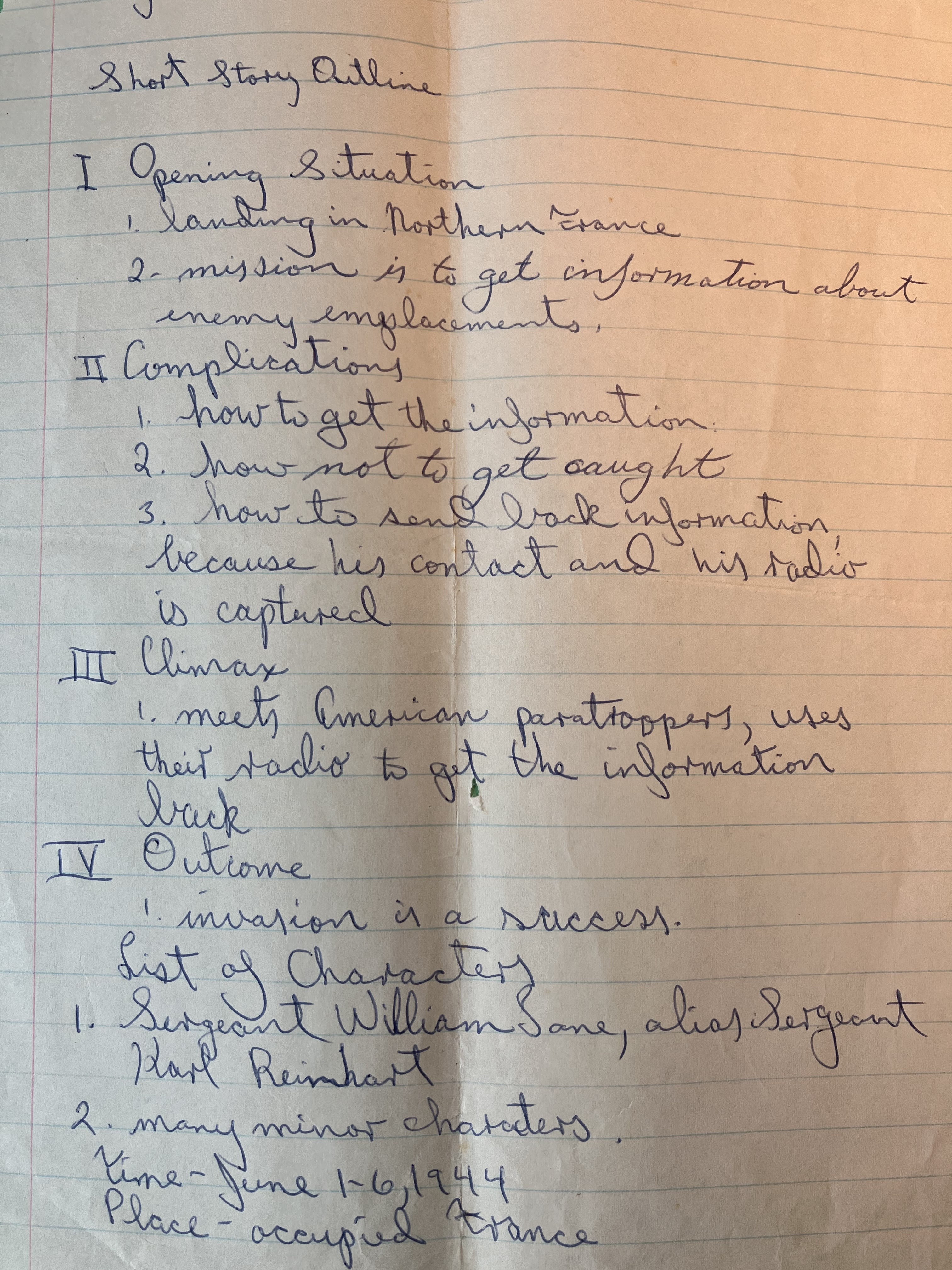
Grabbing inspirations as they fell into my lap, my next piece was Story of a Spy. Snappy titles were still, obviously, in my future. I’d seen The Longest Day the year before, and that film about the D-Day invasion had stayed with me. My version concerned an American soldier sent ashore in advance of the invading troops. Take that, Darryl F. Zanuck.


On the morning of June 6, 1944, Normandy was invaded by Allied Forces. But on the night of June 1, five days earlier, it was invaded by Sergeant William Lane.

GOOD OPENER

Yes! Mr. Gillan was impressed! This story was for a full grade, not just a measly check mark. Looking back after six decades, it isn’t a bad read. I should have edited out “five days earlier,” though. Unnecessary. People can count, after all.

I read on, drinking in his positive comments as the story continued. Our hero scores some vital intelligence about German defenses, and he hooks up with the airborne forces who radio his information to headquarters. He’s a hero, and I thought I was too. Then I turned to the back page.

B+. A PROMISING STORY. POSSIBLY TOO EASY FOR THE SERGEANT — BUT INTERESTING.


B+? Not having been the most studious of high school freshmen, I normally would have been happy with anything above a C. But I was disappointed, except for the fact he had written “but interesting” at the end. However, I have benefitted more from that comment than I could ever have imagined.

I never forgot it. Actually, I’d misremembered it, recalling instead that he’d written “Next time make it harder for the sergeant.” Perhaps that was how I internalized the lesson. There would be a next time, and when that came, it would have to be harder for the sergeant. Obstacles. It was a lesson in obstacles.

The fact that I hadn’t grasped the concept was evident in the outline we’d been assigned to create prior to writing the story. Under Complications, I’d written “How not to get caught.” Brilliant. This is the first and only outline I’ve ever written. After that fiasco, I was going seat of the pants all the way.


The constant flow of stories required by Mr. Gillan demanded creative measures. The Twilight Zone television series was widely popular at the time, and one haunting episode features three astronauts who crash-land on a desert-like asteroid. Short of water, the three fall to fighting over scarce resources. One man murders the other two and takes off with their water. Hiking to the top of a hill, he finds they are still on Earth. Outside of Reno, no less.

Well, if it was good enough for Rod Serling, it was good enough for me. Swap out the spaceship for a B-17, and the story wrote itself. In my version, one of the three survivors of the bomber’s crash gives up hope after wandering in the scorching desert and shoots himself. His comrades climb the next ridge and see their own airbase in the distance.

GOOD CONCLUSION


Whew. Mr. Gillan hadn’t seen that episode.

It was a long time until I took up writing fiction again, but I remembered the lessons from fifth-period English. I began my first novel in 1999, but it wasn’t until 2018 that I submitted my first short story. After being intimidated by the short form, I finally had found a way into that style of storytelling. This time around, the ideas are my own, and I wish Mr. Gillan was still here to thank.


A GOOD STORY — PLOT WELL DEVELOPED. YOU HAVE DONE VERY WELL.


As have you, Mr. Gillan. As have you.


Question: Tell us, is there a favorite teacher who influenced your life?
Give them a shout-out here!


James R. Benn is the Dilys, Barry, and Sue Federer Historical
Mystery-award nominated author of the popular Billy Boyle WWII mystery series and three stand-alone works. His novel The Blind Goddess was long listed for the 2015 Dublin IMPAC Literary Award. Benn is a graduate of the University of Connecticut and has an MLS degree from Southern Connecticut State University. He worked in the library and information technology fields for over thirty-five years before leaving to write full-time. Benn and his wife Deborah Mandel live on the Gulf Coast of Florida.

Sunday, August 29, 2021

James R Benn on Road of Bones


LUCY BURDETTE: Today we welcome our friend James R Benn, the author of the acclaimed Billy Boyle series. He raises a question dear to all writers' hearts: What to call the darn book? Take it away Jim!

What's in a name? That which we call a rose,
By any other name would smell as sweet.

—William Shakespeare, Romeo and Juliet (Act II Scene ii)


James R Benn: What’s in a name? That’s the question authors confront when choosing the title for their book. The truth is, any other name will not smell as sweet. No matter how good the writing between the covers, the title must grab the reader’s attention. A poorly chosen title—one that is perhaps clumsy or boring—can keep readers from cracking open the book. A title’s job, in my opinion, is to force a question. To stop the browsing reader in their tracks. To arouse their curiosity. 

For me, the title also has another job. It should reflect the theme of the book, to act as a constant reminder of the deeper thread of meaning I am weaving into the story. Some authors may not place so much emphasis on the title in their process. Some may pick the title after the manuscript is complete. But for me, it’s a symbol of what I’m writing about.

So, when I decided to set a Billy Boyle novel in the Soviet Union (thanks to Reed Farrell Coleman, but that’s another story), I began the search for a title as soon as I started my research.

It didn’t take long.

The R504 Kolyma Highway is a road through the Russian Far East, aka Siberia. It’s also known as the Road of Bones.

Title search complete. 

The road, most often called the Kolyma Route, is a gravel track, often covered in mud or ice. It was built by political prisoners during the Soviet Union's Stalinist era. Inmates of the Sevvostlag labor camp started the first stretch in 1932, and construction continued into the 1950s. The prisoners worked in horrifying conditions. Winter was long and bitterly cold, summer blisteringly hot, rampant with swarms of mosquitos. The Kolyma Route extends to Yakutsk, where the coldest temperature ever outside of Antarctica was recorded. 


As prisoners extended the roadway, it was used to bring in more prisoners to camps that comprised Stalin’s Gulag. The Kolyma Route stretches 1,260 miles through desolate, frozen wasteland, connecting Magadan on the Pacific Ocean to the city of Yakutsk, 280 miles south of the Arctic Circle. 


Why is it called the Road of Bones?

The roadway was built on permafrost. It is estimated that between a quarter million to one million slave laborers died in the process. Where to bury all those bodies? The Soviets solved the probably neatly, interring the corpses in the fabric of the road.

If the high estimate of the death toll is correct, that makes for 793 bodies per mile entombed within the Road of Bones.

As Joseph Stalin said, “Death solves all problems. No man, no problem.”


The Mask of Sorrow is a monument located on a hill above Magadan, Russia, commemorating the many prisoners who suffered and died in the Soviet forced labor system. 


Photo credit: Сергей Ковалев, via Wikimedia Commons.


There’s a recently freed Russian political prisoner in Road of Bones—the book, not the route—and his fear of being sent back to the camps is a driving force behind the story. The title helped to focus me on writing about the challenges of existence within the oppressive Communist system, and the chilling effect it had on Soviet citizens.


But wait. There’s more to the story. There’s a ghost. Or a ghostly woman, as The Siberian Times called her in 2018. Spotted at several locations at the southern terminus of the Road of Bones, she walks alone, refusing all offers of assistance, even in frigid winter weather. Her name may be Luidmila. She may be from Kazakhstan, and she may be headed for Kamchatka, a peninsula that extends into the Pacific Ocean. She’s been called a spirit of Siberia and the ghost of a prisoner who died on the road. Nothing is certain about her, so feel free to make up your own answer. 


That’s my story. Now tell me yours.

Everyone, what’s your favorite title?

Here’s my book title of the month. Hats off to Dennis Duncan and this brilliantly clever title:


Writers, how do you select your titles? Does it sound like I’m over-thinking all this, or does something here ring true?

Readers, does a unique or interesting title grab your attention? Or does this sound like a whole lot of folderol?


James R. Benn is the Dilys, Barry, and Sue Feder Historical Mystery award nominated author of the Billy Boyle WWII mysteries. He splits his time between the Connecticut shoreline and the west coast of Florida, with his wife, copyeditor Deborah Mandel.

About Road of Bones:

Billy Boyle is sent to the Soviet Union to conduct an investigation into a double murder. Teamed with a KGB agent, he has to navigate the dangerous currents of life in Stalinist Russia.

***In other business this week, Kevin Tipple is the winner of the Bouchercon anthology, This Time for Sure. Please email me raisleib at gmail dot com with your snail mail address.

***And Robin Coxon is the winner of A Time to Swill. Email Sherry with your snail mail address to arrange the drop! sherryharrisauthor at gmail dot com.

Wednesday, July 13, 2016

"Showrooming" and the Independent Bookseller’s Dilemma


SUSAN ELIA MACNEAL: Today I'm proud to be hosting  bookseller Robin Agnew of the terrific independent bookstore, Aunt Agatha's Mystery Bookshop, in Ann Arbor, Michigan. Aunt Agatha's is a charming shop, chock full of  great mysteries, hand-picked favorites for display, and a warm and knowledgeable staff eager to match readers with that absolutely perfect book. Alas, the new-ish customer practice of "showrooming" has caused this small business owner to take pause and have an existential conversation with her inner curmudgeon. Welcome, Robin!


show·room·ing
noun, informal:  the practice of visiting a store 
or stores in order to examine a product before 
buying it online at a lower price.


ROBIN AGNEW: I often work in the store on Saturdays, usually our busiest day of the week, when our college town welcomes lots of out of town visitors and shoppers, especially in the summer when the weather is nice and it’s pleasant to walk around downtown.  

Often visitors to the store will snap some photos.  Some of them like the ambiance of our store which is, to put it mildly, packed to the rafters with books and book-ish smells. Some even take a photo in front of the store by our logo. I like that and find it charming.

More recently, however, I’ve found that many people use cameras for a different reason – to take a picture of a book they plan to then go online and buy for, I’m assuming, less money.  Now, I can certainly accept that people will go online and buy things.  I do it myself,  That’s anyone’s prerogative.

What I find difficult to accept is the fact that we have taken a great deal of trouble to populate our store with the widest possible variety of mystery and crime novels, displaying them thematically, labeling and describing our favorites, etc.  It’s often these books that are photographed. These aren’t books that could be found browsing on online - they are particular recommendations made by us with our particular sensibility.

I recently had a nice family – older parents, late 20s or early 30s daughter – who came in, browsed, and the parents picked up and bought a book.  Their daughter merely picked up books I had carefully selected to display and photographed them, all the while chatting pleasantly.

She was assuming I could certainly understand her need to save 4 or 5 dollars.  Being in a downtown, I see all kinds of people, from the genuinely destitute to the clearly wealthy. I’ve often given a discount or merely given books to people who obviously don’t have the money for something to read. I don’t even mind giving away a novel to an obvious drug addict – maybe that novel will give them a bit of solace, I hope so.

But why middle-class people feel entitled to go ahead and seek the “best deal,” the “biggest discount,” while at the same time demanding your service and attention I find difficult to fathom. I recently posted a whine about this on facebook and got a staggering number of responses, many from authors and booksellers. My dilemma: to put up a sign, or not to put up a sign?  Is it too curmudgeonly?  My husband thinks so.

I got answers ranging from charging a photography fee (appealing, but certainly difficult if not impossible to collect) to suggestions for signs saying “No photos,” “These books never run out of power,” “Buy local,” “Want to remind you that buying a book from us instead of online guarantees good karma” (this from a former bookseller, now a writer), “Photographs $5 payable in advance,” “Our books are shy.  That is why we wrap them in brown paper before leaving the establishment,”  to “No Drinking, Smoking, Electronic Purchasing, or Swearing.”

And from a couple booksellers I respect:  “Signs, probably not, comments specifically to the individual, yes…The challenge is to make your point politely.”   And from a longtime friend and colleague, “Independents should embrace being curmudgeonly – folks already think we are just because we work in bookstores.  Mostly, I think that the answer to this issue is simply to keep doing what we do, which is engaging customers one on one when they walk into our stores.”

I have created a sign that says “Your cell phone is not a shopping tool.”  And I know there are other reasons to photograph – to see if you already have the book, to add it to your list and come back to it later – but mostly this kind of showrooming is on the rise and while I haven’t yet put up my sign, it remains to be seen how far my embrace of codger-hood will go. I feel it coming on.


SUSAN ELIA MACNEAL: When I saw Robin's original Facebook post, I tried to make her feel better by saying I used electronic media the other way around — basically, what I do is download hundreds and hundreds of free sample chapters, read them at odd times (on the subway, waiting at a doctor's office), mark down which one's I really like, then go find them at our local bookstore or the library. 

Lovely Reds and readers, what's your opinion of "showrooming"? Have you ever seen anyone do it at a bookstore? If you were a bookstore owner, how would you handle it?

Tell us in the comments!


Aunt Agatha’s

213 South Fourth Avenue
Ann Arbor, Michigan 48104
734.769.1114
Hours of Business
Monday - Thursday 11-7
Friday & Saturday 11-8
Sunday 12-5

Friday, August 14, 2015

James Benn, Billy Boyle, JFK, and THE WHITE GHOST


SUSAN ELIA MACNEAL: Reds and lovely readers, I'm delighted to introduce James R. Benn — Jim — author of the Billy Boyle series, set during World War II. I loved this series from the debut and eagerly await each new novel. In number ten, THE WHITE GHOST, the series moves to the Pacific Theater and pairs Boston Irish cop Billy Boyle with another Boston Irish boy — maybe you've heard of him? — John F. Kennedy. 


Susan Elia MacNeal:  Jim, your tenth book in the Billy Boyle series leaves the familiar ground of Europe in World War II for the Pacific Theater. What brings Billy to the South Pacific?


James R. Benn: It’s been a reader request for some time. I struggled with how to approach the notion, and finally came up with the idea of pairing two Boston Irish boys: Billy and John F. Kennedy. But when I started looking into how their timelines could intersect, I found that by May 1944, the date of the last book, JFK was already back in the States and discharged from the navy. I thought that idea was a no-go until I happened to notice a gap between the third and fourth books, several unexplained months which accorded nicely with the aftermath of the sinking of PT-109. Here’s how it’s explained in the forward to The White Ghost:

Now, the story of how Billy Boyle came to journey to the South Pacific in 1943 can finally be told.
     Astute readers may have noted Billy’s absence between the invasion of Sicily (Blood Alone), which occurred in July, 1943, and his appearance in Jerusalem in November 1943, before being sent on assignment to Northern Ireland, as recounted in Evil For Evil.
     He was not idle during those months.
     With the governmental veil of secrecy lifted, the events of 1943 immediately following Billy’s Sicilian assignment are chronicled here for the first time.

SEM:    So Billy and Jack are both from Boston, both Irish boys. Are they good friends?

JRB:     They once were; but one thing I learned about the Kennedy family is that friends were often viewed in light of what they could do for the Kennedys. Quite often, it was a one-way street. Jack Kennedy often treated his life-long friend Lem Billings terribly, and their interactions provided the backstory for Billy’s relationship with Jack. Billy’s family is working class Boston Irish; the Kennedys were what was called “lace curtain” Irish, meaning that they were working their way up the social ladder, leaving the shanty Irish behind.


SEM:    There have been many stories about JFK’s father Joseph Kennedy Senior. For instance, that he was a rum-runner during Prohibition, and openly dated movie stars while married to his wife Rosemary. Did you find any of that to be true?


JRB:     Whatever you’ve heard about Joe Senior – the truth is worse than that. The one thing that was never proven was that he made money smuggling alcohol into the US during Prohibition. He did own distilleries in Canada, and I can’t imagine a man like him passing up that sort of money-making opportunity. One thing is for certain; when his Harvard class reunion was held during the 1930s, he was tapped to provide the booze. He had his daughter Rosemary lobotomized, basically in an effort to control her unruly behavior. He did so without consulting his wife or discussing it with the family. This was in 1941, when the operation was still new and untested. Dr. James Watts and Dr. Walter Freeman performed the lobotomy. Watts used an instrument that looked like a butter knife, cutting brain tissue through a frontal incision. As Watts cut, Freeman put questions to Rosemary, asking her to recite the Lord’s Prayer or God Bless America. When she began to become incoherent, they stopped. She spent the rest of her life in a nursing home. Her mother did not visit her for twenty years. Her father never did, and never spoke of her again. That was the kind of environment in which Jack Kennedy grew up.

SEM:    Are there other historical characters in this book? It seems like the Kennedys might well take center stage.

JRB:     There were too many interesting characters in the Solomon Islands for that to happen. One was Merle Farland, a nursing sister who worked at a Methodist mission on Vella Lavella in the Solomons. When the Japanese invaded, most nurses were evacuated. She stayed on, working with Coastwatchers to give advance notice of Japanese raids. She was finally brought out with a B-17 crew she’d rescued, along with a group of Japanese prisoners. When she arrived at Tulagi, across the strait from Guadalcanal, her presence sparked a rumor that Amelia Earhart had been found. Having taken some fictional liberties with her story, the character’s name is Deanna Pendleton, for a young woman who won a character naming at a charity event.

SEM:    I’m curious if the experience of researching and delving into the Kennedy family history has soured you at all on the Kennedy “mystique”?


JRB:     I grew up with JFK on television, and felt the promise of all he had to offer. I think I do understand the character of John F. Kennedy better, and how in the crucible of war he found something deep and meaningful. It was a sobering and widening experience for this man of youthful privilege, and he did take what he learned to heart. I think I am more cynical about the entire family history, and see it as the political machine it always was. But JFK seemed to rise above much of that, and perhaps it was that wartime experience that brought out what could have been greatness.

Oddly enough, I did recently have an encounter with the Kennedy mystique. I was testifying at a Connecticut General Assembly hearing about public library funding, when a State Senator came to the podium to speak. It was Ted Kennedy Junior, who is currently serving in the state senate. He’s tall, good-looking, with that shock of Kennedy hair, and he spoke with passion.

He had me at “My name is Ted Kennedy Junior.”

SUSAN ELIA MACNEAL: Jim, thank you so much for joining us to talk about Billy Boyle, the publication of THE WHITE GHOST, and JFK. Reds and lovely readers, what are your thoughts on history and fiction intersecting in novels? What questions do you have for Jim about the Kennedys and their legacy?


Thursday, September 11, 2014

Detectives Beyond Borders' Peter Rozovsky and "Crime During Wartime"


SUSAN ELIA MACNEAL: I'm delighted to introduce Detectives Beyond Borders' Peter Rozovsky, writing about "Crime During Wartime," a panel he moderated at Bouchercon 2013 in Albany.

Enjoy!

PETER ROZOVSKY: I changed the name of a Bouchercon panel because of Susan Elia MacNeal. The panel, at Bouchercon 2013 in Albany, spotlighted crime fiction set during World War II and its aftermath conflicts, and I had called it “World War II and Sons.”

“What about daughters?” Susan asked, and I explained that the “sons” in this case were not people, but rather the Cold War and the Korean War, personified as male.  Susan accepted my explanation with good grace. But she had got me thinking about the books our panel would discuss, and I realized these were at least as much about people as they were about fighting. 

When I welcomed the audience, I told them the panel was now called “World War II and Its Offspring” because the stories that Susan told, and those of her fellow panelist/authors James R. Benn, J. Robert Janes, John Lawton, and Martin Limón, were more about persons than about personification, and those persons were, of course, women as well as men.  

Sure, Benn’s Billy Boyle is an aide to Gen. Eisenhower, but he’s also a brash kid from South Boston thrust into a world far bigger than anything he had encountered before, and the passages where he realizes this are some of the most affecting in Benn's books. (MacNeal's Maggie Hope, though brilliant, college-educated, and heiress to an English home, is, like Billy, something of a fish out of water, and a more interesting character for it.)

I told the audience in my (brief) introduction that war was like a magnifying glass, multiplying the real or imagined significance of any action, including “ordinary’ murder, arson, and embezzlement. But it’s really more like a raindrop or a tear. It will magnify a scene, but the lightest touch to the surface on which it rests will set the lens vibrating and hopelessly distort the view.

Among the members of that wartime crime panel, that sense of unease, of the distortions and diffractions war works on the way people see the world and are themselves seen, is strongest in J. Robert Janes and Martin Limón. Janes pairs a German Gestapo and a French Sûreté inspector investigating crimes in occupied France during World War II. Limón’s novels and stories have two American G.I.s in South Korea looking into crimes that involve the U.S. military—two outsiders, that is, poised uneasily between two divided cultures. 

Amid a military hierarchy often more interested in protecting its own brass than in justice, amid a Korean culture sometimes mysterious to Limón's American investigator-protagonists, and always in the face of the looming military menace of North Korea, it is no wonder that the most "ordinary" crime acquires deep and menacing dimensions. And, though a disclaimer that prefaces Janes' Kohler and Sr. Cyr novels claims Janes merely inquires after the way "ordinary" crimes were solved in occupied France, his moral universe is the darkest of any noir I have ever read. Here, too, there are no "ordinary" crimes.

And how about this brilliant dissection of England's national character (and characters) in John Lawton's Second Violin?  Read the passage, then reflect that Lawton sets the scene in an English internment camp for aliens from enemy countries, notwithstanding that some had escaped the terror of what seemed about to happen in those very countries:

"`And I'm Rod Troy ... of Hampstead.'

"`It helps," said Drax, `and it will not detain us long, if we state for the record our city of origin. ... Arthur Kornfeld, of Vienna, keeps records for us. We all feel it helps to know where we all come from. To have something written down by us rather than by the British. Helps us not to ... not to lose touch. A matter of identity. No small matter you will agree.'

"Rod did agree. It was a matter of identity that had brought him here in the first place.

"`In that case,' he said, perfectly willing to play the game, "`I'm Rodyon Troy, also of Vienna. Indeed, I think you'll find more than a few of us are.'

"Drax stuck out both hands to shake one of Rod's, beaming at him as though he'd found a long-lost son. Behind him Rod heard Jacks plonk his gladstone bag on the table and say, `Billy Jacks, Stepney Green.'

"Kornfeld said, `It won't hurt, you know. And we're all in the same boat.'

"Billy shot a surly glance in Rod's direction, looked back at Kornfeld.

"`OK, OK, whatever `Ampstead says. Abel Jakobson, Danzig. Now, where's me bleedin' tea?'"

(Lawton's principal characters are English, but his novel Bluffing Mr. Churchill offers an entertaining version of the American innocent abroad, a young embassy staffer plunged into London in 1941, puzzled by Cockney rhyming slang and staggered by the sight of solitary houses left standing after German air raids.  Are stories about civilians in wartime particularly fascinating to we North Americans, the majority of whom have been mercifully free of such experiences in real life?)

The wars need not be long past. Some of my favorite crime fiction in recent years has come out of Northern Ireland, from authors grappling with the effects and after-effects of a kind of war – the sectarian Troubles – on daily lives.   See Anthony Quinn's Disappeared, for example, or Stuart Neville's Ghosts of Belfast.  I'll leave it to one such author to sum up the appeal of crime fiction set during wartime, of the terror, the exhilaration, and the sheer wonderment that something like ordinary life sometimes goes on amid hellish circumstances.

"I wanted to set a book in this claustrophobic atmosphere," writes Adrian McKinty in an afterword to his novel The Cold Cold Ground, "attempting to recapture the sense that civilization was breaking down to its basest levels. I also wanted to remember the craic, the music, the bombastic politicians, the apocalyptic street preachers, the sinister gunmen and a lost generation of kids for whom all of this was normal."


SUSAN ELIA MACNEAL: Reds and lovely readers, do you read historical fiction? Who are some of your favorite authors? Do you believe, as Peter does (and I do), that "war [is] like a magnifying glass, multiplying the real or imagined significance of any action, including “ordinary’ murder, arson, and embezzlement"?


Peter Rozovsky writes the Detectives Beyond Borders blog. His reviews and essays have appeared in Following the Detectives: Real Locations in Crime Fiction; The Cultural Detective; Nordic Noir: The Pocket Essential Guide to Scandinavian Crime Fiction, Film & TV; Words Without Borders; the Philadelphia Inquirer; and elsewhere. Read Detectives Beyond Borders at http://detectivesbeyondborders.blogspot.com/





