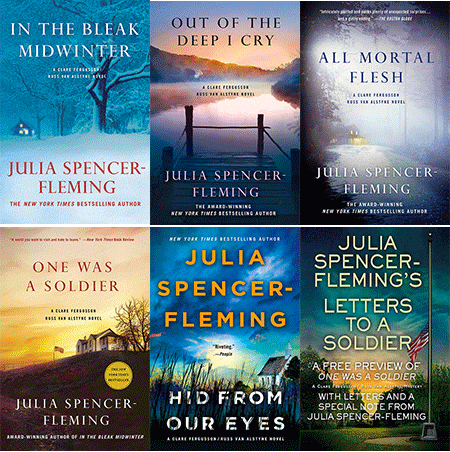
 JULIA SPENCER-FLEMING: Mette Ivie Harrison can only be described as a woman who leaves all the rest of us in the dust. Literally - she's completed four Ironman competitions and multiple ultra marathons (those are the ones that go 50 miles or more.) She's the successful, critically acclaimed author of seven young adult novels and one nonfiction book, IRONMOM. She picked up the violin and the piano as an adult to keep up with her children. Did I mention she has five children? And a Phd from Princeton? And she volunteers for her ward? And quilts? Do you feel inadequate yet?
Don't. Instead, read THE BISHOP'S WIFE, Mette's first adult novel and first mystery (and a New York Times Notable Book. Okay, feel a little inadequate.) Along with being a twisty mystery, THE BISHOP'S WIFE is an emotionally honest account of issues many, many women face today. How to be a faithful person in a patriarchal religion. How to be a feminist when your primary role is wife and mother. How to be your authentic self when the culture all around you demands you perform womanhood in a clearly defined way.
Here's Mette Ivie Harrison with us today, talking about growing up, growing wise, and growing into herself.
 In 1988, I was in a group of 48 high
school seniors (24 men and 24 women) who were invited for 3 days to
the campus of Brigham Young University as the final interview portion
of the competition for the “Ezra Taft Benson” scholarship, named
after the then President of the Church of Jesus Christ of Latter-Day
Saints. These were the best of the best, the cream of the crop. We
went through long written tests, as well as group projects where we
were being observed from behind mirrored glass. We had all of our
meals with the judges, and were being evaluated on everything from
table manners to conversational style.
In 1988, I was in a group of 48 high
school seniors (24 men and 24 women) who were invited for 3 days to
the campus of Brigham Young University as the final interview portion
of the competition for the “Ezra Taft Benson” scholarship, named
after the then President of the Church of Jesus Christ of Latter-Day
Saints. These were the best of the best, the cream of the crop. We
went through long written tests, as well as group projects where we
were being observed from behind mirrored glass. We had all of our
meals with the judges, and were being evaluated on everything from
table manners to conversational style. 
On the final day,
I had an exit interview with one of the professor/judges who had
looked through my application with a fine-toothed comb and asked me
about my answer to “Who is your personal hero?” It was Ghandi.
This was just after the movie with Ben Kingsley had been released. I
had not done any extra reading, but the movie portrayed the man as a
kind of prophet. The professor asked me if I would change my mind
about Ghandi if I found out that he had been a user and abuser of
many of the women in his life. I thought only briefly about my answer
and said, basically, no. He still did the good that he did, even so.
 I won the scholarship, and attended BYU
for two years, until I moved on to a PhD program at Princeton
University. I have continued to think about that one question about
Ghandi for the rest of my life, and wondered many times what would
have happened if I had answered differently. You see, I did read more
about Ghandi and my image of Ghandi became rather tarnished, as it
turns out every hero’s image I have ever had. George Washington,
Benjamin Franklin, Thomas Jefferson, Woodrow Wilson, Franklin
Roosevelt, John F. Kennedy, Gary Hart, Bill Clinton. We sometimes
excuse them as “products of their times” or as “men with
appetites.” It is still an excuse and it leaves a bitter taste.
I won the scholarship, and attended BYU
for two years, until I moved on to a PhD program at Princeton
University. I have continued to think about that one question about
Ghandi for the rest of my life, and wondered many times what would
have happened if I had answered differently. You see, I did read more
about Ghandi and my image of Ghandi became rather tarnished, as it
turns out every hero’s image I have ever had. George Washington,
Benjamin Franklin, Thomas Jefferson, Woodrow Wilson, Franklin
Roosevelt, John F. Kennedy, Gary Hart, Bill Clinton. We sometimes
excuse them as “products of their times” or as “men with
appetites.” It is still an excuse and it leaves a bitter taste.
I returned to Utah to work at Brigham
Young University myself after my dissertation was complete still a
staunch believer of Mormonism, but when my youngest daughter was
stillborn in 2005, I had a terrible crisis of faith. It was less
about specific doctrines of the Mormon church or shocking revelations
about the history of the church and more about the reality of God
Himself, and the way in which we grapple with tragedy as humans, and
as Mormons. I spent the next seven years as a faithful
church-attending Mormon atheist, which was a useful solution since I
didn’t have to really grapple with theological issues as such.
These were all problems invented by people, it seemed to me, to make
sense out of things that made no sense because they were random
events. Or they were attempts to create a holistic theology out of a
disparate series of documents and leaders who had different ideals,
purposes, and goals over two centuries of time.
 But in 2012 I came to a longing for a
spiritual life once more. And so in the past two years, I have
decided to work my way back to the Mormon church. Strangely enough,
this involved writing the first of a series of detective novels in
which the main character (Linda Wallheim in The Bishop’s Wife), a
far more faithful woman than I was when I wrote her, grapples
nonetheless with the problems I struggle with. And she does not
flinch away from them, nor does she lose her faith. She was the woman
I wanted to become, a woman who contemplates seriously the flaws of
the great men within the church, the issue of the invisibility and
powerless of women, and the need for the Mormon church to address the
questions of this century rather than continuing to deal with the
persecutions of the first forty years of our religion.
But in 2012 I came to a longing for a
spiritual life once more. And so in the past two years, I have
decided to work my way back to the Mormon church. Strangely enough,
this involved writing the first of a series of detective novels in
which the main character (Linda Wallheim in The Bishop’s Wife), a
far more faithful woman than I was when I wrote her, grapples
nonetheless with the problems I struggle with. And she does not
flinch away from them, nor does she lose her faith. She was the woman
I wanted to become, a woman who contemplates seriously the flaws of
the great men within the church, the issue of the invisibility and
powerless of women, and the need for the Mormon church to address the
questions of this century rather than continuing to deal with the
persecutions of the first forty years of our religion. The essay that the church has recently
published on the topic of Joseph Smith and polygamy made me cheer. It felt like an enormous step forward in honesty and
in becoming a church that deals with flawed heroes and flawed
prophets, that faces head-on the kinds of difficult stories that
other religions have faced for many years. If a religion has at its
head a man who is by some evaluations a criminal, does that mean
there is no basis for faith? Must a Mormon believe that the Book of
Mormon is an actual translation of the Gold Plates? Can Joseph Smith
be at one and the same time a man of “appetites” and also a
prophet of God?
The essay that the church has recently
published on the topic of Joseph Smith and polygamy made me cheer. It felt like an enormous step forward in honesty and
in becoming a church that deals with flawed heroes and flawed
prophets, that faces head-on the kinds of difficult stories that
other religions have faced for many years. If a religion has at its
head a man who is by some evaluations a criminal, does that mean
there is no basis for faith? Must a Mormon believe that the Book of
Mormon is an actual translation of the Gold Plates? Can Joseph Smith
be at one and the same time a man of “appetites” and also a
prophet of God? I find a kind of satisfaction now in
sitting with these questions without demanding one answer or another.
I also recognize that other Mormons are deeply disturbed by this
cognitive dissonance and would much prefer a Mormonism that has
easier answers and a more black and white view of the world. And I
honor those Mormons, because in my experience, these are also the
people who are most likely to volunteer to come help me move
furniture. They are there to help at homeless shelters, to make
quilts to send to the Philippines after the disaster there. They
donate money to good causes. They come and listen to my complaints
and hold me while I weep and they do not ask for anything in return.
I find a kind of satisfaction now in
sitting with these questions without demanding one answer or another.
I also recognize that other Mormons are deeply disturbed by this
cognitive dissonance and would much prefer a Mormonism that has
easier answers and a more black and white view of the world. And I
honor those Mormons, because in my experience, these are also the
people who are most likely to volunteer to come help me move
furniture. They are there to help at homeless shelters, to make
quilts to send to the Philippines after the disaster there. They
donate money to good causes. They come and listen to my complaints
and hold me while I weep and they do not ask for anything in return.
And so to my young self, who was so
sure that Ghandi was her hero and that she could never be swayed from
that opinion, I say—good for you. To the self I am now who is
disturbed by men who claim divine mandates that excuse misbehavior, I
say—good for you. Both selves were rooted in deep moral conviction,
and Mormonism is a big enough church for all.
How about you, dear readers? Have you had clashes between your young-self assurance and your older-self doubts? Do you live with questions that may not have answers? Join the conversation, and two lucky commenters will get a copy of THE BISHOP'S WIFE!