Showing posts with label Paula Munier. Show all posts

Tuesday, April 22, 2025

Originality Begins with You by Paula Munier

 “What is originality? It is being oneself, and reporting accurately what we see and are.”

--Ralph Waldo Emerson

LUCY BURDETTE: A few weeks ago I took a Sisters in Crime workshop online from Paula Munier on the subject of plotting. (I'm always looking for help on that subject!) I enjoyed it so much that I persuaded Paula to share some of her 'secrets' with you!

PAULA MUNIER: Be yourself. Advice we hear from the day we’re born from everyone from our mothers and teachers to our ancient philosophers and present-day Ted Talk pundits. It’s good advice for artists, too—and now that getting paid for making art is more difficult than ever and AI and other forms of copyright infringement abound, being ourselves might be the only thing that can save us. 

Whether you paint or sculpt, craft or compose or choreograph, design or dance, or write, as I do, originality is now our best weapon in the war against human creativity. As someone once said (maybe Oscar Wilde, maybe Thomas Merton, maybe someone else altogether), “Be yourself; everyone else is taken.” I was reminded of this by the one and only Matt Weiner, writer and producer and creator of Mad Men. I recently took a class from him on ideas and the imagination through the Los Angeles Review of Books, and in that class, he encouraged us to note the things what we liked, and to write them down in a notebook. 

Of course, I’m doing it—I’m doing everything Matt told us to do—and was reassured by his advice because I do something similar every time I need to jump-start my imagination. When I don’t know what to write, I remember My Writing Rule of Three: 


1) Write what you know.


2) Write what you love.


3) Write what you’d love to know.


Taking that rule further, I use a bubble chart I created while writing Plot Perfect. It’s a list-making exercise, basically, a brainstorming strategy for artists regardless of medium. Here it is:


When you don’t know what to write or paint or sculpt or craft or compose or choreograph, do the bubble chart. The lists serve as a kind of X-ray of your likes and dislikes, your beliefs and your values, your past, present, and future selves. In short: What makes you, you.


From Bubble Chart Lists to the Bestseller Lists

I have the bubble chart to thank for my Mercy Carr mysteries. I’d always wanted to write mysteries, ever since reading the Bobbsey Twins and Nancy Drew and Sherlock Holmes as a kid. I had several unfinished manuscripts in the proverbial drawer. Meanwhile, I’d published a lot of nonfiction, and acquired a lot of nonfiction and fiction projects as an acquisitions editor and as an agent. But my dream of writing a mystery series eluded me.

Then Phil Sexton asked me to write a book called The Writer’s Guide to Beginnings for Writer’s Digest Books. I needed a first chapter that I could use to illustrate certain fictional techniques and revision strategies. I couldn’t use anyone else’s first chapter for that purpose, so I wrote an opening chapter of a mystery—and I threw in everything I knew and loved and would love to know, working straight from my bubble chart’s lists. I grew up in a military family, so I made my heroine, Mercy Carr, a former MP who’d served in Afghanistan. I love dogs, so I gave her a canine companion named Elvis. I love the woods of northern New England, so I set the story in Vermont’s Green Mountains. I love stories about foundlings—from the Bible’s Moses to Anita Shreve’s Light on Snow to Julia Spencer-Fleming’s In the Bleak Midwinter—so I opened the story with Mercy and Elvis finding a baby abandoned in the forest. I even threw in a little Shakespeare because the bard is, well, The Bard.

Long story short: My agent read The Writer’s Guide to Beginnings, and said: “That’s a good opening chapter. You should write that mystery and I’ll sell it.” Armed with my bubble chart lists, I finished A Borrowing of Bones, the first book in my Mercy Carr series—and it made the USA TODAY Bestseller List. The first chapter of that novel is the first chapter that appeared in the writing book, with very few changes. The seventh book, The Snow Lies Deep, comes out in December. I’m working on Book #8 as we speak.


It’s All About You

As human beings, we can’t help but admire and appreciate originality, especially in our artists. Look upon a Matisse, and we admire and appreciate his unique mastery of color. Listen to Bob Dylan, and we admire and appreciate his personal yet profound lyrics. Read Alice Hoffman, and we admire and appreciate her particular illumination of the mystical and magical and mysterious aspects of life. These individual qualities inform these artists’ work and make their work special. 

The good news is: We are all originals. We owe it to ourselves and our art and the world at large to make the most of that originality. So, go ahead: Be yourself.

LUCY: Thanks Paula! And now it's your turn Reds, what would be on your bubble chart?


PAULA MUNIER is the Senior Agent and Director of Storytelling for Talcott Notch Literary and the  USA TODAY bestselling author of the Mercy Carr mysteries. A Borrowing of Bones, the first in the series, was nominated for the Mary Higgins Clark Award and named the Dogwise Book of the Year. Blind Search also won a Dogwise Award. The Hiding Place and The Wedding Plot both appeared on several “Best Of” lists. Home at Night was named Library Journal’s Mystery Pick of the Month. The Night Woods, the sixth book in the series, debuted in October 2024, earning a starred Library Journal review among other acclaim. THE SNOW LIES DEEP debuts in December. Along with her love of nature, Paula credits the hero dogs of Mission K9 Rescue, her own rescue dogs, and a deep affection for New England as her series’ major influences. She’s also written three popular books on writing: Plot Perfect, The Writer’s Guide to Beginnings, and Writing with Quiet Hands, as well as Happier Every Day and the memoir Fixing Freddie: The True Story of a Boy, a Mom, and a Very, Very Bad Beagle. She lives in New England with her family and four rescue dogs and Ursula The Cat, a rescue torbie tabby who does not think much of the dogs. For more, check out www.paulamunier.com. 


Tuesday, October 1, 2024

Maiden, Mother, Crone by Paula Munier

JENN McKINLAY: I am absolutely thrilled to announce that another Mercy Carr mystery is dropping in 8 DAYS!!! Here's the fabulous author and friend to the Reds, Paula Munier, to tell us all about it.


PAULA MUNIER: Maiden, mother, crone—those are the three aspects of the Triple Goddess that are meant to correspond to the stages of a woman’s life. I’ve considered this as I’ve moved through my life from one stage to the next, and as I’ve written my novels, from one character to the next. One of the joys of writing my Mercy Carr mystery series is the generations of women that I get to write about—grandmother, mother, daughter, granddaughter—in effect revisiting every phase of my own life as a female. 

In THE NIGHT WOODS, which debuts this week, my heroine Mercy is very, very pregnant with her first child. It’s been a long time—okay, some thirty years—since I last gave birth, and even longer since I bore my first child. When I sat down to write the story, I worried that I’d have trouble calling up my memories of that (pregnant) time. But to my surprise, I remembered every grand and gory detail—from the initial, interminable nausea—I threw up everything I ate around the clock for the first five months—to the moment I heard those three most glorious words from my doctor, “It’s a girl!”

Of course, I wasn’t chasing murderers through the Vermont woods like my character Mercy, or being chased in turn by wild boar in that same woods. I could only imagine what that might be like. That’s what we writers do. We make stuff up. The trick is to ground the unreal in the real—and the real came rushing back to me as if my water was breaking all over again. 

When it came to describing the sinking feeling that I was somehow stuck on a bobbing boat on choppy seas for nine months or the tender thrill that accompanied every baby’s sharp kick or even the realization during labor that I was no longer in control of my own body and that there was nothing to do but hang on and hope that the little alien passed quickly through that absurdly narrow portal to the world beyond my vagina—I didn’t need to use my imagination. I still have muscle memory on my side. 

It turns out that motherhood is like riding a bike. You never forget. When I held my first grandchild in my arms for the first time, I knew what to do. Little Elektra was a crier, and only I could coax the baby girl to sleep. My daughter, who’d rolled her eyes at practically everything I said from the age of fourteen onward, was impressed. I went from well-intentioned idiot to Best Babysitter Ever overnight. 

Now Elektra is sixteen, and she’s rolling her eyes at her mother. But not at her grandmother. I am “Grandmama Paula”—and as such, I am beyond reproach. Because as nice as being a mother is, being a grandmother is way better. It’s all the fun and none of the responsibility. You can spoil your grandkids silly and if they turn out to be serial killers, it’s not on you. And your grandchildren love you unreservedly; they’re never embarrassed by anything you say or do. No “Okay Boomers” from them.

I love being a grandmother so much that I wrote mothers and grandmothers into my Mercy Carr novels, too. Grace is Mercy’s mother, and like my own (lovely) mother, she’s a paragon of chic, setting a standard for style her daughter can never meet. Mercy, who lives in cargo pants and Henley T-shirts, has come to terms with her mother’s disapproval, but under duress will don one of the designer outfits her mother buys her for special occasions. 

I’m not as cool or as self-possessed as my heroine; I really am still trying to please my mother. She’s 89 and lives with us, so there’s no escape. She expects me to “do my toilette” and dress elegantly and appropriately for the day, no matter that my day here in what my children call “Nowhere, New Hampshire” is spent at a computer in a house in the woods. 

Apart from the wildlife, the only creatures who see me are the dogs, the cat, my husband, and my mother. The dogs don’t judge me, my husband doesn’t judge me, but the cat and my mother totally judge me. To appease Ursula The Cat and Marilyn the Mom, I feed the cat first (feline before canine, every time) and put on makeup and “casual chic” clothes. I know when I get it right, because she tells me. (If I don’t, I am greeted with a disdainful silence.) There is an upside to this: I’m always ready for an impromptu Zoom meeting. Still, in my next life, I’m going to wear cargo pants and Henley T-shirts. Just like Mercy.

Patience is Mercy Carr’s grandmother, the one character all readers seem to like. Patience is a veterinarian, and most everyone in the village loves her, too—even the most persnickety of cats. She’s the one Mercy turns to when she needs advice—and her grandmother never disappoints. She sweetens her unvarnished guidance with good eats—from Yankee pot roast to doberge cake—just like my own grandmother used to do.  

Grandma Emma was a wise and practical woman from Indiana farm country. She married very young and had my dad when she was only sixteen. She worked at the local GE plant for thirty years, got divorced long before it was socially acceptable, and raised two kids on her own. (Years before the rest of the family acknowledged my miserable first marriage, she took me aside and told me to leave my husband.) Grandma Emma married three times and left a string of bereft beaus when she died in her early sixties. She could bake a fine pie, make her own dandelion wine, can and preserve all manner of fruits and vegetables. Every year on my birthday she sent me a card with a $100 bill inside. The woman was strong and resourceful and indefatigable—and I miss her every day. But she lives on in Patience.

Writing Mercy and Grace and Patience allows me to celebrate the relationships between mothers and daughters, grandmothers and granddaughters. In so doing, I salute the women who’ve loved and nurtured and supported me all my life—and I redouble my efforts to do the same for those who come after me. It’s my way of honoring the knowledge and wisdom one generation of women imparts to the next, and passing it on.

Maiden, mother, crone—and I’m living them all. And writing them all. I wouldn’t have it any other way.

How about it Readers? Do you enjoy multigenerational tales? Why or why not?


PAULA MUNIER is the USA TODAY bestselling and award-winning author of the Mercy Carr mysteries and Senior Literary Agent at Talcott Notch Literary. She’s also written three popular books on writing, including the bestselling Plot Perfect. Along with her love of nature, Paula credits the hero dogs of Mission K9 Rescue, her own rescue animals, and her volunteer work as a Natural Resources Steward as her series’ major influences. She lives in New England with her family, four dogs, and a cat who does not think much of the dogs.


Monday, December 4, 2023

What We're Reading


 LUCY BURDETTE: Just in time for stocking stuffers, it’s what we’re reading day! I have a few things to suggest. Of course, I picked up Rhys’s new Georgie Royal Spyness mystery right away. This one featured a very pregnant Georgie with a new French chef, and a nearby neighbor with a poison garden. It’s delightful, as always, and there is a cameo from none other than Agatha Christie.

Sometimes I read so many mysteries that I feel like I need to cleanse my palate with a non-mystery novel. This time I chose Love Marriage by Monica Ali. I absolutely loved this story of a pair of engaged English doctors of Indian descent, whose lives go off the rails once their quirky families meet. I’ve had this book on my stack for a year and I’m so glad I read it!

If you’re in the mood for a thriller with a suburban Connecticut setting, I can recommend Elise Hart Kipness's debut, Lights Out. I enjoyed the sports reporter character, Kate Green, and look forward to reading about her in action in the next book. The town of Greenwich, Connecticut was a strong character as well.

Now I have to ask: has anyone read The Covenant of Water by Abraham Verghese? John and I chose this to listen to on our week long voyage south. He’s an amazing writer, but the book is so long! He introduced so many different stories that I assume will come together in the end. We only made it through 15 hours of listening, with 15 more to go! So now John is tasked with finishing it and summarizing the high points for me. Some friends insisted it was their favorite book of the year with a magnificent ending, so I may pick up a paper copy to finish.

JENN McKINLAY: Per Julia’s recommendation, I am reading N.K. Jemisin’s The Fifth Season. Brilliant!!! I recently finished The Fourth Wing by Rebecca Yarros and I can see why it’s so popular - high stakes and action packed and steamy! I recently read the horror/thriller Just Like Home by Sarah Gailey. Very creepy! And for romance, I highly recommend The Christmas Wager by Holly Cassidy (aka Hannah McKinnon). So much fun!

JULIA SPENCER-FLEMING: I’m deep into my Christmas-themed reading already: I’m reading Kate Carlisle’s THE TWELVE BOOKS OF CHRISTMAS, Janice Hallett’s epistolary novella THE CHRISTMAS APPEAL, and in the rom-com category, I’m about to start THREE HOLIDAYS AND A WEDDING, by Uzma Jalaluddin and Marissa Stapley, which takes place in a snow-bound small town in 2000, when Christmas, Hanukkah and Ramadan all intersected.

And in non-seasonal books, remember this when summer rolls around again: AGONY HILL by Sarah Stewart Taylor. I got to read it for blurbing purposes and it was SO good, even if I’m still blinking at a book set in 1965 as being “the first novel in a new historical series.” Yes, I was very small at the time and don’t remember it, but I’m pretty sure my lifetime isn’t historical. Right, guys? Right?

HALLIE EPHRON: I just finished Christian Cooper’s memoir, BETTER LIVING THROUGH BIRDING: NOTES FROM A BLACK MAN IN THE NATURAL WORLD. Cooper is the Black birder who took the viral video of a woman who called the police on him in New York’s Central Park ramble… But the book is much more than that. It’s about growing up nerdy and waking up to the wide world of birds. And writing for Marvel. And traveling. And finding his voice as a Black author and a gay guy. 

RHYS BOWEN: Not too much time for reading recently but I just read a book I had to blurb called THE WARTIME BOOK CLUB by Kate Thompson. It was set on the island of Jersey and was harrowing, touching and very real. Since I’d been doing my own research on Jersey in the summer everything was very personal for me.

Now in the middle of THE ECHO OF OLD BOOKS by Barbara Davis.  Fascinating so far.

DEBORAH CROMBIE: I haven't been reading as much as usual, because of my listening to my books on Audible project, but I've read–and loved–Rhys's PROOF OF THE PUDDING, and Paula Munier's HOME AT NIGHT, so good! I've also been reading my way through Alexia Gordon's Gethsemane Brown series, as I did a panel with Alexia at Crime Bake. I also loved S.J. Bennett's MURDER MOST ROYAL (I adore this series.)

Top of my to-read pile is Jenn's SUGAR PLUM POISONED, and the new Richard Osman.

LUCY: I started Paula's book last night--it's excellent! The other two are on my pile as well.

HANK PHILLIPPI RYAN: Oh, oh, listen you all--do you know of Cara Hunter? I had not heard of her, and had to (got to!) interview her, and as a result, read her essentially interactive thriller MURDER IN THE FAMILY, which is brilliant and incredible!  Go look it up–it is a tour de force in structure, and I adored it, and I instantly ordered a whole pile of her other books, beginning with CLOSE TO HOME, which is also fabulous. Oh, I am so happy to have discovered her!

I loved Janice Hallett’s A CHRISTMAS APPEAL, all written in emails, but don't be put off, it’s so brilliant.  I am a massive fan of her other books, too. Tess Gerritsen’s new THE SPY COAST is fantastic–so well written, about a retired spy who uses her current “invisibility”--we’ve all felt that, right?--to her advantage. Highly highly recommended. Oh, one more–Sulari Gentill’s THE MYSTERY WRITER,  which is super-meta, and genius, and (underneath)  a terrifying and thought-provoking take on the publishing industry.

We're almost afraid to ask, but Reds, what are you reading??


Tuesday, October 17, 2023

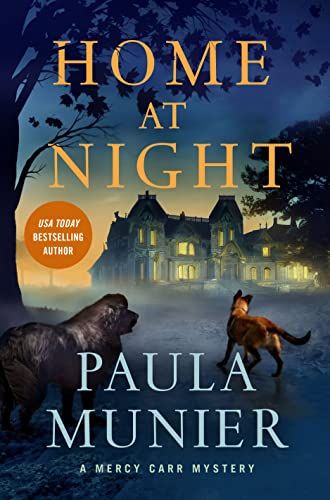
Paula Munier--Home at Night

DEBORAH CROMBIE: I am such a huge fan of this series that I've had this book release marked on my calendar! There's a new Mercy Carr novel from Paula Munier on your shelves today, and what's not to love with a gorgeous New England setting, dogs, romance, suspense, and a terrific mystery?  


And what a great cover! Here's Paula to share why this book has a special meaning for her.


The Best Houses, Real-Life and Literary


I love houses. I’ve lived in so many places in my life—too many to count, thanks to an Army brat childhood that took me from Georgia to Germany, Ohio to Oklahoma, North Carolina to New Orleans, among other places, and an adulthood spent chasing husbands and jobs from Nevada to New Jersey, Connecticut to California, Ohio to Florida, Louisiana to New England. I’ve hung my hat in French Officers Barracks, Swiss chalets, Las Vegas condos, shingled Cape Cod cottages, Santa Cruz beach houses, Boston triples, Ft. Lauderdale bungalows, college dorms, Married Student Housing (as bad as it sounds), basement apartments in Chicago, studios in New York City, brand-new ranch homes and 19th century farmhouses in Illinois and Indiana corn fields and U.S. Army quarters everywhere.

As a child I dreamed of living in a house all my own. I loved the houses I read about in books: My favorite was the Orchard House, where Louisa May Alcott grew up and where she set Little Women, which was my favorite book as a girl. (Of course, I wanted to be Jo. Didn’t we all want to be Jo?) I visited the house—now a museum—as a middle-aged woman and it did not disappoint.

And, of course, I adored Misselthwaite Manor, the large, forbidding English country house on the Yorkshire moors, where Mary Lennox is sent to live with her uncle when her parents die of cholera in The Secret Garden by Frances Hodgson Burnett. (Duncombe Park in North Yorkshire stood in for the estate in the 2020 film adaptation, starring Colin Firth and Julie Walters.)

The best part, naturally, was the garden. How I longed to have a garden like that one day….

There was Pippi Longstocking’s Villa Villekulla, where she lives with her horse and her monkey and drinks all the soda she wants from the tree in her yard that grows a popular Swedish soft drink—because what kid wouldn’t love that? And 221B Baker Street where Sherlock Holmes played his violin and injected himself with his 7 percent solution and solved the crimes of the century. I devoured all of Sherlock Holmes after a British friend gave me a collection of the stories when we visited her in England—the beginning of a lifelong love affair with the U.K.  (Sir Arthur Conan Doyle made up that address, but in time the streets were renumbered and now there’s a Sherlock Holmes Museum at that address in London. Such is the power of fiction.) Even the boxcar where the four orphans take up residence in Gertrude Chandler Warner’s The Boxcar Children, seemed like heaven to me.

It took me nearly a lifetime, but now I live in a 260-year-old Colonial on 19 acres of woods in what my Millennial child calls “Nowhere, New Hampshire.” It’s the perfect home for a writer, full of secrets and stories and maybe even a ghost or two.


Houses like mine are everywhere in northern New England. In HOME AT NIGHT, the fifth book in my Mercy Carr series, Mercy is house-hunting in Vermont, and the house that wins her heart is a Victorian limestone manor, a faded beauty built by a Civil War hero for his young wife in 1866. They say she died young under mysterious circumstances, and now haunts the house. That doesn’t bother Mercy, and even when she finds a dead body in the library, she’s determined to make the place her own—she’ll just have to solve the murder first. 

It was so much fun to write a story set at Halloween in a haunted house. I spent a lot of time researching houses, finding the just right one for the story—and changing my mind more than once. Being a writer allows me to live many lives in many houses….

What houses have you loved? Which houses have haunted you? What are your favorite houses in real-life and in literature? Let’s talk houses!


PAULA MUNIER is the USA TODAY bestselling author of the award-winning Mercy Carr mysteries. The fifth book in the series, HOME AT NIGHT (October 2023, Minotaur), was inspired by her volunteer work as a Natural Resources Steward. An agent by day, she’s also written three popular books on writing: Plot Perfect, The Writer’s Guide to Beginnings, and Writing with Quiet Hands, as well as Happier Every Day and the memoir Fixing Freddie. She lives in New England with her family, four dogs, and a cat who doesn’t think much of the dogs. For more, check out www.paulamunier.com.


Beware the blackbirds…

It’s Halloween in Vermont, winter is coming, and five humans, two dogs, and a cat are a crowd in Mercy Carr’s small cabin. She needs more room—and she knows just the place: Grackle Tree Farm, with thirty acres of woods and wetlands and a Victorian manor to die for. They say it’s haunted by the ghosts of grieving mothers, missing children, lost poets, and a murderer or two, but Mercy loves it anyway. Even when Elvis finds a dead body in the library.

There’s something about Grackle Tree Farm that people are willing to kill for—and Mercy needs to figure out what before they move in. A coded letter found on the victim points to a hidden treasure that may be worth a fortune—if it’s real. She and Captain Thrasher conduct a search of the old place—and end up at the wrong end of a Glock. A masked man shoots Thrasher, and she and Elvis must take him down before he murders them all. Under fire, she and Elvis manage to run the guy off, but not before they are wounded, leaving Thrasher fighting for his life in the hospital, Mercy on crutches, and Elvis on the mend.

Now it’s up to Mercy and Troy and the dogs to track down the masked murderer in a county overflowing with leaf peepers, Halloween revelers, and treasure hunters and bring him to justice before he strikes again and the treasure is lost forever, along with the good name of Grackle Tree Farm….

DEBS: Now, let's add Halloween and haunted house to my list of reasons to love this book... 

READERS, what houses have been special to you? What are your favorite literary houses?


Tuesday, March 23, 2021

In Like a Lion, Out like a Lamb; a guest post by Paula Munier

JULIA SPENCER-FLEMING: Yesterday, we were talking about the mundane, yearly rituals of spring, a season that, more than any other, calls to mind ritual. At least, it does here in New England, where we watch for the extra five minutes of sun, the forsythia, the first daffodils, and then the lilacs. We wait for the largest mound of snow in the shadiest part of the property to vanish, despite the fact that snow transmutes, not into gold, but mud.

Nobody captures New England's seasons and small-town rituals like Paula Munier, whose Mercy Carr series made a big splash with its debut, A BORROWING OF BONES, and continued with BLIND SEARCH.  The third book, THE HIDING PLACE, will be out a week from today on March 30th, so you have time to preorder it from your local bookseller. If you haven't read Paula before, her post today, on the joys and sorrows of March, will give you a taste of her gorgeous prose.


“In the Spring, I have counted 136 different kinds of weather inside of 24 hours.”

--Mark Twain

 When I moved to New England more than twenty years ago, I quickly realized that there were three things you could talk to even the most laconic Yankee about: 1) Sports (meaning the Red Sox, the Patriots, the Celtics, or the Bruins); 2) driving directions (meaning which convoluted way you came to get wherever you are); and 3) the weather (meaning it’s likely to change as you speak).

In the land of unpredictable weather, the climate is never more capricious than it is in Spring. Well, we may call it Spring, but it’s really a calamitous clash of three major seasons: Winter, Spring, and Mud. With the Ides of March come the most treacherous stage of this transition, when slush may seep into your foundation and mire may strand your four-wheel drive vehicle and ice may break under your feet. All this while snowdrops peep out of the snow and sap flows in the maples and chorus frogs croak away.

I set the third book in my Mercy Carr series, THE HIDING PLACE, in March because it’s a story about the transitions that mark our lives, for better or worse: season to season, place to place, relationship to relationship, childhood to adolescence to adulthood and beyond. There is promise and peril in these transitions—and even when we survive and thrive as a result, we are not the same. We are forever changed. If we’re lucky, we are reborn. 

March is the time where winter and spring stand side by side. In New England this annual rebirth is inescapable, as the icy-white landscape melts into the rainbow colors of printemps: the pale, perfect shade of green leafing buds, the cheerful yellow of forsythia, the royal purple of crocus, the bright azure of bluebells. But even those of us living in tropical places where the seasons are less distinct have suffered through the desolate winter of this pandemic. As we sign up for vaccines and set the clocks forward and order seeds for our summer gardens, we must still wear masks and shelter in place and send virtual hugs to our grandchildren on Zoom.

And we must still bury our dead. My 87-year-old father died earlier this month. (Not two weeks after he received his first vaccine. Sigh….) It was sudden and not sudden, unexpected and expected, a bitter farewell and a sweet blessing, all at once. We buried the Colonel’s ashes at a lovely military cemetery at the edge of a woods, to the sound of birdsong and the bugler’s Taps. It was one of those beautiful warm and sunny days that Spring sends early in the season as a sacred promise. We couldn’t help but believe that Dad was in a better place.

A week later it’s 9 degrees outside. Cold and grey, befitting our grief. But signs of Spring are everywhere. My heirloom vegetable, herb, and flower seed packets arrive from Artistic Gardens in Vermont. The daylight lingers a little longer every day. Eastern phoebes and pine warblers and white-winged crossbills return.

The owls are hooting and the woodpeckers are pecking and the red-winged blackbirds are conk-la-ree-ing. The dogs are discovering their lost bones and the cat is venturing out on snow-free ground and I am cleaning closets and choosing wallpaper and setting my seedlings in south-facing windows to soak up the sun. 

After the graveside service for my father was over, the cemetery manager—a tall, kind man named Patrick—said this to us. “People are always looking down here. Down at the earth. Down at the stones. Down at the epitaphs.”

We looked at him. Baffled.

“Yesterday a bald eagle flew over during a service,” said Patrick. “Remember to look up.”

We all looked up. The sky was blue and empty and the sun shone brightly. There was no bald eagle. No sign from my father.

But it’s early days yet. Spring is not here in full flower. As we emerge from this long winter, let’s keep to our rituals. Let’s keep an eye out for signs. And let’s remember to look up.

You can find out more about Paula Munier and the Mercy Carr series at her website. You can friend Paula on Facebook, follow her on Twitter as @PaulaSMunier and enjoy great posts about books and dogs on her Instagram, @PaulaSMunier.

Don't forget to make your reservation to see Paula and Hank in conversation on Tuesday, March 30 at 7pm EST!    

Thursday, November 7, 2019

Wild and Wonderful Weather, a guest blog by Paula Munier

JULIA SPENCER-FLEMING: Let's just get this out of the way first: Paula Munier's Mercy Carr series is like me. With dogs.

Now, obviously, this isn't something I would write in a blurb. Which I have had two unsuccessful shots at, I might add. Paula's editor sent me a copy of the first Mercy Carr mystery, A BORROWING OF BONES. I thought I would blurb it. But I was just three months past Ross's death and had way overestimated my ability to focus. Missed the deadline. 

Then, this past summer, I bumped into Paula at Thrillerfest. I told her how much I loved A BORROWING OF BONES and asked if she could use a quote for BLIND SEARCH. (Ever polite, Paula didn't mention she already had raves from Lee Child and Lisa Gardner.)  But when I asked her editor for an ARC, I was told it was too late for a blurb. (I did, however, get a copy. Yay!)

Which may be just as well, because every time I recommend this series to someone, I wind up saying, "It's me. With dogs." Of course, it's not exactly like my books. Paula has her own unique voice and edge. But there's a damaged army vet and a handsome local lawman. There's action and suspense and a bittersweet romance. And perhaps most of all, there's the setting: the beautiful, singular, dangerous, half-settled and half wild Northeast. Which is what Paula is going to talk about today.


Thank you, Julia, and all you lovely Jungle Reds for inviting me for tea. For that is how I think of dropping by here, not as the usual blog check-in, but rather as tea time with some of the most talented, fun, and funny writers and readers I know.

As I sit here in my comfy armchair in my study, all cozy with my tea (English Breakfast, milk and sugar), a nor’easter howls outside, high winds tumbling flower pots and tossing tree limbs and scattering leaves. The windows rattle as the rain pelts the panes and the walls creak, but we figure our old Colonial has been surviving these storms for 269 years (and we put a new roof on last year), so we’re safe enough.

After living in Northern California for nearly twenty years, where there is little actual weather but lots of natural disasters, I learned the hard way that the ever-changing New England climate demands preparation, planning, and patience.

I DEFINITELY want tea with Paula!
Mud rooms are a necessity, for, well, mud. And rain and snow and sleet and leaves and acorns and even ladybugs (who knew). You need ready access to boots, umbrellas, shovels, scrapers, sand, blankets, a first aid kit, water, a whistle, bug spray, and sunscreen—and if you’re smart you’ve got all that in your four-wheel drive vehicle as well. That’s how variable the weather is.

As Mark Twain said, “If you don’t like the weather in New England now, just wait a few minutes.” This is why—contrary to our xenophobic reputation—talking to New Englanders is so easy. You can always talk about the weather, sports (the Red Sox, the Patriots, the Celtics, or the Bruins, not necessarily in that order), and/or the route you took to get wherever you now find yourself.

This is also why I set my Mercy Carr series in New England. Weather makes a great character, and here it’s as much a part of the setting as quaint villages and back country roads and deep, dark forests. Especially in the second book of the series, BLIND SEARCH, which debuts this week.

On the opening day of hunting season—autumn to the rest of us—a small boy wanders off into the Vermont woods and gets lost. It’s a splendid sunny October day and the foliage is at its peak but this being New England you can count on a bomb cyclone—superbad blizzard to the rest of us—hitting and that lost boy witnessing a murder. It’s up to former Army MP Mercy and her retired bomb sniffer dog Elvis—heroes to the rest of us—to solve the crime, apprehend the murderer, and keep the boy safe until the snowplows get through.

Now that I’m a seasoned New Englander (at least in my own mind), weather plays a key role in my stories, just as it plays in my life. What role does weather play in your life, real or imagined? Which of your best/worst weather stories are you willing to share?

Pour yourself a cup of tea, and let’s talk about the weather….


PAULA MUNIER is a senior agent with Talcott Notch Literary, specializing in commercial fiction and nonfiction, and the USA TODAY bestselling author of the Mercy Carr mysteries. A Borrowing of Bones, the first in the series, was nominated for the Mary Higgins Clark Award. The second, Blind Search, pubs this month. She’s written three popular books on writing: Plot Perfect, TheWriter’s Guide to Beginnings, and Writing with QuietHands, as well as Fixing Freddie and HappierEvery Day.