Showing posts with label Publisher's Weekly. Show all posts

Monday, July 21, 2014

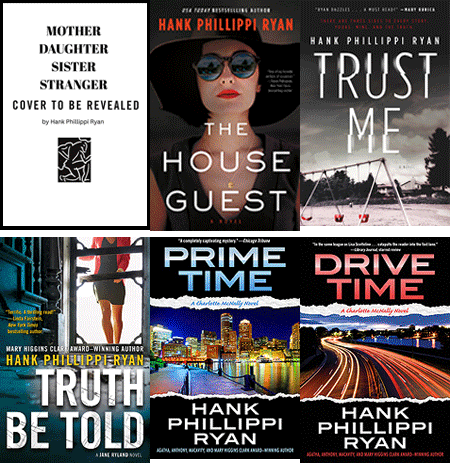
The Truth about TRUTH BE TOLD


HANK PHILLIPPI RYAN:  It’s “what we’re writing” week!  And I am deeply in the midst of (you heard it here first) WHAT YOU SEE, the next Jake and Jane novel.

I am also deeply into author-crazy.  TRUTH BE TOLD comes out October 7 (you may hear a bit more about that around these parts), and the author-crazy comes from knowing the reviews are about to start.  And I’ve just received advance notice of two of them…and I’ll reveal (!!!) below.

But first.  There’s a question that some authors loathe...but I love. And that is: where do your stories come from? Some authors answer with caustic throw-aways—Schenectady, says one very famous guy. The grocery, says another.

But I think “where do your stories come from” is fascinating. I recently heard Jacqueline Winspear talk about her new book, and she has an amazing book-birth story.  Hallie, too. And Susan.

And as for TRUTH BE TOLD, (And oh, did I tell you it it’s a Library Journal Editor's Pick? Whoo hoo!) I can tell you exactly where it came from.

It’s a puzzle of four parts.


The first? My husband is a criminal defense attorney. When we first met, I asked: Have you ever had a murder case where the defendant was convicted, but you still thought they were innocent?" His eyes softened a bit, and then he said: “Yes.”   The man was charged with murder in the death of a young woman—the prosecution said he had lured her to a forest, and tied her to a tree.  

The first time Jonathan represented the man, the case ended in a hung jury. The state brought the charges again, and again Jonathan represented him, and again, a hung jury.

The state brought the charges again, and the defendant—well, let’s just say he decided he wanted to handle the case his own way this time. Jonathan disagreed.  The man got a different lawyer. He was convicted, and is still in prison.
Jonathan told me he still, to this day, thinks the man is innocent.

Hmmm.  Idea.

Another puzzle piece? Another of Jonathan’s cases. A man in prison, incarcerated with a life sentence for shaking a baby to death, recently confessed to a cold-case murder. It’s very unlikely that he actually did it—so why would he confess? 

Hmmm. Idea.


Another puzzle piece.  We recently did a big story on abandoned homes in Boston. They are all places the banks have foreclosed on, where the owners have been evicted, and the houses are now empty. All are for sale.  Many of them are neglected, with broken windows and overgrown lawns. But some are in good shape.  While I was interviewing the head of Boston’s Inspectional Services Department about this, I began to wonder. What could be going on inside those forgotten empty houses?

Hmmmm.  Idea.

I also thought about the people who had been evicted from those homes. People who’d gotten mortgages from banks with lots of money, but who through some failure of their lives, some catastrophe or disaster, some wrong decision or bad luck had not been able to keep up the payments.  Wouldn’t there be something that could have ben done to prevent that? If a banker-type really cared about their customers, wouldn’t there be something that could be done to keep people out of foreclosure?

Hmmmm.  Idea.


And finally, I was sitting at the computer in my TV station office, writing a story, and thinking about why I do what I do as a reporter.  It’s making history, I decided. It’s creating the record of what happened in our lives, the comings and goings, that issues and the solutions, the documentation of how we live.  And people believe it, right? What’s on TV and in the newspapers becomes a resource by which all is remembered and relied on.

And then I thought—what if some reporter decided not to tell the truth? Not big discoverable lie, but simply—little things. A sound bite, a reaction, a quote.  Who would know? What difference might that make?  And what would happen when the truth was finally told?

Hmmm.  Idea.

And in the way we all do as authors, by spinning and polishing and twisting and turning, and shooting it full of a lot of adrenaline and a little romance, I got the key elements of TRUTH BE TOLD:
  
 A mortgage banker turned Robin Hood decides to manipulate bank records to keep people out of foreclosure, a murder victim is found in a foreclosed home, a man confesses to the unsolved Lilac Sunday murder, and a reporter makes stuff up.   

And when it all comes together in the end: TRUTH BE TOLD.

And now you know exactly where it came from.

Reviews? So far—so fabulous.  Publisher’s Weekly says:

"Smart, well-paced…Ryan cleverly ties the plot together, offers surprising but believable plot twists, and skillfully characterizes the supporting cast."

And whew, Kirkus says:

"Foreclosure fraud entwines with a 20-year-old murder case in the latest knotty, engrossing mystery-thriller by an award-winning Boston journalist...  Ryan seasons her mix with vivid Boston local color and caustic observations on new media—which one would expect from a journalist who's won even more awards for her TV reporting than she has for her mysteries. Ryland and Brogan are such a cute couple that you wonder how long it'll be before somebody makes a TV series out of them." 

And here’s a tiny bit from Chapter 2.


                                                        Chapter 2
          “Why would he confess if he didn’t do it?” Detective Jake Brogan peered through the smoky one-way glass at the guy slumped in the folding chair of Boston Police Department’s interrogation room E. What Jane would probably call “skeevy,” too-long hair scraggling over one ear; ratty jacket; black T-shirt; tired tan pants. Thin. Late thirties, at least, more like forty. How old would Gordon Thorley have been in 1994, when Carley Marie Schaefer was killed? Late teens, at most. Around the same age as Carley. “This guy Thorley just shows up here at HQ and insists he’s guilty? You ever seen that? Heard of that?”
 “Let’s get some lunch. Ask questions later.” DeLuca jammed his empty paper coffee cup into the overflowing metal trash bin in the hall outside the interrogation room. “Sherrey will get all we need, give us his intake notes after. Could be a bird in the hand.”
“Not exactly ‘in the hand,’” Jake said. “If he’s a whack job. There’s also that old ‘innocent till proven guilty’ thing.”

HANK: So, Reds and readers, do you like to know where a story came from? Or would you rather believe it’s all a product of the author’s imagination?
And pssst. I have an ARC of TRUTH BE TOLD for one commenter! 

Saturday, September 29, 2012

Killer Show, America's Deadliest Rock Concert


JAN BROGAN -  More than one hundred concertgoers lost their lives in 2003 when the band Great White set off pyrotechnics inside the Station Nightclub in West Warwick, Rhode Island. It was a tragedy of epic proportions that didn't have to happen. 

John Barylick, the lead attorney representing the victims had an inside look at all the disturbing evidence and has written a non-fiction narrative account that Publisher's Weekly praised for its storytelling and called: "An exploration of the perils of greed and corruption as well as testament to the strength of the human spirit.: And added "Barylick has created a modern cautionary tale that will take your breath away." 

We are extremely lucky to have John as our guest today and even luckier to have three copies of Killer Show, America's Deadliest Rock Concert (University Press of New England) to give away to names chosen at random from our comments page, so get your comments and questions for John ready. 

 Drinking From a Fire Hose 
by John Barylick

My need to write Killer Show  arose when both the criminal and civil actions resulting from The Station nightclub fire resolved (by plea bargains or settlements) without trials.  There was a pervasive sense in Rhode Island of questions remaining unanswered, and frustration that facts suggesting culpability of many persons (some of whom did not face criminal charges) would never come to light.  

There would be no “Perry Mason moments;” no public accounting.
Also, when I’d tell friends about some of the back stories I learned about the Station Nightclub Fire, their reaction would be, “You couldn’t make this stuff up!  You’ve got to write a book about it.” They encouraged me to try to write a book that would, hopefully, become the definitive account of the tragedy.

I figured that’d be easy enough. Lawyers write stuff, right?  Lots of “whereas,” “heretofore,” and “party of the first part”.  Nothing to it.  A friend gave me Anne Lamott’s Bird by Bird, and I started right in.

Lamott helpfully instructs fledgling writers to just “get that Shitty First Draft on paper.” An initial draft in my house was called an “SFD.”   My first cut at chapter 1 put the “S” in “SFD.”  Heavy on facts, light on description, it read like the introduction to a legal brief.  “More show, less tell,” advised my researcher friend.  I’d show her.

The second draft of chapter 1 was ALL show.  A forced metaphor here, a strained simile there….  Hmm, this writing a book might not be so easy.  Subsequent attempts eventually struck some kind of balance, and I was off and running for three years.

The problem wasn’t a lack of material for KILLER SHOW.  The problem was an overabundance of evidence and stories.  Thousands of pages of witness statements and grand jury testimony had become available to the public in response to a public records request made by several newspapers.  To use an unfortunate analogy in the context of the case, making sense of it all was like trying to drink from a fire hose.

The eventual solution was to record bits of story arcs on small strips of paper and put them into thirty separate manila chapter envelopes.  When approaching a chapter, I’d lay out all the strips in its envelope, arrange and rearrange them, then begin writing.   I’m sure that there exist software packages designed to computerize this task, but I just can’t imagine doing it without having physical story chunks to manipulate.  It at least gave me the illusion of control.
From a writer’s standpoint, my challenge was to present all this information while maintaining a fast-paced narrative – and without exhausting the reader.  One of the devices chosen to accomplish this was insertion of “lesson chapters” amidst “action chapters.”  The lesson chapters address subjects such as fire science, crowd behavior, sprinkler systems, burn medicine and tort law.  Hopefully, these breaks from the action not only provide richer context for the story, but also provide the reader a short breather, particularly from the actual fire chapters, which can be emotionally exhausting to read.


I’m wondering what level of technical background JRW bloggers prefer in their non-fiction narratives?  What are their favorites in the genre, and how did those authors handle the delicate balance between “action” and “lessons”?  (Personally, A Perfect Storm, Into Thin Air, and Devil in the White City are some of my favorites for striking this balance between research and narrative. I don’t think I’m the only reader in whose brain Sebastian Junger’s detailed description of drowning is forever imprinted!)

The Epilogue was added at the urging of my editor at University Press of New England, who felt that readers would like to “catch up with” characters they met in earlier chapters.  I’m very glad for that suggestion, because the Epilogue provided an opportunity to relate a final poignant vignette about one of the fire’s heroes.

Do JRW readers tend to establish an emotional connection to characters, even in non-fiction, and do they want to learn more recent history about them?  (Or, is that what Google’s best suited for?)


 Or more info, check out www.KillerShowBook.com and on Facebook. http://www.facebook.com/KillerShowBook.


JAN BROGAN - First I want to thank John for a terrific post; next I want to remind you all that we have three copies of Killer Show to give away, and lastly, I want second at least two of John's choices for my favorite narrative non-fiction books, A Perfect Storm and the Devil In the White City.   I'll  add one of my own,  The Big Short by Michael Lewis, and ask, how about you? What are your favorites?


LISA ALBER won yesterday's copy of The Art Forger. Lisa, please email me at www.janbroganbooks.com