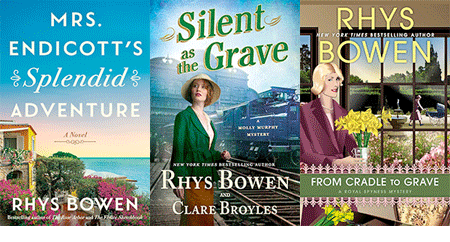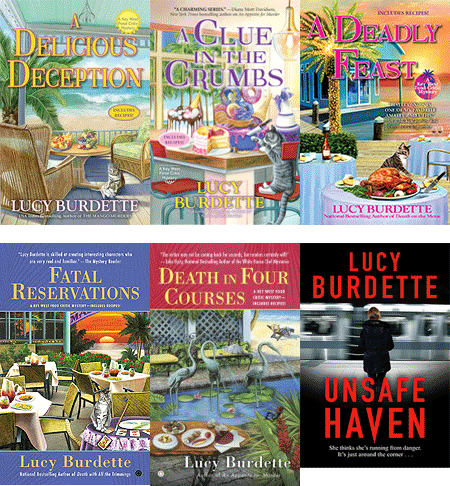
HANK PHILLIPPI RYAN: Some crime fiction is all about food. Right? How could our Lucy Budrdette be the success she is without it? And our Rhys’ new book is even called The Proof of the Pudding. And our Jenn’s cupcake novels are absolute icons. The Nero Wolfe books were foody, and..well, we could go on.
My Charlotte McNally kinda lived on almonds and diet Coke. I thought that said a lot about her. And in one of her stories, a chicken caesar salad played a pivotal role.
In many kinds of crime fiction, though, food is maybe…a second thought for the author. Or a third. And as a result, for the character.
.webp)
Why is that? When you see R. J. Jacobs' new book, THIS IS HOW WE END THINGS, admit it: you will probably predict that it's about murder, not about dessert.
Why don't thriller writers talk more about food? Motivation is why thriller writer RJ Jacobs-–a practicing psychologist–-does what he does. So when he asked that question about his own books, he came up with a deliciously fascinating answer.
By R. J. Jacobs
Since it’s almost Thanksgiving, I’d like to say a few words about eating.
.webp)
I’m an avid exerciser, to be fair, but I think a lot about food—what I’m in the mood for, reasonably healthy, and what’s on hand. I usually think about morning coffee before I go to bed the night before.
Recently, I realized that I’m troubled about how little the characters in our thrillers seem to eat and how rarely they seem to even consider their food. Surely, they’re famished. They have a lot going on—much more than I do in a typical day—and I’m hungry all the time.
I get how sleek storytelling requires certain omissions and that excessive detail can stall momentum. Conventional wisdom says we shouldn’t get too far in the weeds about the qualities of a character’s meal unless it’s relevant to the action. Fine. But maybe we should get into some weeds, sometimes? Our characters have needs and food’s at the top of the list, or at bottom of the pyramid, as Maslow might have said.
They need sustenance.
Here’s my case for more nutrient-rich narratives in three points:
1. Illustrating food choices helps develop a character.
A diet has connotations. It’s a little stereotypical, but consider the ethically-minded, conscientious vegetarian. Or the aggressive, perhaps tellingly blood-thirsty carnivore. It makes a difference what they choose to put on their plate. You feel like you know these eaters by observing them. You understand something about what drives them and about what they value. And you can guess about what lengths they’d go to to have their preferences met.
2. Ditto with eating habits.
Picture a the conscientiousness (or perhaps reticence) of a picky eater, delicately forking a salad. Maybe that’s someone who likes things just so, or who’s carefully contemplating the plans of the crime he’s about to commit.
Now imagine the barbaric indifference of someone messily shoveling in their bites. That sounds more like me, now that I think of it— careless and slightly preoccupied, but driven! Surely, this is not a character who’s prepared to pull of a complicated scheme.
3. Their approach speaks volumes.
We know plenty about characters who have a lean and hungry look in their eyes, but what does it mean when a character has lost their appetite? Or isn’t willing to nourish themselves? In regular life, they’d seem depressed, even lifeless, not eager to engage with the world.
And are they getting anything out of their journey through the story? I’ve read plenty of articles about whether or not it’s healthy to drink a glass of red wine—whether or not the antioxidants are worth the calories, and so on. But what these articles seem to miss is that having a glass of wine is enjoyable. Pleasure increases quality of life. It’s worth pursuing. It’s good for a person, keeps them going through tough times.
And our characters are having a tough time.
Maybe they’d be grateful to have a bite.
HANK: SO interesting! I always think about what my characters eat. But mostly they're hungry, and that affects their decisions. And blood sugar.
So how about you, Reds and readers? How do you use food in your novels–as just food? Or as insight? And readers, do you see the varying layers of meaning of food?
.webp)
R.J. Jacobs has practiced as a psychologist since 2003. He maintains a private practice in Nashville, focusing on a wide variety of clinical concerns.After completing a post-doctoral residency at Vanderbilt, he has taught Abnormal Psychology, presented at numerous conferences, and routinely performs PTSD evaluations for veterans. His novel And Then You Were Gone was published in 2019 by Crooked Lane. His second novel: Somewhere In the Dark, was published in August 2020. His current novel is This Is How We End Things (Sourcebooks, 2024), which Megan Miranda called “A captivating exploration into the psychology of lying, and a high-stakes, dark-academia thriller full of twists and secrets.”
.webp)
Riley Sager meets If We Were Villains in a compelling new psychological thriller following a cohort of graduate students studying the psychology of lying—until one of them is discovered dead. But how do you catch a killer who may be an expert in the science of deception?
Campus is empty, a winter storm is blowing in, and someone is lurking in the shadows, waiting for their chance to kill again.
Forest, North Carolina. Under the instruction of enigmatic Professor Joe Lyons, five graduate students are studying the tedious science behind the acts of lying. But discovering the secrets of deception isn't making any of the student's more honest though. Instead, it's making it easier for them to guard their own secrets – and they all have something to hide.
When a test goes awry and one of them is found dead, the students find themselves trapped by a snowstorm on an abandoned campus with a local detective on the case. As harbored secrets begin to break the surface, the graduates must find out who's lying, who isn't, and who may have been capable of committing murder. It turns out deception is even more dangerous than they thought…
A foreboding new dark academia thriller of deception and suspense, This is How We End Things follows the unraveling of a close group of students as they contend with what it means to lie, and be lied to.