Showing posts with label Stephanie Barron. Show all posts

Friday, October 20, 2023

Learning How to Live--and Die--with Jane--Stephanie Barron

DEBORAH CROMBIE: Here on the blog we have recently touched on the endings of much-loved series. Today we will celebrate--and mourn--the not-unexpected ending of a series that has been a personal favorite of mine from the very first book. Stephanie Barron (whom you also know as Francine Mathews) shares with us her journey with her beloved Jane Austen.


LEARNING HOW TO LIVE—AND DIE—WITH JANE

By Stephanie Barron


            I have spent nearly thirty years adrift on the sea of Jane Austen’s mind: reading her letters, absorbing her novels, studying her encounters with people she loved and the strangers who darkly amused her. In 1994, plagued with a peculiar but engaging voice in my head, I wrote Jane and the Unpleasantness at Scargrave Manor. Pregnant with my first child, I had been rereading Austen’s novels that winter, as I generally do during the bleaker seasons. For whatever reason, Jane became the internal voice-over of my life. Simply to silence her, I sat down and transcribed what she told me. That she was a detective seemed obvious—her great gift as a writer was a profound understanding of the human heart, and no skill is more vital to exposing truth, deceit, and motivation.

I picked up Jane’s narrative in 1802, when she was twenty-six and had just accepted, then rejected, an offer of marriage from the heir to a considerable property in her Hampshire neighborhood, Manydown Park. The proposal came from the younger brother of her great friends, the Bigg sisters—Elizabeth, Kitty and Althea--which made it as attractive as the financial security marriage offered; but the brother in question, Harris Bigg-Wither, was six years younger than Jane and suffered from an acute stutter that rendered him socially awkward and painfully shy. In short, she did not love him.

Deciding against marriage was a crossroads in Jane’s life that intrigued me, a moment when she turned aside from a broad and well-tended path for women of her era into a narrow track that led to unmapped territory. Stripped of the financial security of a safe marriage and hating her dependency on her brothers, she turned instead to writing and actively publishing her novels. If she had accepted Harris’s proposal, we might never have known her name.

I followed her over the next fifteen years, and fifteen mystery novels, from Steventon to Bath, Southampton to Canterbury, Derbyshire to London, and a few places in between. I introduced her to Byron, Wellington, Mrs. Fitzherbert, and Carlton House. Rather than a retiring spinster in a limited rural sphere, Jane proved to be a woman of the world: hobnobbing with spies and dangerous politicians, equally engrossed by global politics and trends in high culture. As she moved through my pages, Jane grew older. So did I. She suffered heartache; I had my second child. She settled down in her beloved cottage at Chawton and published Sense and Sensibility; I watched my sons grow up and leave for college.

Now, with this last book, we have reached the year 1817 when Jane Austen died on July 18, at the age of forty-one and a half. She had gone to Winchester with her sister Cassandra that May for specialized treatment at the hands of a notable local surgeon, Mr. Giles-King Lyford, a scion of a prominent Hampshire medical family who was Surgeon-in-Ordinary at the Winchester hospital. Suffering possibly from Addison’s Disease, possibly pancreatic cancer, she moved into lodgings at No. 8 College Street, a place found by her old friend Elizabeth Bigg, now the widowed Mrs. Heathcote, who was an occasional patient of Lyford’s and lived in the nearby Winchester Cathedral Close.


I knew that bringing Jane full circle from Harris Bigg-Wither’s dashed romantic hopes to Elizabeth Heathcote’s care in her final days was an important series arc, offering a look back at the first novel, Scargrave Manor, as we followed Jane into this Final Mystery. The ancient royal and ecclesiastical city of Winchester, replete with history and shadowed by its famous cathedral, was too rich a setting to miss, but I had no desire to write a book about a wasting Jane Austen, confined to her deathbed in a cramped and rented room. I was aware, as well, that no fewer than eight of Jane’s nephews had matriculated at Winchester College, the oldest boys’ public school in Britain, founded in the thirteenth century. This, too, was a rich vein to mine for a detective plot. Jane and the Final Mystery takes place, therefore, in late March of 1817, when I have Jane and her nephew Edward, a recent College grad, visit her old friend Elizabeth Heathcote at her home in the Cathedral Close. Elizabeth’s son William, one of nephew Edward’s closest friends, is still a student at Winchester College—and someone is determined to make his life a misery. Another boy has just been found dead. And Jane, at Elizabeth’s request, undertakes one final investigation.


I have brought my beloved sleuth within weeks of her death, but chose to part from her on a note of hope, because that is what Jane herself seemed determined to feel. On Tuesday, 27 May 1817, she wrote a letter to her nephew Edward from “Mrs. Davids (sic), College St Winton.”

     Mr. Lyford says he will cure me, & if he fails I shall draw up a Memorial & lay it before the Dean & Chapter, & have no doubt of redress from that Pious, Learned & disinterested Body. –Our Lodgings are very comfortable. We have a neat little Drawing-room with a Bow-window overlooking Dr. Gabell’s Garden....We see Mrs. Heathcote every day, & William is to call upon us soon.

     She wrote to her London friend Frances Tilson a few days later that: My attendant is encouraging, and talks of making me quite well. I live chiefly on the sofa, but am allowed to walk from one room to the other. I have been out once in a sedan-chair, and am to repeat it, and be promoted to a wheel-chair as the weather serves.

     This appears, however, to have been the final letter she was able to write. Her condition varied but continuously declined over the next month and a half, and early in the morning on Friday, 18 July 1817, Jane Austen died. The following Thursday she was laid to rest in Winchester Cathedral, with her nephew Edward and her brothers Henry, Edward, and Frank as mourners.

     She was unable to finish the novel she called The Brothers, which has come down to us as Sanditon, but her brother Henry ensured that The Elliots, renamed Persuasion, was posthumously published in 1818 along with Northanger Abbey--a book she had written decades before, sold for ten pounds, and been forced to buy back from the publisher when he refused to print it.


     When readers ask why Austen’s novels have endured for more than two centuries, I say it is because she teaches us how to live. That’s the fundamental reason we humans turn to any story, oral or written, visual or graphic; because we learn from it how to survive. Elizabeth Bennet and Anne Elliott, Elinor Dashwood and Emma Woodhouse, remind us of ourselves in their intelligent and perceptive pursuit of happiness; but as I’ve grappled with ending this series, I’ve come to understand that they also teach us how to endure the terrible costs of existence. Austen’s work is about surviving the end of things as much as, with each triumphal wedding, she celebrates their beginning.

In her novels there lurks always the long shadow of a missing and beloved character: Anne Elliott’s mother; both of Darcy’s parents; Elinor and Marianne’s father. Henry Tilney and his sister are, in Catherine Morland’s mind, literally haunted by their dead mother. This is no surprise when we examine Jane Austen’s life, because death was a constant part of it. Before she herself left the world in 1817 at the age of forty-one and a half, she suffered the loss of her sister’s fiancĂ©, four of her brothers’ wives, her father, and her close friend, Anne Lefroy. Grief for her father and Madame Lefroy, most Austen scholars would agree, weighed so heavily upon Jane that she stopped writing altogether for several years.

As I sat at my desk one late afternoon writing the last chapters of Jane and the Final Mystery, my husband texted me from the airport, where he was meeting our younger son’s plane. Have you heard from him? he asked. He’s not here, and he’s not answering his phone.

That was the beginning of the worst hours of our lives, when we learned that our son Stephen was dead. His loss came out of the blue, on a stormy October afternoon when he was supposed to be arriving home, and the tragedy of his death at the age of twenty-four destroyed any ability I might have had to confront Jane’s end.

I set aside this manuscript and fell into the dark maw of grief. When I was able finally to look at the pages again, I found Jane waiting at the edge of my mind, as I always have. For once, she was silent. But her stoicism and hope in the face of her own decline, her gratitude for the people she loved, and her ability to let go of what she cherished most, offered me a bit of grace. Jane learned wisdom early, and she culled it from the most unforgiving of circumstances as well as the most rewarding. Her stories endure in fact because they do not spin fairytales of unalloyed happiness. As I am sure she knew too well, the price of love is sometimes pain.

In the end, we all have our brief passage through the world, in light and shadow, as my version of Jane has had hers in these fifteen novels. It is the words that will outlast all of us.


Stephanie Barron


Friday, November 18, 2022

Francine Mathews--Strolling Home to Nantucket

DEBORAH CROMBIE:  As we're coming up to Thanksgiving next week, I'm more than ready for an atmospheric Christmas mystery. Francine Mathews has just the ticket with her new Merry Folger Nantucket novel, DEATH ON A WINTER STROLL. This series has long been one of my favorites, and I couldn't wait to dive--or jingle!--into this one. 


Here Francine gives us a little taste of a magical Nantucket Christmas.

Strolling Home to Nantucket

Francine Mathews


When you fly from Colorado to an island thirty miles off the Massachusetts Coast the first weekend in December, dusk comes early. By the time you’ve boarded the nine-seater Cessna at Logan and been assigned the copilot’s seat, the runway lights are a brilliant map branching under darkness. You stare through the cramped windscreen at the tail of the Lufthansa jet waiting for takeoff right in front of you, the Cessna no bigger in comparison than a fly on the flank of a rhino. You lift up over the shoreline of Boston and turn south with the storm front, stretching its fingers across Cape Cod.


     Half an hour later, as you squint to penetrate the blackness of the sky, which is indeterminate from the blackness of the sea, a faint glow helps you pinpoint the horizon. Another few minutes, and the glow becomes starbursts, a scattering of lights that signifies tiny settlement in the vastness of the Atlantic. A few minutes more, and the short runway in the middle of the moors is flung like a necklace before the Cessna’s windscreen. You pitch forward, judder to the ground, come with a whine to a halt.

You’ve landed on Nantucket, and it’s the most magical time of the year.


My series detective, Meredith Folger, would argue the point, of course. Born and raised on the island, she’s convinced that every Nantucket day is magical. But the first weekend in December has been particularly special for the past half-century, because that’s when Santa arrives. Rounding Brant Point on the deck of a Coast Guard cutter, he makes his way from Straight Wharf to the top of Main Street in a raucous parade. Over ten thousand people throng the center of town, dressed as lighted Christmas trees, sexy elves, reindeer. For countless visitors, it’s a smashing kickoff to the holidays. For the island’s retailers, it’s a welcome infusion of cash in the midst of off-season. For Nantucket police, it’s a sometimes-exasperating exercise in crowd control.


For the past two years, Stroll was canceled due to the COVID pandemic. For two years, Nantucket has isolated in place, its shops empty, restaurants closed, school kids sent home, and beaches deserted.


This year, Merry knows, the pent-up demand of delayed gratification for in-person partying will make Stroll a killer weekend. Her force will be stretched to the limit. Add a television crew producing a streaming series in the middle of Polpis, and the Secretary of State’s family holed up in an ancestral home in town, and the security demands are mind-boggling.


And that’s before the first body is found...


Have yourself a Merry little Christmas.


No-nonsense Nantucket detective Merry Folger grapples with the aftermath of the COVID-19 pandemic and two murders as the island is overtaken by Hollywood stars and DC suits.

Nantucket Police Chief Meredith Folger is acutely conscious of the stress COVID-19 has placed on the community she loves. Although the island has proved a refuge for many during the pandemic, the cost to Nantucket has been high. Merry hopes that the Christmas Stroll, one of Nantucket’s favorite traditions, in which Main Street is transformed into a winter wonderland, will lift the island’s spirits. But the arrival of a large-scale TV production, and the Secretary of State and her family, complicates matters significantly.
 
The TV shoot is plagued with problems from within, as a shady, power-hungry producer clashes with strong-willed actors. Across Nantucket, the Secretary’s troubled stepson keeps shaking off his security detail to visit a dilapidated house near conservation land, where an intriguing recluse guards secrets of her own. With all parties overly conscious of spending too much time in the public eye and secrets swirling around both camps, it is difficult to parse what behavior is suspicious or not—until the bodies turn up.
 
Now, it’s up to Merry and Detective Howie Seitz to find a connection between two seemingly unconnected murders and catch the killer. But when everyone has a motive, and half of the suspects are politicians and actors, how can Merry and Howie tell fact from fiction?
 
This latest installment in critically acclaimed author Francine Mathews’s Merry Folger series is an immersive escape to festive Nantucket, a poignant exploration of grief as a result of parental absence, and a delicious new mystery to keep you guessing.


Francine Mathews/Stephanie Barron was born in Binghamton, New York, the last of six girls. She attended Princeton and Stanford Universities, where she studied history, before going on to work as an intelligence analyst at the CIA. She wrote her first book in 1992 and left the Agency a year later. Since then, she has written 30 novels, including the critically acclaimed Nantucket Mystery series, the Jane Austen Mystery series, and a number of historical fiction and thriller novels. She lives and works in Denver, Colorado.

DEBS: Francine, thank you so much for the gorgeous photos and descriptions of Nantucket. I'd love to experience a Nantucket Christmas some day!

REDS and readers, where would you spend your dream Christmas?

Thursday, February 17, 2022

Stephanie Barron--Jane Austen's Man of Mystery

DEBORAH CROMBIE: It is always such a treat to have Stephanie Barron (who you also know as Francine Mathews) here on Jungle Red! Francine is multi-talented and I love her both her historical novels and her contemporary mysteries set on Nantucket, the Merry Folger books.

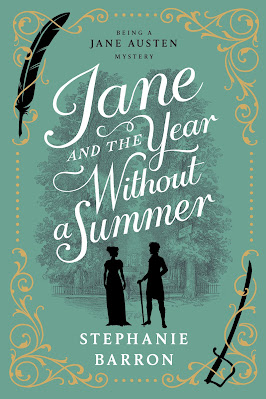
But her Jane Austen mysteries, written as Stephanie Barron, have a special place in my heart. I've followed Jane's adventures from the very first book, and am always thrilled when I know there is a new Jane novel coming my way.  JANE AND THE YEAR WITHOUT A SUMMER is the 14th,  and finds Jane and her sister Cassandra taking the waters at the new spa town of Cheltenham--a fun Cotswold link for me! But there is more than mystery going on in Jane's life--there is a little romance, too, as you will see.


Jane Austen’s Man of Mystery: Raphael West

 by Stephanie Barron

     For the past twenty-six years, I’ve been writing a series of mystery novels with Jane Austen as detective. The first, Jane and the Unpleasantness at Scargrave Manor, showcased the famous English Regency novelist in December, 1802, when she was twenty-six years old, and had just accepted an offer of marriage from the twenty-year-old brother of her dear friends Althea and Catherine Bigg. Harris Bigg-Wither, heir to the Hampshire estate of Manydown, was in a position to make Jane’s life comfortable and secure—one reason she probably agreed to marry him. But he was socially awkward and suffered from a pronounced stutter, and Jane was not in love. After a sleepless night, she descended the stairs to breakfast and retracted her consent.

This was such a social solecism in Austen’s day that she and her sister Cassandra broke off their visit to the Biggs and left Manydown immediately to return to their own home in Steventon. Jane was a jilt—someone who toyed with an honourable gentleman’s affections and treated his heart with careless cruelty. But she was also a woman of conviction, and we’re fortunate she refused to marry for mercenary reasons. If she had become Mrs. Harris Bigg-Wither, mistress of Manydown, we might never have known her name.

Accepting a life of financial penury and dependence, as Austen did by refusing her one documented offer of marriage, meant that she was thrown back on the resources of her pen. If she’d married and succumbed to all the duties of managing a great house and rearing its owner’s children, she would never have to publish her novels. They would have remained an amusing pastime, like the amateur theatricals she wrote as a young girl.

But did rejecting Harris mean Jane’s life was completely devoid of romance?

I say not. Emphatically not.

One of the treats of writing historical fiction, particularly about famous people (something I’ve done repeatedly in my thirty novels to date) is that I offer them opportunities they may have missed in their real lives. One character who has surfaced in the past three Jane Austen mysteries, most notably in the current and fourteenth novel Jane and the Year Without a Summer, is Raphael West—the handsome, sensitive, and intelligent artist Jane first encounters in book twelve, Jane and the Twelve Days of Christmas. He’s the son of famous Georgian painter Benjamin West, an American from Philadelphia who became Court Painter to George III of England, and founded the Royal Academy in London. A contemporary of Jane’s—a widower and father to a grown daughter—Raphael quickly becomes Jane’s notable detective sidekick and love interest.

But who was Raphael West, and is it possible Jane actually met him?

And why did I decide to make Raphael a character in my ongoing series?

Jane herself showed me the way:

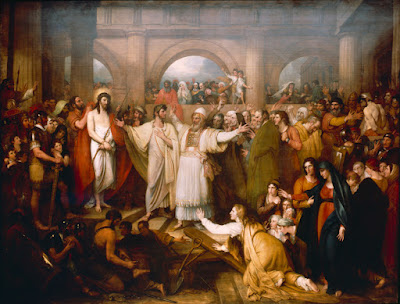
I have seen West’s famous Painting, & prefer it to anything of the kind I ever saw before. I do not know that it is reckoned superior to his “Healing in the Temple,” but it has gratified me much more, & indeed is the first representation of our Saviour which ever at all contented me. “His Rejection by the Elders” is the subject.—I want to have You and Cassandra see it.

--Jane Austen in a letter to her friend and housemate Martha Lloyd, date Friday 2 September 1814, written from London


                                          Christ Rejected by the Elders, Benjamin West, 1814

It was clear from this passage that Jane not only saw this painting of Benjamin West’s, she’d seen several. This isn’t surprising; West was the most famous painter in England of large-scale historic scenes throughout Austen’s life. His “Death of Nelson” and “Death of Wolfe,” depicting idealized and quasi-religious ends for two of Britain’s great war heroes, were hugely important propaganda pieces in contemporary politics. Remember, this was an era when there were no photographs, and popular understanding of events was spurred by graphic prints and cartoons sold in the streets, or by traveling exhibits of spectacular works of art.

But West was unique for the time in his brazen self-promotion and hustle. For forty-five years, he operated a multi-use compound at his home in the fashionable West End, at 14 Newman Street. This was a block of houses newly-built as London expanded during the Georgian era, and West both lived in his modern row house and set up his studio there—along with an atelier for art students under his tutelage, many of them American, and a gallery where he hung and sold his work. He was not simply an artist; he was an entrepreneur, and he capitalized on the public enthusiasm for his great works of history by flogging his paintings to anyone who cared to ring the bell at 14 Newman.

In other words, you suddenly didn’t have to be a king or emperor to be an art patron; you could be any person with money and taste, and you, too, could own a Benjamin West.

When Jane writes that she’s just seen “Christ Rejected by the Elders,” it’s possible she attended a public exhibition. But it’s equally probable that she saw it in the gallery at Newman Street—the painting was executed in 1814, and West would have wanted to exhibit it in his own gallery. Which means that Jane may, in fact, have encountered Benjamin West’s eldest son, Raphael, at 14 Newman Street. Of West’s two sons, Raphael was his father’s right-hand man.

Art at this time was very much a studio product, meaning that Raphael and the students in his father’s atelier made sketches and studies for the subjects of West’s great historical tableaux. Raphael never achieved the artistic status of his dad, but he was definitely a significant part of the family business. I own a catalogue of his drawings, many of them sketched during a trip he made to the United States, and his hand is deft and sure. He also surfaces in promotional ads in London papers from 1820, when his father died, and the entire West stock was being sold—along with the Newman Street house.

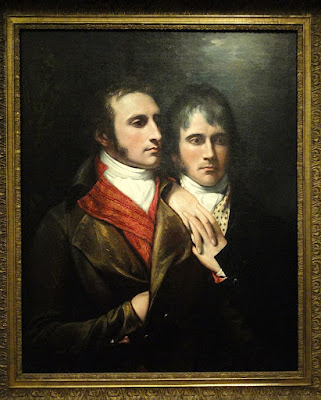
It's difficult to find much in the historical record about Raphael. I know he was married and had at least one daughter; I know he emigrated to France with his father for a period of several years after the Revolution, which makes him useful as a quasi-spy against Napoleon, whose transition from Man of the People to dictator disillusioned the whole West family. I also know he was handsome: his portrait, painted by his father, shows him as a man of fashion who’d make a perfect Darcy in an Austen novel.


 Raphael West and Benjamin West, Jr. by Benjamin West, c. 1796, Nelson-Atkins Museum of Art

In Jane and the Year Without a Summer, we’ve reached 1816 in Austen’s life. It’s a wretched time in England—the economy has plummeted due to the end of the Napoleonic wars, and there’s a famine throughout Europe and North America due to a catastrophic climate event caused by the most massive volcanic eruption in recorded history. Jane’s family is in upheaval: her brother Charles has lost his ship in a hurricane and he may be court-martialed; her brother Henry’s banks have failed, leaving him destitute; and her wealthy brother Edward is being sued by Jane’s neighbors for wrongful inheritance, or fraud. Jane herself is feeling ill, and decides to run away to the spa town of Cheltenham with her sister, Cassandra, for a bit of R&R.

Raphael West visits Cheltenham at the same time—and sparks fly as the pair stumble over an unfortunate series of bodies.

I like to think these two intriguing Creatives found endless subjects to discuss. Maybe it’s only a product of my fevered imagination—but Jane Austen deserves, at any time in her brief life, a partner worthy of her intelligence.


Stephanie Barron is a graduate of Princeton and Stanford, where she received her Masters in History as an Andrew W. Mellon Foundation Fellow in the Humanities. Barron is perhaps best known for the critically-acclaimed Jane Austen Mystery Series, in which the intrepid and witty author of PRIDE AND PREJUDICE details her secret detective career in Regency England. A former intelligence analyst for the CIA, Stephanie--who also writes under the name Francine Mathews--drew on her experience in the field of espionage for such novels as JACK 1939, which The New Yorker described as "the most deliciously high-concept thriller imaginable." She lives and works in Denver, CO.

DEBS: Don't you love the idea that Jane Austen, whose heroines always met their match, had a handsome and witty flame of her own? It's a delicious set up, and a fascinating period.

Do stop in and chat with Stephanie--if you have any Jane Austen questions, here's your chance to ask them!

Wednesday, June 10, 2020

Francine Mathews--Death on Tuckernuck

DEBORAH CROMBIE: I am a huge fan of anything Francine Mathews writes! Some of you may know her as Stephanie Barron, author of the Jane Austen Mysteries, as well as That Churchill Woman, and the wonderful historical standalones, The White Garden and Flaw in the Blood

But I've know Francine longest as the author of the contemporary Nantucket Mysteries, featuring Nantucket police detective Merry Folger. Death on Tuckernuck is the sixth and newest book in the series.  


The Washington Post says of it, "A mystery that’s so suspenseful it’s hard not to skip a chapter to see if certain deeply likable characters are still alive . . . The novel lives and breathes New England island life, with a plot brimming with the best kinds of rude surprises," and I totally agree! Here's Francine to share her inspiration for this suspenseful and atmospheric mystery.


A VERY PRIVATE MURDER:

DEATH ON TUCKERNUCK ISLAND


     I am emphatically not a morning person. And that Wednesday in July I was doubly groggy from waking every hour the previous night, in a subliminal terror that I might oversleep. So as I turned my rental car into the Madaket road and headed for Hither Creek at seven-thirty a.m., coffee cup at the ready, I plugged a vague address into my phone’s GPS app just to be certain I arrived where I needed to be.

Jackson Point, on the western end of Nantucket Island.

There was a boat waiting there I couldn’t afford to miss, owned by a man I’d never met, and had only spoken to once. If I got lost or didn’t appear by eight a.m., he’d leave me behind without a second thought. He’d agreed only reluctantly to make room for a passenger on his morning run across Madaket Harbor, and he’d probably be relieved if I didn’t show. I was determined that wouldn’t happen. I’d been trying to catch this boat for the better part of a year.

I write a series of detective novels set on Nantucket, featuring a woman police detective named Meredith Folger. I’d researched five novels in this idyllic setting, part historic New England whaling town and part sybaritic playground, but this morning I was on a mission to get off the island and onto neighboring Tuckernuck--a scrap of sand nine hundred acres round that sits in the Atlantic a mile and a half from Nantucket’s left coast. There is no public ferry between the town of Madaket and Tuckernuck’s Lagoon, as it’s called, where a handful of boats are moored. 


Neither is there any public access, per se, on Tuckernuck itself. The place is entirely owned by the few families that have passed down houses through multiple generations. There are no paved roads, no beach stands or coffee shops, no gas station or package store, no roadside shack selling sand spades and boogie boards. No restaurant or art gallery. No electrical grid. No public water. Not much cell phone coverage, and next to no internet. It is a place of generators and oil stoves, the night sky brilliant with stars.


And unlike nearby Nantucket, there are no tourists or day trippers on Tuckernuck. The island is intensely private, and its residents are fiercely protective of their peace and isolation. To set foot on the Lagoon’s gantry dock or one of Tuckernuck’s beaches, one must be a resident or an invited guest.

I, of course, was neither.

I was mounting what we used to call, in my old days as a CIA analyst, an Intel Op. I was deliberately penetrating a Denied Area with the goal of collecting privileged information. I was, in short, a writer determined to research the perfect location for a murder. And I had gone to idiotic efforts to make it happen.

The previous summer, I’d appeared at the Nantucket Book Festival and cheerfully announced in my author presentation that I wanted access to Tuckernuck, hoping some local reader would be thrilled to arrange it for me.

No one was thrilled.

I’d queried Nantucket friends, residents with boats, about taking me over. All of them looked leery. “It’s private property, you know,” they said. “You’ll really can’t go out there.”

In Colorado that winter, I contacted a friend with the last name of Coffin, whose ancestors were some of the first people to build houses on Tuck early two hundred years ago. He’d never been there himself. But he had a few friends who’d summered there all their lives. He gave me their names and email addresses. Slowly, gradually, I formed a network of people whose memories I could tap, whose teenage experiences threw light on a community so cut off from the rest of the world it might as well have been Everest.


One of them, in turn, gave me a phone number for a guy named Manny. He was a Caretaker, she said. Or in another words, a man with a boat and the keys to Tuckernuck’s kingdom.

Caretakers are professionals who sustain life on Tuckernuck. They are hired by the small island’s residents to spend a good part of their lives from mid-May to mid-October ferrying everything necessary for a comfortable existence between Jackson Point and the Lagoon. This includes blankets, toilet paper, strawberries, cases of wine, rose bushes, lawn mowers, steaks, tonic water, limes, solar panels, Portuguese bread, propane, gin, patio umbrellas, sacks of dog food, lawn chairs, milk, pate, and paint. Anything you might consider necessary for happiness, including the one-hundred and twenty-five guests you invited to your Tuckernuck wedding, can be transported by a Caretaker’s boat, and then removed—along with your week’s worth of trash and your dead wedding bouquets.

The Caretakers are people of deep and hard-won institutional knowledge. Tuckernuck is surrounded by constantly shifting shoals of sand, so unpredictable and wayward that they are merely dotted lines on nautical charts. To navigate the channel into the Lagoon is a tricky and oft-revised endeavor, best accomplished by those who tackle it daily. The Coast Guard avoids Tuckernuck; the draft of its boats is too deep. There is no fire department or police presence on the barrier island, no EMTs. Consider, then, what happens in an emergency—medical, or otherwise. A fire, perhaps, or an act of violence. A sudden stroke in the brain or a clot in an artery. Each trip between Tuckernuck and Madaket takes roughly twenty minutes, in good weather. Call it an hour by boat to the hospital in the best of circumstances.

But what, my feverish imagination asked, about a crisis in the worst of circumstances? --A vessel grounded on one of Tuckernuck’s shoals, say, as a hurricane bore down on New England?

--And what if there was a body in that boat?

How would the police respond, in the form of Meredith Folger?

And what would happen when a crime scene was set adrift in a gale?

This is how writers amuse themselves. How we pass the time. But Caretakers? They’re the ones who answer cries for help. Who stand between life and death. Who might get marooned with a killer in the midst of a natural disaster.


I left my car in the unpaved beach permit lot. There were only two boats idling off the landing. One was a local sportfisherman’s, calibrating the best spot to drop anchor. The other was a scuffed, well-used, and perfectly ordinary aluminum working boat with an outboard motor lowered for action. A guy in a gray sweatshirt was shifting gear around the bow.

“Are you Manny?” I called out to him, breathless.

He shook his head. “I’m George.” In his broad New England accent, it came out as Geoahrge. “Manny’s my brother.”

“He agreed to take me to Tuckernuck.”

“Oh, yeah?” George surveyed me speculatively. “Who you going to see?”

I uttered a name. George shook his head. “He’s not there. Left Saturday.”

“I know,” I attempted. “He offered to rent me a cottage. I’m  going over to look at it.”


“Yeah?” George was persistently skeptical. “What are you gonna do over there?”

“Walk to the house.”

“You know there are people living in it now, right? You can’t bother them.”

“Absolutely not.”

“You can’t just walk around. It’s all private property.”

Yes, I knew.

I subsided meekly on the dock, pacing while I drank my coffee. George heaved empty trash bins into the belly of his craft. Every scrap of garbage generated on Tuck has to be carried back by boat and then trucked to the Nantucket landfill. The smell of diesel fuel and brine rose from the pilings. A gull or two dipped its wings overhead. Then Manny arrived, all grizzled beard and swordfisher’s cap thrust back on his mane of hair, and studied me with his brother’s blunt speculation.

“Who you going out there to see, again?” he asked.

I muttered the name.

Manny scratched his head and gazed out over the harbor at the thin graphite smudge on the horizon that was Tuckernuck. “Don’t look in any windows or walk down any driveways. Don’t bother anybody. We’ll take you off at noon. Got it?”

I got it. I scrambled onto the middle seat of the boat and tried to look as small as possible. George cast off the painter while Manny fired up the motor. And then the boat backed and turned with a wave for the neighboring fisherman, and we headed out to sea.


What remains in my memory now of those hours on Tuckernuck is the eeriness of the empty landscape. Colonies of birds in the thousands, screaming above the eggs they’d laid in the sand and dune grasses. A white-tailed deer; a lone heron in the marsh; a snake slithering across the sandy track beneath my feet. The desolation of an abandoned house, engulfed in decades of scrub oak and rugosa. The wind, and the echoing impression of silence when it dropped. 


I walked the entire perimeter of the island and much of the interior, and encountered only a single other soul, as lost and out of her depth as I was. But I returned to downtown Nantucket that night with a vivid mental notebook of impressions and anecdotes imparted by Manny and George. I had only to mention, on our return trip to Jackson Point, that I’d worked as a nanny on the island forty years before, and suddenly, I was acceptable—a working stiff, too, who like them had catered to Summer People. They unbent and told me a few things about their lives. How they, too, owned a second home on Tuckernuck, along with the fleet of boats that serviced its residents; how deep the Milky Way could be on clear nights; how precious the isolation and peace could seem, in the height of Nantucket’s tourist frenzy. Manny and George gave me passage to the forbidden place, yes, but they gave me something more valuable—the stuff of character. Months later, writing Death on Tuckernuck in a Colorado winter, it was the Caretakers who’d lasted.

I hope they and their remarkable island come as much alive in the pages of my latest book, for you.


More about Death on Tuckernuck: In the Category 3 winds of a late-season hurricane, Nantucket police detective Merry Folger and her team attempt a rescue off the secluded island of Tuckernuck—only to discover a deadly secret.
As a hurricane bears down on Nantucket, Dionis Mather and her father have their work cut out for them. Their family business is to ferry goods and people back and forth from Tuckernuck, the private island off Nantucket’s western tip, a place so remote and exclusive that it is off the electric grid. As caretakers of the small plot of sand in the middle of the Atlantic, the Mathers are responsible for evacuating Tuckernuck’s residents. But as the storm surge rises and the surf warnings mount, Dionis has to make a choice: abandon whatever—or whoever—was left behind, or risk her own life by plunging back into the maelstrom. Even she has no idea what evil the hurricane is sheltering.
When the coast guard notifies the Nantucket police of a luxury yacht grounded in the shoals off Tuckernuck’s northern edge—with two shooting victims lying in the main cabin—detective Meredith Folger throws herself into an investigation before the hurricane sweeps all crime-scene evidence out to sea. Merry is supposed to be on leave this weekend, dancing at her own wedding, but the Cat 3 has thrown her blissful plans into chaos. As her battered house fills with stranded wedding guests and flood waters rise all over Nantucket Island, Merry has her own choice to make: How much should she risk in order to bring a criminal to justice?

DEBS: Reds and readers, would you want to spend a long summer in such an isolated place?

Comment below to be eligible for this fab giveaway from Francine!

Signed trade paperbacks of the previous 5 books in the series
A Women’s size M Nantucket Beach Permit T-shirt
A jar of Bartlett’s Farm Beach Plum jelly
12 oz. Nantucket CoffeeRoasters Sconset Blend
A Beach Sign key fob from iconic Murray’s Toggery
A shatterproof thumbprint wine glass with a silhouette of Nantucket.


 Francine Mathews, who also writes as Stephanie Barron, is the author of 29 novels of mystery, espionage, and historical fiction. A former intelligence analyst at the CIA, she lives and writes in Colorado. DEATH ON TUCKERNUCK is available now from Soho Crime.