
HALLIE EPHRON: So many authors take a circuitous path to publishing their first novel. I went from teaching elementary school to college teaching to writing for high tech to freelance copywriting before selling my first novel, FINALLY!, ten years after I decided to try my hand at writing fiction.
Crime fiction authordom is littered with formers - in Jungle Red alone we have a former attorney, a former psychologist, and a former librarian.
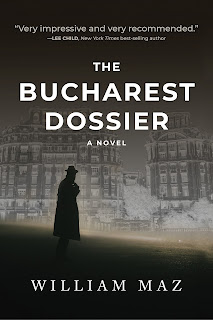
Today's guest William Maz, with his debut novel THE BUCHAREST DOSSIER (applause!), has had a full career as a physician before stepping off the deep end and joining us. Today he's here to talk about the how and why of it.
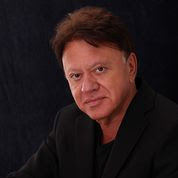
WILLIAM MAZ: I was a practicing physician before I retired early to devote my full time to writing. But I have been a writer since high school, and have continued to write during my medical career. You can say that I’ve always been a writer who took a twenty-five-year off-and-on sabbatical to practice medicine.
Did being a doctor help me to write fiction? Studying medicine does develop talents that are useful in many aspects of life, including writing. It teaches you to do proper research, and to observe the people around you—how they walk, talk, move their hands, show their emotions, laugh, and cry. It teaches you how to think critically, how to follow the consequences of one action upon another, and how to understand a person’s often subconscious reasons for his or her actions.
Medicine also teaches you to listen to people’s stories. Everyone looks at the world, and their own lives, through stories they create. Creating stories is so universal that it may be a hard-wired part of our brains, an evolved method of making sense of our lives. Understanding the structure of a story, which is very different from “real life,” is key. Life is a continuous flow of events, most of which have no obvious connection to each other. Some questions get resolved decades later, or after the people have passed away. Others never do.
The story is different. It is a compact “retelling” of the events, with a beginning, a middle, and an end. It includes motivations, causal links between events, a climactic “Aha!” moment, and a resolution, most of which real life doesn’t offer. Creating a story out of life’s seemingly random events thus brings a form of understanding.
But which story do you tell? Medicine teaches you to “do no harm,” to relieve suffering, to save lives. You also learn that there is little difference between humans and the other forms of life around us – just a few DNA changes. Seeing anything suffer or die has become abhorrent to me. I have seen too much of it.
That can be a problem if you’re writing a spy thriller. I have never liked thrillers with a lot of killing. I am a great Le Carré fan partly because there is very little violence. The thrill is in getting into the minds of the spies, discovering their motivations, and figuring out the puzzles.
In my early drafts, I subconsciously avoided writing scenes with violence, even with direct confrontation. But since my novel takes place during Romania’s bloody revolution, a country in which I was born, I realized I had to include some scenes of what actually occurred. What I eventually chose to tell is a love story inside a spy thriller inside a historical novel. At the pinnacle lies the love story, the ultimate subject of the novel.
Medicine doesn’t help you write a novel. Writing does. And reading. They call it a craft, but it is more than that. It is a passion, at least for me. They say that there are two kinds of writers: those who like to write, and those who like to have written. I am the former.
HALLIE: "[Fill-in-the-blank] doesn't help you write a novel. Writing does." Here, here!
But having lived does sometimes give you something to say... and it sounds like medicine was a fertile ground.
How does who you were "before today" affect what material you choose to read (or write)?
ABOUT THE BUCHAREST DOSSIER
The triumph of love during years of atrocity and depravation is brought hauntingly to life in THE BUCHAREST DOSSIER (Oceanview Publishing; March 15, 2022) by William Maz—a love story within a spy thriller within a historical novel. Maz shows how love can survive even under the direst of circumstances, in this case the brutality of Romania’s bloody revolution, and the miserable and debilitating years under Communist regime.
CIA analyst Bill Hefflin is a disillusioned Romanian expat who has lost his sense of community, his core identity, his language and his sense of home. He arrives in Bucharest on the eve of the 1989 Romanian rebellion at the insistence of his KGB asset, whom he code-named Boris. As Hefflin becomes embroiled in an uprising that turns into a brutal revolution, nothing is as it seems, including his search for his childhood love, Pusha, a ghost from his past in Bucharest, which has taken on mythical proportions.
With the bloody events unfolding at breakneck speed, Hefflin realizes the revolution is being manipulated by outside forces, including his own CIA and Boris—the puppeteer who seems to be pulling all the strings in Hefflin’s life.
Can Hefflin find the answers before he’s swept away in the bloody tidal wave of revolution?
WILLIAM MAZ was born in Bucharest, Romania, of Greek parents and emigrated to the U.S. as a child. He is a graduate of Harvard University, Mount Sinai School of Medicine, and Yale residency. During his high school and undergraduate years, he developed a passion for writing fiction. He studied writing at Harvard, the New School, The Writer’s Studio in New York City, and with Gordon Lish, and is now writing full time. The Bucharest Dossier is his debut novel.








