
Showing posts with label art forgery. Show all posts

Tuesday, June 3, 2025

The Artifice of Art


HANK PHILLIPPI RYAN: What is as fragile as originality? It’s why we prize it, right? The idea that something–say a piece of art–is the only one of its kind that exists.

But since that “originality” is what makes it valuable, it also makes it tempting. I mean–all you have to do is make one exactly like it–and who would ever know?

Or create one that seems to be from the same mind and hand. Tempting, huh?

Until Interpol comes to the door.

The oh-so-talented Katherine Reay has tapped in to that temptation–not by copying, of course, but by exploring the devious and manipulative minds of people who do.


The Artifice of Art


By Katherine Reay


After writing three spy novels, I delved into the world of art forgery for The English Masterpiece. At first, I was nervous — could forgers be as compelling as spies? Could the stakes, the intrigue, and the tension be as high? I quickly discovered the answer is an unequivocal YES! Though spies and forgers play on different fields and wield dissimilar “weapons of the trade,” they are both skilled, secretive, duplicitous, and fascinating masters of illusion. What you see is never what you get. Spies have changed world events in ways we will never know.


And all those “masterpieces” we swoon over while touring the world’s most storied museums? Picassos, Vermeers, Monets, and more… Experts estimate at least twenty percent of that art is faked and forged, with some experts taking that number as high as forty percent.


Conducting research for any novel is always fascinating for me. I love digging into the details and the history. And for this one I delved deep into paint composition, canvas, undertone, underpainting, and all the details behind the creation, curation, and insurance of art. But it was the forger, the psychology and motivation behind forgery, that intrigued me the most.


Let’s look at two of the world's most famous forgers and you’ll see what I mean.

Han van Meegeren, a Dutch painter who specialized in forging Johannes Vermeer during WWII and had the audacity to sell his works to the Nazis (the art-voracious Hermann Goering in particular), is often considered the world’s greatest forger. Biographer Jonathan Lopez called him a “talented Mr. Ripley with a paintbrush,” a conman famous for selling paintings that he himself declared “perfect forgeries.” And perhaps he was right.

During his trial for selling national treasures to the Nazis, van Meegeren actually had to prove his paintings were fakes and claimed, instead, that by tricking the Nazis he was a national hero. He still went to prison for a year for forgery, but the public loved him.

A contemporary forger, Wolfgang Beltracchi recently finished serving his prison term and is back to painting today, though under his own name now. He provides another example of the forger’s hubris. In the 2014 documentary, Beltracchi: The Art of Forgery, he wonders aloud why his forgeries aren’t as acclaimed as true Campendonks or Ernsts — after all, they are as beautiful. He even goes on to imply he has improved upon their style and works.

But it’s not all about ego and hubris, it’s about money too. In this high-stakes world of art, deception, forgery, and greed, van Meegeren accrued about $30M in today’s terms and Beltracchi over $40M. That said, once a forger is caught collectors and insurance companies definitely work to claw back those gains. What they can’t rectify, however, is the permanent tainting of the world’s artistic archive — for most forgers won’t and don’t reveal the locations of their entire oeuvre.

My novel, The English Masterpiece, centers around a forged Picasso, as he was the twentieth century’s most famous artist and remains the world's most forged artist. I guess if your work spans five movements there is a huge scope for forgery. And forgers do have their favorite movements and artists.

A couple of genuine Picassos featured in The English Masterpiece — The Old Guitarist and Woman in a Red Armchair. You have probably seen them many times.

But here is also one “forgery” in honor of the story.
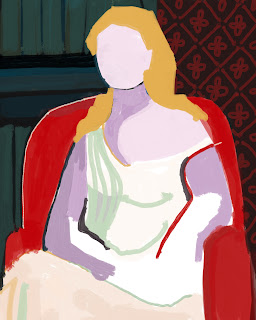


My daughter created the painting that comprises the novel’s focal point, the fictional Picasso’s Woman Laughing. It’s still work in progress and, as her mother, I promise she won’t dip into the dark side of the art world and try to sell it. But it was a fun project.

So the question is… Do you think you could make a painting or drawing that is”in the school of” a master? If we could wave a magic wand and let you do it perfectly, who would you like to emulate?


HANK: Wow, that is such a tricky question. I would like to emulate…ah, John Singer Sargent? I have no idea how he could paint fabric so gloriously that it seems real. Remember when I was in fifth grade–funny how this just came back to me!–I wrote an essay about how I would like to be able to paint like Rosa Bonheur. Aw. The Hank of the past emerges in art.

How about you, Reds and readers?


ABOUT THE AUTHOR


Katherine Reay is a national bestselling and award-winning author who has enjoyed a lifelong affair with books. She publishes both fiction and nonfiction, holds a BA and MS from Northwestern University, and currently lives outside Bozeman, MT, with her husband and three children.

Follow Katherine on Instagram, Facebook, X, and her personal website here.


ADVANCE BOOK PRAISE

“[A] fascinating look behind the scenes of art dealings and the workings of the museum.” —Booklist


“Crackling with tension from the very start, Reay’s latest is a twisty, smart read infused with the heady atmosphere of the 1970s London art world. The novel deftly explores the nature of artistic genius, the ethics of deception, and the cost of speaking up for what is true. A gem of a read!”
—Fiona Davis, New York Times bestselling author of The Stolen Queen


“Art… London… Seventies Glam… Yes, please. The English Masterpiece has ALL the goodies—especially for historical fiction lovers and art aficionados. Readers will relish Reay’s stylish prose and rich, unforgettable characters amid a propulsive cat and mouse chase into the opulent and obsessive world of multi-million-dollar art and deception.”
—Lisa Barr, New York Times bestselling author of The Goddess of Warsaw


Wednesday, November 15, 2023

Tim Maleeny and the ART of writing a mystery...

 HALLIE EPHRON: Today I am thrilled to host Tim Maleeny. The tag line for his latest Cape Weathers mystery, HANGING THE DEVIL, irresistible: 

It was supposed to be a simple job: steal the paintings, leave the forgeries.


Tim's mystery novels are always intricate, fascinating, and alternately heartpounding and funny. This new entry in the series is somethig more - it's deeply steeped in art.

Welcome, Tim!

TIM MALEENY: Hallie, big thanks to you and all the Reds for letting me join for the day!

Before I start talking about writing, research, and art, I have to mention that I’ve been trying to declutter lately—not my strong suit—and at my wife’s insistence finally tackled the daunting task of emptying an old storage unit.

As you’d imagine, Careful What You Wish For keeps popping into my head, that’s such a terrific book! Fortunately none of the dark corners of our storage unit or the bins bulging with books and papers have revealed any dark secrets or put me in peril...yet.

HALLIE: This is starting to sound all too famliar...

TIM: However, one thing I did discover is a stack of posters and prints that once decorated an old apartment of mine, which brings me to the topics of today’s post: research and art history. These are subjects in which I had a rough working knowledge when I began writing my latest novel, Hanging The Devil, but my research revealed I had so much more to learn.

The book opens with a daring heist at The Asian Art Museum in San Francisco that goes horribly wrong when a helicopter crashes through the skylight, a robbery ending in tragedy that sets off a series of events connected to a global ring of smugglers, master forgers, and organized crime.

The story is loosely based on actual crimes, so I had to get my facts straight, which meant visiting museums, studying catalogues, and learning how to paint a convincing forgery.

I don’t know about you, but I tend to get lost in the research for my novels, maybe because writers love learning, or perhaps because the one thing I’ve truly mastered is procrastination. Either way, this story needed characters who came across as credible experts, which meant I had to travel down the rabbit hole as far as I could go.

What I discovered over the course of my research is that the stories behind the art were, by far, the most fascinating part of the puzzle.

Most of the paintings and sculptures I admired when I was younger were captivating for the skill of the artist, and while that’s still the case, my investigations led to a genuine fascination with how art gets made.

Researching the materials used to make paints in prior centuries—something any good forger must know—demonstrates how incredibly important art is to the human psyche. Whether writing, painting, sculpting or composing, telling a story in words, pictures, marble or song isn’t easy, and it used to be much, much harder than it is today.

When it comes to painting, certain pigments weren’t readily available, which limits your color palette. Imagine being asked to write a novel but only with certain letters or words? The chemistry behind the materials used to perfect paints that would hold over time was practically alchemy, trial and error involving everything from tree sap, dead insects, pulverized gems, and animal urine. (Yes, you read that last one correctly; it’s better not to ask.)

Not to mention the lack of indoor plumbing or electric lighting a modern artist’s studio might be expected to provide. It’s hard enough to paint in full daylight, let alone by candlelight with no central heating while your subject is scratching the head lice away.

When you hear the stories behind the art—the themes represented and the politics of the day—you start to appreciate why these efforts at self-expression served a great purpose, an outlet for people to find their voice and society to see itself from a fresh perspective. And then, when you learn what it took to physically make the masterpieces we’ve all seen and admired, it gives a new appreciation for why art matters, and why our own visceral response to a story, painting, or any work of art, is an emotional echo of something much bigger than ourselves.

As for mixing my own paints and becoming a master forger, I’ve decided to stick with writing. The tree sap is impossible to wash off, the dead insects are gross, and the rest of it...well, I prefer to play with words.

###
TIM MALEENY is the multiple award-winning author of the Cape Weathers mysteries and the bestselling comedic thriller JUMP. His latest caper is Hanging The Devil, named the Mystery Pick of the Month by Library Journal in a starred review for its “relentlessly fast-paced plot and dry humor.” A former resident of San Francisco, Tim currently lives and writes in New York City.

HALLIE: And lucky for us that Tim has decided to stick with writing. What we do for our "art"! I want to know how he knows what handling dead insects is like... Tim will be dropping by today so if you want to know more about art forgery, fire away!

Wednesday, October 11, 2023

Susan Shea brings back Dani O'Rourke.

RHYS BOWEN:  I first met Susan Shea at the Book Passage Mystery conference where I mentored her first novel. She remembers that I took one look and said "Your book begins on page 19". She took that advice and sold the book, and the series. They were great stories involving the high stakes art world but never got the exposure they deserved. Then they went out of print. However there is good news. Tell us, Susan.

SUSAN SHEA: Hello Reds, and thanks, Rhys, for inviting me back. Not sure how many Reds have entered the brave new world of hybrid publishing, but I just stepped into it with three books in a short series, the Dani O’Rourke Mysteries.  Why would I do it? Well, different books in the series were published traditionally in so many editions and versions, and by more than one publisher: hard cover, trade paperback, mass paperback, book club, audio, large print. They got lovely critical reviews and my writer friends and those readers who contacted me loved them. Hank and Rhys blurbed them. But there was one issue that frustrated me and may well have hurt sales and a wider readership: Not one cover in any edition gave potential readers a clue about the contents. Nada. And none of the editions bore any graphic relationship to the others! In fact, at times Amazon showed varying editions of the same book at different prices and with different covers on the same screen!

 My first piece of good fortune was in getting the rights for all three back without cost and, after sitting for a year of should-I-shouldn’t I, I dove in. Many readers had only been able to find one or two, wanted to re-read them, or wanted to give them to friends and couldn’t find them. Even more tempting were the readers who kept asking for a new Dani story. More good fortune, my son is a freelance book designer who has lots of indie clients and can help navigate the indie publishing universe. With him as my (paid) producer, we were off. With his help I chose an illustrator who understood my goal of having covers that, finally, said something specific about each novel. She imagined Dani into a visual character who enlivened the new covers.


 All three came out last week and I’m just beginning the business of promotion, another hill to climb. But I feel I’ve finally done Dani justice, and my hope is these covers and some promotion may lure new groups of readers into her crime and romance adventures. Who knows, another Dani might come next. 

RHYS:And for those of you who never met Dani or need reminding: she is a modern, successful career woman in the high stakes art world. Sometimes glamorous, sometimes dangerous. A world that Susan herself knew well, although she never stumbled upon a dead body!

And to whet your appetite here is the opening scene of Murder in the Abstract:

 I could already hear a change in the tone of conversation outside the restroom door. As gregarious as an open bar and the presence of their peers rendered San Francisco’s social butterflies at a party like this, the anxious quality of this particular hum set it apart.

 “Get down here. Peter needs you.”

“I’m on my way.” Peter Lindsey is my boss. He’s also the director of the Devor Museum. I may be a senior executive, too, but when he says jump, I do.

Snapping the phone shut, I quick-checked my reflection. The new green eye shadow did nice things for my hazel eyes but the flame lipstick had to go. On my large mouth, it looked like clown makeup.  I swiped it off and settled for lip gloss.

Nudging the door open with my shoulder, I reached for the pager. The display showed Peter’s cell phone number. I speed-dialed while easing my way past guests, a few of whom were looking over the railings of the central staircase that ran up the spine of the handsome old Edwardian building to the glassed roof atrium.

Something was wrong, but I couldn’t see what it was when I peered over the heads of the shifting, murmuring crowd. Was there a fire? I sniffed, but didn’t smell smoke.

Squeezing past the outstretched arms of the two Museum guards standing at the third floor landing after getting a nod of recognition from one of them, I hurried down the carpeted stairs. It looked as though the guards’ orders were to keep people from coming down, which surely meant it wasn’t a fire. But what the hell was it?

The bar had been set up in the large first floor lobby for tonight’s preview of Matthew Barney’s multimedia installation, so, naturally, that’s where the biggest crowd was. I paused at the second floor landing and looked toward the two-story, glass entrance doors installed a few years ago over the howls of architectural purists. Strangely, because our liquor license from the city forbids Devor Museum guests from loitering outside the entrance, there seemed to be as big a crowd on the sidewalk as inside the building.

An elevator opened into the lobby as I peered down, disgorging a score of black-clad, dot com types and a security guard, a temp brought in for the evening by the look of him. They merely added to the crush. I made it down to the first floor, maneuvering past a flock of twenty-somethings in Prada and Jimmy Choos who were chattering about guys with cute butts, while craning their pretty necks and sniffing the tension in the room.

Even though I’m tall, I couldn’t spot Peter over the heads of the crowd. Len is short, a matter of some sensitivity to him. I worried he’d need one of those bicyclers’ flags to stand out right now.

“What happened?” I asked a portly man blocking my path to the information desk, where I guessed staff might be gathering.

“Someone said a body just landed outside,” he replied without taking his eyes off the glass doors.

SUSAN: What about you, Reds? Have you gone the indie / hybrid route with any of your novels? Are you thinking about it if you can get rights back to books that are lingering out of sight of readers? Or, do you read this and say, “Never! Not for me!”

Susan C Shea is the author of six critically praised crime fiction novels, three set in San Francisco with side trips to some of her favorite places, and three set in rural France. A fourth French village novel comes out early next year. She’s a member of Mystery Writers of America and Sisters in Crime and lives in Marin County, California, where two cats interfere daily with her writing.


Sunday, October 8, 2023

Overdue or Die @MarilynLevinson

LUCY BURDETTE: it's always a pleasure to find out what Marilyn Levinson will come up with next. I know you'll enjoy reading about the art forgery background she chose for her latest book!


ALLISON BROOK/MARILYN LEVINSON: Every new book in a series requires research. In OVERDUE OR DIE, the seventh book in my Haunted Library series, my sleuth Carrie Singleton is looking for the perfect wedding venue. What fun I had accompanying Carrie and her fiancé Dylan as they scouted out various places; as Carrie and her bridesmaids shopped for Carrie's wedding gown and bridesmaid dresses. I also researched theft and forgery in the art world because both play a large role in OVERDUE OR DIE.

Stories of stolen art work have always fascinated the general public. Who hasn't been intrigued by the heist at the Isabella Stewart Gardiner Museum, when thirteen works of art were stolen and never recovered? Helen Mirren starred in the popular film "Woman in Gold," about the Klimt painting of Adele Bloch-Bauer that was stolen by the nazis during World War Two, and, after much haggling, was  returned to its owner. The painting can now be viewed in the Neue Gallerie in Manhattan.   

Art forgery has a long and interesting history. Many supposed "masterpieces," revered for years in museums, have later been proven to be copies of the original paintings. Recently, a technical staffer at Munich's Deutsches Museum was sentenced to prison for stealing paintings from the museum, which he sold at an auction house, and replacing them with crude forgeries.

Art theft and forgery are major themes in OVERDUE OR DIE. Dylan has just taken possession of a famous painting he's inherited, when he's assaulted and the painting is stolen. The FBI's Art Crime Team tells him the painting was stolen so forgers could make copies of it and sell them to unsuspecting buyers. Though the painting and other artwork is recovered, this collection of artwork is only the tip of the iceberg of a huge, well-organized art forging syndicate. After Dylan spots a forgery on an art collector's wall and the owner of a local gallery is murdered, Carrie and Dylan investigate to find out if the syndicate is operating in their home town.

What fascinating aspect of research have you incorporated in a mystery, or enjoyed reading about? 


 About Marilyn: A former Spanish teacher, Marilyn Levinson writes mysteries and novels for kids. Her books have received many accolades. As Allison Brook she writes the Haunted Library series. Death Overdue, the first in the series, was an Agatha nominee for Best Contemporary Novel in 2018. Overdue or Die, the seventh book in the series, had its debut October 10th. Other mysteries include the Golden Age of Mystery Book Club series and the Twin Lakes series. 


Her juvenile novel, Rufus and Magic Run Amok, was an International Reading Association-Children's Book Council Children's Choice and has recently come out in a new edition. And Don't Bring Jeremy was a nominee for six state awards. Her YA horror, The Devil's Pawn, will be out in a new edition next year.

Marilyn lives on Long Island, where many of her books take place. She loves traveling, reading, doing crossword puzzles and Sudoku, and chatting on FaceTime with her grandkids and playing with her kittens, Romeo and Juliet.

ABOUT OVERDUE OR DIE: Carrie Singleton has more than her fair share on her plate: her job at the Clover Ridge Library, preparing for her wedding to Dylan Avery, and hoping that the local art gallery doesn’t steal away one of her part-time employees. Her fiancĂ© Dylan accompanies her to the beautiful home of Victor Zalinka—art collector and successful businessman—to select paintings for an art show at the library. While Carrie muses that Victor's home would be the perfect wedding venue, Dylan spots a forgery among the paintings in Victor's collection.

Then Martha Mallory is found murdered in her art gallery. With the assistance of Evelyn, the library ghost; the resident cat, Smoky Joe; and the office manager of Dylan’s private investigation company, Carrie comes up with a suspect list long enough to rival the size of an encyclopedia. During her investigation, Carrie stumbles across a terrible truth: Martha’s murder was part of something far bigger and more dangerous than she could have ever imagined. And it all leads back to the art gallery.


Order OVERDUE OR DIE right here. 

Amazon page: https://amzn.to/41nQiec

Follow Marilyn/Allison on social media:

Facebook: 

Goodreads: 

Twitter:  ; https://twitter.com/AllisonBrookML

BookBub: https://www.bookbub.com/authors/marilyn-levinson; 

Instagram: 


Sunday, June 11, 2023

Can You See "The Light"?

HANK PHILLIPPI RYAN: Can you draw? Insert howling laughter. A picture with words? I can try. But give me a paintbrush or a set of colored pencils, and  I’m gonna…politely give them back.

But can art lead to murder? We certainly know it can! And let’s welcome our dear pal Jeannette DeBeauvoir to take us on a creative journey–with a question at the end!


When you live (and write!) in an art colony

By Jeanette DeBeauvoir


I’ll begin with a confession: I am not a visual artist. No, hang on, I lie—I can draw a duck. It’s a very fine duck, mind you, but it’s still… just a duck.


Not very impressive anywhere, and especially not here. I live in Provincetown, Massachusetts, on the very tip of Cape Cod, what some call land’s end—well, you can see why: look out to sea and the next bit of continent you’ll encounter is Portugal. And this kind of isolation attracts a certain type of person, people who might not fit in any other place.


Among those misfits are artists. As I said, I’m not one of them, so I don’t fully understand what goes into what they speak rapturously and reverently of as “The Light” or “The Provincetown Light.” It is some shimmering combination of sky and clouds and sea and spindrift and makes a certain magic they try to replicate—or at least reflect—on canvas. And they’ve been doing that since Charles Webster Hawthorne opened the Cape Cod School of Art in the summer of 1899, making Ptown today the oldest continuously operating art colony in North America. By 1915 as many as 90 students were learning his style of impressionist painting en plein air.


Eight books in, working on my Sydney Riley Provincetown mystery series, I finally smacked my palm against my forehead and exclaimed, “I live in an art colony!” (It only took me 15 years to come to that conclusion.) With all the other local history, themes, and celebrations previous books in the series highlighted, I’d in fact never talked much about art.


So I took care of that, and the result is The Fine Art of Deception, out this week. An art colony can provide an excellent backdrop for all sorts of fraud and forgeries, which can in turn lead to murder, every mystery novelist’s delight.


What if, I wondered, a Charles Hawthorne wasn’t actually… a Charles Hawthorne?


If you’ve ever been down an Internet rabbit hole, then you’ll understand what happened to me as I started doing research into art fraud. The field is rich. (And shocking—a decent percentage of the great paintings we revere in museums and collections are counterfeit! There is no telling how many fakes still lie in plain sight, accepted as originals by experts and the public alike.) I read about the Knoedler Gallery in New York City; Sotheby’s refunding of money for a fake Old Master and later a Picasso in London; the Baroque and Renaissance forgeries of Eric Hebborn in Italy… the list goes on and on.


And that doesn’t even include art theft. I’m in Massachusetts, so it’s natural for me to include everyone’s favorite, the Isabella Stewart Gardner Museum heist—especially since one of the former suspects lived on Cape Cod!


It was interesting to notice how this research has changed the way I look at paintings now. Provincetown has a Friday-evening tradition called the Gallery Stroll. Galleries—and there are hundreds of them in this tiny space—time their opening receptions for Friday nights, and even where there isn’t a specific opening, wine and cheese are on hand everywhere to lure people in. I often do at least part of the Stroll, and it’s always pleasant, seeing new things, running into people I know… all very civilized.


But now I find I’m not there just for the social part: I’ve discovered I’m really interested in paintings, in technique, in results. I’m looking at art differently. I didn’t go quite full rabbit-hole, of course; I don’t look at paintings now with all the investigative and forensic considerations in mind, though they’re obviously important. But I went far enough in to have gained what I think of as Art Fraud Appreciation 101. I look at a piece now and wonder, if I were to do a fake by this artist, where would I start? What would be the most important component to capture? What is this artist’s “voice”?


It may be going at things sideways, but I’ve found that thinking about forgeries and fakes has increased my own appreciation of the “real” paintings I see. In a sense, looking for the places where fraud could occur underlines how significant those places are, and how details count. How Artist A uses our famous light, as opposed to how Artist B does it. Where they choose to sign their work, and why they made that choice. What kinds of brushstrokes do they use? How do I imagine they felt, working on this piece?


I’m thinking a lot more about the art I see, and that is the greatest gift this book could have given me. I hope you’ll read it—and have the same experience!


HANK: This is fascinating! And you know how instantly recognizable our favorite artists are, right?

Who are your favorites, and why? And hey, Reds and readers...can you draw? We know our Rhys is incredibly talented--how about the rest of you?


Jeannette de Beauvoir is a bestselling author of historical, mystery, and literary fiction (and an occasional poet!) whose Sydney Riley series is now on its ninth book. Her work has appeared in a number of literary journals and anthologies, and she is a member of the Authors Guild, the Mystery Writers of America, Sisters in Crime, and the National Writers Union. Her novels are firmly rooted in a sense of place, whether a mystery series set in Montréal or historical fiction set in medieval France; she herself lives and writes from a small cottage by the seaside.


More at jeannettedebeauvoir.com, where you can read her blog, hear her podcast, and sign up for her invariably interesting newsletter!


 The Fine Art of Deception


Trouble is in the wind for wedding planner and amateur sleuth Sydney Riley

Her boss Glenn has grown secretive; her best friend Mirela is hiding something, and Sydney’s daily routine at the Race Point Inn has grown stale. Sydney’s boyfriend, Ali, is in town as part of an investigation whose details he’s hesitant to share, and living together in her tiny apartment has become a challenge, to say the least. Any charm she’d found in her hand-to-mouth existence has disappeared.Something has to give—and it does: A visit from Sydney’s father turns treacherous when the investigation of a hit-and-run death leads her to the intimidating and subterranean world of high-priced art. Then Glenn vanishes as a dangerous storm races up the coast, and Sydney comes face-to-face with deception—both on canvas and in real life.Jeannette de Beauvoir’s flare for drama, detail, and suspense brings the art world to life in this ninth book in the Provincetown mystery series.

Friday, September 6, 2019

Stephanie Kane--A Perfect Eye


DEBORAH CROMBIE: We are having an arty week here on Jungle Red! I've always been fascinated by books centered on art, whether it's heists or scams of clever forgeries. And when stakes AND egos are high, you have a perfect recipe for misdeeds of the highest order. Add a French Impressionist to the mix, and I am totally hooked! Here are some startling facts--and a helluva story, from author Stephanie Kane!

 STEPHANIE KANE-- My Favorite Criminal
It’s estimated that twenty percent of the art in museums today is fake. That’s roughly one in five paintings hanging on the wall. How do forgers get away with it? I care because as a crime writer, I’m always looking for a good crime. That means an interesting criminal.
Not that I’m promiscuous. I do have standards. Sex and money may be the root of all crime, but a purely financial motive doesn’t do it for me. I like my crime straight, not with a dose of humor; capers and heists are out no matter how clever they are. Nor do I like gratuitous sex or violence. My crimes need a psychological motive, the more twisted the better. And the criminal has to be be self-defeating. The seeds of his downfall must be embedded in the obsession itself.
In A PERFECT EYE, a landscape by Impressionist Gustave Caillebotte becomes the template for a murder. To ignite a grievance powerful enough to kill, the painting had to mean something personal to the killer. What kind of guy gets that torqued over a landscape? That led me to forgers. It turns out the best ones don’t do it for the money. They do it to make a point.
The classic art forger is a failed artist who is frustrated by the art world’s refusal to recognize his genius. He gets his revenge by showing how easily the “experts” are fooled. But once he proves his superiority by getting away with it, it isn’t enough. Now he wants credit. Forgers are twisted and self-defeating, but my criminal still needed one more thing. I had to relate to him personally.
When I was a lawyer, the client who gave me nightmares wasn’t the one who decapitated a kid in a low-slung sportscar when the hitch on his trailer failed; at least he was remorseful. My nightmare was an ordinary con man. Con men thrive on marks. They’ll leave $100 on the table to cheat you out of $10. Because lawyers want to believe in their clients, they are prime marks. I certainly was. And he knew it.
My con man sabotaged his case just because he could. I dreaded our interactions. By the time I got him a deal for restitution and counseling, I couldn’t stand to be in the same room with him. Sensing my discomfort, at the last minute he nixed the deal. I was able to get out of the case only after he stiffed me on my fee. But for a novelist, revenge can be sweet.
When I plugged my revulsion for that con man into my forger, he started to become real. A forger is a human shell. Like a con man without a mark, he’s nothing without a real artist to copy. Which brought me to how he does it.
Unsurprisingly, some forgers glory in their work. They even write books about it. A real forger, Eric Hebborn, was more than generous with his tips in The Art Forger’s Handbook. The first step is mastering technique.
As with a con, the art is in the line. A forger’s lines are as fundamental as a painter’s touch.
Experts look for a flowing line in one part of a drawing or painting and a hesitant one elsewhere. When Hebborn tried to make a forgery too faithful to the original, his line was halting—too deliberate and precise. He sped it up and it began to flow. Spontaneity mimics the throes of creation.
The second step is creating a convincing backstory. The art world calls that provenance. An unbroken chain of title from the time the artist completed a painting is rare; gaps in the chain are the rule. For a forger, each gap is an opportunity to salt the record with phony data: letters, diaries, an early sketch of the painting itself. How would my forger create a false provenance? Gustave Caillebotte was a forger’s dream.
When Caillebotte died at age 45, he left just a small body of work. He’d inherited wealth, and unlike Monet, Renoir or Degas, he never had to paint to sell. He was also intensely private. He left no journals or diaries, but in 1883 from his countryside estate he wrote to Monet about his frustrations with a series of landscapes he was painting: For the two months I have been here I have worked as much as I could—but everything I do is really bad. Caillebotte practically begged a forger to paint one more in the series—a “lost” landscape that would be the breakthrough he so desperately sought.
But could my forger get away with it?  


Gustave Caillebotte, Paris, Rainy Day (The Art Institute of Chicago)

Authentication of paintings has traditionally rested on connoisseurship, the so-called “eye” of an art historian or dealer who has expertise in the artist’s work. Forensic tests can be expensive, destructive and non-definitive, and a forger can beat them with period materials. Centuries-old canvasses can be found in flea markets throughout Europe; in his book, Hebborn provides a recipe for boiling acorns to make iron gall ink. It goes back to the expert’s eye. Who doesn’t want to find a lost Impressionist masterpiece? And having found one, why let it go?
Now it’s game on. Hubris and clashing egos put criminal and victim on a par, and the line between good and evil blurs. As he craves recognition from a world he despises, the forger’s dodgy moral code kicks in. People believe what they want to believe. As the con man says, there’s a sucker born every minute. In a world where perception so often trumps truth, my forger could pull it off. The one thing he might not count on is a paintings conservator with a perfect eye of her own.
Like I said, revenge is sweet. 
DEBS: I love the Caillebotte painting above, owned by the Art Institute of Chicago. Reds and readers, do you have a favorite art-related crime novel? Share with us, and chat with Stephanie!

 
Stephanie Kane is a lawyer and award-winning author of four crime novels. Born in Brooklyn, she came to Colorado as a freshman at CU. She owned and ran a karate studio in Boulder and is a second-degree black belt. After graduating from law school, she was a corporate partner at a top Denver law firm before becoming a criminal defense attorney. She has lectured on money laundering and white collar crime in Eastern Europe, and given workshops throughout the ountry on writing technique.
She lives in Denver with her husband and two black cats. Extreme Indifference and Seeds of Doubt won a Colorado Book Award for Mystery and two Colorado Authors League Awards for Genre Fiction. She belongs to Mystery Writers of America, Rocky Mountain Fiction Writers and the Colorado Authors League. CONNECT WITH STEPHANIE KANE ONLINE WEBSITE: writerkane.com






