Showing posts with label clea simon. Show all posts

Wednesday, March 5, 2025

Clea Simon--The Butterfly Trap

DEBORAH CROMBIE: It is always a treat to have the multi-talented author Clea Simon visit here on JRW. Clea writes both cozies and dark psychological suspense, which inspires transports of admiration from me--I can't imagine how you twist your brain into such different shapes! Clea's latest, THE BUTTERFLY TRAP, definitely falls on the suspense side of the ledger, and here she is to tell us what inspired it.


What patterns are playing out in your life?


Hi and thanks for having me here today! Or here again, I should say, since you’ve hosted me before. Which brings up the question I’ve been wrestling with lately: What are the patterns you see in your lives? And, maybe more to the point, how do we use them in our writing?

This hit home just last week when I found myself teetering on the verge of an old fight. In brief, I’d been home all day working on the computer, with the exception of a short (and very careful!) walk in the icy day. My darling husband Jon (no relation to Hank’s Jonathan) had gone to the Boston Public Library to do some research. (He’s retired, but that just means more time for his own writing projects.) And so when he came home, I nearly jumped on him, full of things I wanted to tell him. How the writing was going. What the cat did. Thoughts on the day’s news (oh, so many thoughts…). And I could almost see him recoil.

To explain, he’d been at the library, but he’d been dealing with people all day. And I? Well, I’d only been dealing with the people in my head. All of whom were dying to come out.

It was all too much. I caught myself, and he met me halfway, asking about the day’s work and more. But in that moment, I saw a dynamic I recognized.

You see, my mother was an artist – a painter and printmaker, who dabbled in other media as well and who also, of course, had the full responsibility for us kids. My father was a doctor. An internist with a private practice, who saw patients all day. Too often, that meant a conflict at the end of the day. He’d come home, tired and wanting some quiet. And she, who hadn’t spoken to an adult all day, would be bursting with thoughts – with ideas she wanted to share. Ready for contact. Needless to say, it didn’t always end well.

In the worst scenarios, the tension would simmer for about an hour. By then, we’d be sitting at the dinner table – because, of course, despite her own work, my mom had to have dinner on the table at six! At some point, my mother would start to needle my father. Little things. Half-said comments that she wouldn’t repeat. And, inevitably, at some point, my father would blow up. He was a big man with a big voice, so this would be loud and, frankly, scary. My mother would run off to the kitchen, crying. And I, her youngest (and female), would follow to comfort her, leaving my father at the table. But even then I would be aware that he wasn’t really angry. In fact, he’d be confused. What had happened? Why had he exploded? He was like the proverbial bull in the china shop at that point, unable to take another step without causing damage. And as I hugged my Mom in the kitchen, I also felt sympathy for him. They were caught in a pattern that neither had the awareness to break.

In retrospect, so many other factors played into their relationship – and into their fights. Her work, for one, was never taken as seriously as his – by my father, by society at large. It certainly didn’t bring in an equivalent amount of money, which is too often how we measure such things. And there had been an imbalance in the relationship from the start: She’d been the beautiful artist he had pursued, winning in part with the promise of being able to give her a comfortable life – as a doctor’s wife. But was that who she wanted to be? Although he supported her work (and, I believe, was proud when she sold to museums and was honored in juried shows), did he ever understand it?

I confess, it took another friend’s disastrous relationship to make me revisit these old patterns in my own life. He and his then-love had come to visit, and by the third day, while she was sleeping in, he and I were crying at the kitchen table. It was impossible, he was saying. She drank too much. She was crazy. “But R-,” I remember saying to him. “You like the crazy! You’re drawn to it!”

“I know, but…” he replied (at least as I remember it. In truth, he might have resisted my diagnosis a bit longer). And sometime that day, as they both packed to go, it hit me. These patterns of love and anger. Where the fulfillment of one dream means the denying of the other. The way we wreck the ones we adore. And that night, I began to write The Butterfly Trap, a he said/she said tale of love and obsession that explores the dynamics of relationships, gender roles and expectations, along with lots of blood, dirty deeds, and sex (hey, I do write to entertain!).

And me and Jon? I don’t know if I’m any more careful these days. But I’m certainly more aware. Patterns can so easily become habits, treads worn in our minds… leading us down a tragic path.


What about you? Do you see patterns from your family of origins that have persisted in your lives? Are they useful or can you learn from them? Let me know!


About The Butterfly Trap:

Anya and Greg seem to be the golden couple, until dark secrets come to light and unleash inevitable devastation in this slow-burn he said/she said psychological suspense novel.


Greg has his life all planned out: become a doctor, buy a house, and have a wife and children – and when he meets Anya during his post-doc studies in Boston, all of his dreams seem to come true. It’s love at first sight, and Greg doesn’t shy away from changing his life to provide Anya, his beautiful butterfly, with everything she wants and needs.


Anya is a struggling artist, determined to make it as a painter in Boston’s art scene – but getting involved with shy and sweet Greg could thwart her lifelong ambition. Their relationship unfolds like a classic love story . . . except that Anya seems to be hiding something that unsuspecting Greg soon must face.


Are Greg and Anya truly the perfect couple, or will jealousy, uncertainty, and dangerous machinations break them apart in the most dreadful way imaginable?


“The theme of fear and control in a relationship emerges in Simon’s slow-burn latest, along with the exploration of the many ways two people can deceive each other.” – Booklist


Before turning to a life of crime (fiction), Boston Globe-bestselling author Clea Simon was a journalist. A native of New York, she came to Massachusetts to attend Harvard University and never left. The author of three nonfiction books and 32 mysteries, most recently the psychological suspense The Butterfly Trap, her books alternate between cozies (usually featuring cats) and darker psychological suspense, like the Massachusetts Center for the Book “must reads” Hold Me Down and World Enough. She lives with her husband, the writer Jon S. Garelick (another Boston Globe alum), and their cat Thisbe in Somerville, Massachusetts.


Saturday, November 25, 2023

What is Tortitude?


HANK PHILLIPPI RYAN: I know the answer–definitively!--to the question the wonderful Clea Simon is asking.

She says “Thank you, Hank, for having me over on Jungle Reds today! I’m going to dive right in and get all cat-centric and ask your readers: Are tortoiseshell cats crazy?”

Let me answer that quickly. Yes yes yes. My dearest cat Lola, who lived to be 20, was the bossiest most persnickety cat that ever existed. Back in the day, when we did not know things about cat food, she would ONLY eat Tender Vittles. And ONLY from a new pouch. And one night when I got home a tiny tiny bit later than usual, she’d –I am not kidding–opened the cabinet, pulled out the cardboard container box, ripped it open and taken out ALL of the vittles pouches, ALL of them, and opened ALL of them and scattered the food all over the kitchen floor.

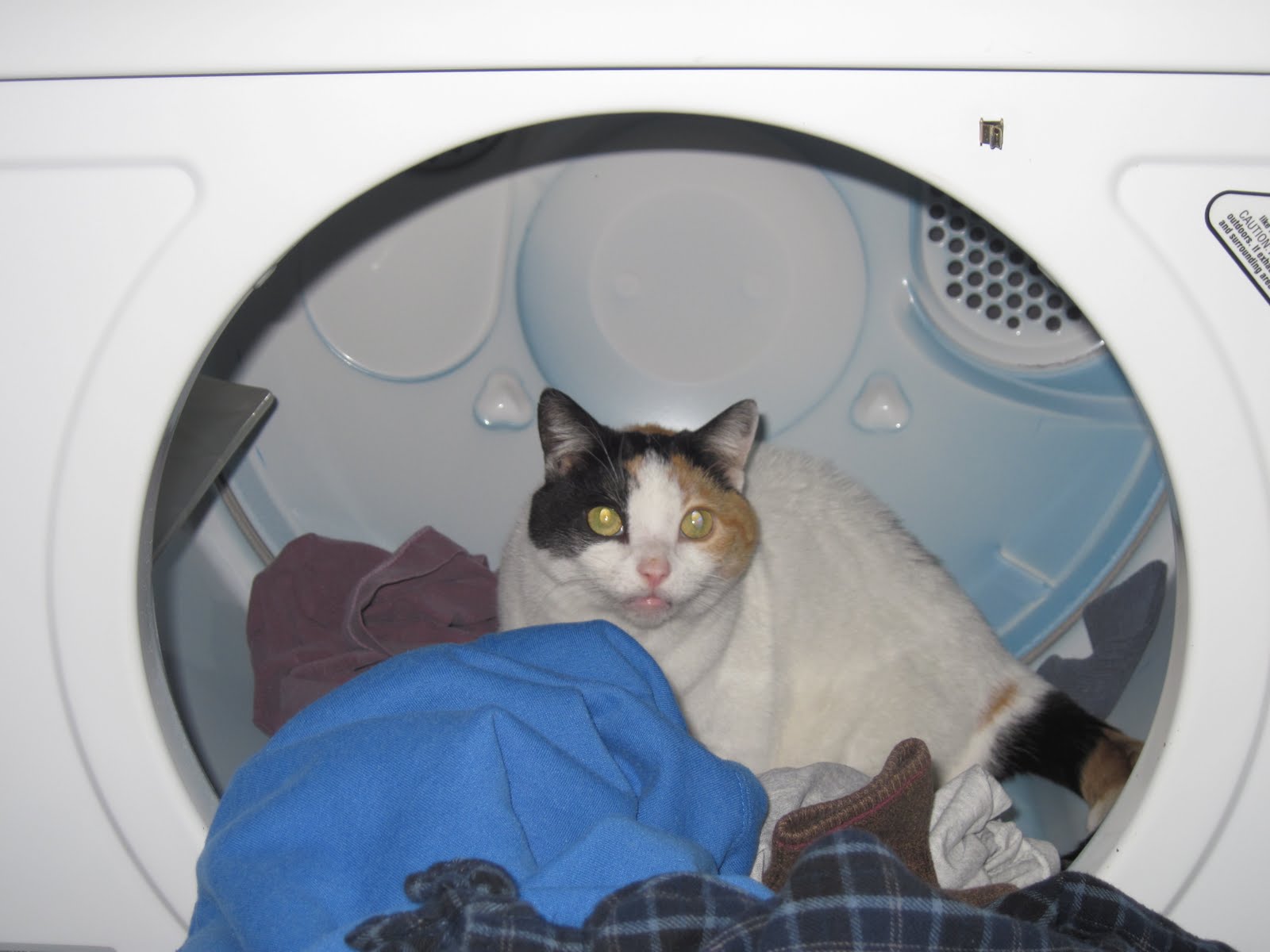
Don't you love the reflection?


So many more examples, but here’s one more. Lola was famously a one-person cat. She hated, HATED, everyone but me. When Jonathan arrived in our lives, he turned out to be allergic to cats. Well. Apparently Lola, seething with jealousy, decided to drive him away, and honestly, followed him relentlessly wherever he went. When he sat down, she was instantly on his lap. See photo! She was so brilliant and diabolical.


I got Lola from the humane society when she was so small she could not go upstairs, because she couldn't put her front paws on the stair above her back paws. I had gone to get a fluffy gray kitten, but when Lola saw me, she put her paw through the bars and tapped me. So, that was that.

ANYWAY. Here’s the wonderful Clea Simon with proof.


Are tortoiseshell cats crazy?


CLEA SIMON: I’m asking because that’s one of the (non-murderous) questions raised by the sudden inexplicable appearance of a tortoiseshell kitten in TO CONJURE A KILLER. The multi-colored cats are known for their odd behavior, and, after all, this kitten has been responsible for leading my cozy’s human heroine to a dead body. A day later, a kindly vet, who examines the stray, offers the theory that this little creature might have been dumped by its previous owner because of what has become known as “tortitude,” a combination of attitude and, yes, aggressiveness that can seem positively un-feline to the uninitiated.


That nice vet isn’t nuts, nor is he perpetuating old wives’ tales. As the partner (I don’t dare say “owner”) of a tortie, I know that they are very different cats. Before Thisbe came into my life, I lived with the wonderful Musetta, a tuxedo cat who loved us ­– and no one else – and was otherwise a wonderful, and perhaps traditional, cat. But since my husband and I welcomed Thisbe into our home, we’ve become accustomed to having an extremely loyal and attentive – but very assertive ­– little tortie in our lives!


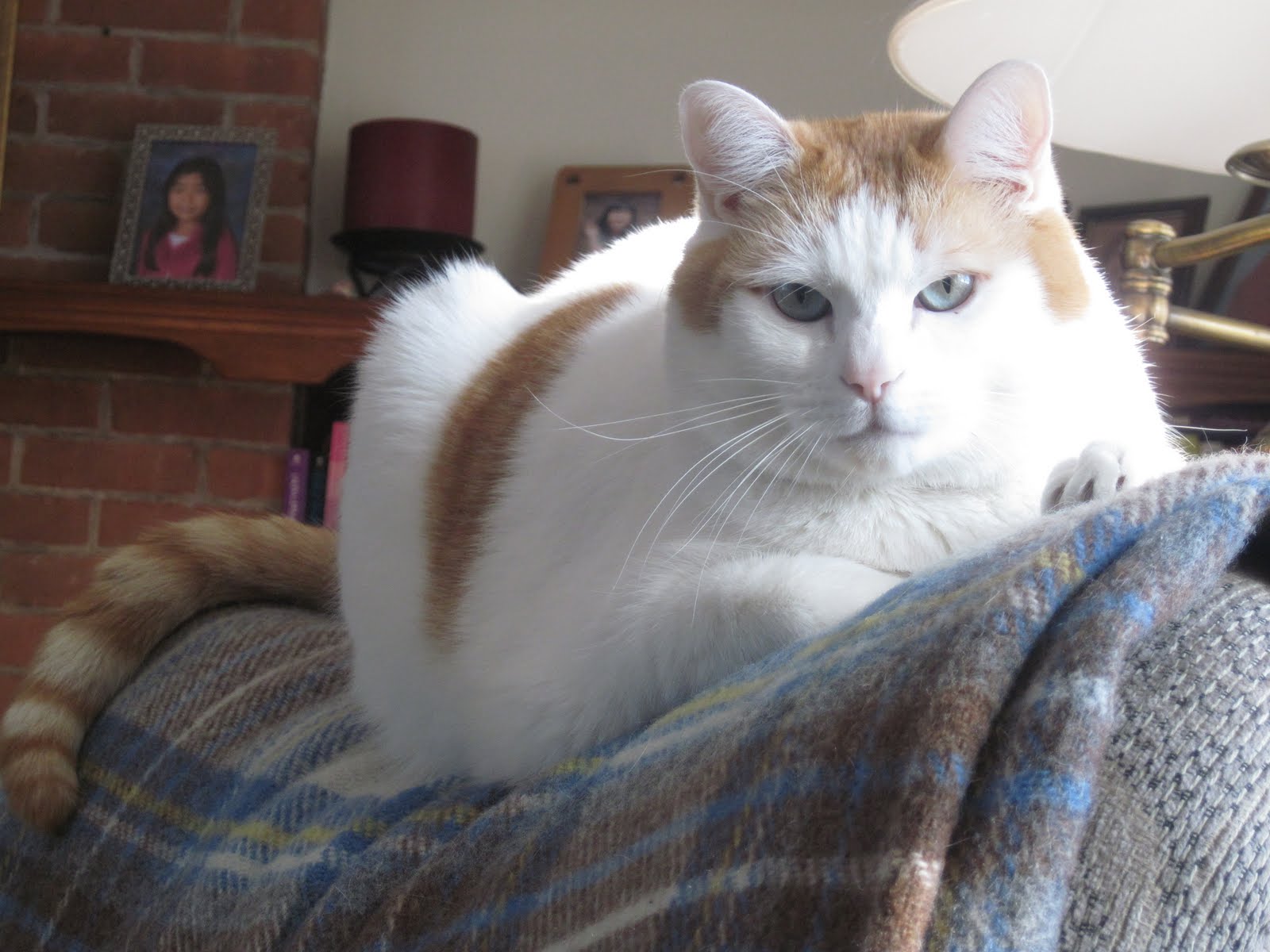
When I launched the “witch cat of Cambridge” series, I hadn’t yet met Thisbe, and so I made the feline heroine a calico named Clara. As a calico, she’s basically white, but with orange and black markings. (Because she has one black ear and one orange, colors that continue down like patches over her eyes, her litter-mate/sister Laurel teases Clara, calling her “the Clown.”). I liked the idea of a calico’s very particular genetics. Cat coloring is controlled by genes on the X chromosome, so in order for a cat to have all these colors – the orange, black, and white, they must have XX chromosomes. Which means that, although there are a few genetic oddities, 99% of all calicos are female.


I love Clara. She’s the point-of-view character in my “witch cat” cozies, and she’s unfailingly loyal to her human, Becca. But having lived with Thisbe for a few years, I knew I had to get a tortie into the mix in this new book. Torties have the same genetics as calicos, but their base color is black or brown (as opposed to a calico’s white) mixed with the gingery red or peach. And unlike calicos, they’ve developed a reputation for being … well, assertive. And smart, as well.


There may be some genetic reason for this. The Conscious Cat blog cites a 2016 University of California-Davis study, based on a survey of 1,200 cat owners, that found that, indeed, torties were more likely to exhibit “challenging and aggressive” behavior. (The blog also notes that some people report female cats as being more independent than males, which could also be a factor.) Cats.com cites the same study, while noting that understanding your cat is key to a good relationship. And as someone who cohabits with a tortie, I can attest both to their energy level (at five, Thisbe still plays like a kitten – jumping six feet off the ground to smack at anything flying by) and her intelligence.


Do you know the old saw: Dogs have owners, cats have staff? Well, Thisbe has proved this true. When we hid one of her interactive toys (one we put away for her safety when not in use) above a wine rack, she proceeded to bang on the hanging wine glasses to get our attention. One broken glass (she knocked it down) was enough to make us jump – and now she bangs on the remaining glasses whenever she wants us to do something, even if her toy is already out for play! She has us thoroughly trained. On the plus side, she’s one of the most attentive and affectionate cats I’ve ever met, and every day she lets us know we are her humans.


So is this tortitude? And is there a reason that the little kitten in To Conjure a Killer is keeping silent about the murder? To Clara, the newcomer is a mystery – that little kitten isn’t talking. To Becca, she’s just a beautiful stray, one that she wants to welcome into her home. But is she ready for the tortitude? Are we?


Have you had an experience with a tortie? Or with another cat that exhibited … shall we say, unusual behavior?


HANK: See above! And Lola still comes to me in dreams, and tells me–yes, she talks–that she’s fine and happy. I rely on that. How about you, Reds and Readers?


About TO CONJURE A KILLER: Kitten season can be murder…


Becca Colwin is coming home from her job at Charm and Cherish when she sees a tortoiseshell kitten run down an alley ­– leading to a dead body.


As a connection between Becca and that corpse is confirmed, Becca comes under suspicion — and is dragged into a cyberware scandal, thanks to her cheating ex, Jeff. The unfaithful computer geek and his high-power investor were working on stealth software designed to record and transmit personal data – a new form of spyware that would be of interest to everyone from the police and security agencies to cybercriminals. And when Jeff’s former friends and colleagues approach her, Becca finds the police aren’t the only ones watching her. (To Conjure a Killer will be published by Polis Books on Nov. 14.)


About CLEA SIMON: Clea Simon is the author of more than two dozen mysteries, most of which involve cats, and three nonfiction books, including the Boston Globe bestseller, The Feline Mystique: On the Mysterious Connection Between Women and Cats. A former journalist and New York native, she now lives in Massachusetts, the setting of TO CONJURE A KILLER, the fourth in her “witch cats of Cambridge” series. She can be found at www.CleaSimon.com and on Instagram (cleasimon_author) and Facebook (Clea Simon).

Tuesday, January 22, 2019

Clea Simon--How Did You Meet Your Pet


DEBORAH CROMBIE: If there's one thing we love to talk about almost as much as books on Jungle Red, it's our animal companions. And if there's one thing author Clea Simon--who writes The Witch Cats of Cambridge series--should know about, it's cats. Here she has a heartwarming (and a little harrowing) story about meeting her latest feline muse, Thisbe.

 
CLEA SIMON: If you’ve read Lucy Burdette’s saga of bringing T-bone home, you know that adding a four-legged member of the family can be complicated. Reading about her adventures with the shelter brought me back to last winter and our own search for a new feline friend.

We had said goodbye to Musetta,  my own little muse, the previous September. 


But it took several months before I was ready to welcome a new cat into my life. By the time I was – sometime that winter – I faced the same problem that young Lucy did. Kitten season was several months away. Plus, in the 16-plus years since we’d adopted Musetta, the shelter situation had changed. In New England, people have gotten so good about neutering their pets that kittens were hard to come by. “Come before we open and with elbows out,” one Boston area shelter told me. (Older cats  – perfect pets for those who don’t want to deal with kitten craziness – are still begging for new homes!)

In desperation, we turned to PetFinder.org, where we saw a blurry snapshot of a cute little tortie gal. 


But when we asked if we could meet her – chemistry being crucial in an adoption – we were told she wasn’t in New England. She was going to be transported, along with her littermates, from West Virginia in a few weeks. If we wanted her, we could meet them in a parking lot outside Hartford on a particular Sunday evening – and we should have $50 in cash in an envelope.

Wow, did that raise questions – not to mention red flags. We’d been told that the kittens had been vetted, but how would we know for sure? Would these kittens be socialized? Healthy? Would we fall in love? Then again… that little face…

We tried to plan. I made an early morning vet appointment for the next day, choosing a big city vet that had a shelter. We barricaded off an area of our living room so the little creature wouldn’t be able to hurt herself – or evade capture the next morning when it was time for her checkup. Jon and I began bargaining – if she was FIV positive, we could keep her. If she was FeLV positive, well, we’d talk to the vets… We went to meet her knowing that we might surrender her the next day. At least she’d be off the streets, we told ourselves. If she had some horrible incurable illness, at least she’d have care – or a merciful end…

Reader, you can guess what happened next. We handed over our carrier and the $50 – hardly anything when you consider months of food, vet care, and transportation! – and brought a complaining kitten home. And when we opened that box, back in our “kitten safe” area, we met not a scared feral but a self-assured little fur person, intent on exploring her new domain. Several hours later, when went to bed, we dutifully barricaded her downstairs, only to hear the most plaintive mew. Yes, we lifted the barricade and Thisbe bolted upstairs to jump on our bed, where she settled on Jon’s pillow for the night.

You can guess the rest. Despite our fears, the vet found only the usual kitten issues – all resolvable with love and wormer. And now I find myself cat valet in chief once again, interrupting my writing to fetch and throw catnip mice, fish balls out from under the sofa, and generally act as aide-de-camp to my new feline mistress.

So, tell me, how did your pet come to you? Let’s a share our pre-Valentine’s Day love stories here!
 
The author of more than two dozen cozy/amateur sleuth mysteries featuring cats, three nonfiction books, and one punk rock urban noir, World Enough (Severn House), Clea Simon likes to keep busy.

 
 The Boston Globe best-selling author’s latest is A Spell of Murder, the first in a new “Witch Cats of Cambridge” cozy mystery series out this month from Polis Books. 


 Clea lives in Somerville, Massachusetts, with her husband and one (1) cat. She can be reached at www.cleasimon.com and on Twitter @Clea_Simon

Here's more about A SPELL OF MURDER

“It’s Harriet’s fault. It’s always her fault, not that she’ll ever admit it.” So begins A Spell of Murder: A Witch Cats of Cambridge mystery, the first in a new cozy series that mixes feline fiction with a touch of the paranormal, and a little romance as well.

Becca, newly single and newly unemployed, wants to believe she has psychic powers. With nothing but time – and a desire for empowerment – she’s studying to become a witch. What she doesn’t know is that her three cats – Harriet, Laurel, and Clara – are the ones with the real power. And when Harriet – “a cream-colored longhair with more fur than commonsense” – conjures a pillow for her own comfort, Becca believes her spells are finally working. Could that be why Trent, the coven’s devilishly handsome leader, has been showing her special attention? Or why Suzanne, a longtime coven member, draws her aside to share a secret – a confidence that may lead to murder?

Delightful," raves Publishers Weekly. "You don’t have to be a cat lover to appreciate this paranormal cozy’s witty observations, entertaining dialogue, and astute characterizations."

DEBS: I LOVE tuxedo cats. We have one, and have had another, who alas is no longer meowing with us. But isn't it weird that black and white cats are not called "tuxedos" in the UK? It's so descriptive!

And I adore torties--fascinating cat genetics there. Thank you for sharing with us.

REDS and READERS, tell us how you met your pet! 

Clea is giving away a copy of A SPELL OF MURDER to one lucky commenter!


Sunday, June 10, 2012

Clea Simon


JAN BROGAN: Clea Simon is the author of 10 mysteries and three nonfiction books.  Her latest mysteries are “Grey Expectations” (Severn House), featuring the feline ghost Mr. Grey, and the Booklist-starred “Cats Can’t Shoot” (Poisoned Pen), which hosts several dogs as well as the curmudgeonly tabby Wallis. She, her husband Jon, and their tuxedo cat Musetta live in Somerville, Mass., where Clea and Musetta have taken to watching the birds together, sometimes with bad intent.   Please welcome her to Jungle Red! 


CLEA SIMON:  I’m an animal lover. And as they are in my writing, critters of one sort or another are essential to my life. Even, sometimes, ghost pets. Animals. I love them so much I can’t let them go. So you wouldn’t think I’d be throwing plates at critter, would you? Attempting to kill one, in cold blood?
What’s worse, there were witnesses. But I can explain.
To start with, I live in the city. Yes, we now have a little yard and I’ve gotten a bit obsessive about my bird feeder, doing my best to lure the cardinals and finches and discourage the ravenous sparrows (aka “pigbirds”) with every combination of seed and suet available. And I’m enough of a cat person that I keep up on the news of coyotes (there’s supposedly a pack in the woods of nearby Mt. Auburn Cemetary) and those nasty, weaselly fishers (spotted only one town farther out!) that are reclaiming their territory. But I’ve got an indie coffeehouse a five minute walk away, and two world-class bookstores within 20. There are buses and subways, and the sounds of sirens. I like it that way. It feels civilized.
So imagine my surprise when a friend dropped by and said, “You know, you’ve got a wild turkey at the end of your street.” I was wearing socks, no shoes, when I opened the door and I immediately ran out to see. Sure enough, a young male (we think) was two doors down, in a neighbor’s driveway, clucking. I ran back to alert Jon and we watched, entranced until we realized that our presence was probably keeping him in that driveway – and that he was likely clucking his distress. And then, being animal lovers, we walked away. We let him be.
Jon returned the favor only four days later, calling to me as he left for work. “Turkey!” He yelled. “On the shed!” Sure enough, the young male – we’re assuming for argument’s sake it was the same bird – was perched on our little tool shed. I watched him, entranced, as he sat, thinking whatever it is that birds think. My neighbor was watching too, and we did the miming thing (“Turkey!”) and waved. Turkey!
All was fine, and I went to get my coffee. And that’s when it happened. The turkey, spurred on by whatever motivates these birds, hopped into my yard. I ran for the camera and caught him pecking at our tiny bit of grass. I thought about going outside, about opening a gate. After all, it was probably easier to hop down into a fenced yard than to hop out of one. And I am, as I may have said, an animal lover. But then the turkey spread his wings and with a few flaps elevated himself to the top of our fence, right by the trellis where I have been training a sweet autumn clematis in hope of September blossoms. Once again, I was in awe.
And then he started eating. No, not eating. Grabbing big beakfuls of leaves and pulling them off, dropping half of them and denuding the young plant. Pulling it off the trellis. And I lost it. Still in my nightshirt, I ran out to our back deck and clapped loudly. Hey, it works with the cat. But the turkey only stared at me, as if to say, “Hey, lady, what’s your problem.” I yelled and clapped some more. No response. More leaves gone.
Finally, I picked up the drainage plate from an empty planter and winged it at him. It fell short – and shattered, our grass not being that thick. And that’s when I realized that I was standing on the deck, in my nightie, screaming bloody murder at a bird. I couldn’t tell if my neighbor was amused or appalled, he dropped his curtain so quickly, but I was forced to confront the dark truth at the bottom of my soul. I am an animal lover. But when forced to defend my clematis, I just may be capable of murder.


JAN: Clea's book, as well as all Severn House mysteries are now available on ebook atAmazon, Kobo, Barnes&Noble, and the Book Depository. You can like Severn House at  http://www.facebook.com/severnhouse
And you can follow at: @severnhouse

Clea will be stopping by to answer your questions about mysteries, animals, or animal mysteries. For more info on her books check out her site at http://www.cleasimon.com


Wednesday, March 3, 2010

A Place for Cats?

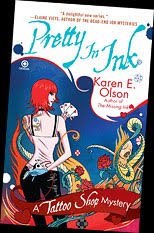
JRW welcomes another cat-loving mystery writer today--Karen Olson. Karen is the author of a series set in New Haven, CT featuring reporter Annie Seymour. And Karen's brand new book in her tattoo shop mystery series, PRETTY IN INK, hits bookshelves this week. Welcome Karen!

KO: Let me first say: I love cats. I am a definite cat person. Growing up,
we had so many cats that I’m not sure I can name all of them. Some
didn’t last too long, but others we had for a long time. As an adult,
I had a cat named Thisbe for 20 years. When I met my husband, I told
him I’d had Thisbe longer than any man. He took that as a challenge.
Sadly, Thisbe went to the big catnip patch in the sky five years ago.
But we now have two cats, Eloise and Hemingway. They are both a little
too fat, even though we don’t feed them as much anymore. Eloise does
like to nibble crumbs off the floor, so maybe she’s getting too many
carbs. She was named after Eloise at the Plaza; she’s more than a
little crazy. Hemingway was named after Ernest, because while he’s
very macho, he’s also a little bit gay.

Again, I want to say that I love cats. But I have been very reluctant
to put them in a book.

In my first mystery series, my protagonist, police reporter Annie
Seymour, couldn’t possibly have a cat. Annie is a bit too
self-centered and too independent to have to worry about a cat. She’s
working all the time and wouldn’t have time for it. In my tattoo shop
series, Brett Kavanaugh lives with her brother, Tim, a Las Vegas
police detective. They’re both in their 30s, single, and not thinking
about a pet. In fact, they could possibly both be dog people, but
since dogs are way too high maintenance, it just won’t work to give
them one. Somehow going out and solving crimes isn’t conducive to
walking the dog a few times a day.

That said, I know how much readers enjoy a good cat in a story. And I
don’t mean the cats that solve the crimes or speak to their owners or
each other. My good friend Clea Simon writes wonderful books with cats
in them, and the cats never speak but play a big role in the plots.

Always looking for a way to connect with readers, I began to wonder if
I shouldn’t put a cat in one of my books. Should Sylvia Coleman, the
elderly tattooist in my Ink series, own a cat? Maybe Bitsy Hendricks,
the tattoo shop manager who is a little person, or Joel Sloane, the
tattooist who looks like a biker but has a much gentler soul (see
reference to Hemingway, above).

No, none of those things would work. I tried. Really I did. But what I
ended up with was the perfect cat for PRETTY IN INK, set in Vegas with
drag queens at its plot’s center: A stray, feral cat skittering
through the parking lot at Chez Tango, the drag queen club, with a red
ribbon in its mouth. His appearance is brief, but notable. It plays a
role in the plot without being overt about it.

What about you? Do you think cats have a place in mystery novels?

JRW: Always room for a cat, Karen! Good luck with the new book! Read more about Karen, her cats, and her series at her website. And she's standing by for comments and questions.

Thursday, January 10, 2008

On Libraries & Librarians


Ro: This week I'm in Philadelphia preparing for the American Library Association's MidWinter meeting. Twenty-five mystery writers from MWANY will be meeting and greeting librarians from all over the country.

Almost every writer I know has a favorite library or librarian story. Tell us yours. In the meantime here's one from best-selling author Clea Simon

Clea: How do I love libraries? Let me count the ways. While I was researching my last nonfiction book, “The Feline Mystique: On the Mysterious Connection Between Women and Cats,” I saw a mention on a TV special of a study done in England on predation by cats in a small West Country village. Seriously. Being the tech savvy girl that I am, I immediately went online to find it. Well, I did. In German. Which I do not speak. And when I tried the Google “translator” the result was wildly humorous, but not at all useful.
So I went down to my local brick-and-mortar (or, this being Cambridge with its beautiful 19th Century H.H. Richardson Romanesque castle of a library, hewn-stone-and-mortar) library and explained my predicament to one of the librarians. “No problem,” she said to me. “But it may take a few days.” Within two days, she had the original journal article – in English – copied for me. Once again, I was reminded that electrons in the ether are still easily trumped by human ingenuity, know-how, and (I suspect) a phone call from one research librarian to another, perhaps overseas. I thanked her profusely, and in the “Feline” acknowledgments, but it hardly seems enough.
I wish I could drop by my local library tomorrow, seek out that librarian and thank her again. But for now, I can’t. My library is being renovated – its beautiful lawn with the names of great Greek thinkers set in stone, its Japanese peace garden, and its shady walks are all torn up, replaced by a construction site that looks more like a crime scene. There is hope: The copper beach, such a pleasure to read under, is still standing. And all the plans posted along the makeshift fence promise everything else will soon be back, perhaps as early as this summer. But until then, it’s a mess, more than half the books in storage, accessible through a temporary library housed in a nearby school. And that’s not the same, somehow, and I miss my library something fierce.
So when I was asked to contribute to a small volume by local writers celebrating the return of our library – oh, soon, I hope! – I wrote a mini-mystery featuring a local cat, who waits under that tree, and waits and waits for the day her book-borrowing friends will come back. I guess at heart I am that cat, waiting and hoping. How could I not?
Neither libraries nor librarians figure in my current full-length mystery series, in “Cries and Whiskers,” “Cattery Row,” or “Mew is for Murder.” The heroine of these books, Theda Krakow, knows how to research, but as a freelance music journalist. One of her best buddies, Bunny, works in a newspaper library – aka the “morgue – but while she invariably helps Theda dig up useful and interesting background tidbits, she hasn’t had a huge part in the action. Not yet. But in a nonseries book that I’m working on, my grad student heroine spends much of her time in Widener, the main Harvard College library. It’s a place I came to know and love during my undergrad years, and I’ve recently signed up for an alumna pass so I can revisit the scene of my youth – and figure out where exactly a killer would hide. I have very mixed emotions about setting a scary chase scene in a library. But, hey, mysteries all resolve, so I won’t be chasing anyone out of the stacks, will I? Maybe a little bit of suspense will just lure more of us in to that wonderful world, a mystery of its own.

Clea Simon is the author of the Theda Krakow mysteries, most recently “Cries and Whiskers,” and three nonfiction books. She can be reached at http://www.cleasimon.com