DEBORAH CROMBIE: And now for something completely different! Where else can you go from stately pageantry in England to the African bush from one day to the next? And learn fascinating things you never dreamed you needed to know?
Our guest today, Michael Stanley, reminds me what a wide window on the world books provide us. I may have been an Anglophile from an early age, but growing up I was also enthralled by Africa, and particularly by the Bushmen, because I'd had the good fortune to learn about both through books. I was thrilled to meet these fascinating people again in A DEADLY COVENANT!

We Love our Research
Michael Stanley
Most writers we know enjoy the research for
their books nearly as much as they do the writing. That is certainly true for
us – after all, we’re both retired academics. When we decided to set our
Detective Kubu books in Botswana, we knew little about the details of the
country, even though both of us had visited it. So we hit the books.
Of particular interest were the Bushman cultures.
We both had a great admiration for the Bushmen and an extreme distaste for how
they'd been treated. (For example, less than a hundred years ago, one could buy
a license to hunt them.) Partly for that reason, partly because they are a
significant group in Botswana, and partly because their culture is so different
from almost anything in the West, we’ve given them a major role in a number of
our books, including A Deadly Covenant,
the mystery we’ve just released. In fact, the backstory of our third mystery, Death of the Mantis, is all about
Bushman culture and an effort to ensure it doesn’t disappear. That book was
short-listed for an Edgar.
Our research uncovered many intriguing
aspects of Bushman life – far too many to include here. However, since the
Jungle Red Writers are often pre-occupied with killing people, or at least
thinking about killing people, we thought we’d discuss one poison that a number
of Bushman groups have used in their hunting. It is so lethal that it is the
Bushman equivalent of the nuclear deterrent policy. That idea is if the major
powers all have arsenals of nuclear weapons, none will start a war because it
would guarantee mutual destruction. Similarly, for the Bushmen, the fact that different
groups had this poison prevented them from fighting each other. Since there is
no known antidote, mutual destruction would be assured.
The poison is used for hunting, and the main
reason for having such a powerful poison is that Bushman bows are quite
rudimentary and do not have the power to kill a large animal outright. Instead,
the Bushmen have discovered several remarkable poisons that they use on their
arrows. The animal then runs off, and the hunter has to run after it until the
poison has enough effect to drop it. This can be hours or even days in the case
of an eland, for example, which is a huge antelope that can weigh up to 2,000
pounds. Even though the poison can bring down a large animal, the meat is safe
to eat.
The most intriguing of the poisons is the
one from Diamphidia nigroornata beetles, which lay their eggs on the branches
of the Commiphora trees in the frankincense and myrrh family.

They then cover the eggs with their own
faeces, creating a hard shell when dry. Eventually the larvae shed their
protection and burrow up to a metre into the sand next to the tree, where they
make a cocoon from sand. It may take several years before they molt into pupae.

The Bushmen dig up the larvae and pupae and
gently squeeze and combine the liquids in a container. When they are ready to
hunt, they apply the poison, not to the tip of the arrow in case they nick
themselves, but rather to the base of the arrowhead.
Several things about this astonished us.
First, how did the Bushmen eons ago discover the larvae buried so deep in the
sand? Second, how did they figure out that the liquids inside the larvae were
toxic if they got into the bloodstream, but safe if ingested? Finally, one can
only wonder how many Bushmen died before they figured all this out.
The design of the arrows is also clever.
Because the shot animal often runs through scrub and bush, and because
resources in the Kalahari are few and far between, the arrows that Bushmen use
have two parts: the head with the poison and the shaft. When an animal is hit
and starts running, the main shaft falls off and is reusable. The part with the
poison remains fixed in the animal and is retrieved when the animal collapses.
Surprisingly, the arrows don't have flights, which means that the hunter has to
get very close to his prey before shooting. One theory we read about is that
the legendary clicks of the Bushman languages evolved as a form of
communication that wouldn’t spook animals. .


Our new Detective Kubu mystery, A Deadly Covenant, is set near Tsodilo Hills, which the Bushmen regard as the birthplace of humankind. While digging a trench for a new water project, a backhoe operator unearths the skeleton of a long dead Bushman. Kubu and Scottish pathologist, Ian MacGregor, are sent to sort out the formalities, but the situation rapidly gets out of hand. MacGregor discovers eight more skeletons—a massacre of Bushmen including women and children. However, the locals deny any knowledge of the event.
When an elder of the village is murdered at
his home, the local police believe it was the result of a robbery gone wrong.
Kubu thinks otherwise. So does an elderly woman who believes it was the work of
Mami Wata, a powerful river spirit. When she dies in an apparent crocodile
attack, suspicions rise.
Things become still more complicated when a
mysterious Bushman appears at the massacre site, collapses, then disappears
again, but seems connected to the murders in some way.
Kubu’s boss, Assistant Superintendent
Mabaku, joins them as accusations of corruption are levelled at the water
project, and international anger builds over the massacre of the Bushman
families. But they have no idea how the recent murders link to the dead Bushmen.
As they investigate, they uncover a deadly covenant made many years before by
an unknown group, and they begin to fear that their own lives may be in danger.
Once again, Bushmen play a key role in a
Detective Kubu mystery!
DEBS: I want to know how the Bushmen discovered that you had to mix the two liquids together!
Michael Stanley is actually the writing team of Michael Sears and Stanley Trollip, and if you're curious about their academic pasts, and how they ended up writing about Botswana, here's more--
Both are retired professors who have worked in academia and business. Sears is a mathematician, specializing in geological remote sensing. Trollip is an educational psychologist, specializing in the application of computers to teaching and learning, and a pilot. They were both born in South Africa.
They have been on a number of flying safaris to Botswana and Zimbabwe, where it was always exciting to buzz a dirt airstrip to shoo the elephants off. They have had many adventures on these trips including tracking lions at night, fighting bush fires on the Savuti plains in northern Botswana, being charged by an elephant, and having their plane’s door pop open over the Kalahari, scattering navigation maps over the desert. These trips have fed their love both for the bush, and for Botswana.
It was on one of these trips that the idea surfaced for a novel set in Botswana.
Here's Michael.

And Stan!
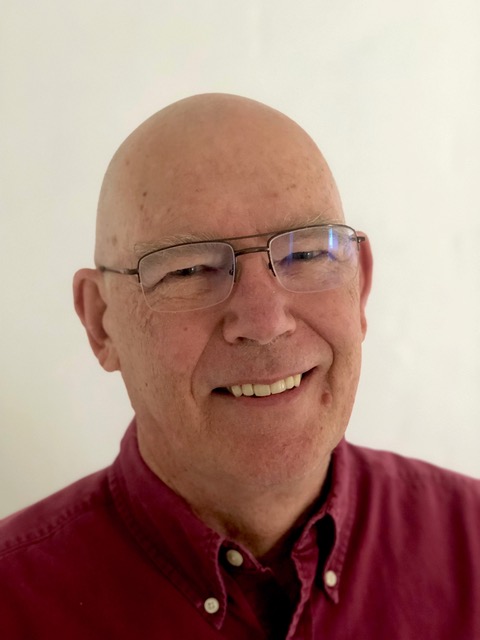
I was so sorry to have missed them at Bouchercon!
Stan and Michael will be dropping in to chat and answer your questions, and will give away a copy of A DEADLY COVENANT to one lucky commenter!