Showing posts with label historical mystery. Show all posts

Tuesday, March 12, 2024

Celebrating the Twentieth Molly Murphy Mystery

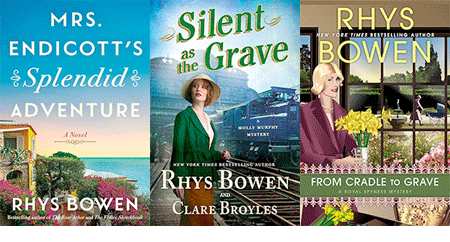
 RHYS BOWEN:  Today Clare and I are celebrating the publication of our new Molly Murphy book, IN SUNSHINE OR IN SHADOW. It is the twentieth book in the series, so I'm jumping up and down with joy and amazement. Who would have thought that Molly could not only have survived so long but could have flourished?  In all those books she has had plenty of narrow escapes, been bombed, survived an earthquake, and a factory fire, met Houdini, French Impressionists and now has an adventure in the Catskills.

As you know I now write these books with my daughter Clare Broyles, so I thought I’d tell you a bit about my co-writer.

A year ago we were doing a book signing and someone asked  “How did you two hook up?” and I replied, “I made her.”

Yes, I conceived her because I knew I’d need someone to take over my writing legacy one day. (For those of you who take things literally, I’m just kidding).  If I’d really wanted a co-writer I’d have made her watch and study as I wrote, practice character development and plot twists from the time she could talk. But looking back I can see that she did indeed have a childhood that was helpful to a future writer.

We read to our kids from day one. She grew up in a house full of books. She was a precocious child and was reading The Hobbit in first grade. We had a to have a good talk when she wanted to read “Are you there God, it’s me, Margaret” when she was eight (years before I had planned to have THAT talk).  I never censored what books she brought home from the library and was pleased that she self-censored. “I took that one back,” she’d say. “I didn’t like it.”

There was always a lot of pretend play at our house. Clare would write plays. Dominic, the only boy, would always be the prince with a towel around his shoulders as a cape and a wooden sword. Clare, unfortunately, almost never got to be the heroine. Her two sisters would refuse to take part if they couldn’t be Cinderella etc and Clare wound up as the witch.

Story from when she was 11. She got a boyfriend, a nice boy called Mike. She brought him home. I left them alone in the family room. It became awfully quiet down there. I tiptoed down to spy and found them both lying on the floor… on their stomachs, playing with the Fisher Price castle and the Playmobil little people knights, ladies and dragons.

Clare has always been a true renaissance woman:

As a Freshman in high school she got the part of Anne in the diary of Anne Frank. Imagine how emotional it was for a parent to watch that!  She went to college pre-med, but decided she didn’t want to become a doctor and added an English and Spanish literature major. She did independent biology research into calcium binding proteins (way ahead of its time), was offered a fabulous job with Genentec but instead chose to volunteer at a homeless shelter in Juarez, Mexico. There she met her husband Tim and together they did great work in El Salvador, helping people get their lives back together after the civil war.

On her return she got a degree in Music, specializing in opera, wrote and produced a children’s opera. She has since written background music for the Arizona Theater Company and others, winning an Arizona Tony award. She now teaches music, math and the gifted program at a charter school.


So what’s it like working with Clare? Awful. (just kidding again). We work together so well—she has great ideas, we talk through scenes and spark creativity in each other. It gives us an excuse to chat every day. And we never fight. In fact I don’t think I’ve ever been mad at Clare in her entire life. She is so sweet natured. And we laugh a lot. It’s very therapeutic.

Clare adores research. She reads the New York Times for every day we write about and find great snippets to add to our stories. When we started this book we knew we wanted to feature the early Jewish bungalow communities in the Catskills. Clare found there was a retreat center for professional women nearby(no men allowed),also a new state park and a bluestone quarry, creating a great gash in the earth. Such great motives for murder!

Our aim when we write, as well as telling a compelling whodunit, is to immerse the reader in real history, to transport to a time and place. We hope you’ll enjoy being in the Catskills this time. And if you go to our Reds and Readers Facebook group and comment on the live feed you’ll get a chance for a signed copy of the new book.

Tuesday, September 5, 2023

Compare and Contrast in the latest Billy Boyle WWII Mystery by James R. Benn

JENN McKINLAY: I am absolutely delighted to have the brilliant (and fellow SCSU alum) James R. Benn here today to talk about his latest work in the Billy Boyle World War II mystery series, which comes out TODAY! 

JAMES R. BENN: Compare and contrast . . . 

How many times have you seen those words in a school assignment? 
Comparison analyzes things that are similar, while contrasting discusses things that are different. A compare and contrast essay analyzes two subjects by comparing and contrasting both. It’s been a while since my last college English class, but the phrase kept popping into my mind as I was writing Proud Sorrows, the eighteenth Billy Boyle WWII mystery (Soho Press, September 5, 2023).

There are several components to the plot of this novel, but two disparate groups stood out in my mind as prime candidates for a good, old-fashioned compare and contrast. 

The first group is the Ritchie Boys. Ever heard of them?
Most people haven’t. 

I’d heard the name but had only a vague understanding of who they were until I delved into their story. As I researched the plot for Proud Sorrows, I thought this could be the book in which to include them. The more I learned, the more certain I became. Here are the basics:
The Ritchie Boys were a secret Military Intelligence Service program created to interrogate German prisoners of war. Over 15,200 servicemen were trained for these duties at Camp Ritchie in Maryland, and that name ultimately became the moniker of the highly classified project. The men who participated in these specialized interrogations were sworn to secrecy and for decades remained silent about their experiences.

A class at Camp Ritchie, Maryland, 1943.


GIs who trained at Camp Ritchie were not actually called “Ritchie Boys” during the Second World War. That name was popularized after German filmmaker Christian Bauer released a documentary called “The Ritchie Boys” in 2004. 

Some writers use “Ritchie Boys” to refer to all the soldiers who were trained in intelligence at Camp Ritchie beginning in 1942. Others use the term only to refer to the 2,200 German or Austrian Jewish refugees who trained at Camp Ritchie after having immigrated to the United States to escape Nazi persecution. And who often arrived in the States as young children without their parents.

As natural-born German speakers, their expertise in the language and understanding of German behavior made them highly valued, and very effective, interrogators. These men often found themselves interrogating rabid Nazis, the very kind of men who had abused them when they lived in Germany. Extracting intelligence information to save Allied lives and shorten the war was their best revenge.
Martin Selling had endured three brutal months in the Dachau concentration camp before finding haven in America. Ultimately, he trained at Camp Ritchie and served in Military Intelligence. Here he is questioning two recently captured SS soldiers.

Ritchie Boys worked at every level, from frontline units to headquarters and POW centers such as the fictional Marston Hall in Proud Sorrows. A postwar intelligence study attributed 60 percent of actionable intelligence in the European theater to the Ritchie Boys using their specialized interrogation techniques.

Their job was not without danger. In the opening days of the Battle of the Bulge, Kurt Jacobs and Murray Zappler, Ritchie Boys attached to the 106th Infantry Division, were captured when their unit was overrun. One of the former German prisoners identified the two men to his commander as “Jews from Berlin.” The commander ordered them to be shot on the spot, stating, "The Jews have no right to live in Germany."

That Nazi officer, Captain Curt Bruns, was himself apprehended and executed after a court-martial in 1945. He was the first war criminal to be executed by the United States Army for war crimes after World War II. 


The more I read, the more I was struck by how dedicated and committed these men were. They joined the Army as soon as war was declared and suffered from both anti-Semitism and bureaucratic confusion in equal parts. They were still German citizens, and it took the Army a while to realize how useful they could be. Once Fort Ritchie was in operation, each class of soldiers marked their graduation by being sworn in as citizens of the United States.
Many Ritchie Boys made it their personal mission to find family members left behind in Germany as the war drew to a close. It was a hopeless search.

There’s a counterpoint to the Ritchie Boys within the pages of Proud Sorrows. Let’s compare and contrast the young men who fled Nazi persecution in the nation of their birth with those Britons who sought to embrace fascism and emulate the Nazi ideology.
British fascists.


Great Britain saw its own fascist movement in the 1930s. Oswald Mosley and the British Union of Fascists was foremost among these, numbering 50,000 at one point. Other groups were smaller, but even more pro-Nazi and anti-Semitic. All were outlawed in 1940 and their leaders interned, including Archibald Leese of the Imperial Fascist League, which plays a role in Proud Sorrows. 

A supporter of the Imperial Fascist League carries their flag at a prewar demonstration.

Although support for these fascist organizations rapidly declined with the start of the war, leading figures such as Mosley and Leese still held to their anti-democratic beliefs. As 1944 rolled around, and with the threat of German invasion a distant memory, most of the British fascist leaders were released from prison. 

One of these leaders was Archibald Ramsay, the head of The Right Club. The Right Club was one of the smaller British fascist parties, organized as a home for those who found the BUF to be not anti-Semitic enough. Upon his release, Archibald Ramsay reintroduced the 1275 Statute of Jewry to the House of Commons. He'd had a seat in the Commons before his detention, which was never revoked. The 1275 statute was the original document put forward by King Edward I which strictly limited the rights of Jews in Great Britain. 

And this is where the compare and contrast assignment comes in.
While the Ritchie Boys did all they could to help their adopted country free people from oppression, the British fascists acted as a mirror image. While they had been born into a free country, they willingly worked to give up that freedom and welcomed the boot heel of oppression.

These extreme right-wing groups favored the Duke of Windsor (the former King Edward VIII), a Nazi sympathizer. Each of the leaders plotted in one way or another to place themselves at the center of a Nazi puppet state, hoping for a German victory early in the war. Meanwhile, the Richie Boys risked their lives to stop Nazi aggression, putting themselves in harm's way.

As I wrote, I was continually struck at how diametrically and morally opposed the two groups were. The Ritchie Boys emerged as victors after much suffering and struggle and have been rightly lauded for their contributions. The British fascists, on the other hand, were imprisoned, their names now synonymous with shame, disgrace, and betrayal.

And as long as we're talking about compare and contrast . . . watch the past to understand the present.


James R. Benn is the author of the Billy Boyle World War II mysteries. The debut, Billy Boyle, was selected as a Top Five book of the year by Book Sense and was a Dilys Award nominee, A Blind Goddess was longlisted for the IMPAC Dublin Literary Award, The Rest Is Silence was a Barry Award nominee, and The Devouring was a Macavity Award nominee. Benn, a former librarian, lives on the Gulf Coast of Florida with his wife, Deborah Mandel.


Wednesday, August 10, 2022

No Dogs Were Harmed in Midnight on the Marne by Sarah Adlahka

 JENN McKINLAY: Today I am delighted to host Sarah Adlahka, who shares with us the challenges of writing about a gruesome time in history (WWI) without being too horrific. Quite the impossibility, right? Well, Sarah has some thoughts...welcome, Sarah! 

And, Readers, just look at the cover of this novel -- gorgeous!


SARAH: I believe it was during round 2 of revisions for my historical fiction novel Midnight on the Marne that my editor gave me this advice:


“Think about your audience as women browsing the shelves at Target in search of their next book club pick.”


She had already convinced me to cut the detailed interrogation scenes where the protagonist Marcelle is being questioned (tortured) by a German general about her espionage, and she was trying to get me to see that, while the mystery-meat a starving French family would have been eating for Christmas in 1918 might very well have been dog, readers in 2022 – dog lovers in particular – would not be so keen to pick up a book where Fido was the main course. Now to be fair, they weren’t eating their own dog. I do have my limitations.


But how do you write a book about WWI without highlighting the horrors of war? And how do you highlight the horrors of war without getting into the gritty and gruesome details?


Write the story you want to write.

Stay true to yourself.

Paint an authentic picture.


As authors, we hear advice like this all the time. Whether from well-meaning friends who are just trying to encourage us or from critique partners who know how difficult it is to be in the writing trenches. And it makes sense, right? If we’re going to invest years of our lives into a book, shouldn’t it be authentic? Shouldn’t an historical fiction novel reflect the truest details of history, the bygone eras we spend months, maybe even years, researching?


I want to say yes.


I want to be among the die-hards who believe that you really must stay true to your subject matter – down to the grittiest details – to make your words sing. And maybe you do. But making your words sing is not necessarily the same thing as making your words sell. And since we’re in the business of selling words – or books – it just might be a good idea to listen to your editor. They are, after all, just trying to sell your book, and selling books is a tricky business.


Like most things in life, success as an author is linked to the shifting tides of public opinion. It’s linked to trends. And trends change. Opinions change. What’s popular, or even acceptable, in print and television changes from one decade to the next, maybe even from one year to the next, and this was a difficult lesson for me to learn.


I wanted my scenes to be authentic. I wanted my readers to feel the sharp edges of a broken chair, to hear the cries of men over a battlefield, to see the color of war as the sun came up over the horizon. And while it felt like my artistic freedom was being taken away, like I was being asked to paint a rosy sheen over the gruesome reality of war, what I eventually learned was that I was being given a gift. I was not being asked to eliminate those realities; I was being tasked with conveying those horrors through the repercussions they would have on my characters.


The effects of an interrogation – the restless sleep, the hypervigilance around men, the inability to trust – are more significant to the development of a character than the actual event itself. So, while the German general’s interrogation of Marcelle might have been what changed her, it was the consequences of that interrogation that really brought life to her character, that guided her to react the way she did throughout the rest of the story. I didn’t need to show the interrogation for it to have an impact.


And that was the challenge.


As authors we’re constantly being told show don’t tell. Show me that war is dreadful. Show me that battles are brutal. Show me that starvation is ugly. But perhaps we take it too far sometimes. Perhaps we don’t need to see a woman being beaten to understand the repercussions of trauma; perhaps we don’t need to see the carnage of a battlefield to understand the foundation of PTSD; and perhaps we don’t need to see a family eating a dog to understand the desperation of starvation.


It was a difficult lesson for me to learn, but a valuable one no doubt, and you can be sure that if you’re browsing through the Target bookshelves and happen upon Midnight on the Marne, you won’t find any dogs being harmed on its pages.


JENN: What do you think, Reds and Readers? How much grisly fact is too much? 


Book Summary:


Set during the heroism and heartbreak of World War I, and in an occupied France in an alternative timeline, Sarah Adlakha’s Midnight on the Marne explores the responsibilities love lays on us and the rippling impact of our choices.

France, 1918. Nurse Marcelle Marchand has important secrets to keep. Her role as a spy has made her both feared and revered, but it has also put her in extreme danger from the approaching German army.

American soldier George Mountcastle feels an instant connection to the young nurse. But in times of war, love must wait. Soon, George and his best friend Philip are fighting for their lives during the Second Battle of the Marne, where George prevents Philip from a daring act that might have won the battle at the cost of his own life.

On the run from a victorious Germany, George and Marcelle begin a new life with Philip and Marcelle’s twin sister, Rosalie, in a brutally occupied France. Together, this self-made family navigates oppression, near starvation, and unfathomable loss, finding love and joy in unexpected moments.

Years pass, and tragedy strikes, sending George on a course that could change the past and rewrite history. Playing with time is a tricky thing. If he chooses to alter history, he will surely change his own future―and perhaps not for the better.


Sarah Adlakha is a native of Chicago who now lives along the Mississippi Gulf Coast with her husband, three daughters, two horses, and one dog. She started writing fiction shortly after retiring from her psychiatry practice. Her debut novel, She Wouldn’t Change a Thing, was a CNN most anticipated book of 2021. Midnight on the Marne is her second novel.

Wednesday, May 4, 2022

Keep Calm and Write On, a guest post by Jessica Ellicott

JULIA SPENCER-FLEMING: As most of you know by now, I love historical fiction. I majored in history in college, focused on early colonial history for my grad degree, and even wrote my law school thesis on 17th century law codes in Massachusetts. History is a story - it's no wonder it's had such appeal my whole life. 

And I used to wonder, what was it like to live through this time or that time? How did people live through political disruptions,  economic crises, war and plague? 

Well, now I know. Now we all know. But a lucky few, like historical mystery author Jessica Ellicott, actually get to spin gold from the mounds of straw we've all been dealing with.


Over the past couple of years, I’ve been very interested in the different ways that writers have experienced the pandemic. For some, the circumstances made work almost impossible. For others it provided conditions that fostered the most creative and productive period of their lives. For me, the situation created an unexpected learning opportunity.


At the beginning of 2020, before any of us knew what was about to unfold, I was hard at work on the novel that would become my new release, Death in a Blackout. Although it was not my first historical mystery, or even the first I set in the UK, I had yet to write a novel that took place during wartime.


I have to admit, I felt daunted. After all, how could I begin to put myself in the shoes of people who faced such overwhelming uncertainty, in so many areas of life, for years on end? How could I possibly understand what it was like to feel that the whole world had changed overnight and that life as everyone knew it, was suddenly upended?


Which is, of course, where the opportunity came in. Just as the enormity of the pandemic became clear I had begun research that involved spending day after day poring through back issues of the Hull Daily Mail circa 1940. As I read those old editions of an English newspaper it occurred to me that an insatiable craving for up-to-date news on global events was something I could now completely understand. Informational notices about new rules and regulations scattered throughout the pages from 1940 eerily echoed the ones I eagerly consumed from that day’s Washington Post or NYT.


A sense of interconnectedness, of how the impact on far-off places could be felt locally was another point of similarity. Articles enumerating the toll advancing troops had taken on the economies, freedom of movement and even on life itself in cities across the globe struck new chords in me. Even something as mundane as a trip to the grocer snapped some of the war years’ experience into focus. The small, but shocking, amount of inconvenience and discomfort brought on by notices announcing rations on meat or cleaning products, or toilet paper left me with a far greater sense of how unrelenting years of such deprivations could have worn a population down.


Enforced distance from loved ones was another thing I had been lucky enough not to experience regularly until March 2020. Knowing how it felt to be unable to simply set a time to meet up with a friend or family member added so much to my understanding of the lives of my characters. Holidays spent apart drove the lesson home even more, especially as one year turned to two with no guaranteed end in sight.


But I think what taught me the most and urged me on as I wrote the novel was living with so much uncertainty. One of the most challenging things, at least for me, about writing historical fiction is that, positioned as I am in the future, is to remember that my characters have no idea how things will turn out. They do not know that the Allies will be victorious or for how long the war will last or how many people will lose their lives any more than we knew the path of the pandemic when it all kicked off. Uncertainty was our constant companion as much as it was theirs.


Although I hope never to write another novel under similar circumstances, I am very grateful for the opportunity to feel a deeper connection to people of the past, to experience intense emotions that added to my work and to feel encouraged and uplifted by the example of others who found ways to make the best of a difficult situation.  After all, isn’t that the ultimate purpose of stories?


JULIA: Has the pandemic - or another event in your life - made you feel more connected to the past, dear readers? One lucky commentor will win a copy of  DEATH IN A BLACKOUT!


Agatha award nominee Jessica Ellicott loves fountain pens, red convertibles and throwing parties. She lives in northern New England with her dark and mysterious husband, exuberant children and a precocious poodle named Sam.

When away from her desk, she obsessively knits wool socks and enthusiastically speaks Portuguese with a shocking disregard for the rules of grammar. She indulges her passion for historical fiction and all things British by writing the Beryl and Edwina Mysteries and the WPC Harkness Mysteries.


Jessica’s books have received starred reviews from Publishers Weekly as well as from Library Journal. Her first novel won the Daphne du Maurier award for mystery. As Jessica Estevao she wrote the Change of Fortune Mysteries. When inspiration strikes, she writes contemporary mysteries as Jessie Crockett.


She loves to connect with readers via the Wickeds blog, FB, Instagram or through her newsletter.