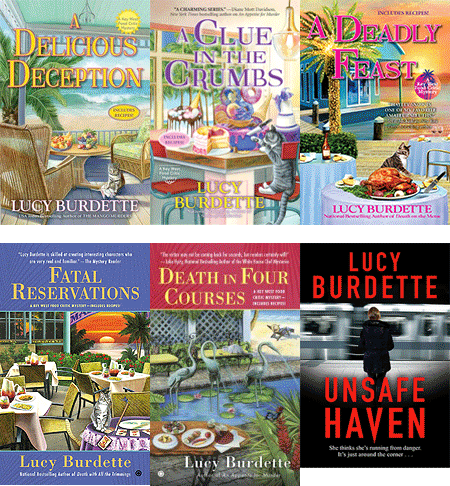

LUCY BURDETTE: I went to hear Betsy Lerner speak at RJ Julia booksellers two weeks ago about her new book, SHRED SISTERS. She was a long time nonfiction agent and editor before starting to write her first novel. I became most intrigued with her answer to how she could write about such a young woman when she is a long way from that age. She answered: I carry that girl with me everywhere.
For me, this was like hitting a gong that reverberated from head to toe. In the contemporary women’s fiction that I am slowly drafting, the main character is in her early 20s and arriving in Paris for the first time. What in the world would make me feel like I had the slightest idea about what she might be thinking and feeling? I realized that I was drawing from my own experience going to France for 5 months in the 1970’s, feeling overwhelmed and terribly homesick. My memories of landing in Paris and barely speaking the language and knowing not a soul are still seared in my psyche. I was farmed out to a French family to celebrate New Year’s Eve when I first arrived. They ate very late and very thoroughly and all the conversation was in fast French and they served RAW OYSTERS. OMG, I was dying. Many years from now (I hope) on my deathbed, I think that scared and overwhelmed girl will still be with me.
Two questions for the day: As a writer, do you have any trouble writing characters who are much younger or otherwise different from you? Must powerful characters come from personal experience?
HALLIE EPHRON: It’s a challenge for me to write in a VOICE (narrator) who’s a lot younger than myself. That’s where the internet is so helpful because you can go out and LISTEN to podcasts and videos that help tune your ear. (And it helps to have an extended family loaded with “experts” on how their generation says stuff and thinks.)
And yes, I absolutely think the most powerful characters come from personal experience – truly negative traumatic experiences can be spun into gold.
RHYS BOWEN: I got a letter from a reader once saying, “I’ve just seen your photo and until then I thought you were the same age as Lady Georgie.” Flattering, I suppose. But I have to say that when I write first person as either Georgie or Molly Murphy I really do think and feel like them. When I started both series the voice came to me instantly so that it was almost like dictating what they were saying. I have to be inside the head of my protagonist. I don’t know how I would handle a protagonist I didn’t like. And I don’t think I see the world as an elderly woman. Inside the wrinkles is still that twenty something.
JENN McKINLAY: My main characters in the romcoms and the mysteries have ranged in age from 27 to 50. Occasionally I feel like a fraud for writing about a twenty-something who upends her life but then I remember when I was 25, I threw all of my stuff and my cat and moved 3,000 miles across the country with no place to live or job and I didn’t have GPS or a cell phone. When I remember that version of me, I know I’m fine. I do think personal experience is critical for writing. How can you write about fear if you’ve never been afraid? Etc. And, yes, there are versions of me that are so powerful, I still draw on them when I need to.
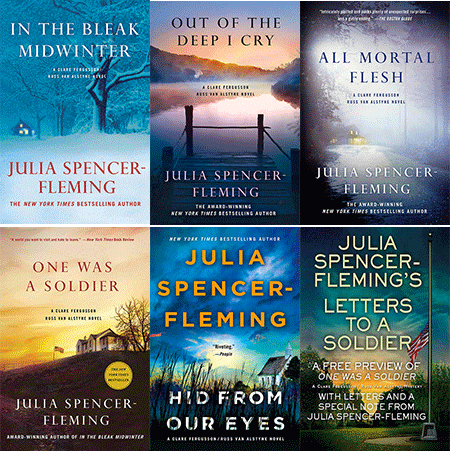
JULIA SPENCER-FLEMING: I don’t think I’d be able to write children as viewpoint characters, because those years seem so distant, and I can’t really connect with the emotions that child had. But the young woman I was? Oh, yes, so very much. Being in college, going abroad for school, the boys, the men, the dancing on the bar (Yes! Only once, though.) That somewhat wild young woman is still inside me, cleverly disguised by wrinkles and gray hair.
I do echo Hallie in that if I’m writing someone young TODAY, it helps enormously to have young people in your life to run the language past. Not just the slang terms - there are words and aphorisms most people under twenty don’t know. I said, “It’s a tempest in a teapot” to my 27-year-old K-drama-watching friend and she had never heard the phrase before. And when I went to explain it, I had to tackle “what is a tempest” first!
HANK PHILLIPPI RYAN: This is a great question. I find it very easy to write little kids–age maybe 5 to 13. Their voices just come out of me, and it’s actually, I will admit, it’s a pleasure. Not sure where it comes from, but I can hear them, and their hopes and fears and misconceptions.
A person older than 40, yes, got that, any gender.
But whoa, a thirty-something woman. That is so difficult, and I really have to think about it. Today’s 30’s are so different from mine–attitude, expectations, confidence.
As for powerful–hmm. I have written powerful scenes that do not come out of my specific personal experience–I have never been kidnapped, for instance. But I can channel fear and darkness from my own fears, I guess, and apply them. It’s like method acting–I can pretend it happened, and then write that. And I do feel the fear–or suspicion, or anger– when I’m in that part of the book. I make myself be someone else.
DEBORAH CROMBIE: I've always liked writing characters that were different from me. Two of my favorites from my very first book were women in the eighties. I felt so at home in their heads, even though I was on the cusp of forty at the time. I like writing children and teenagers, too–those ages are still in my head. Hank has a good point about writing about young women in their thirties and forties, who maybe have more confidence than I did at that age. But do they really feel any different about the basic things?
LUCY AGAIN: As a human being, for everyone, is there a version of yourself that feels so powerful, you will never lose touch with it (even if you might want to?)