Showing posts with label motivation. Show all posts

Saturday, March 2, 2024

What We're Writing Week: Julia Slowly Staggers To A Stop

 JULIA SPENCER-FLEMING: No, it's NOT done yet, dear readers. This is absolutely the worst part of the book for me - the ending. I swear, if I could just publish manuscripts that were 5/8 done and crowdsource the endings, I'd get books out - gosh, who knows, maybe every three years instead of four!

My issue with getting over the finish line is partly me, and partly the nature of the genre. For me - honestly, I don't know. I always slow down here, and we know, I'm not that fast to begins with.


 Psychological barriers to completion? Fear of success or failure? Not wanting to let go? I've done a lot over the past years to improve my scheduling and organization; maybe now it's time for therapy.


The nature of the genre is such that the end of any sort of crime fiction is usually 1) the high point of action and 2) has to tie all the threads together. For the first, well, I'm known for my action sequences. I like them. The readers seem to like them. But they are HARD! Making sure the reader knows who is doing what, where in space and when in a sequence of events... sometimes it feels more like planning a multi-person jaunt through an unfamiliar city via public transportation.


As for tying the threads together - I can only point out I have more than one unfinished piece of very elaborate needlepoint. Oh, I just LOVE adding more and more and more threads. Figuring out what to DO with them... not so much.

However, I am progressing. In fact, if I didn't write such #$%& long books,  I'd be done now, or close to it. Alas, I don't seem to have any more control over the length of my stories than I do anything else. Truly, writing is a mysterious process. 


This is the place where I would usually put some hopefully interesting question that would stimulate lots and lots of backblog comments. Instead, I have a favor to ask. Will you, dear readers, be my accountability partners? I'm highly motivated by guilt (if you had met my mother, you'd understand)  so if one of you asks "Julia, have you written today" EVERY DAY until I finish, I'll be too embarrassed not to write. Don't all do it, for goodness sake, that would be a nightmare. Just one person.

TIA, Julia

Thursday, February 22, 2024

MEANS, MOTIVE, AND OPPORTUNITY by Diane Vallere

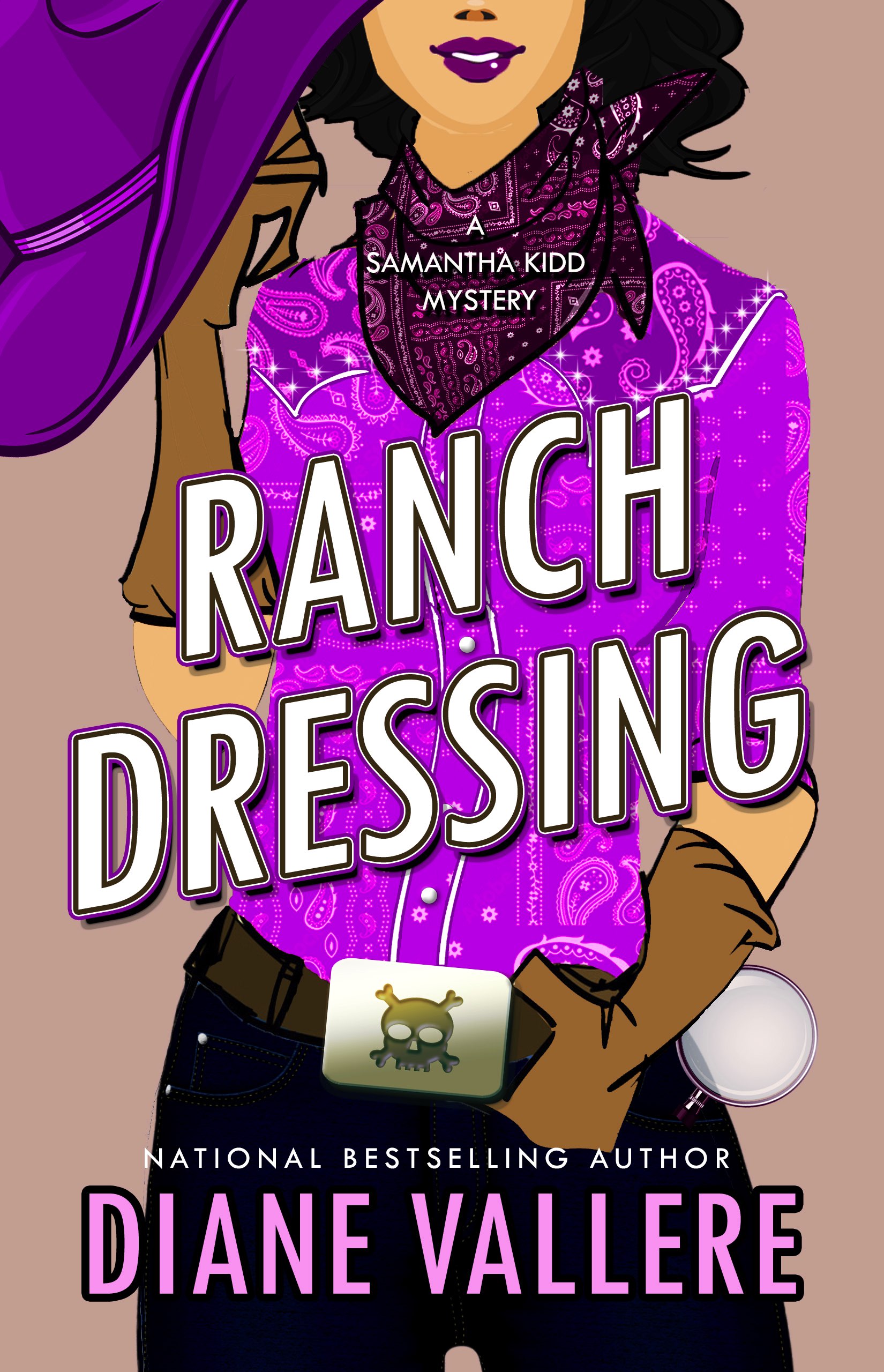
Jenn McKinlay: One of my favorite cozy mystery authors is here today! The amazing Diane Vallere and she is going to get us all clear eyed and motivated and tell us all about her latest Samantha Kidd Mystery -- RANCH DRESSING! If you read yesterday's post, you know this is exactly what I needed to read today. Take it away, Diane!

 
Diane Vallere: The first time I worked with a professional editor, she asked me about my character’s motivation. “What does she want?” she asked. 

“It’s a mystery,” I replied as if the answer to her question was obvious. “She wants to find the killer.” (The “duh” was implied.)

I am ashamed to admit that it took more than that one book to understand what she meant. Oh, sure, I quickly latched on to a fear of failure, and how my character was afraid to not succeed. And that carried me through a book or two, while my character succeeded in exposing the killer but failed at life, learning that failure was sometimes necessary for growth. It’s not a bad lesson to learn, but after a few books, it turns out, our readers actually want to see our characters succeed at life too!


Think about it. Life throws daily challenges at us. Some we win, and some we…keep trying to win. We only give up on the things that aren’t important enough to keep us motivated. But when there’s something we want—which may, by the way, be finishing our manuscript or to losing ten pounds or finally understanding how to style our naturally curly hair (ahem)—that motivation works like a fresh battery to keep us plowing forward even when things get tough. 

Ever get a great idea, something you just know will change your life? You just need to learn how build a bookcase/make fresh bread/change your sparkplugs/cut your own hair/become fluent in French/join a professional society/exercise for an hour each day. And you start out with the best of intentions, you buy the best supplies/ingredients, you pay your dues, you sign up for Duolingo. You sandwich your new habit between existing ones like James Clear suggests in Atomic Habits. You stick to your new routine because it’s important.

Until one day, it’s not. 

Your bookcase is partially built, you’ve been feeding sourdough starter for a month the only thing you make is a sourdough pancake. Your hair is lopsided, and you still don’t know the difference between savoir and connaĆ®tre. It’s not because you’re lazy, or too old to learn, or the principles of chemistry chose to boycott your sourdough starter, it’s because you lost your motivation. None of these things mattered enough to power you toward your ultimate goals. 

I don’t know about you, but my past is littered with partially finished projects that never got off the ground. (Case in point: there’s a partially re-rooted Barbie head sitting next to my desk as we speak.) But I find the time to write. And when I’m not writing, I can work on creative graphics for hours without ever realizing time has passed. Research is like a Vitamin B shot that powers me when I need a pick-me-up. Most of us never worked as hard as we do on the thing we love to do, to the extent that it doesn’t feel like work.   


In RANCH DRESSING, that same character who feared failure, who needed a few books to discover her motivation, goes on a trip to a dude ranch that her father-in-law is thinking of buying. She has no interest in the cowboy life, or western wear, or anything more than the Louis L’Amour books she packed, but the one thing Samantha Kidd cares about is solving other people’s problems. So when she’s relegated to the sidelines—just relax, read your book, we’ll handle this—her desire to help out becomes more than a desire, it becomes a mandate. The more she’s told not to get involved, the more she must. She can’t help herself—she’s that motivated. 

What about you, Reds? What projects have you let languish on the shelf and what keeps you motivated? 


DIANE’S BIO & SOCIAL MEDIA LINKS:

National bestselling author Diane Vallere writes funny and fashionable character-based mysteries. After two decades in luxury retailing, she traded fashion accessories for accessories to murder. As past president of the national Sisters in Crime organization, she edited the Agatha-Award-winning essay collection PROMOPHOBIA: Taking the Mystery out of Promoting Crime Fiction. Diane started her own detective agency at age ten and has maintained a passion for shoes, clues, and clothes ever since.

SOCIAL MEDIA HANDLES:

FB: https://facebook.com/dianevallereauthor

IG: https://instagram.com/dianevallere

YT: https://youtube.com/dianevallere

Website: https://dianevallere.com


RANCH DRESSING BLURB:

When fashionista Samantha Kidd’s father-in-law arranges a week on the dude ranch he’s aiming to buy, Samantha preps for blue skies and clean living. But all too soon she learns life on the ranch is anything but calm. When the owner is found dead inside one of the stables, all signs point to murder.

As Samantha wrangles clue after clue, she smells something rotten—and it’s not manure. In her quest for the truth, she encounters quirky cowhands, brazen barrel racers, and suspicious horseplay—not to mention a social paradigm straight from the eighteen hundreds. 

Can Samantha bring justice to the wild west of eastern New Jersey, or will a renegade ranch dweller get away with murder?

BUY LINKS:

Bookshop.org 

Amazon

Apple

Barnes & Noble

Google Play

Kobo

ENTER THE GIVEAWAY

PREORDER GIVEAWAY: https://www.dianevallere.com/ranch-dressing-preorder-contest

1. Preorder RANCH DRESSSING

2. Fill out form on my website


Saturday, September 5, 2015

The Blood Turns to Ink: How Real Crimes Influenced My Fiction

HANK PHILLIPPI RYAN:  Do all crime fiction readers devour the newspaper? (I still read three a day, and on paper!) Every crime story I see, I think—is that a plot for me? And often, I decide I could never use them, because no one would believe them.  Real life is infinitely surprising, terrifying,  coincidental, unusual, unique. Crushingly sad.

And—haunting. When we least expect it.  What a riveting backstory to day—from the incredibly talented Stephanie Gayle.


 How Real Crimes Influenced My Fiction


I’m from a small town. East Bridgewater, Massachusetts. Population: almost 11,000 when I last lived there. That was 1993, the year I graduated high school. A half-year earlier Kent “Rusty” Taber Jr. was stabbed to death in my small town. He lived in an apartment over the funeral home where he worked part-time as an embalmer. It was very big news. People weren’t stabbed to death in my small town. And the funeral home detail? Made it even spookier. Twenty years after that brutal killing, I wrote my first mystery novel, Idyll Threats. And it wasn’t until I was amidst my copyedits that I realized how much Mr. Taber’s murder had influenced my thinking about policing and murder investigations in small towns.

“When are we calling the Staties?” is something that Chief of Police, Thomas Lynch, hears constantly during the murder investigation I created in Idyll Threats. The locals in his small town don’t think his police force with its one and a half detectives, is capable of catching a killer. This is the exact refrain I heard from locals (including my family) during the search for Kent Taber’s killer. “When will the staties be called?” And eventually the staties were contacted to help, though they didn’t crack the case.

Kent Taber was gay. When this became known, it was assumed that fact that must’ve be key to his killing. To be gay was to be other. My protagonist, Thomas Lynch, is gay. And he’s keeping that fact a secret. Because he thinks his homophobic cops can’t handle the truth. This leads him to withhold crucial evidence pertaining to the murder, evidence that threatens to out him. How much did I internalize from Ken Taber’s murder, from small town talk and hateful speech? Impossible to say. But I’m sure it influenced how Thomas Lynch sees his community. And why I bristle when people say, “Oh, it would’ve been no big deal for him to be out.” I recall what a big deal it was, in 1992, to know a man was gay.  I set my novel in 1997. The same year Ellen DeGeneres made headlines for telling the world, “I’m Gay.”

My fictional crime is more easily resolved than the true-life crime that inspired it. By book’s end the killer in Idyll Threats is identified and arrested. Kent Taber’s murder remained unsolved until seventeen years later when Christopher Colucci was indicted for the crime. Colucci had worked with Taber. Someone reported that Colucci reacted badly to an advance made by Taber.  Five years after the murder, Colucci was involved in a car accident that left him paralyzed. He was deemed incompetent to stand trial due to the mental debilitation that resulted from the accident.

I’d been gone from my hometown so long, the news didn’t reach me. I thought Kent Taber’s killer was still at large. It wasn’t until after I’d finished my novel that I thought to look up the case. It was then that I learned of Colucci’s arrest.  And of Mr. Taber’s family’s disappointment at not having Mr. Colucci stand trial for his terrible crime. It made me grateful for my fictional world, where I can dispense justice in a way the real world sometimes cannot.

It took time for me to realize how pivotal one small town murder was in shaping how I thought about crime. I was quicker to realize that my second book, which features Chief Lynch investigating a kidnapping of a small boy, also owes a debt to history. The second biggest crime sensation of my life? The kidnapping and murder of a small boy from a nearby town. I can still see the yellow ribbons tied round the trees, the ribbons that tattered and faded after the boy had been found and buried.

Violent crimes live on in our emotions, our thoughts, and memories. Sometimes more than we realize. And for me, the blood turns to ink and spills out, many years after the original crime.

HANK:  Yes, Stephanie, so true... we can “dispense justice in a way the real world sometimes cannot.”  And  yet we devour the truth, since it’s a path to understanding.

So, Reds and readers, what do you think? And do you still read newspapers? How? Electronically, or on paper?  

*********************************

StephanieGayle’s mystery, Idyll Threats, earned a starred review from Booklist. Her first novel, My Summer of Southern Discomfort, was chosen as one of Redbook’s Top Ten Summer Reads. Her short fiction and non-fiction have appeared in Kenyon Review Online, The Potomac ReviewPunchnel’s, and other publications. She’s twice been nominated for a Pushcart Prize. She co-founded the popular Boston reading series, Craft on Draft. She tweets under @stephoflegends.

In the summer of 1997, Thomas Lynch arrives as the new chief of police in Idyll, Connecticut—a town where serious crimes can be counted on one hand. So no one is prepared when Cecilia North is found murdered on a golf course. By chance, Chief Lynch met her mere hours before she was killed. With that lead, the case should be a slam dunk. But there’s a problem. If Lynch tells his detectives about meeting the victim, he’ll reveal his greatest secret—he’s gay.


Friday, August 3, 2012

Mind Games


JAN BROGAN: I've always thought that novel-writing was a little like delivering a baby. Your brain has to deliberately forget all the pain and agony of the event so that you'd consider doing it again.

A new study on motivation (Haung et al, 2010), posted by my favorite blog, PSYBLOG seems to confirm this.  It's all now official: the motivated mind often steps in  with some helpful trickery.

If the new goal is to be achieved, it must be made to seem less daunting. In other words, if viewed realistically, babies wouldn't be born and novels wouldn't be written.

In the study, participants were told they were going to be involved in an ongoing effort to collect one thousand t-shirts to send to refugees in Haiti. To make sure they were motivated, they were given a lot of background on how important their task was, how desperate the state of refugees, and in particular,  how severe a lack of basic clothing.

One group of participants were shown only two full boxes of t-shirts already collected, simulating the feeling we get at the start of a big project, i.e. that there is still a lot of work to do.

These participants coped with this by over-estimating the number of t-shirts already in the bag. In fact, in comparison to an unmotivated control group who thought there were, on average, 92 in the box, those motivated souls committed to the task estimated there were 220 t-shirts.

The overestimating made them feel that the goal was more attainable. A self-delusional jump start.

Towards the end of the project, study participants also had a habit of keeping themselves motivated to completion by  under-estimating the progress they had already made. This helped them  push themselves on harder as they approached the goal, when the temptation is to slack off.

In other words, we lie to ourselves both to start and to finish.

This all makes perfect sense to me,  especially since I am reading the Steve Jobs biography and learning about his reality distortion field. But how about you? Have you ever tricked yourself into starting or completing a goal?

ROSEMARY HARRIS: Happens every time I start a hike! "This isn't that long...I've gone farther at a higher altitude. Look, I've already gone 20% of the way!" It doesn't work quite as well for me with writing - as in "Whaddaymean it's ONLY 300 pages?

DEBORAH CROMBIE: Oh, yeah. Every time. "Oh, sure, I can write five hundred words a day starting NOW and the book will be finished ahead of schedule." Ha, ha. Only problem is I never have any idea what I'm doing at the beginning of the book... but if we didn't underestimate how hard it was going to be, I don't know how we'd ever get up the nerve to start.

LUCY BURDETTE: Oh of course, it's fun in the beginning! Anything is possible. We're getting ideas like crazy and thinking of crimes and suspects. Only later does it become clear that we really had NOTHING. Little snatches of ideas with nothing figured out... I'm in that stage now where I need another 50 pages at least--but I've long since outrun my synopsis.

HANK PHILLIPPI RYAN: Are you kidding me? Tricking myself is an integral part of my entire life. My clocks are set fast so I'm not late. I SET THE CLOCKS. And then I "forget."  I don't enter my whole paycheck to my checking register--so I think I have less money than I really have. I'M THE ONE WHO ENTERS THE DEPOSITS. I believe my own stratagems. Oh, and I hide money from myself.  I stash $20.00 in a little pocket of my wallet, just in case. I put it there! But I always forget, and then when I  need, it, I'm SO happy!  About writing? I don't need to trick myself. The fear works just fine.

HALLIE EPHRON: Until I started writing fiction, I was one of those annoying people who got everything finished early. Projects. Thank you cards. College essays. It wasn't hard; I just did it. I found it calming to know I was ahead of my deadlines.

The problem with a book is that the deadline when you start is SO FAR OFF.  Now I'm a ditherer, and no 'trick' other than a deadline bearing down on me can get me to buckle down and write. And sometimes even that doesn't work unless I already have figured out what happens next.

RHYS BOWEN: I can't trick myself when it comes to writing. I'm in full blown panic mode at the start of every single book. The voice in my head whispers "You'll never get this story going. It won't be long enough. You'll say all you want to in 50 pages. It will be a horrible failure and they'll want their advance back." So the first 50 pages are like pulling teeth. Then there is a glimmer of hope. I see my way ahead. I start to write faster and with more confidence. By page 150 we are romping along merrily. I'm on my 29th mystery now and you'd think I'd realize that I know how to do it. But I've found that I need the panic mode to make me work. Several friends say the same.Nut cases, all of us.

JULIA SPENCER-FLEMING: I suspect in my case it's less "tricking myself" than blindly and optimistically planning that I'll be able to write to my max word count every day and that nothing in the rest of my life will interfere with my work. HA. I have to confess, I do the same when I plan to drive somewhere. If Google maps says it takes one hour fifteen minutes, I'll assume traffic is non-existent AND that I'll pick up time by speeding on the highways. Result: always arriving late and harried. Why do I keep doing this I don't know.

JAN: Yes, Julia, I do the same exact thing whenever I go somewhere and I never understood why I did it. Predictably. Almost compulsively. Then, in my last book, Teaser, my addictive protagonist, Hallie Ahern, became dependent on the adrenaline rush of danger (think the Kennedy clan) and I thought - okay,  now I've written something I really can't relate to, because I don't even like the thrill of boardwalk rides.  But then one day as I was racing around, leaving myself no time and getting harried in traffic, the thought occurred to me:  Maybe I'm doing this for the adreneline rush.  I mean, why else would I put myself through this all the time?

But that's some other study I'm sure!  How about everyone else out there? What mind games do you play to get your goals accomplished?


REMINDER: Melissa Robbins, your name was chosen to win a copy of No Way to Kill a Lady by Nancy Martin.  Please email me at Janbrog@comcast.net  with your snail mail address so Nancy can send you a copy.  Thanks! 

Sunday, February 24, 2008

ON PLASTIC


On May 9, 2007 Tupperware announced Brooke Shields as the celebrity spokesperson for Tupperware’s "Chain of Confidence" campaign in the USA. The campaign invites women to celebrate the strong bonds of female friendships and the self-confidence derived from those relationships.

**Wikipedia
I‘m generally not a yeller. In the face of adversity, I’m usually more in the problem-solving mode than the victim mode.

So why, the other day, was I in my kitchen howling? Because a whole raft of plastic containers and lids—-separate and I’m sure none matching any other-—came tumbling clattering sliding down onto my head from the highest shelf in the cabinet. Apparently they were finally executing their long-plotted plan to escape.

It was hilarious, I’m sure, if you aren’t the one being buried in a plastic avalanche. I tried to bat them away, unsuccessfully, as they attacked me. I wound up surrounded by plastic stuff, the cabinet empty, the floor covered. Me enraged.

To make it worse, my darling husband started laughing, always a mistake in situations like this, and he later told me I was yelling “Why? Why?” (Kind of like Nancy Kerrigan without the little skirt.)

Why? Why? As if the world doesn’t allow things to happen without a reason. (And it doesn’t count that the reason is that I had Fibber McGee’d them into the cabinet and of course they were gonna fall.)

But it got me thinking. In books, nothing should happen without a reason. And if Charlie McNally had Tupperware fall on her head, there would have to be a bigger picture reason why. To prove she's disorganized. Or a pack rat. Or to remind her of gravity, which then reminds her of a clue.

When I was editing PT from 743 pages down to 323, I did it by asking why, why, why. Why is this scene here? Why does this character say that? Why does she drive to the police station? And if it didn’t mean something, out it went.

So—shall we talk about motivation? Or-- whether anyone has conquered the Tupperware problem? (Hallie, I think I still have one container of yours…)

JAN: I feel the exact same way when I inadvertently create a mini earth quake or catastrophe -- which is not an infrequent occurrence. Why me?? Why have the Kitchen Gods done this to me now? Right now when I was (probably) rushing to get something done in the too-little time I always leave for it. And now have five minutes to get somewhere twenty minutes away.

But that's me. I have a feeling you are better with time management. And your tupperware catastrophe was probably a good omen. In fact I'm sure someone must have done a Feng Shui book about how Tupperware earthquakes in your "wealth corner" or "creativity corner" are predictive of good fortune!!! The tumbling out of fortuituous ideas..... See if you are a novelist Hank, you can make up a new meaning for every life event!

As to writing a scene -- I think every little bit of dialogue, action and characterization has to be there for a reason, or else we don't have storytelling -- we have life as it is -- with all its randomness and tedium. NO one wants to read about actual life. We want to read the meaningful, moving, suspenseful and condensed version.

RO: I tend to write lean so when I ask why, I generally have to add stuff as opposed to taking stuff out. More often I find myself asking "why wouldn't she..." If I can convince myself that it isn't too far-fetched for a character to do something, then I let her do it. But when you write an amateur sleuth, she will invariably do things that most real people wouldn't do..like stick her nose in where it doesn't belong.

Re: rubber containers...that's why I store them in a bottom drawer.

ROBERTA: Me too, Ro: I'm in the spare camp. I would never, ever, ever be in the position of having to edit from 743 pages to 300-something. I don't think I've hit the 300 page mark yet for a book! I think I must make assumptions about what's in my head and how well it's translated to the page.

And some day we should talk more about sticking noses where they don't belong. Every once in while it's enough to make me want to write a police procedural. Except (sigh), it sounds like so much work...

HALLIE: You know, what we're talking about is the intersection of plot and character. Your plot requires your Fiona to do X, but it only works if you've established a personality and history for Fiona that makes her doing X inevitable. And in a first draft, sometimes you write 443 pages of backstory that later needs to be cut. Not me...I'm like Roberta and I have to layer that stuff in later in order to make actions ring true.

If I store my plastic containers on the bottom of that closet, then I'll have to store the vacuum cleaner on the top shelf and then... it's too ugly to even contemplate.

HANK: Intersection of plot and character. I love that, Hallie. Because it also creates a moment of action. At an intersection, you have to make a decision. Turn? Go straight? I was reading a pal's manuscript, and at one point I asked : "Why does she do that?" And the answer came back: "She just does." That's a dead end.

But really, I do want to know what you do with your Tupperware-ish stuff. I found one of those plastic-containers-stacked-on-a-lazy-susan things. At the drug store? And it's terrific. (Next blog, pan lids.)

And PS--did you all see the cover of the new New Yorker? (My husband was laughing when he saw it (see above.) I said, all in denial, "It's a thesis she's writing, I think." He kept laughing)