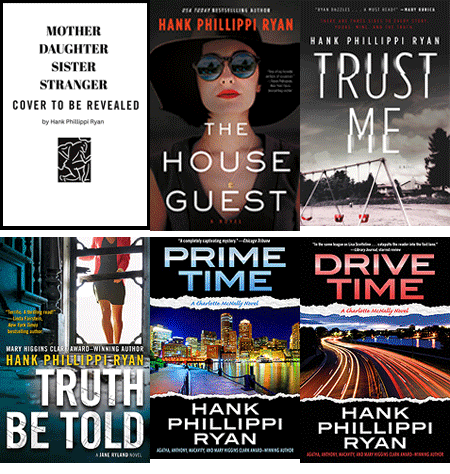
HANK PHILLIPPI RYAN: It was a day that will live in book infamy. The day the Massachusetts Department of Transportation completed the demolition of the Cape Cod rotary (a hideous terror ride for drivers that was impossible to navigate and equally impossible to survive) and replaced it with the streamlined and efficient "flyover" traffic pattern.
Good for drivers, terrible for me. Since that Cape Cod rotary had been a huge plot point in one of my books.
But the only good thing about such writer drama is commiserating with my pals. Do you know Tessa Wegert? Of course you do! She's brilliant and so talented, a terrific writer and a treasured friend.
Real-life geography also had one very unsettling close-to-deadline moment. But! She prevailed.
That time when life imitated art: The challenge of real-world settings in crime fiction
By Tessa Wegert
At this year’s New England Crime Bake (which was excellent as always), I participated in a panel about fiction vs. reality. Together with Bruce Robert Coffin, David Handler, Frankie Bailey, and moderator Edwin Hill, we discussed all the ways that real life can seep into stories, particularly when it comes to real-world settings that are too perfect (or too perfectly creepy) not to immortalize in a book. Oscar Wilde said, “Life imitates Art far more than Art imitates Life,” and that was certainly my experience when writing THE KIND TO KILL.
The Shana Merchant series, about a New York State Police detective tasked with protecting the Thousand Islands while living in the shadow of her serial killer cousin, is largely set in the true-to-life community of Alexandria Bay, NY. Whenever possible and relevant, I weave in the area’s fascinating history (think Gilded Age island mansions, titans of industry, and—I kid you not—river pirates).
One real-life location made its way into the fourth book in the series, called THE KIND TO KILL.

Photo Credit: Mike Franklin
Take a moment to Google “Carleton Island,” and you’ll see why: for over 70 years, the once-spectacular home sat abandoned, slowly crumbling at the water’s edge. The Carleton Island Villa off Cape Vincent became the inspiration for The Carleton, the fictional upscale bed and breakfast where much of the action in my mystery about a missing tourist and potential copycat killer occurs.
It didn’t occur to me that, after so much time, someone would come along and snap up the property, let alone plan to renovate it just as the fictional Barlowe family does in the book. It wasn’t until two days before my copyedits were due that I discovered the island had been sold…and that its new owner intends to open a bed and breakfast.
Out of respect for the new owner, I changed to the name of my inn, though regular visitors to the area will still recognize the iconic island home.
There’s a reason why a good many authors choose not to cite real locations in their work.

THE KIND TO KILL involves a raucous pirate-themed street festival, an event that is—in fact—held in Alexandria Bay every summer. One key character works for The Watertown Daily Times, the local newspaper that residents of the area turn to every morning, and tourist attractions like Heart Island’s Boldt Castle provide a backdrop for Shana, her partner Tim Wellington, and her Bureau of Criminal Investigation team. I’ve found that knitting colorful bits of reality into my stories adds authenticity, credibility, interest, and even a sense of urgency for the reader.
I sometimes wonder if I’ll be hearing from the developer who bought that property. With any luck, he’ll agree to sell THE KIND TO KILL to guests of the real inn on Carleton Island.
Do you include real settings in your writing, or enjoy reading about them in the work of others? Share your thoughts about fact vs. fiction and art imitating life (or vice versa!) in the comments.
HANK: I love to read about real life settings! How about you, Reds and Readers? And have you ever gone anywhere AFTER you read about it in a book? (And that gorgeous house in the blog seems like a perfect pace for a Jungle Red retreat!) And--we will clamor for the book!

THE KIND TO KILL
Former NYPD detective Shana Merchant is a skilled Senior Investigator keeping New York’s beautiful Thousands Islands community safe. She’s a loving partner. A strong woman. A survivor.
She’s also bound by blood to a serial killer. And after months of concealing the truth from the world as she hunted Blake Bram down, her secret is finally out.
Shana just wants to get on with her life and win back her community’s trust. But as Alexandria Bay fills up with tourists in advance of the annual festival known as Pirate Days, a visitor goes missing, and the case threatens to destroy not just the celebrations, but what remains of Shana’s reputation.
Shana’s not to blame for the killer in her family, but people are starting to whisper that she attracts trouble. That A-Bay was safer before she arrived. And as the investigation deepens, Shana starts to fear that they may be right.
Because while Bram is gone, he is far from forgotten.
Tessa Wegert is the author of the popular Shana Merchant novels, which include Death in the Family, The Dead Season, Dead Wind, and The Kind to Kill. A former freelance journalist and digital media strategist, Tessa’s work has appeared in Forbes, The Huffington Post, Adweek, and The Economist. She grew up in Quebec and now lives with her husband and children in Connecticut, where she studies martial arts and is co-president of Sisters in Crime CT.