Showing posts with label research. Show all posts

Monday, April 13, 2026

Research Rabbit Holes by Jenn McKinlay

 The Winner of Leslie Karst's MURDER, LOCAL STYLE is Brenda Gaskell! Brenda, please send an email to julia at julia spencer - fleming dot com (remember the hyphen!) and I'll connect you to Leslie.


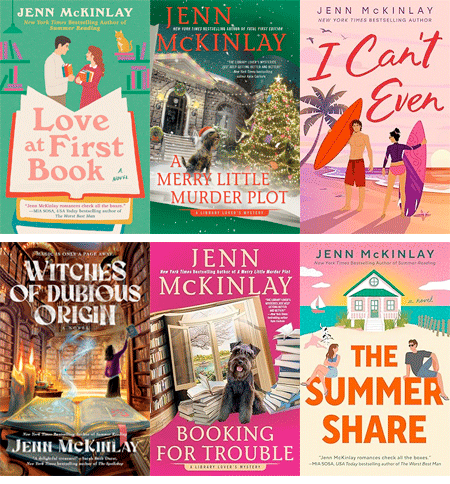
JENN McKINLAY: Writing brings an author to some seriously strange places. Over the course of sixty plus books in different genres, I’ve done deep dives into everything from how certain poisons work, naturally, to the inner workings of beauty pageants, dog shows, Elvis impersonators, and NFL football teams. I’ve studied conditions like dyslexia and anxiety and interviewed professionals about narcissism and obsessive compulsive disorder. And I’ve done boots on the ground research for settings from Arizona to New England to Italy (a hardship, I know). If you ask me what my favorite research was to date, I’d have to say going to the top of the Eiffel Tower for a pivotal scene in PARIS IS ALWAYS A GOOD IDEA. Hard to beat, I know. 


How about you, Reds? What is your favorite research deep dive and what book did you use it in?


RHYS BOWEN:  Every one of my books seems to involve a research deep dive. Exotic places, other times, the royal family, not to mention poisons and blood spatters. I studied the whole training program for secret agents in WWII. I sat inside a Blenheim Bomber and tried on a flight helmet. I have walked every street in lower Manhattan and at this moment I’m becoming an expert in appraising fifteenth century books! I love the way we become accidental experts!


Much of my research involves a trip somewhere. Researching at the antique Correr library in Venice. Learning to make Tuscan pasta. This is definitely the fun part. Eating on a dock beside the Mediterranean is magical. 


LUCY BURDETTE: With my Key West series, most of the research has been exploring the undercurrents of the island. I did love my two experiences with the citizens police academy and sheriff’s police academy. There is an almost-deserted island I need to visit for next book, though it scares me a little…


Other than that, Paris, Paris, and Paris!


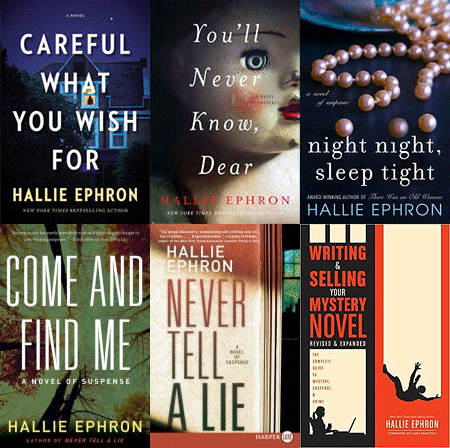
HALLIE EPHRON: Every book has involved a foray into some topic or place I’d never have imagined myself investigating. I’ve been to a brain bank (donated brains arrive in FedEx boxes and get stored in buckets so they look like oversized cauliflowers taking a bath). I was a tourist in an MRI lab (how to kill someone? Let me count the ways!) The mud flats at low tide in and around Beaufort, South Carolina (not a place you want to get stuck). 


I started writing a book about a psych/intern who works nights as an exotic dancer, but realized that research into what that would be like was a bridge too far.  Nope, not going there.


JULIA SPENCER-FLEMING: My on-site research has consisted of a lot of hiking around places in upstate NY, looking for likely sites to hide a body and buildings and business that catch my eye - I want to make sure the reader absolutely feels like they are right there in Washington County.


When I wanted to describe Clare piloting a helicopter in the southern Adirondacks, I went to my dad. For years, he had the top of the line, most recent version of Microsoft Flight (with different kinds of yokes and controls to match the aircraft he was “flying” and he led me through the entire spin up process and flight plan - the program let me see what Clare would have seen. You can take the man out of the Air Force, but you can’t take the Air Force out of the man, I guess.


I keep saying I’m going to set a novel in someplace warm (Aruba?) or beautiful (Vienna?) but so far, it’s all snow, mud or high heat/high humidity. Sigh.


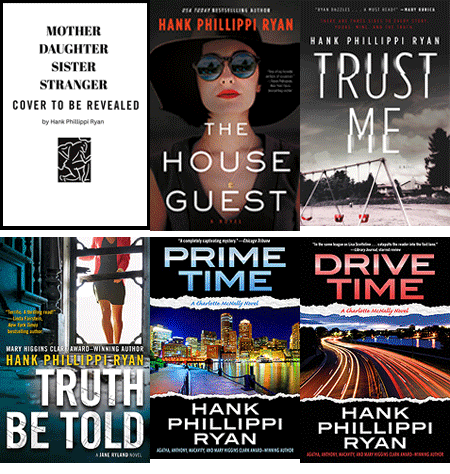
HANK PHILLIPPI RYAN: Usually I make stuff up. And as a reporter, I’ve wired myself with hidden cameras (and got caught in a cult once...ahh) and gone undercover and in disguise. Been in prisons and jails and behind the scenes at the airport and courthouse and been with SWAT teams and tear gassed and inside a nuclear reactor. (Oh, and in the FBI Academy, I figured out how to fool the lie detector. They are, truly, STILL mad at me.) I have, though, done a lot of on-line research into the psychology of revenge, and geography of an area, and time zones, and things like “how long to drown in salt water vs. fresh water” and “what are the symptoms of CO poisoning.” That stuff has to be right. Still mostly, I make stuff up.


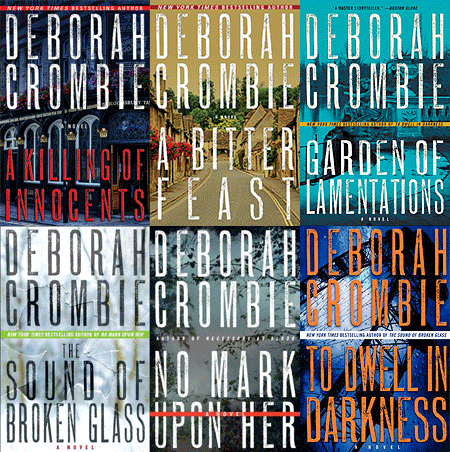
DEBORAH CROMBIE: I have had such a blast doing research for my books. From the history of tea to distilling single malt scotch, London during the Blitz and Notting Hill in the Sixties, elite rowing, search and rescue dogs, Crystal Palace and the Great Exhibition, immigration in East London, fire investigation, female chefs and life in a professional kitchen, to undercover cops in the Met, and more… How to pick a favorite? I don’t think I can!


How about you, Readers, what informational rabbit holes have you fallen into?


Friday, July 11, 2025

Research 101: a.k.a. Learning to Kill (on paper!) by Allison Brennan

Jenn McKinlay: Last week I had the very good fortune to sign books at the Poisoned Pen Bookstore with the extremely talented Allison Brennan. Of course, I asked her to visit us and she very graciously agreed. So here she is to talk about the warm and fuzzy topic of writing what we know or rather what we don't know.

BUY NOW!

Allison Brennan: Later this year, Im presenting a workshop titled How Can I Write What I Know When I Havent Killed a Man?

Its a fair question. Especially when writers are constantly told: Write what you know.”

Well, if I only wrote what I knew? My books would be mind-numbingly dull. Im a mom. A daughter. A wife. You know—like millions of women. I once worked in the California State Legislature, which sounds more exciting than it was. (Spoiler: it wasnt.) I went to a college prep high school, dropped out of college after two years, and my first job was at a bookstore, where I had to prove I could alphabetize and make change. I've also been a bartender, admin, hostess, a waitress for roughly two minutes (I was terrible), and spent a summer at Marine World learning how carnival games work—yet still couldnt win a single one.

 The truth is: if you're writing crime, thrillers, or suspense, you cannot rely on television for research. Just because a fictional FBI agent tracks a suspect cross-country doesnt mean the real FBI lets agents hopscotch around the country like Jason Bourne on a road trip. (Yes, I made that mistake once.)

 Some authors do write from specialized experience—doctors writing about doctors, veterans writing military thrillers. It adds a layer of authenticity thats hard to fake. Tess Gerritsen made Maura Isles come alive with her medical background. John Grisham nails courtroom drama. Tom Clancy practically was a submarine. And Jack Carr? Real-deal Navy SEAL turned bestselling author.

 But heres the thing: Tess had never been a cop, and she still gave us Jane Rizzoli. Lisa Gardner has never been a man, but writes in the male POV quite well. And Im reasonably certain Gregg Hurwitz has never moonlighted as a government assassin. (But if he has...I take it back. Great job. Very convincing.)

 So no, Ive never killed a man. But I have a vivid imagination. And if I can picture it? I can write it.

 And I’ve pictured some very fun, er, interesting, um, diabolical … well, let’s just say my husband definitely doesn’t want to get on my bad side,

 Let me introduce you to my best friend: The Book of Poisons. That book has helped me off more characters than I care to count.

 Back when I was writing my second novel—my debut wasnt even published yet—I needed to figure out how to sabotage a car so it would break down after only a few miles of driving. This was before Google answered all of lifes weirdest questions. So I called mechanics in my town.

 Hi, Im Allison Brennan. Im writing a novel. What could I put in a cars gas tank to make it stall a few miles down the road?”

 Shockingly, no one answered my question. Instead, they hung up. I suppose I’m lucky they didn’t call the cops.

 Desperate, I brought it up at my nieces baptism (as one does), and my brother-in-law said, Hey, my buddys a mechanic. Let me grab him.”

 Five minutes later, Im pitching this mechanic my scene, explaining that sugar doesnt quite work unless the gas is low. He nods and says, You want to clog the fuel filter. Thatll do it.”

 We brainstorm. He suggests molasses—heavy, slow, perfect for settling at the bottom of the tank and causing problems right on cue. Boom. Sabotaged car. Kidnapping scene secured.

 Perfect.

 Since then, Ive:

 * Observed an autopsy.

* Played both hostage and bad guy during FBI SWAT training.

* Toured Quantico.

* Done countless ride-alongs.

* Interviewed experts about everything from blood spatter to bomb tech.

 All to make my stories more authentic—even if Im still making stuff up for a living.

 My latest book, Beach Reads and Deadly Deeds, is my 49th novel. Its a little lighter than my usual thrillers (read: fewer corpses, no blood), but the research was still essential—especially since Id never been to the Caribbean.

 In the first draft, I had my characters taking a hot air balloon ride. Very romantic. Except... there are no hot air balloons on Caribbean islands. At all. I researched how they work, and realized theres a very good, very scientific reason theyre not floating around out there. Ive since forgotten what it is—but the balloons had to go.

 Then theres the fictional island of St. Claire, where my protagonist Mia Crawford is sent on a mandatory vacation. I made a rough map to help with continuity. Then midway through the book, I hit a problem: a scene required Mia to hike from point A to point B, but there was no path. I panicked. My entire mountain-trekking sequence was ruined.

 Until I remembered: St. Claire isnt real. I made it up. I can put a path anywhere I want.

 Waterfall too far north? Slide it south. Boom. Problem solved. Magic of fiction.

 Now, I have made mistakes. Some on purpose, for the sake of the story. Others? Honest goofs. Like the nurse who emailed me to say she threw my book across the room because I miscalculated a Valium dose by about... 500%. Whoops.

 The thing is, we dont know what we dont know. Thats why research matters. But I try not to let my research show. It should be invisible. Seamless. If readers are too busy noticing my fun and clever facts, theyre not fully immersed in my story.

 My rule of thumb? Willing suspension of disbelief.

 If the characters are compelling and the story is gripping, readers will go along for the ride—even if a detail is a little off.

 That said… if I were to plan a murder, Id want to do it right.

 I mean, Id want my characters to get away with it. Definitely just my characters. Wink wink. (Ha! Just kidding! In case the NSA or someone is reading this …)

So tell me: Do you appreciate when authors get the research right? And are you willing to overlook a few missteps if the story's too good to put down?


Allison Brennan is a New York Times and USA Today bestselling author best known for her Quinn & Costa FBI thrillers and the Lucy Kincaid series. She lives in Arizona with her family and assorted pets. Beach Reads and Deadly Deeds is her 49th novel.


Saturday, June 7, 2025

Down The Rabbit Hole We Go!


Don't forget! Join us for REDS AND READERS HAPPY HOUR Saturday June 7 at 7 PM on Facebook! Prizes and surprises! And all the news.

HANK PHILLIPPI RYAN: It’s from Alice in Wonderland, isn’t it? That we go “down the rabbit hole” into research? How many of us have visited there?

And –how many of us can get out? That may be the better question. Why does every answer lead to another question?

Because–because we are lucky.

And here is Kate Woodworth with her own particularly unusual adventures.  And she speaks for us all! Who but a writer could have such a fabulous and hilarious journey?


Once You Were Normal. Now You Write Fiction


By Kate Woodworth

You know how it goes: You’re struggling with a line of dialogue and a thought rushes past, holding a stopwatch and muttering “I’m late! Deadline!” Next thing you know, you’re down the rabbit hole, telling yourself that research is necessary. Are there chestnut trees on Maine islands? What about skunks? How do zoning issues get resolved in small towns? What’s a swimmeret?

You are now deep in Tunnel One. The original question has disappeared. The ticking of the deadline clock is no longer audible. Instead, you hear the murmuring of future readers growing louder. They are wearing deerstalker hats and looking for your missteps with high-power magnifying lenses. You should quit researching. Get back to work!

For motivation, you show some pages to a trusted friend, hoping for an enthusiastic, “It’s GREAT! Don’t spend time researching! Just write!” Instead, you get: “I don’t believe your main character knows anything about farming.” Unsurprising because, of course, you don’t know anything about farming. No more internet research. It’s time to talk to experts.

Suddenly, you’re in a world that resembles the real one, except that strangers are willing to answer random questions simply because you have identified yourself as a writer. All those years trying to amass education and experience so as to appear credible in the working world, and now all you need to tell people is that you like to make up stories and they’ll explain how to trim a goat’s hooves and all the ways a tomato crop can fail.

Some things—like birth—are hard to witness unless you live on a farm, and so hours are lost watching lambs being delivered on YouTube. Others—like lobster courtship and mating—are so surprisingly fascinating that you find your friends backing away, unwilling to listen yet again to your nattering about the convenience of sperm packets that can be stored for a year or more.

By now, you’re essentially living in the research rabbit hole.

Sometimes your body is present, doing the required life things. But in your head, you are finding unexplored…important unexplored…tunnels. Why, exactly, is the Gulf of Maine warming faster than almost every other body of water on the planet? Do lobsters have lips? Scampering wildly from question to question, you run headfirst into someone who lives the life you’ve given your character: an actual lobsterman. Retreat!

You cold call unintimidating pseudo-experts, like captains who take tourists out for an “authentic lobster cruise”. You elbow aside a honeymooning couple from Colorado and a seventh grader with an essay due. You screen out your spouse’s murmured apologies.

“Research,” he says, by way of explanation, perhaps hoping to convince others you’re a scientist.

You ace the quiz on how to sex a lobster (it’s all about the swimmerets). Your hand is first in the air when your guide captain for volunteers to hold a lobster. When he asks, “Who wants to kiss a lobster?” you don’t hesitate. You pucker up. Dozens of cameras click. You wonder about kissing another “man” in front of your husband but decide it doesn’t matter. You didn’t kiss the lobster on its lips (too close to those claws!) and, besides, it’s research.

What’s the strangest thing you’ve done as part of researching your book?


HANK PHILLIPPI RYAN: I am still laughing about “I don’t believe your main character knows anything about farming.” That’s SO perfect.

So yeah, what’s the strangest thing you’ve done as research–or, how about this, what’s a cool thing you learned when you were looking for something else?

OR–tell us the first thing in your search history right now. Mine is: "Do chipmunks eat rat poison?” SO important!

AND: Whoa. Look at Kate's book cover below. Isn't it gorgeous?


About the Author

Kate Woodworth is the author of Little Great Island, a novel about the power of love and community in the face of climate change on a small Maine island, and of the monthly Substack, Food in the Time of Climate Change…which gives her plenty of reasons to wander the research rabbit hole. For more, visit katewoodworth.com.


About Little Great Island


On Little Great Island, climate change is disrupting both life and love

After offending the powerful pastor of a cult, Mari McGavin has to flee with her six-year-old son. With no money and no place else to go, she returns to the tiny Maine island where she grew up—a place she swore she’d never see again. There Mari runs into her lifelong friend Harry Richardson, one of the island’s summer residents, now back himself to sell his family’s summer home. Mari and Harry’s lives intertwine once again, setting off a chain of events as unexpected and life altering as the shifts in climate affecting the whole ecosystem of the island…from generations of fishing families to the lobsters and the butterflies.

Little Great Island Illustrates in microcosm the greatest changes of our time and the unyielding power of love.

Buy the book: https://bookshop.org/p/books/little-great-island-kate-woodworth/21515752?ean=9781960573902&next=t


Sunday, December 22, 2024

What You DON'T See


HANK PHILLIPPI RYAN: What you do see, every Tuesday at 4 PM on CRIME TIME on A Mighty Blaze on Facebook, is my face, and an author's face, and you get to hear an interview with someone who just wrote a terrific new book. You get to ask questions, and spin the wheel of fun, and someone always wins a book.

And it all looks very seamless and fun. 

But what you don’t see is the brains of the operation.

Behind the scenes is a brilliant genius of a woman named Margaret Pinard. She and I have worked together for what – – five years almost now? She is the producer of CRIME TIME, and honestly Reds and Readers, without her the whole thing would fall apart. More than fall apart..be nonexistent. And I am astonishingly grateful to her every moment of every day.


But here’s the other part of Margaret. She is a brilliant, brilliant author! Her brand new book is called Orla Rafferty Seeks Her Fortune, which is about the best title I’ve ever heard. And you can find more about it  on Instagram @Margaret Pinard.

And like so many of us here at Jungle Red, she adores her research. And can come up with all kinds of reasons to do it! See if you agree – – and I will award a copy of Orla Rafferty, to one lucky commenter!


A Research Trip Is as Good as a Rest


By Margaret Pinard

Who here loves a novel that drops you into another place and time?

Yes, yes—you need story, character, pacing, and all that, but I love escaping into the tactile feel of Somewhere Else, be it fantasy, mystery, historical, or what-have-you.

So I suppose it’s no surprise that if readers enjoy this… writers might too! And this is how I, a writer in a slump and at a standstill with a draft, turned to a research trip to find my bearings.

These bearings appear to be permanently installed in Scotland. Having written six books with Scottish locations and/or people, my heart knows what it wants. And I needed to make my latest soul-refresher of a trip as useful to the draft as possible, which meant assessing, planning, and capturing.

I’m sure you all know how to plan a trip. But let me show you what I did to assess, plan, and capture, in case you ever need to use my excuse.

ASSESS


Where are we in the drafting or editing process? What do we need?

In my case, I had a sort of franken-draft. Started out with one idea, grafted another onto it, plotted a trilogy! But then I needed to reconcile all the backstories and motivations, which meant a lot of revisions. (I do not recommend this method; it landed me in the previously mentioned slump.)

So I was looking for supporting cast members and sensory details that would help ground the reader and reveal the main character. I had surfed through history books and bibliographies to narrow down the location and set my sights on ‘The Three Touns’ of Saltcoats, Ardrossan, and Stevenston (all in Ayrshire) for my founding myth of Irish rebels fleeing imprisonment.


The biographical sketches I’d read for people (men) of interest pointed me to Ayrshire, and I thought a small, seaside town would provide a good contrast to the industrial bustle of Glasgow (note: we’re talking about the 1830s!). Then I went to Google Maps to look for local museums and their hours (and possible closures).

Bingo!

A converted church in Saltcoats was open Monday through Wednesday and the last Saturday of the month—well, now I had my dates! (I opted for off-season for better airfare—February in the Lowlands!)

Since I had a few key letters in my story, I wanted to see some representative samples of those, or at least some on which I could model mine for authenticity’s sake. For that, I would need to seek out the Glasgow City Archives collections, in the Mitchell Library, which were available by appointment, Tuesday through Thursday and the first Saturday of the month.

Well, I could just make both of those schedules work!

Here were the two strongest leads to help me balance out my story. Now I just needed to plan the itinerary to make them possible.

PLAN

I sent the first email to the archives on October 25th, 2023. This is when I started requesting the airfare alerts, also. I had to find the right contact, confirm procedures, narrow down the materials I wanted to view for the short time I would have (six items only!), provide consent forms, etc.

(And yes! This was my idea of a relaxing good time!)

There was no one to contact at the North Ayrshire Museum, so that was left up to fate, which you’ll see wanted to have a laugh at my expense later. I arranged the plane, train, and room (because why would the airline fly me to Glasgow when it could just dump me in London?), and crossed my fingers.

CAPTURE

Then came the magical part.

It was ‘stotting down’ in London when I arrived, and the complete drenching I got on the walk to the hotel had to be remedied by a browse at the iconic Waterstone’s across the way. Suddenly, the woolens were not quite so sodden…

It was the darndest thing. Late February, I got on the dreary London train and zoomed north to Glasgow, and the skies cleared. The sun (sun! In February!) stayed out in Ayrshire for the entire four days I was there.

OK, OK, enough about the miraculous mental health bath, I hear you saying—how did I capture my details?


First to the countryside with its converted church. This part of Ayrshire has a lot of commemorated history, and so the exhibits that they’d arranged were not all relevant to my story’s class (middle), trade (newspapers), or era (1830s). But there was still a vibe.


The wooden marquis, polished to a dark shine, displaying names in gold of each year’s Best Boy and Girl of the local school: pride. The silver tea urn presented as a prize for a bowling tournament: wealth. The set of three dishes given to a servant when the Earl of Eglinton’s castle was to be abandoned: a complicated web of emotional connections between classes. 

With this museum, I was getting the material culture experience: what was important enough to save over the centuries?

I also perused the museum’s specialized library and chatted with the knowledgeable curators. 

And here’s the fate-laughing-at-me part. 

When I arrived, I was exactly on time for opening. But I walked the perimeter twice, stepping among gravestones, and couldn’t find an entrance. So I walked away, checked the website on my phone again, and returned, perhaps ten minutes after the hour. I was staring at the likely front door, wondering what I would do if it didn’t open—when it did! And I just about gave the poor woman a heart attack when she saw me standing 10 feet away.

She ushered me into the foyer, and as I took off my obligatory pack and coat quietly, the other woman in the library area turned around and I nearly scared her to death too! Apparently they aren’t used to folks being both eager and quiet? At any rate, they were great fun to chat with about local history and gave me several very helpful local walking tour maps.

At the City Archives, I again arrived right on time, but this time there were other researchers queueing with me outside in the cold. No heart attacks. I was ahead of my appointment time, so I browsed among the city collections and fell headlong into several histories of Glasgow’s banking sector—a fascinating evolution—or perhaps that’s my Shiny Object Syndrome speaking. Saving for later.


I did find representative samples of letters and records, though some of the records I saw were not those I’d requested. They were short-staffed, and trying to be accommodating, so I just rolled with it. What could I capture from:

An 1830s ‘letter book’?

An 1826 letter from a ward to his guardian?

An 1850 letter about a woman starting a lending library?

A letter from a group of men supporting the local laird in an election?

And this is when the magic of research obliterated my slump. When I arrived back home, I shuffled all my notes together, sat down, and actually made progress.

I had new names, new positions that made that society work, a desultory tone of voice for a woman, a tone to use when speaking to a superior and trying to stay in his good graces. These sent me swimming back into the whitewater of my political awakening story, with many personalities to choose from.

Margaret, 1; Slump, 0.

What’s the most powerful place you’ve visited for research, or incorporated into a story?


HANK: Slump, zero! LOVE this!

What do you think, Redsa and readers? Tell us one pivotal place–and a copy of ORLA RAFFERTY SEEKS HER FORTUNE to one very lucky commenter!


Margaret Pinard is a free-wheeling soul from the 19th century who finds it easiest to disguise herself by drinking tea, writing historical fiction, and popping off to the British Isles 'for research.' She has published seven novels and one collection of short stories. Her latest historical fiction work dives into 1830s Glasgow to highlight one woman’s political awakening to an age of revolutions--the first of a planned trilogy. Margaret hosts an active Youtube channel and blogs on the Patreon platform.


Tuesday, October 8, 2024

Rhys is Researching.

 RHYS BOWEN: This has been one of few occasions when I'm NOT writing. Clare and I are close to the end of the next Molly book and I'm leaving it to her to finish it (we know whodunit and why).

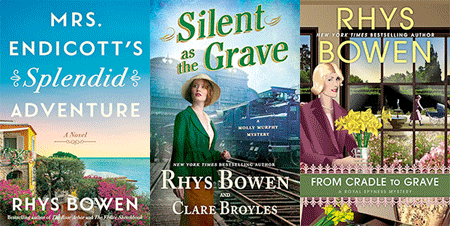
I am due to start on the next Spyness book, which I'm calling FROM CRADLE TO GRAVE.  AND, as many of you will know if you follow us or are a member of Reds and Readers, I have managed to sneak a quick trip to Europe spending a lovely week in the town of Cassis, in Southern France.  The reason for going there ( apart from fabulous views, sunshine and good food) is that I have used it as the basis for my next stand alone novel MRS ENDICOT'TS EXCELLENT ADVENTURE. I've talked about it here--middle aged British woman escapes to the South of France and starts and new and exciting life. 

The town I have set this in is fictitious but anybody who has been to Cassis will recognize it. I made it fictitious as bad things happen in my story an there is a villa on the cliffs that doesn't exist in real life. I had been through the area before so I had a general impression but I wanted the details that bring a story to life and make it real. So I made notes as we drove through the countryside--more pine trees than I had expected. I made notes as I walked thrugh the market and saw what was for sale. 

And when they landed the catch at the port and when the men assembled to play Petanque. Now I can go through my ms and fine tune all the descriptions, bringing my town of St Benet to life.

Cassis (and my St Benet) is a small harbor town set amid steep hillsides with a great cliff at one side.


The area is famous for the Calenques (inlets between steep sea cliffs). The hillsides are covered in vines.


At nighttime it's magical: 

And our apartment had this lookout from the grounds.


 Not bad, huh? Needless to say I didn't get any real writing done while we were there. Back to the grind later this week.

Writers, do you have to go to the place you are writing about? Readers, how important is the feel of the place in a book?


Monday, September 30, 2024

RESEARCH REVELATIONS by Jenn McKinlay

JENN McKINLAY: After sixty books written, I have to say I’ve had to research a wide variety of topics from hoarding to driving in Ireland. But in A MERRY LITTLE MURDER PLOT (coming out on Oct 8th), I had to research the possibility of death by electrocution using a string of holiday lights…well…oh, wait, I can’t tell you anymore because it might spoil the book. Suffice to say, it is very possible. 


PRE-ORDER NOW

Now tell me, Reds, what is the most interesting/oddball/alarming thing you learned while researching one of your books?


HALLIE EPHRON: How easy it is to kill with an overdose of Tylenol. It’s scary how little it takes. Also: dead bodies don’t bleed. If it’s bleeding it ain’t dead (yet). Also: It’s pretty easy to “accidentally” kill someone in an MRI lab (between the super-powerful magnets and the massive amounts of liquid nitrogen, easier than you want to know). It’s amazing that mystery writers can even sleep through the night.


RHYS BOWEN: as Hallie said, in real life too many people get away with murder. How easy it is to tell an elderly person he’s forgotten to take his pills so that he gets a double or triple dose. And if an autopsy is done you say “ he was getting so forgetful!”


My garden is full of oleander. While not as deadly as rumor would have it it looks like a bay leaf in a casserole.


The most interesting research I ever did was asking John to help me in a scene where Evan has to wrestle a gun away from a man on a steep mountainside. We tried to act it out and ended up in an interesting position entwined on the floor, much to the horror of one of our kids!


HANK PHILLIPPI RYAN: Oh, so much fun! And if someone looked at my search history, they would really be perplexed. How long does it take to drown in salt water, what does someone look like when they’ve been asphyxiated. Can you make mac & cheese with bananas? Seriously, I cannot tell you why I looked that up.


There are always, always, wonderful things you find that you were not looking for. For instance, my character Jane Ryland is called Jane Elizabeth. Her idol is Nellie Bly, the reporter. Guess what Nellie Bly’s real name was? Elizabeth Jane. I just loved that, and I did not know it when I wrote it.  


DEBORAH CROMBIE: Just think what our collective search histories would look like! a veritable smorgasbord of murder methods! Jenn, I electrocuted someone in my very first book, and learned why it's not unreasonable that regular outlets are not allowed in bathrooms in the UK… Also for that first book I remember posing myself on the stairs as if I'd been pushed down them–ouch! And like Rhys, we've done our share of role-playing. The lengths we will go to for our plots!


JULIA SPENCER-FLEMING: I went down a rabbit hole while researching the 1930s scenes in OUT OF THE DEEP I CRY and wound up learning how to harness a horse team for plowing. I actually used some of, too, as Harry McNeil questions someone! 

Weirdest research was with the help of my dear late friend, Tim LaMar. Tim was my go-to guy for guns and violence. Despite being a gentle and very physically unimposing man, Tim knew his stuff, and he walked me through how to turn a sapling into an offensive weapon, and what hitting someone's head with a big rock sounded like. 

And I second the concern over our search histories! You can imagine the sorts of things I was Googling for when researching the upcoming book, which is about a Neo-Nazi militia. Please don't come for me, FBI!

LUCY BURDETTE: The searcher would find my history heavy on poisons as well! Lily of the Valley? Check! Some kind of poisonous nut that would work well in a pie crust? Check! I also loved my research for the golf lovers mysteries–I went to actual LPGA tournaments to talk with the players, and even bought a slot to play in the professional/amateur tournament. It took most of my (admittedly small) first advance, but I wouldn’t trade that memory for anything. John caddied for me and was paid $50 at the end:)

How about you, Readers, what bizarre information have you learned while reading or researching that you didn't know before?