Wednesday, September 5, 2012

Declan Burke and Books to Die For


JULIA SPENCER-FLEMING: It's a question we all get asked; authors and readers, librarians and booksellers. Facebook and Goodreads and Library Thing ask it. People at book signings, interviewers, and students ask it. But who would be crazy enough to ask it of 120 of the most well-known crime fiction writers of today?


A couple of Irishmen, of course. Today, Declan Burke is here to talk with us about the very simple concept - and the sometimes complicated execution - of getting a list of Books to Die For.


Just say you were asked to recommend one great mystery novel to the whole world. It's the book you love more than any other, and love is often irrational. Love is not in the slightest bit worried about technical brilliance or cultural importance or defining or inventing a genre. Love is passionate, illogical, often perverse. We're talking about the book that can render you speechless, the words jumbling on your tongue, in the rush to sing its praises.  


So - which single book would YOU choose? 


That was the general gist of the question John Connolly and I asked of almost 120 writers from all around the world for BOOKS TO DIE FOR. The response was astonishing. 


In retrospect, I suppose we should have expected to be overwhelmed. Is there any question more intoxicating to a book lover than, “So, what's your favourite book?” 


Equally, there's no question more ridiculous to a book lover than, “So, what,s your favourite book?” Because really, who could possibly limit themselves to just one book?


But rules are rules, and there is only a finite amount of paper in the world, so we held each contributor to a single book. 

Naturally, every single author who contributed an essay picked exactly the book we thought they would pick. 


You're picking up on the sarcasm, right?

 
Right. Because if there's one thing I've learned from the process of putting BOOKS TO DIE FOR together, it's this: Never try to second-guess a writer on the subject of their favourite novel. 


Put it this way. You'd imagine that the name of Agatha Christie, for example, might come very high on the list of first options. That there would be a queue, and not a particularly orderly one, to write about the Grand Dame of the Golden Age of the British mystery novel. 


Well, you'd be wrong. I'm guessing - there I go again - that many of the contributors were second-guessing us. Believing that Agatha Christie would be one of the first names to be chosen, they went for less obvious choices. 

As it happens, the flurry came near the end of the process, and we ended up including two books by Agatha Christie. 

By contrast, we could have held a lottery among all the authors who wanted to write about Josephine Tey. 

Was I aware of Josephine Tey's literary legacy? Yes. Had I the faintest inkling that she remains so vitally important to successive generations of writers? Not an iota. 


This was just one of the many wonderful surprises that came with putting together BOOKS TO DIEFOR. Many of the titles and writers chosen were familiar to me, of course; but one of the joys of the project was discovering authors and novels I'd never even heard of before.

 
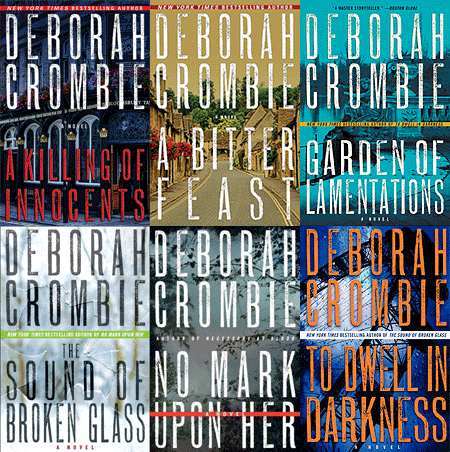
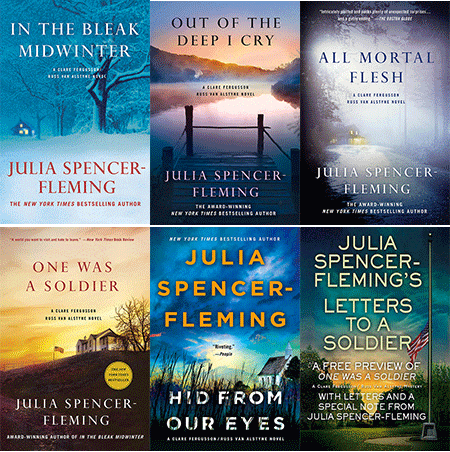
The contributions from two of the Jungle Red writers fall neatly into both categories outlined here. Had I heard of Deborah's choice? Yes, of course, and I've enjoyed her author's novels immensely. Julia's choice? I'm ashamed to say I'd never even heard of the book. Will I be picking it up on her recommendation? Absolutely.

But let's go back to our original question. What is YOUR book to die for, the book that changed the way you think about books, the one mystery novel you'd recommend to the readers of the Jungle Red blog?

Tell us what it is, and why that is the case, and the most interesting and original suggestion will win a copy of BOOKS TO DIE FOR and a copy of SLAUGHTER'S HOUND.

And now, it's over to you!


DeclanBurke has published four novels: Eightball Boogie (2003), The Big O (2007), Absolute Zero Cool (2011) and Slaughter's Hound (2012). Absolute Zero Cool was shortlisted in the crime fiction section for the Irish Book Awards, and received the Goldsboro / Crimefest “Last Laugh” Award for Best Humorous Crime Novel in 2012. He is also the editor of Down These Green Streets: Irish Crime Writing in the 21stCentury (2011), and the co-editor, with John Connolly, of Books toDie For (2012). He hosts a website dedicated to Irish crime fiction called Crime Always Pays and is on Twitter as @declanburke.


Tuesday, September 4, 2012

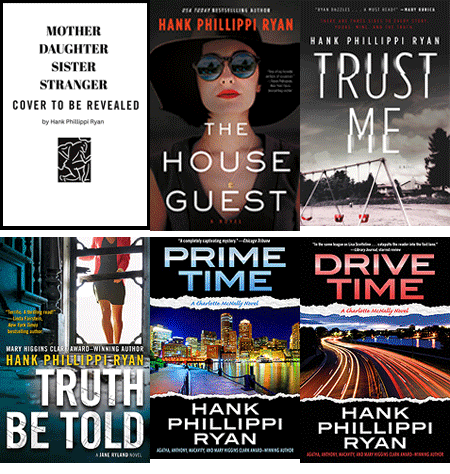
Who Is THE OTHER WOMAN? Ask Hank --

JRW: Our own Hank Phillippi Ryan's much anticipated "The Other Woman" launches today and Jungle Red is thrilled to welcome it in style!  

As for Hank, she's seeing stars (starred reviews from Library Journal and Booklist; IndieNext Great Read). So we had to haul her down to earth to talk about this fabulous suspense novel that's being compared to the work of Harlan Coben and Lisa Scottoline, but which in truth is uniquely her own.

On the (gorgeous!) cover of the book it says: You can choose your sin but you cannot choose your consequences... Readers will be repeatedly taken by surprise at where the story leads.
 

So welcome, Hank! (And we'll give away a copy to a lucky commenter!)

Hank, this book it's so different from your Charlie McNally novels which are thrilling, of course, and suspenseful, and funny, like The Other Woman -- but somehow this seems bigger. Were you consciously trying to shift into higher gear?

HANK PHILLIPPI RYAN: Well--I didn't really think about it as “higher gear.”  I thought about telling this story--and how it needed be told to make it as suspenseful and full of tension as possible.  The story was so big and so juicy that I realized that it couldn't be told from a single first-person viewpoint, because the reader had to know things that some of the characters didn't know. That meant I had to craft the story in a different way. So the form came from the essence of the story.

JRW: This novel has five viewpoint characters, as many plots and subplots, and, not to spoil anything but a huge number of breathtaking twists, some of them coming right on top of each other. And yet reading feels seamless. How did you keep everything straight?

HANK: That is one of the magical things about writing this book. I had the whole book—every word and every theme-- in my head the whole time. Like those plates on sticks on Ed Sullivan, I had to keep all the plots spinning. And keep each one understandable. When I neared the end of the book I actually made a list of all the loose ends that had to be tied up, and one by one I crossed them off.

And I was constantly surprised. Each time I figured out what happened, I would say  WOW I had no idea! So when readers are surprised at the outcome--well, I was, too..

Practically speaking-- if writers are interested--I made a scene-by-scene chart which included what happened at the end of each scene. So then when I went back I'd know the last thing that POV character knew.  

JRW: This book is so full of surprises for the reader, too! You start the book thinking: "The other woman" -- Oh, I know what that means. This is the "philandering politician" story told from the viewpoint of the mistress. Only it isn't. Well, it is but it isn't, which so cool.

HANK: (Laughing) Thank you! Yes, I was 100% conscious of that! I love being able to play with readers' perceptions. First, remember that I didn't know what was going to happen.

After that, it's sort of all happening on three levels-- I know what I know as an author. I know what the reader expects. And I know if I don't do what the reader expects, that's what reader expects, too. So I have to do something else.  I wanted the reader to go into the book thinking one thing and then—after turning pages as fast as they can-- come out thinking, whoa, that's not what I predicted at all.

JRW: Jane Ryland, your hero, is a reporter who will do anything to protect a source and suffers for it. Have you had times when you had to do something personally risky to protect a source?
HANK: I'm trying to think if there's anything that I can actually tell...

JRW: Is that your final answer?

HANK: Yes.

JRW:
Can you tell us where you got your names, especially Jane Ryland and Jake Brogan? Because they sound awfully familiar...

HANK: Oh, this is so hilarious. I needed a name for this character. I knew her name was Jane, that was set from the moment I had the idea for the story. But what was her last name? So I'm on the Acela from Boston to New York, thinking like crazy, very frustrated, and I gave up. I said to myself:  Fine. The next name I see on a building or billboard is going to be the name. Zooming through Connecticut I see billboard that says Ryland Industries.

So I think, perfect. I love it! Jane Elizabeth Ryland. And it never crossed my mind that it was like Ryan. Never never never. Until I read the advance bound manuscript that the publisher sent. And I thought holy moly – Ryland is kind of like Ryan. A year and a half after I started writing the book!

Jake Brogan. I needed his name to be similar to Jane's (you’ll see why when you read the book!) so Jake works perfectly. His name had to be Irish, because his grandfather was a police commissioner in Boston. (Which is why Harvard-educated Jake is a cop. I envisioned them watching Hill Street Blues together!)  I went through all of the Irish-sounding names, and they were too obvious, too predictable, not quite right. Then one day I thought--Brogan!  Detective Jacob Dellacort Brogan. Jake Brogan. Perfect. And it wasn't until later I thought--oh no!  Jan!  

JRW: With your Charlie McNally series, you've said that Charlie is an TV news reporter who worries about what she's going to do when the camera doesn't love her any more. Here you are, six years later, still a glamorous investigative reporter on TV with what certainly looks to all of us like your breakout novel.

HANK: Aw. Thank you. Crossing fingers. Remember what I said about spinning the plates? I love my work as an investigative reporter. I've done it for 35 years and I'm still thrilled every day coming to work. As an investigative reporter you never know what's going to happen and you can work to change the world and get some justice and help the good guys win. 

But as for the novel writing—and remember, I started that at age 55!--there's never been anything that I love as much as that. The walls fall away and I’m in my own world when I’m writing. So what will happen next? As in my books, I just don't know.

JRW: Well, we all feel like we're in the last inning of a no-hitter, holding our breaths, and hoping you shoot the moon.

Here’s the video about The Other Woman— like the book itself, it’s not what you’d expect! And it’s getting a lot of buzz. 


So, gentle Reds, join the conversation! You know Hank will answer any question... well, almost any. And remember--we're giving away a copy to one lucky commenter!

Monday, September 3, 2012

Workin' Hard/Hardly Workin' -or- Getting The Axolotl

Thanks to all of you who took our survey for our game show panel at
Bouchercon--the annual World Mystery Convention, (Friday (10/5) at @2:45). We have wonderful, smart, hilarious answers (to be revealed at the conference and here the week after!)

But we need MORE! Survey Part II is up with 10 more questions so please, help us
out by taking the survey. The link is here.

JULIA SPENCER-FLEMING: Labor Day! The day America honors its hard-working citizens by giving them a day off to grill burgers, go to the amusement park, and spend one last day working on the tan before summer vanishes.

As a self-employed writer who works from home, I have friends who kid me about every day
being a holiday. And I have to admit, making a living as a novelist is pretty sweet. No dress code, no time clock, no coworkers stealing lunch from the fridge. But it was not ever so. I have had my share of awful jobs, just like the rest of the country. There was the waitressing gig where I had to dress in a corseted dirndl that constantly threatened to expose the Bavarian Alps, if you know what I mean.

There was the five-month temp job reviewing loan documents for a recently-acquired bank. The work itself was fine, but I was alone all day in a white-walled room with only a folding chair, a table, and stacks of bankers boxes. The place was down to a skeleton staff, and I went for days without seeing anyone else. At the end I felt like Malcom Macdowell's character in A CLOCKWORK ORANGE (post-brainwashing.)

Then there was my ill-fated stint "selling" vacuum cleaners door-to-door. I felt so guilty trying to scare poor people into buying $5,000 cleaning systems (Dust mites! Disease! Asthma!) I would end each call sitting in my boyfriend's car, crying. Never sold a thing, AND I screwed up my bf's transmission and had to kick in big bucks to fix it. (This is why I can never be a self-published author. I need an entire sales team behind me, because my solo version of marketing would consist of me saying, "Um...I wrote this book? And...you can check it out of you want. Or not. That's cool, too.")

How about you, Reds? What are your most memorable awful jobs?
ROSEMARY HARRIS: Try as I might I can't think of one. I've liked all my jobs - until I didn't. But that had more to do with its being time to move on. What have I done...bookstore manager, Cliffs Notes Sales rep, book buyer for catalog company (Publishers Central Bureau...anyone remember them?) video buyer/sales, video producer, consultant...writer.
If pressed (and so I don't totally sound like Pollyanna) I'd say working for public television was the hardest job for me. Everyone there was so earnest! And thinking about sales was declassee. I had a good laugh when that Randy Newman song, It's Money That Matters came out with the line about people working for public radio - "in any fair system they would flourish and thrive..but they eke out a living..they barely survive." Yup.

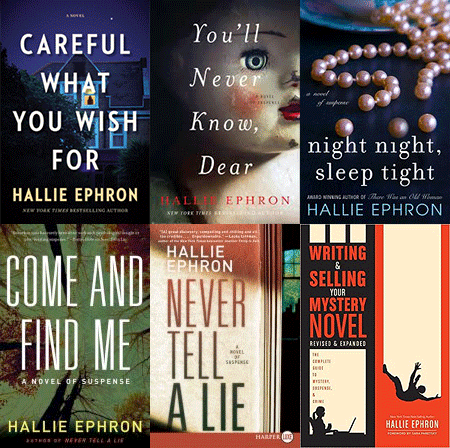
HALLIE EPHRON: Worst ever -- and there's stiff competition in this category -- was the job I
took selling magazine subscriptions. Cold calling people. We worked out of a motel room and everyone smoked. I didn't last long.
As a temp I had one excruciatingly boring job after another  typing invoices and filing, and I learned to take the bus all over the Los Angeles area. One weekend I gave out Lays potato chip samples at a Ralph's supermarket in Beverly Hills.

Best temp job was working as a summer temp at the main office in Standard Oil's Inglewood oil field. The engineers were adorable, all men. Every two weeks I had to learn a new job as I rotated through the all female office workers' jobs when they took vacations. Xeroxing and delivering mail isn't bad when you only have to do it for 2 weeks. My favorite was reading oil output maps for the individual wells. The traces were on 12-inch wide circles of graph paper and I had to interpolate the results. I had not the slightest idea what I was doing but the guy I shared the office with was a stitch.

LUCY BURDETTE: Sure I had some crummy jobs (cleaning motel rooms at a beach resort=Not. Fun.) But one rises above the rest.

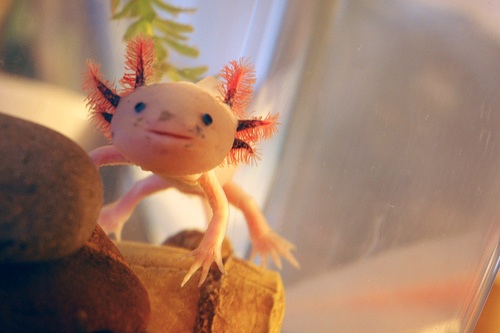
I was desperate for cash in college so took a job taking care of axelotls in the biology department. These are prehistoric-looking amphibians and there were walls of them, each in its own plastic box of water. I can't recall what experiments were being conducted, but I do know that some of them were albino and some were grafted together, stomach to stomach. Since these creatures won't eat anything unless it's moving, I had to take chunks of frozen liver in tweezers and wave this in each axelotl's cage--then they would snap at the liver and gulp it down. They needed four or five bites a piece. A PIECE.

And then to make things worse, the boxes needed cleaning twice a week. Dump the creatures into the sink, scrub out the slimy boxes, return axelotls to their cages.

I must be winning this contest, don't you think???


JULIA:  Oh, yes.
 

HALLIE: Hands down, Lucy.

There really ARE axelotls?? Am I the only one who remembers the Mad Magazine poem about
them:
I wandered lonely as a clod,
Just picking up old rags and bottles,
When onward on my way I plod,
I saw a host of axolotls;
Beside the lake, beneath the trees,
A sight to make a man's blood freeze.
And so on...

HANK: Yes, MAD is the first thing I thought of when I say axolotls. I thought MAD had made them up.

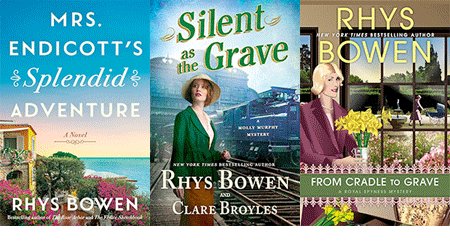
RHYS BOWEN: I've had my share of jobs I couldn't wait to leave. Scrubbing the moss off the tops of five million heather pots in an unheated greenhouse in December looms large in my memory. As does wielding the tea trolley round the hallways of IBM London... not always able to control it and careening into labs that were security access only (lasted one week).

I also remember unfondly my first job in the US, doing PR for the California Nurses Association. At their convention two of us had to attend all meetings, then after the last session at 10 p.m. we had to write up the day's newsletter--typing it to a one of those skins that ran on the old copying machines. One mistake and you start over. And the evening one of the organizers showed up saying she wanted one of us to talk to the press urgently. "We're just finishing the newsletter," my colleague said. The woman rolled her eyes. "Oh come now. It doesn't take two of you to do a little thing like that," she said.  That must have been the first time I had the urge to kill. No wonder I became a mystery writer.DEBORAH CROMBIE: I don't think anyone can compete with Lucy and axolotls.  I was a biology major and I didn't know there were such things! But, if I must, I'll go with my first job out of college. I was secretary/assistant to two guys who ran (and were the sole employees other than me) an advertising agency. They were more or less the in-house agency for a big local car dealership, but they also had accounts like discount carpet warehouses and industrial cleaning supplies.  I typed (badly), filed (badly), answered the phone (quite nicely) and got to write a little copy for the crummy accounts. None of this sounds too awful, except for the fact that these two guys were two of the biggest jerks I've ever met. After my supportive family and my supportive liberal arts college, I was NOT prepared. They sneered, they criticized, they behaved, shall we say, very inappropriately, they withheld paychecks. Then they fired me because I was late one day, having wrecked my car trying to get to work in an ice storm.

I think I've been killing them off ever since.

HANK PHILLIPPI RYAN: Debs! Yikes. Poor thing. But you won in the end, right? They're
probably buying your books now.

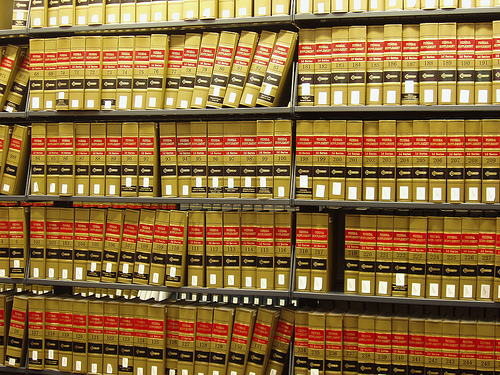
Ah, my worst job actually turned out to be the best job, as those things happen. I was a proofreader and index-maker for Bobbs-Merrill publishing company. My partner Joanne and I had to read the ENTIRE Indiana Code of Laws out loud together--we took turns, one reading aloud and the other comparing with the words and punctuation on the galleys, and making corrections.

So imagine , the two of us at age 18 or so: "Capital c, chapter one, comma, new paragraph, capital s, section one and ON AND ON for eighteen volumes including torts, wrongs, insurance rules and steam boiler regulations.

And when we finished, we had to make the index! And to do that, we used....index cards! And alphabetized them all. About a BILLION of them.

It was paper cut city. But actually, not that awful. And the skills of that drudgery have come in quite handy.  (And sometimes it was even interesting. If you care about such things.)


JULIA: So there you have it, dear readers. How about you? What's your worst job - and was it really so bad when you consider it might have been feeding axelotls?