Showing posts with label Harlan Coben. Show all posts

Tuesday, October 11, 2022

What We're Writing: Hank takes a short story challenge!

HANK PHILLIPPI RYAN: It’s Tuesday, and since I am second alphabetically, Tuesday is my "what we’re writing" day.


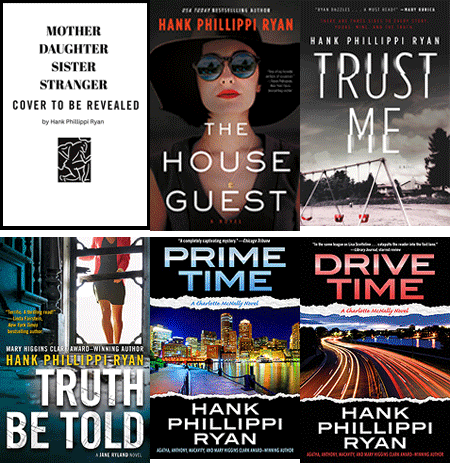
My current writing adventures include the final glorious edits of The House Guest, slogging through the hideous middle of One Wrong Word--and the release of a short story in an amazing anthology!


The story all began with the most wonderful email I’ve gotten in a long time. From CJ  Box and Harlan Coben. (!!!) Inviting me to be one of 11 authors to contribute to their short story anthology called Birds of Prey, under the imprimatur of International Thriller Writers. Each story had to be about a bird of prey.  It took me about zero seconds to say yes.


Followed by days of existential angst as I tried to figure out what the heck to write.


As it turned out, the story is a perfect example of an idea that did not work!


When Harlan and CJ asked me to participate in this, I tried to think of something as weirdly exotic as I could. And decided I would write about an extinct bird. A bird that did not exist anymore. 


How would I do that? I didn't know, but it seemed like a plan. So, I researched extinct birds. And found the Haast eagle, supposedly the biggest eagle that ever existed, which fell into extinction because it could not feed itself enough. Something like that.  


Oh, I thought, that sounds, metaphorically, like "corporate." A super-big company, devouring everything in sight, and yet, still could not sustain itself.  And that seemed like a brilliant idea. 


However. Apparently not. I could not write that story. I could not figure out, not at all, how to do that. And I was a little bit worried. Really really worried, in fact.

At some point, I walked into our family room and my husband was watching Dr. Zhivago. He has watched that movie countless times. His daughter is even named Lara. I said to him. 


"Are you watching that movie again?" And he said, "Yes, I love this movie."


 And I said, "I know you love it, honey, but how many times can you watch the same movie?" And he said, "I could watch this movie forever."


I burst out laughing, and said "I can just see that, you’re 150 years old, and all you do is watch Dr. Zhivago."


 And he said, "That doesn’t sound bad to me."


 So then I thought--and this is the writer process--what if there were someone who watched the same movie over and over? Over and over and over. Why would they do that?


And that was fascinating to me. And since the bird book was preying on my mind, I thought: how could I made that a bird story? What movies have birds of prey in them? And first, my brain said "The Falcon and the Snowman."


And the other half of my mind laughed, and said "No, Hank, that is not the one."


 Exactly. Because of course, there’s only one movie that a person could watch over and over that features a bird of prey. 


And that is The Maltese Falcon. And that is the story I wrote.


It stars Robyn (an ex-con, now senior citizen/nursing home attendant) and her boyfriend Jay, newly released from prison. Robyn has managed to get Jay a job at the home where she works. One of their charges is a resident named Finnian Webley, who has never said a word, or responded to anyone. He just watches The Maltese Falcon all day. Over and over. It's on mute.


Robyn and Jay are walking down the hall toward his room.


(I have to say, this story does not sound like "me" at all. I was so surprised at the way it came out.) 


Here's a tiny bit  from "Jailbirds."


                                                         ******

She remembered when Jay said goodbye that day, or not said goodbye; he’d just turned and walked away. And she had no idea how long 32 months would turn out to be. But it was long enough for her to get angry, then sad, then miserable, then enraged, then forgiving. Now, she didn’t know what she was. Thirty years old, and in love—whatever that meant—with this person, this person with no future, and they were walking along a godforsaken hallway, with godforsaken people, who just waited here to die, and what she was doing here, she didn’t dare to try to understand.

“I can’t wait for tonight,” Jay told her. “The last thing we’re going to do is watch TV, right, Birdie? I may never freaking watch television again. I don’t want to turn out like this guy.”

“Hush. We’re here.”

“I thought you said he can’t hear.”

They knocked on the door of Apartment 410, Robyn assembling her words, assembling her face, putting on the demeanor of a person who cared. She did, actually, if she faced it. Her own parents had died before they got old enough to be in a place like this, and sometimes she wondered whether they might have been lucky.

“Why are you knocking?” Jay asked. “If he can’t hear, what difference will it make?”

She loved his voice, even asking that moronic question. She had longed to hear it, nights and mornings and, sometimes, just walking along Riviera Beach, listening to the waves and the stupid seagulls and thinking about decisions people made.

“I think he feels the vibrations or something,” she said.

The door clicked open, and Finnian Webley sat there, looking at them, or not looking at them; it was hard for Robyn to tell. His short-sleeved plaid shirt, fraying once-blue plaid, hung across his thin shoulders, and a sparse scrabble of spiky white hairs seemed to sprout randomly across his splotchy pale face. She worried about him, kind of, his sunken eyes and the hollows in his forehead. The way he licked his thin lips, as if he were thinking about something that she could never know.

                                       ******


HANK: The anthology  BIRDS OF PREY came out less than a week ago! And it is now an Amazon Bestseller, and the number one mystery anthology! It is an audio only, an Audible original, and is absolutely fascinating.  It includes 11 stories,  by, among others, Tess Gerritsen, Robert Dugoni, Kathy Reichs, SA Cosby, and me.


Here are some of the authors on a zoomcast about it.


Here’s the link to the Audible book! It is quite astonishing. There are owls, and falcons, and seagulls, a condor, a Ford falcon car, and mine, starring predatory jailbirds and a movie.


What bird of prey would you have chosen?


Friday, August 4, 2017

What makes a perfect opening line? Jenn McKinlay

Opening lines -- I collect opening lines like a kid collects sea shells on the beach. Or, in the case of my nephew, a smelly dead crawfish that managed to stink up our vacation home until we tracked it to the pocket of his bathing suit where the stench almost knocked us out, but I digress.

Novel openings. What makes a good one? What magical combination of ingredients spellbinds the reader into continuing with a story? I have no idea. When it comes to opening lines, I am a fraud, a cheat, and a swindler. Why? Because my opening lines are almost always dialogue.

Truthfully, I never set out to start my books this way, but I am a horrible eavesdropper and I find it virtually impossible not to listen to other peoples' conversations, especially if they are being dramatic, funny, or tearful. Because, of course, I have to know why they are crying, maybe I can help! A friend of mine from college called this “dipping”. When we’d go to Conn Hall for dinner, I’d lean back to better hear the conversation behind me and she’d say, “Jenn, are you dipping again?” 


I’d shush her, giving her the double raised eyebrows look, and report back on the break up, argument, declaration of love, or what have you that was happening. Pro tip: If you don’t want people to overhear you, save the personal convos for when you're alone and not in a dining hall that seats three hundred people or at an intimate restaurant where the next table is mere inches away.


When I began writing, it was just natural to begin the story in the midst of a conversation, hopefully luring the reader into “dipping” just like I do. Yes, I still do it when a particularly interesting conversation unfolds around me. Bad manners, I know. Still I can't help it. For me, I find dialogue between characters to be the best way to set the tone of the book and it keeps me from info dumping a lot of background on the reader by weaving it into the conversation and hopefully scoring a few laughs along the way.


So, how about you, Reds? What are your tips and tricks for writing your opening lines? And what are some of your favorites?

Friday, April 4, 2014

What Debs is Writing--Just Make It Up

DEBORAH CROMBIE: I think I want to be Harlan Coben. Incredibly talented and successful. A really nice person. Tall. (Well, maybe as tall as Harlan would be stretching it a wee bit...) And there is the gender thing, which might be a slight issue.  All minor adjustments, I'm sure, none of which would be nearly as difficult as becoming the writer who says (as we mentioned earlier this week,) "Research? I just make things up."

Here I confess to being THE neurotic researcher. I have to check every single detail, and if I can't find something out, I will tie myself in emotional (and physical--just ask my back) knots trying to figure out what MIGHT be right.

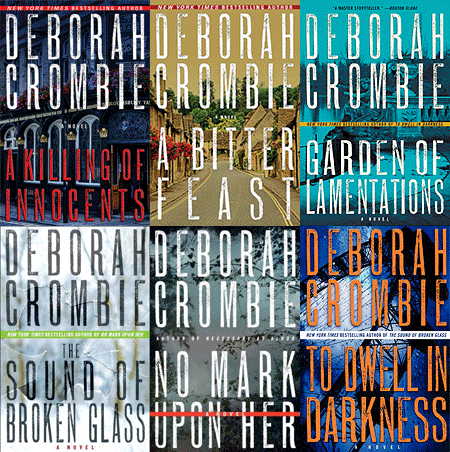
You would think that after fifteen books, it would get easier. But Kincaid/James #16, To Dwell in Darkness, has been (excuse my British) a real bugger. In some moment of madness, I decided I wanted to set off a bomb--well, actually an incendiary grenade--in the beautifully restored St. Pancras International Railway Station, which is now the Eurostar terminal, in the King's Cross area of central London. Why, you may ask? 

Because I was, and still am, smitten with St. Pancras. The original railway station was one of the marvels of Victorian design and engineering, and the station, and the accompanying hotel, are steeped in London history. After a long decline, St. Pancras came near to falling to the developers' bulldozers. But wiser, and probably more cash-savvy, heads prevailed, and the restoration is a thing of beauty and Gothic glory, teeming with human life and traffic. 

So why not murder? (You know all crime writers are a little warped, right?)

And then came the sticky stuff. Jurisdiction, procedure, all those little nit-picky technical details. (Do you know what happens to the British rail system nation-wide when you shut down a major terminus for even an hour???) Not to mention a very complicated plot that I could have set anywhere in central London, but chose to plop in the middle of St. Pancras. 

So, after months of reading and worrying, and multiple viewings of one of my favorite episodes of MI5 (that counts as research! Rupert Penry-Jones as Adam Carter, sigh...) in which there is a bomb threat in a major London railway station, I finally pretty much decided to... DO A HARLAN. I wrote what seemed logical, and to me, reasonable, considering what I'd learned AND the constraints of fiction. (Because nobody really wants to read about two-hundred detectives and all the tedious things that they do...)

Did this cure me of obsessive researching? Uh, no. Here is a little snippet from the beginning of Chapter Eleven of To Dwell in Darkness:


He left the dark blue Ford in the car park at Didcot Parkway Railway Station sometime before dawn. You weren’t likely to be noticed coming or going from a railway station car park at odd hours, nor was the car likely to be thought abandoned if left for a few days.

A few days… Who was he kidding, after what had happened at St. Pancras? Maybe forever. But he couldn’t think about that, not yet, and at least in a railway station car park it would be some time before the car was tagged and towed, and even then nothing in it should link to him.

After a quick check to assure there was no one else about, he stowed the supplies from the boot in his big pack. Then he wiped down everything he’d touched with a clean cloth, locked the car and pocketed the key.

He stood for a moment, adjusting the weight of his heavy pack on his shoulders, gazing at the deserted station platform. Even in the dark he could see the towers of nearby Didcot Power Station. Ironic, that, as he’d participated in the protests that had got Didcot A shut down. And what had it mattered, in the end?

A train horn hooted in the distance, the sound carried on the bitter wind. He shuddered. He couldn’t bear trains now.

He turned east, towards the Thames, and began to walk.

Is there really a Didcot Parkway Railway Station? You bet. I've been through it many times, but have never stopped. But I knew where I needed my mysterious unnamed character to be, in order to walk to where he is going, and Didcot was the perfect spot. Here is where Google maps becomes your
friend. And Google Earth. Is there really a Didcot Power Station? Yes, there is. And you can see it from the railway station. And Didcot A was shut down, in part because of the demonstrations of eco-protesters. It was one of the worst polluting coal-fired power stations in Britain. Didcot B is scheduled to close in the next few years.

So, readers, what level of verisimilitude do you expect from authors? Are you willing to go with "Learn as much as you can, and then make up what makes sense and keeps the story moving?"

Tuesday, September 4, 2012

Who Is THE OTHER WOMAN? Ask Hank --

JRW: Our own Hank Phillippi Ryan's much anticipated "The Other Woman" launches today and Jungle Red is thrilled to welcome it in style!  

As for Hank, she's seeing stars (starred reviews from Library Journal and Booklist; IndieNext Great Read). So we had to haul her down to earth to talk about this fabulous suspense novel that's being compared to the work of Harlan Coben and Lisa Scottoline, but which in truth is uniquely her own.

On the (gorgeous!) cover of the book it says: You can choose your sin but you cannot choose your consequences... Readers will be repeatedly taken by surprise at where the story leads.
 

So welcome, Hank! (And we'll give away a copy to a lucky commenter!)

Hank, this book it's so different from your Charlie McNally novels which are thrilling, of course, and suspenseful, and funny, like The Other Woman -- but somehow this seems bigger. Were you consciously trying to shift into higher gear?

HANK PHILLIPPI RYAN: Well--I didn't really think about it as “higher gear.”  I thought about telling this story--and how it needed be told to make it as suspenseful and full of tension as possible.  The story was so big and so juicy that I realized that it couldn't be told from a single first-person viewpoint, because the reader had to know things that some of the characters didn't know. That meant I had to craft the story in a different way. So the form came from the essence of the story.

JRW: This novel has five viewpoint characters, as many plots and subplots, and, not to spoil anything but a huge number of breathtaking twists, some of them coming right on top of each other. And yet reading feels seamless. How did you keep everything straight?

HANK: That is one of the magical things about writing this book. I had the whole book—every word and every theme-- in my head the whole time. Like those plates on sticks on Ed Sullivan, I had to keep all the plots spinning. And keep each one understandable. When I neared the end of the book I actually made a list of all the loose ends that had to be tied up, and one by one I crossed them off.

And I was constantly surprised. Each time I figured out what happened, I would say  WOW I had no idea! So when readers are surprised at the outcome--well, I was, too..

Practically speaking-- if writers are interested--I made a scene-by-scene chart which included what happened at the end of each scene. So then when I went back I'd know the last thing that POV character knew.  

JRW: This book is so full of surprises for the reader, too! You start the book thinking: "The other woman" -- Oh, I know what that means. This is the "philandering politician" story told from the viewpoint of the mistress. Only it isn't. Well, it is but it isn't, which so cool.

HANK: (Laughing) Thank you! Yes, I was 100% conscious of that! I love being able to play with readers' perceptions. First, remember that I didn't know what was going to happen.

After that, it's sort of all happening on three levels-- I know what I know as an author. I know what the reader expects. And I know if I don't do what the reader expects, that's what reader expects, too. So I have to do something else.  I wanted the reader to go into the book thinking one thing and then—after turning pages as fast as they can-- come out thinking, whoa, that's not what I predicted at all.

JRW: Jane Ryland, your hero, is a reporter who will do anything to protect a source and suffers for it. Have you had times when you had to do something personally risky to protect a source?
HANK: I'm trying to think if there's anything that I can actually tell...

JRW: Is that your final answer?

HANK: Yes.

JRW:
Can you tell us where you got your names, especially Jane Ryland and Jake Brogan? Because they sound awfully familiar...

HANK: Oh, this is so hilarious. I needed a name for this character. I knew her name was Jane, that was set from the moment I had the idea for the story. But what was her last name? So I'm on the Acela from Boston to New York, thinking like crazy, very frustrated, and I gave up. I said to myself:  Fine. The next name I see on a building or billboard is going to be the name. Zooming through Connecticut I see billboard that says Ryland Industries.

So I think, perfect. I love it! Jane Elizabeth Ryland. And it never crossed my mind that it was like Ryan. Never never never. Until I read the advance bound manuscript that the publisher sent. And I thought holy moly – Ryland is kind of like Ryan. A year and a half after I started writing the book!

Jake Brogan. I needed his name to be similar to Jane's (you’ll see why when you read the book!) so Jake works perfectly. His name had to be Irish, because his grandfather was a police commissioner in Boston. (Which is why Harvard-educated Jake is a cop. I envisioned them watching Hill Street Blues together!)  I went through all of the Irish-sounding names, and they were too obvious, too predictable, not quite right. Then one day I thought--Brogan!  Detective Jacob Dellacort Brogan. Jake Brogan. Perfect. And it wasn't until later I thought--oh no!  Jan!  

JRW: With your Charlie McNally series, you've said that Charlie is an TV news reporter who worries about what she's going to do when the camera doesn't love her any more. Here you are, six years later, still a glamorous investigative reporter on TV with what certainly looks to all of us like your breakout novel.

HANK: Aw. Thank you. Crossing fingers. Remember what I said about spinning the plates? I love my work as an investigative reporter. I've done it for 35 years and I'm still thrilled every day coming to work. As an investigative reporter you never know what's going to happen and you can work to change the world and get some justice and help the good guys win. 

But as for the novel writing—and remember, I started that at age 55!--there's never been anything that I love as much as that. The walls fall away and I’m in my own world when I’m writing. So what will happen next? As in my books, I just don't know.

JRW: Well, we all feel like we're in the last inning of a no-hitter, holding our breaths, and hoping you shoot the moon.

Here’s the video about The Other Woman— like the book itself, it’s not what you’d expect! And it’s getting a lot of buzz. 


So, gentle Reds, join the conversation! You know Hank will answer any question... well, almost any. And remember--we're giving away a copy to one lucky commenter!