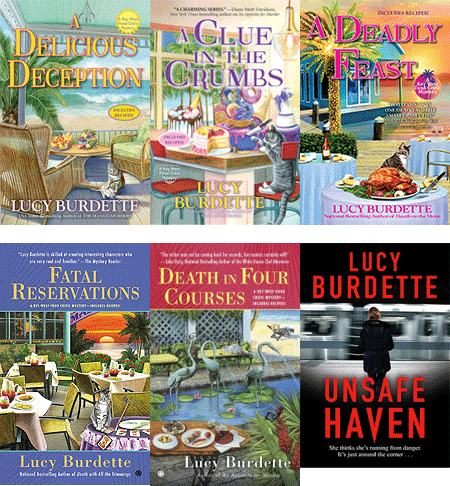
LUCY BURDETTE: Today it's my pleasure to welcome our funny and talented Scottish/American pal, Catriona McPherson, to tell you about the genesis of her new book. (She also happens to be a retired president of Sisters in Crime International, like Hank and me! You've got brass on the blog today...)
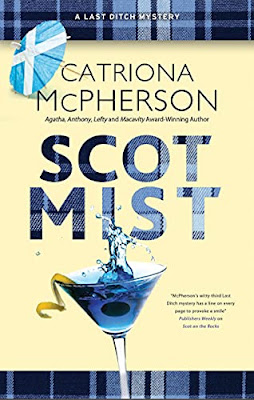
CATRIONA MCPHERSON: I’ve been asking myself a lot recently what counts as historical fiction. Malice Domestic reckons it’s fiction from before 1960. Left Coast Crime says it has to be before 1950. But I think I’ve written a historical novel set in 2020.
SCOT MIST opens on Friday the 13th of March that year, the day the California governor (in real life) closed Disneyland and extended the tax-filing deadline. In fictional Cuento, CA, the residents of the Last Ditch Motel were deciding what to do in the event of a lockdown.
Can you remember what you were doing, thinking, saying, planning for, on that day? And doesn’t it feel like a long time ago? I wrote SCOT MIST in November and December of 2020 and even that feels like a different era from now – the current time, which a librarian on Twitter, @Kellywellread, calls “the pandammit”.
Food was on our minds that March, wasn’t it? I was just about to learn how to make soda bread, the lazy cook’s sourdough, how to shop for two weeks at a time of two people eating every meal at home, and how to not buy things “just in case” despite the constant talk of the supply chain breaking.
So I was mining my own experience, if not my own response, when I wrote a scene in which Lexy Campbell is deputized to go and lay in supplies for the newly formed community at the Ditch:
(In the Cuento Costco, Saturday 14th March 2020)
There was a crackle in the air as our brainstems told us to hide nuts and pick off impala (not sure what species this is; go with me) while our cerebra said maybe we could share it all and make sure no one went short. And I was shopping for seventeen. It is impossible to shop for seventeen, for ten days, more if we stretched it, and not look like a hoarder.
I stuffed my trolley with the breakfast choices of everyone from José – Bran Buds – to Navy – expensive mush with a name in such heartfelt font I couldn’t decipher it. I bought lamb for our Iranian night (Arif had packed his spices from home for exactly this eventuality and he talked me through how to choose garlic like an old French man training a truffle dog); I bought beef for our Mexican night (“Fat fat fat!” Maria had said, taking my face in her hands and shaking my head to make sure it went in. “Grasa! Grasa!” I got it. She had probably been fighting a losing battle with the Queens of Lean for all her years here north of the border.) I bought chicken for taco night, for Blaine’s clean-eating requirements, and for Todd’s eventual carb crash. I bought bacon for breakfast-for-dinner night, and fish fingers for the under tens, of which there were suddenly five! And bread and jam and peanut butter and crisps and dips and Oreos and beans and pasta and popping corn and a big paper sack of flour because everyone else was buying it and by now I was my lizard brain’s bitch.
I didn’t ever do that or anything like it. In fact, I had no dramatic experiences in supermarkets at all. I did have one moment of random kindness and one moment of sisterly connection.
The kindness: Neil and I were standing in the paper products aisle in mid-May, looking at the empty shelves, going “Wow. They were right then.” when a young couple came up and said “We picked up this TP because . . . reasons. But we don’t need it. You take it.” Readers, we took it. And for months afterwards we asked what it was about us that looked particularly in need of toilet paper. It’s not a welcome thought.
The connection: I was piling another two weeks’ worth of stuff onto the conveyor belt – organic this, wholewheat that, lettuce, spinach, lentils, plain yoghurt. Then came four family packs of Kettle Chips and a handful of huge Dairy Milk bars. The check-out operator caught my eye. I shrugged and said, “Eff it.” She nodded and said, “Good girl.” It’s not much of a war story as war stories go, but it still makes me smile and tear up when I remember.
I’m guessing pretty much everyone has stories of kindness and connection to share from those very strange early days of this very strange time. I would love to hear them.
About Scot Mist: March 2020 and Operation Cocker is a go! The owners of the Last Ditch Motel, with a little help from their friend Lexy Campbell, are preparing to support one another through the oncoming lockdown, offering the motel’s spare rooms to a select few from the local area in need of sanctuary.
While the newbies are settling in, an ambiguous banner appears demanding one of them return home. But who is it for? Lexy and her friends put a plan into action to ward off the perpetrator, but the very next night, a resident disappears and a message scrawled in human blood is found.
As California shuts down, the Last Ditchers make another gruesome discovery. They tried to create a haven but now it seems as if everyone’s in danger. Is the motel under attack from someone on the outside? Scary as that is, the alternative is worse by far.
About Catriona: National-bestselling and multi-award-winning author, Catriona McPherson (she/her), was born in Scotland and lived there until immigrating to the US in 2010.
She writes historical detective stories set in the old country in the 1930s, featuring gently-born lady sleuth, Dandy Gilver. The latest of these is 2021’s THE MIRROR DANCE. After eight years in the new country, she kicked off the comic Last Ditch Motel series, which takes a wry but affectionate look at California life from the POV of a displaced Scot (where do we get our ideas, eh?). Book 4, SCOT MIST, came out in January. She also writes a strand of contemporary psychological thrillers. The latest of these is last year’s A GINGERBREAD HOUSE.
Catriona is a member of MWA, CWA, Society of Authors, and a proud lifetime member and former national president of Sisters in Crime. www.catrionamcpherson.com