Friday, June 3, 2022

Nancy Cole Silverman--The Navigator's Daughter

DEBORAH CROMBIE: What an inspiring week we're having! I've been looking forward to Nancy Cole Silverman's THE NAVIGATOR'S DAUGHTER, which debuts next Tuesday, June 7th.
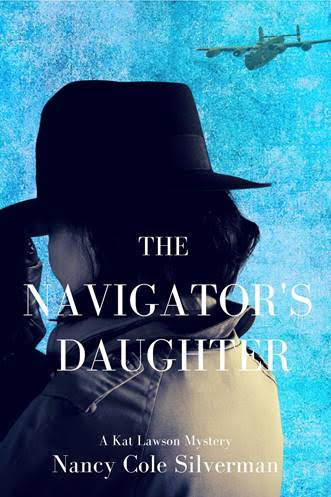
It's just the sort of book to get stuck into for a good summer read, and I love her answer to the perennial, "Where do you get your ideas?" I've heard some authors get a little impatient with this question but it is always one of my favorite things to talk about, and I'm equally fascinated by other authors' answers. What could be more interesting than the magic of the creative process?


Inspiration!  From Whence Does It Come?

BY Nancy Cole Silverman

As writers, we’re always being asked where we come up with our ideas or the inspiration for a story?  For me, that initial spark can be anything; a sight, a sound, or even a smell—like a sweet perfume or the briny scent of salt air. For an instant, I get a picture in my mind’s eye, a flash of an idea that like an earworm, won’t leave me alone until I’ve put something down on paper.  

Sometimes, I describe that story-flash like the cover of a jigsaw puzzle. It comes to me briefly like a colorful picture on a box then when I sit down to write, it crumbles in front of me, as though someone has turned the box upside down and all the pieces have fallen in a mix onto my desk.  It’s then I know my job is to comb through the tabs and put the picture back together again.

That’s how the story for THE NAVIGATOR’S DAUGHTER, captured me.  I was sorting through old family photos shortly after my father passed, and I came across of picture of dad with his crew taken in Italy towards the end of the war.  Dad was a navigator/bombardier, and they were shot down over Hungary on their 13th mission.   


I had heard the story since I was a young girl, but looking at the photo, I couldn’t help but wonder about what had happened to dad and members of his crew while they were MIA? He had never told me.

Then, years ago, after the Iron Curtain fell, my dad got a letter from a young man in Hungary who said he had found my dad’s plane. Dad asked me to correspond with the man and eventually, he even asked if I might like to come to visit and see the country. Holding that letter in my hand and looking at the photo of my dad and his crew, was the spark that started me thinking...what if?

What if, is the phrase that sends me and writers like me running to the keyboard.  What about you? What is that sparks your creative thought process? 

DEBS: I LOVE this story! Nancy, you'll have to tell us if you went to Hungary. And which one of those handsome young men is your dad? I also love your image of the shattering puzzle. I've had that experience, where you suddenly get the whole book in one piece, then once you start picking apart the story it falls apart. Then, of course, you start the painstaking process of sticking it all back together.

Here's more about THE NAVIGATOR'S DAUGHTER:

Getting caught in the middle of an international art theft ring wasn’t supposed to be part of the deal Kat Lawson made with her dying father. But when her father receives a mysterious letter informing the former WW2 navigator/bombardier that his downed B-24 has been found and asking him to come to Hungary, Kat suspects this is all part of some senior rip-off scam. Her father insists she goes, not only to photograph the final resting place of his plane but also to find the mother and son who risked their lives to rescue him and hid him in a cave beneath an old Roman fortress. Kat’s trip uncovers not only the secrets of the cave where her father hid and of those who rescued him but a secret that will forever change the direction of her life—that is—if she can get home safely.

You can pre-order it here!


After twenty-five years in NewsTalk radio, Nancy Cole Silverman retired to write fiction. Her Carol Childs Mysteries features a single mom whose day job as a reporter at an LA radio station often leads to long nights solving crimes. Her Misty Dawn series is centered on An aging Hollywood Psychic to the Stars, who supplements her day-to-day activities as a consultant to LAPD. Silverman’s newest work, The Navigator’s Daughter, is scheduled for release June 2022. Silverman lives in Los Angeles with her husband and a thoroughly pampered standard poodle.

READERS, are you interested in where writers get their ideas?


Thursday, June 2, 2022

Connie Berry--When You Can't Go There

DEBORAH CROMBIE: Several of us in the last couple of weeks have said how much we enjoyed Connie Berry's new Kate Hamilton mystery, THE SHADOW OF MEMORY. 


I am a big fan of this series so when Connie mentioned in a comment that she hadn't been able to go to the UK to research this book, I asked her to tell us how she managed all the descriptive and authentic details in her novel. (As much as I've moaned about not being able to go to England, you know this is a big issue for me!)

Here's Connie to share what you do WHEN YOU CAN’T GO THERE:

Some people talk about their Covid puppies or their Covid babies. Authors talk about their Covid books. Just about every book released in 2021 and 2022, including my latest, The Shadow of Memory, was written without the benefit of in-person research. I was actually scheduled to fly to England when the travel ban fell in March of 2020. A second optimistically planned trip in October of 2020 was also canceled and a third in March of 2021.

In the meantime, I had a book to research.

One of the specific places I’d planned to explore was the Suffolk coastline with its sand-and-shingle beaches and faded Victorian seaside resorts. There, in a fictional village called Miracle-on-Sea, I’d placed Netherfield Sanatorium, a former private mental hospital. I’d been to the Suffolk coast many times, but never on a research trip. That makes a difference. You notice different things—not just the geography, architecture, climate, and history of a place, but the sense of it, the sounds, smells, tastes, textures, and mood. Meeting people who live there, hearing what they say and how they say it, helps you understand them—what makes them laugh, what makes them angry, how they view their lives and world events, and (not insignificantly) what they like to eat. Also, there are always specific questions that must be answered

So what do you do when you can’t go? You do the next best thing.

Here are four resources that helped me write The Shadow of Memory while locked down in my office, aka my laundry room, in Ohio:

1. Photographs & Videos

A wealth of visual images are available online, from YouTube videos and documentaries to travelogs to Google Maps. During Covid, one of my favorite resources turned out to be old films of people speaking in the various Suffolk dialects. Invaluable. Google Street View saved me from an embarrassing inaccuracy. Early in the planning stages for The Shadow of Memory, I’d pictured Netherfield Sanatorium on a cliff overlooking the sea and Deben estuary. Dramatic but impossible—and I should have known better. A topographical map reminded me that the heath and marshlands near the estuary are very near sea level. The best I could do was place the mid-Victorian sanatorium on a low promontory.

2. Personal Sources

Over the years, I’ve been lucky enough to develop a number of invaluable sources: a detective inspector in the Suffolk Constabulary, a clergyman in the Church of England, the former Chief Operating Officer of the National Trust, a solicitor specializing in trusts and wills, an administrator in the Suffolk Coroner’s Office, a textiles curator at the Victoria & Albert museum. During Covid, they graciously answered all my questions. If you’re wondering how I developed these sources, the answer is simple: I asked. Most people are more than willing to help.

3. Newspapers

While I subscribe to The Telegraph, my favorite source for research is the British Newspaper Archive . Especially helpful are the local and regional papers, which combine national news with local events, social announcements, advice columns, and advertisements. I love the historical newspapers. Since my books include elements of the past, I can check things like obituaries in the 1960s and how crimes were reported in the Victorian era. I depend upon this resource even when I can travel.

4. Real Estate Websites

This one may seem strange, and one realtor in Peterborough, Cambridge, is still hoping I’ll chose a semi-detached house there, but real estate websites are perfect for sorting out the various ways English people live and the words they use to describe their living spaces. Americans would call the main room in a house, for example, the living room. In the UK, depending upon the type of house and the historical era, that same room might be called a reception room, a lounge, a parlor, or a drawing room. These sites can also tell you where in a city you’d find upscale properties and where you’d likely find Council estates. Just as in the U.S., interior and exterior photos are available, along with a wealth of other information. I needed a modest but modern house in Peterborough, for example, and found one for sale in a new housing estate on the south side of town, complete with a description and photos. It ended up in the book.

I’m glad the internet offers writers so much helpful information. Writing a book set in another country is harder without actually going there, but it’s not impossible.  I just hope I don’t have to do it again.

DEBS: I so agree with Connie about the importance of the sense impressions in conveying a setting. For those, I've had to rely on memory. But I've used many of Connie's resources, including real estate sites! I did not know, however, about the British Newspaper Archive!

And I'm not nearly as good as Connie at asking people to share their expertise--Connie will have to give me confidence lessons!


As Kate Hamilton contemplates her future with DI Tom Mallory, she is also helping her colleague Ivor Tweedy organize an auction in a village on the Suffolk coast. Netherfield Sanatorium, an abandoned Victorian insane asylum, is being converted into luxury flats, and Kate and Ivor have been asked to auction off a fine collection of antiques, including a 15th-century painting attributed to the Dutch master Jan Van Eyck. But when retired criminal inspector Will Parker is found dead, Kate suspects the halls of the sanatorium housed much more than priceless art.


Kate is surprised to learn that Will Parker was her friend Vivian Bunn’s first boyfriend. They met in 1963 at a seaside holiday camp when, along with three other teens, they explored an abandoned house where two years earlier a local doctor and his wife had died under bizarre circumstances. Now, when a second member of the childhood gang dies unexpectedly—and then a third—it becomes clear the teens discovered more in the house than they realized.


What was the deadly truth they unwittingly found? When Kate makes a shocking connection between a sixty-year-old murder and the long-buried secrets of the sanatorium, she understands that time is running out for Vivian—and anyone connected to her.


Connie Berry writes the Kate Hamilton Mysteries, set in the UK and featuring an American antiques dealer with a gift for solving crimes. She was raised by antiques dealers who instilled in her a passion for history, fine art, and travel. Her debut novel won an IPPY Gold and was an Agatha Award finalist. Connie is a member of MWA, CWA, and SinC. She loves history, foreign travel, cute animals, and all things British.

DEBS: Readers, have you learned new research skills in the last couple of years?


Wednesday, June 1, 2022

Queen Elizabeth's Platinum Jubilee

DEBORAH CROMBIE: Fellow Anglophiles, are you ready for Queen Elizabeth's Platinum Jubilee? 

Since I won't be attending the celebrations in person, I'm hoping that some of this weekend's events will be available to stream on Britbox, as that's the only option I've seen suggested other than using a VPN. 

But in any case, I can follow along on the Royal social media accounts (their accounts are terrific--there is even a Corgi emogi for Twitter and a sticker for Instagram!)


And I can reminisce.

In September 1976 I made my first ever visit to the UK, a whirlwind visit that was part of a "grand tour" with my parents, who had been to Europe several times. I don't think we were in London much more than a day, although we spent more time in Oxford, Bath, and the Cotswolds. It was long enough, however, for me to fall madly in love. (I do remember that top of my sightseeing list was 110 Piccadilly, the fictional home of Dorothy Sayer's Lord Peter Wimsey.)

Once back home in Texas, I worked through the winter and spring, saving my pennies, determined to get back to England as soon as possible. And what better goal than to attend the Queen's Silver Jubilee, which just happened to be my birthday weekend in June, 1977?


I kept a diary on that trip, but I have no idea what happened to it. I also have no clue how I ended up with a balcony viewing spot for the Queen's procession. I didn't know anyone in London then. But a balcony spot I had, and I snapped an entire roll of photos with my pocket sized Minox camera. 

Imagine my distress when I got the film developed back home and discovered there had been a light leak in the camera--every photo was ruined. Sigh.

I have never actually been a huge Royal follower, but 70 years on the throne is quite something and I hope everything goes well for Her Majesty. 


I'd love to see all the bunting, and the floral display at the Tower of London.


I'd love to attend a street party, ride the purple double-decker buses, and sample one of these scrumptious-looking Jubilee puddings. (These Lemon Swiss Roll and Amaretti Trifles won the Platinum Pudding competition.) 


Not to mention the concerts, the hot air balloons, the exhibitions, and the souvenirs! The British hospitality industry is hoping to make around 3 billion pounds, which would go someway towards recouping pandemic losses.


The British definitely know how to make the most of a big occasion--there will even be a special Corgi Derby in Scotland!

How about you, dear REDs and readers? Any plans to participate vicariously in the Jubilee? 

P.S. For Britbox subscribers, or those who might be tempted to subscribe, there is a two part special on this year's Chelsea Flower Show!