Saturday, November 18, 2023

Meet Tara Sidhoo Fraser’s ghost self…

HALLIE EPHRON: Today we’re thrilled to welcome Tara Sidhoo Fraser. I heard her read from her then work-in-progress, and had to seek her out after to tell her how moved I'd been by what she'd written. Now her book is out!

When My Ghost Sings: A Memoir of Stroke, Recovery and Transformation
, is one part memoir. every bit a mystery.
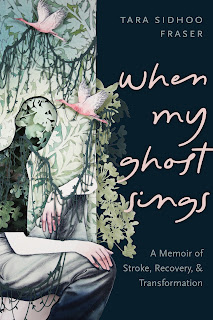
Tara describes it as “an apology letter, a song of mourning.” It’s a moving and enthralling story, unlike anything that we’ve featured here on Jungle Red.

It's my pleasure to introduce you to Tara and her “ghost self”…

TARA SIDHOO FRASER: Seven years have passed since my stroke, which I had at the age of 32, however, it is her reckoning with I was still haunted by the murky memories of my previous life. Since I have published my story, others have referred to this form of memory haze as amnesia and I suppose that is the correct term. Though I was able to understand what some things were and most people’s names, many things were fuzzy. And, strangely, as memories did begin to surface, they were seen through someone else’s eyes-the person whose body I stole. I call this person Ghost.
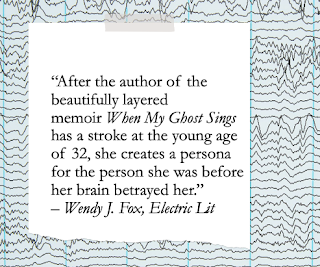
The stroke, itself, was caused by a rare mutation in my brain. After surgery, my memory of self and my world were incredibly murky. I felt as though I was a different soul in another’s body.

To verbally express this was impossible for me but to write about it, felt safe. Through writing, I was given the opportunity to invite Ghost to speak. Together, we created a memoir of lucid exploration of amnesia, selfhood, and who is left behind when the past is obliterated.

When I began writing my memoir, it was merely the task to write out my feelings following the stroke. To experience my memories and to create an almost timeline of events.

However, once I began writing, my heart and Ghost had much more to express! Each morning, while it was still dark, I brewed coffee, set my musical playlist, and invited my Ghost to sing.

I fell into the madness of writing, many times carrying on from the wee hours of the morning to late afternoon. It felt as though, my ghost and I had formed a pact, to share her story. It was now my responsibility to complete this promise.

Photo by Kristine Cofsky

As mentioned, this novel is also an apology letter to Ghost. It is a memoir of her lived experiences as well as her own. It is also an apology letter to each lover during this time period.

Truly, writing this memoir was a way for Ghost to reach each person and bid farewell.

And while, this story is deeply personal, I know that for other people reading her memoir, it can ring truth and bring forth connection. Since publishing my memoir, I’ve been fortunate enough to share conversations with other people who have had similar experiences, either with someone they know or personally.

When My Ghost Sings: A Memoir of Stroke, Recovery and Transformation,
is a mystery set in the liminal space of amnesia. It is a lyrical memoir of healing, a farewell letter, and an embracing/reclamation of selfhood. Publishing this book is such a gift because now, Ghost’s story will always exist and can never be forgotten.

HALLIE: Utterly fascinating. Wondering if any of our readers have had close encounters with amnesia, or sensed that you had a ghost self? As I read Tara's description, it made me think of that sense so many people have that they've had past lives. Food for thought.

Friday, November 17, 2023

Inspired by her "in-hair-itance" - Keenan Powell penned THE SORROWFUL GIRL

HALLIE EPHRON: Weren't many of us, at one time or another, obsessed with our hair?

I certainly was. It curled up on one side and down on the other, giving me the dreaded BOZO the CLOWN look. And inspired me to mope about and complain.

Her hair inspired Keenan Powell to mope about and complain, too. But finding the "roots of those roots" also inspired her to write THE SORROWFUL GIRL -- part social history, part adventure, part murder mystery, part family saga, and completely engaging.
We're thrilled that she's here today to talk about how The Sorrowful Girl came about.

KEENAN POWELL: The inspiration for my Gilded Age novel, The Sorrowful Girl, was my investigation into why I have naturally curly hair. The hair wasn’t an issue for me until I hit first grade and the other kids, all straight-haired, called me “Fuzzy Wuzzy.”

I wanted to know why I was different, so I asked my mom.

She said it came from our Irish ancestors named Barrett. But that was all she knew, and she was uncertain at that. She also told me my great aunts had seen leprechauns when they were in Ireland. So it’s not that I doubted her veracity, but I wondered how accurate her sources were.

When I discovered ancestry.com and began building the family tree, I learned that my second great grandmother, Mary Barrett, had immigrated from Crossmolina, Co. Mayo, in 1865 with her husband, following her parents, William and Ann Barrett.

Aha! There were Barrett ancestors, but did they have the hair?

I met a cousin online also was descended from William and Ann Barrett. She told me that indeed the family tree is rife with naturally curly hair.

My cousin, JoAnn, was an accomplished amateur genealogist. In 2013, we spent a delightful few days visiting Adams, walking through graveyards, pawing through the recorder’s office file cabinets, and spotting locations where our family and had lived and worked.

Adams has a nineteenth-century village atmosphere, nestled between Mount Greylock on the west and the Hoosac range on the east. The presence of Mount Greylock must have felt like home to my ancestors, who had lived in view of Nephin Mountain back home in Ireland.

Standing on the sidewalk in downtown Adams in view of Mount Greylock, I envisioned the old trolley that my grandfather rode. I visited the storefront where one ancestor had worked as a dressmaker. We drove by the Berkshire Mill, made famous by Lewis Hines for his child labor photographs, where many of the family had worked from the age of fourteen years. We also visited the apartment complex that at one time was filled by entirely by my family, the place where my great grandfather’s bar stood, the block named after an uncle, one of the men who championed the creation of the Mount Greylock State Reservation.


My imagination took hold.

I wanted to tell the story of how these brave Irish ancestors came to the United States in the mid-eighteenth century for sanctuary, leaving behind their beloved, but impoverished Ireland, how they fought against anti-Irish prejudice, and how hard they worked to build a better life for their children. I am in debt to these people.

The result is The Sorrowful Girl. In it, I attempted to weave the immigrant struggle with the beauty of the Irish culture. The protagonist is Liam Barrett, an Adams police officer who had dreamed of going to law school but was forced to give up his dreams when his father died unexpectedly, leaving Liam as the sole breadwinner. His sidekick, Father Frank is a young priest from County Cork, who scandalizes the parish by telling stories from the old religion, the myths of Ireland.

Liam is called upon to investigate the death of Deirdre Monaghan, a young Adams woman, who was working at the estate of industrialist Alistair Cunningham. Deirdre’s dream was to see the world. She got no further than Pittsfield. Cunningham, a powerful man, wants a quick arrest of the most likely suspect. But Liam wants to make sure that an innocent man is not hung. Liam wants justice.

The title, The Sorrowful Girl, is a reference to the ancient story of Deirdre of the Sorrows. A beautiful child, her foster father wanted her for his own when she was old enough to marry. But she fell in love with a handsome young warrior, and they ran away. The story tells of their pursuit and eventual capture.

If you’re interested in learning more about The Sorrowful Girl, the e-book is free on Amazon from November 17 to November 18. Link: Amazon.com: The Sorrowful Girl: A Liam Barrett Gilded Age Novel (Liam Barrett Gilded Age Novels Book 1) eBook : Powell, Keenan: Kindle Store. I hope you enjoy it. This is the story of my heart.

PS. As it turns out, my mother’s great aunts were born in the US and never went to Ireland. So they probably never saw leprechauns, but who’s to say?


Biography
Keenan Powell is a Lefty- and Agatha-nominated author. Although she was one of original Dungeons and Dragons illustrators, art seemed an impractical pursuit – not an heiress, wouldn’t marry well, hated teaching – so she went to law school. The day after graduation, she moved to Alaska where she has vowed to practice until she gets it right.
Visit her at: www.keenanpowellauthor.com
www.facebook.com/keenanwrites/
www.instagram.com/keenanpowell/
| www.pinteerest.com/keenanpowell14

HALLIE: Have you ever looked at yourself in the mirror and wondered where you got your hair/nose/eyes/freckles/... from?

Thursday, November 16, 2023

$$ Canned - memories of a rabble rouser


HALLIE EPHRON: Among the many reports of wealthy idiots and elected politicians behaving questionably, a story that caught my eye was the report that the Governor of Arkansas, Sarah Huckabee Sanders (remember her?), used taxpayer dollars to purchase a $19K fancy schmancy lectern, and then may have altered the receipt showing how the money was spent.


Of course the news went over big in the media.

Now this is small potatoes in the annals of politicians behaving, let us say, *in their own best interest*, but it took me back to my days as a high school senior and editor of the Beverly Hills High School Highlights. To my chagrin I'd discovered that one of my duties as editor was to attend student council meetings. Bo-ring.

And then when I went to one. I was especially interested in a motion that was approved to spend $75 (as I recall) on a can that would stand at the door of the school's auditorium to collect... trash.

$70 in 1964 is the equivalent to $700+ in today's dollars... so it seemed like rather a lot of money to me and my co-editor, Tom Linden. So of course we dashed off an editorial with the headline: $75 CANNED!

The piece ran, and the morning after, we were trundled up to the principal's office, along with our wonderful advisor, Mr. Gelms. Apparently the principal's office had been getting phone calls that morning from parents who'd seen our editorial and were (I like to think) similarly shocked and appalled by such profligate spending.

We sat there smirking as the principal reamed us out and proclaimed that any future opinion-expressing editorials would have to be vetted by his office. An edict which we promptly ignored. (Remember, mine is the generation that rioted at Columbia four years later.)

Do you have any memorable moments in your past when you stood up to... or ignored authority and lived to tell about it?