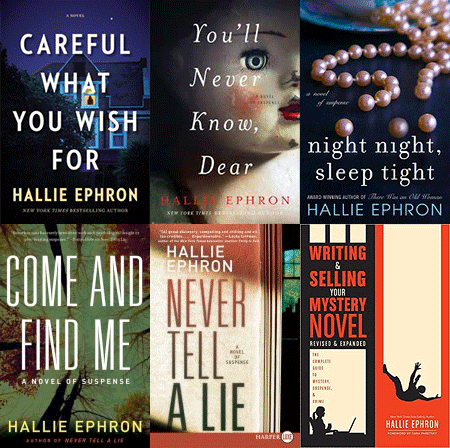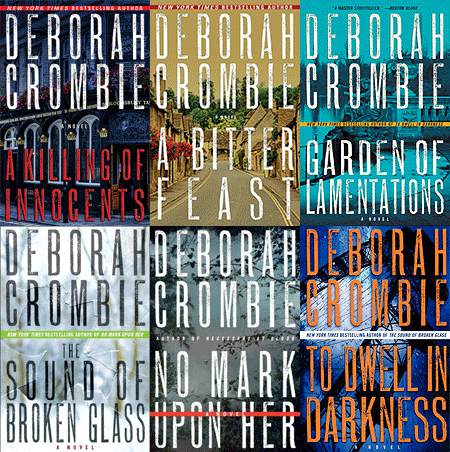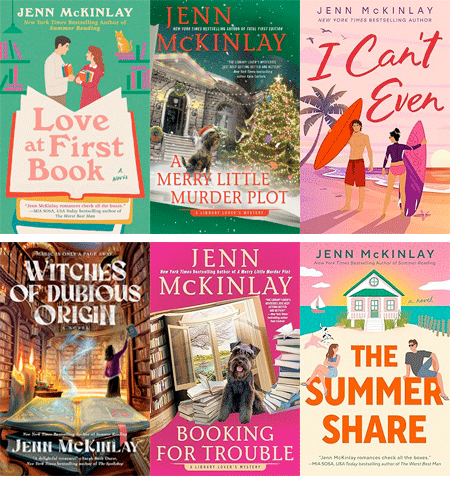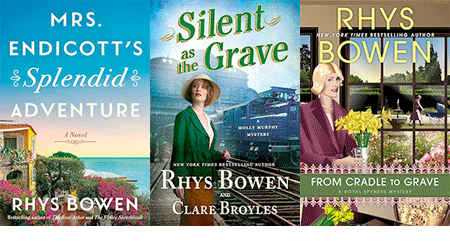
 opening of Marian McMahon Stanley's then unpublished novel, THE IMMACULATE. Ever since then, the nun who haunts those opening pages like Poe's raven has stuck with me.
 The book is just out, and I'm here cheering for Marian. It's a terrific heartfelt read with a fierce courageous nun whose death sets the story in motion.
I asked her to tell us what she's learned from writing and launching her first mystery novel.
MARIAN MCMAHON STANLEY: Two years ago, I wasn’t sure where this journey of writing THE IMMACULATE would take me. I am happy to say that it’s taken me to three wonderful places - to getting published, to becoming part of a spirited writing community
 and to meeting a great group of readers. Here, I share five lessons I learned along the way. Probably not new to you, but were for me.
1. How hard could it be? I’ve read mysteries all my life. I’m a pretty good writer. I think I’ll write a mystery story. I mean, how hard could it be?
Oof. . . it’s hard. Pulling a tight plot together, developing a compelling storyline, creating believable characters, researching, polishing prose. The writing itself, classes, workshops, manuscript critiques, revisions, revisions, revisions. The most important lesson I’ve learned is that writing a readable mystery novel is hard work.
2. I’ll fit it in somehow. Well, hmmm. Not a great plan. Maybe
 because I hadn’t published a book yet, I first tried to fit my writing into the corners, the small spaces of my life that weren’t taken up with other responsibilities. Then, I evolved into an early morning writing schedule, scribbling on a yellow legal pad in the pre-dawn darkness before anyone else was awake. In the green chair in the living room, a small white dog asleep on my lap.
Now, I still start writing in the green chair, but I move to the parlor where I can close French doors against household activity as the
 morning progresses. I put up a WORKING sign with the Parlor Dragon on guard. The doors to my now office/parlor stay closed till I’m done. The dog still sits on my lap. Simple. Why didn’t I think of that before?
3. We live in the story. We’d better choose a story and a set of characters we can live with. I was not prepared for living in two worlds – this world and the one I was creating. I forgot my characters were not real and I worried about them. “They’re even tougher than you are, Aurelius,” I’d whisper. Or “Be wise, Rosaria. Listen.” or “For crying out loud, Leo, just let it go!” This can be disorienting, but it’s also kind of fun and enriching.
4. Even I get tired of hearing about me, but you have to do it. As a reader, I often feel inundated by author promotions. But if we don’t promote, then the book that we worked so hard on will get lost in the marsh. I’m still in the process of learning that delicate balance.
5. A bonus – the writing community! What a bessing. Sisters in Crime, the Guppies (Great Unpublished etc.), Grub Street Writing
 Workshop – all communities of hardworking, talented and enthusiastic authors ready to embrace and support new, unpublished writers. Generous with advice and experience – and maybe even showing up at some small bookstore where you are doing a reading on a rainy night. An unexpected and sweet benefit.
A question for you, dear reader. Which of these lessons resonate with you as a writer and/or a reader?
HALLIE: They all do for me, especially finding the time and place to write. The green chair and the white dog asleep in your lap - I love the image - and the dragon guarding your gate.
THE IMMACULATE, set in Boston, opens with the brutal murder of Sister Mary Aurelius, a tough old nun at the Immaculate Conception School. A former student, Rosaria O’Reilly, is distraught and outraged by her mentor’s death and returns to the neighborhood to find that nothing about this crime is as straightforward as it appears.
Like her protagonist, Rosaria O’Reilly, author Marian McMahon Stanley enjoyed a long corporate career with a Fortune 500 company and, more recently, a senior position at a large urban university in Boston. She is the mother of four adult children and a small pack of adorable grandchildren. She writes in Concord, where she lives with her husband Bill and – just as in the story – a Westie named Archie.
Marian’s next Rosaria O’Reilly book, BURIED TROUBLES, is set in Boston and Ireland. A young Irish journalism student visiting Boston on his independent study project pays a deadly price for his initiative as the long shadows of old grievances and crimes in Ireland reach across the Atlantic.
www.MarianMcMahonStanley.com