The winners of Gail Donovan's SPARROW BEING SPARROW are Edith Maxwell, Lucy Burdette and Judy! Please send me an email at julia spencer fleming at gmail (you know the rest) so I can hook you up!
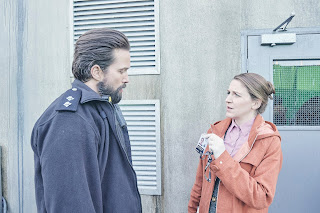
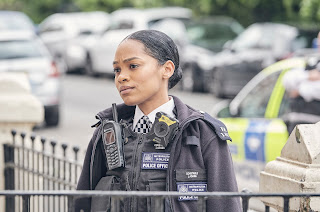
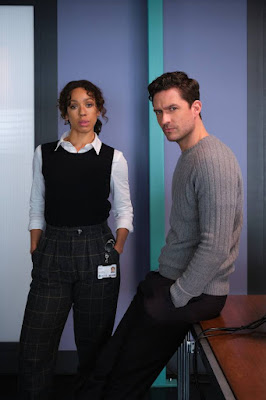
DEBORAH CROMBIE: We have a very special guest today on JRW. Author Kate London, a former Metropolitan Police officer whose novels, POST MORTEM and DEATH MESSAGE, have been adapted for the gripping Britbox series THE TOWER, is here to share the share the books-to-TV process with us. I asked Kate for the nuts and bolts (I was fascinated, for obvious reasons!)

KATE LONDON: In 2014, in the words of the song, I finally found what I was looking for. Not only my first book deal but also the sale of the television option. My plans for world domination could now be put in place.
If that’s the inciting incident, we know
what has to follow: the difficult second act. And so it was. A broadcaster commissioned a script, but took
it no further. The options on Post Mortem and its sequels automatically renewed
even though the project was clearly going nowhere. This was how I learnt the meaning
of the phrase ‘stuck in development hell’.
In 2019 the
rights reverted to me and my agent went out.
I had four
offers: I had arrived for a second time! I sat in Curtis Brown’s offices listening to brilliant
people pitching. It felt unreal, even a bit embarrassing. At least this time I
knew not to entirely believe the hype.
My experience of
the first option had also taught me something vital that should have been
obvious from the get go: it matters very much who writes the adaptation. One of
the pitches suggested that I should write it myself. I’d love to have done that, but, realistically, I
had no screen credit to my name and no experience of writing for television.
None of the other companies had been able to specify a writer. Their pitches
were exciting and persuasive – these were impressive people - but in terms of
the actual adaptation I felt I was no clearer than the first-time round.
There was still
one meeting to go. Patrick Harbinson, showrunner for Homeland and on numerous
other prestigious projects, was living in LA and so we chatted by Skype.
When I asked
Patrick who was going to write it, he said, me. Then, he talked lucidly and
persuasively about the books, how many episodes he would write, how he loved
that Post Mortem, the first book, turned on a conversation in a corridor: huge
consequences following from seemingly small actions. He knew what he wanted to
do. He had read the books closely. And he had a brilliant track record of
consistently making gripping television.
Patrick turned
it all around remarkably quickly. He pitched the series to Polly Hill at ITV who commissioned a script. On the
basis of that script, ITV greenlit the first series. Patrick partnered up with
Damien Timmer at Mammoth Screen and, bingo, in 2021 we were in production. In
2022 filming started on series two, based on my second book, Death Message.
When we chatted
before signing contracts Patrick said he wanted to involve me in the adaptation.
How this works is hard to describe. I knew from the start that Patrick would be
the showrunner, and that the final say would always rightly be his. But I am
included. Patrick sends me drafts, emails me questions. Sometimes we have long
conversations, trying to get to the heart of the problem. Sometimes we fight. It’s certainly not all sunshine and
flowers. But Patrick is always courteous, and often funny too. My respect for
him has only grown. He is immensely skilful, experienced and knowledgeable.
Any writer who
fights for a slavish adaptation of her work is a fool to herself. Television is
not prose. It works differently and under different constraints. A novelist can
change location in the blink of an eye. If she chooses to write a spaceship, it
costs her nothing. She can time travel with ease. It isn’t only these practical
considerations that mean the television series is not the book; prose simply
works differently. Characters in a novel can voice their thoughts and consider
their options. The reader can live inside the characters’ heads. Television works
differently. It must work on its own terms.
But the writer
of the books can still hope that the television version carries the arc of her
original story and some of her concerns and motivations. And she can even work
towards that if she is lucky enough to work with someone who is generous about
collaborating.
Both series are
full of thrills and reversals. They move at Patrick’s breathless pace. But, remarkably, the
narrative somehow has time to breathe, time to capture some of the complexity
that I saw first-hand as a serving officer in London’s police service. In The Tower we see the
flawed police constable Hadley Matthews exactly as I had imagined him, and, in
Death Message, we have time to witness the reality of enduring loss for anyone
who loses a daughter to murder.
DEBS: Check out the trailer below--so gripping!
The books-to-TV stakes are so dicey--adaptations can fail spectacularly or be as good as (although different from) the books. But I've read THE TOWER (Post Mortem) and watched both seasons of the Britbox series, and I think Kate really did hit the jackpot with these productions (and is well on her way to world domination!)