Showing posts with label Delia Ephron. Show all posts

Thursday, December 15, 2022

On being a bone marrow donor... 'Tis the season


 HALLIE EPHRON: On the day after Thanksgiving, "How to Save a Life,” an op-ed piece that my sister Delia Ephron wrote, was published in The New York Times. In it she shared her experience receiving the bone marrow donation that cured her of acute myeloid leukemia (AML is a blood cancer, a disease of thee marrow which produces your body's blood supply). 


The same the disease killed my sister Nora ten years ago. AML also killed my dear husband Jerry. He had a transplant. It gave him a fighting chance, but it wasn’t enough.

Delia remembers facing frightening odds when she was diagnosed and given four months to live. A bone marrow transplant held out the only hope.

She says, “A bone-marrow transplant, for the patient, is a grueling procedure that involves wiping the diseased marrow clean with powerful chemotherapy and transfusing stem cells from a healthy person who is genetically matched. But for the person who makes the donation, it is not difficult."

Her essay describes how
Be the Match and organizations like it (there are more than 50 worldwide, and they all cooperate) enable people to register to become a marrow donor.

Delia says, “You can register and never get called, or one day, with thrilling unexpectedness, you will get a phone call, as my donor Casey did, to tell you that there is an extremely sick person waiting for you to save his or her life.”
The prognosis is best when the donor is young, and doctors are most likely to request a donor under the age of 34.

To register, visit the web site (BeTheMatch.org), complete a brief form, and receive a kit in the mail. Swab the inside of your mouth as instructed and return the swab in the envelope provided. It's super simple

Donors aren’t paid, but organizations like Be the Match cover all costs, reimburse for lost wages or expenses during donations, and arrange for everything like a checkup to make sure donors are healthy.

Since the Covid pandemic began in 2020, the number of people who have registered but then refused to donate when called has risen. It's unfortunate but understandable. But as a result, right now there's even more of an urgent need.

I’m sharing this information in the hopes that in this season of giving, you can share it with someone who might give the gift of life to a stranger.

Quoting my sister: “During the holidays, if you are under 40, register to be a blood stem cell donor. If you are having a baby, donate your umbilical cord to a cord blood bank. Talk to your OB — umbilical cords, rich with lifesaving stem cells, are otherwise, as one of my doctors put it, thrown in the trash. 

"Give these gifts to a stranger. That’s the holiday spirit. If you have children or grandchildren in their 20s or 30s, when they ask you what you want for a present, tell them that you want them to register. Tell them that, for the holidays, you want them to save a life.”

Tuesday, April 12, 2022

Left on Tenth, my sister Delia Ephron's story of survival


HALLIE EPHRON: As so many of you know, I come from a family of writers. If you’d told me five years ago that today we’d be celebrating the publication of my sister Delia’s memoir, LEFT ON TENTH: A SECOND CHANCE AT LIFE, I’d have had a hard time believing.

She wrote this amazing book after struggling through several years of heartbreak. Delia lost our  sister (Nora), then she lost her husband (Jerome Kass), both to cancer.

Several months after her husband’s death, Delia decided to make one small change in her life: she shut down his landline. Which crashed her internet.

Verizon, her phone and internet provider, was less than helpful. After frustrating hours in HOLD hell, Verizon disconnected the phone all right, but also disconnected her DSL. Which led to more hours…

She channeled her frustration the way we Ephron girls were brought up to do: in writing. Her essay, “Love and Hate on Hold with Verizon,” ran on the op-ed page of the New York Times.

Here’s a taste:
This all began because I disconnected one of my two landlines. I don’t need two landlines now that I don’t have Jerry. This is the only change I have attempted to make in my entire life since my husband died, and it has obviously not gone well.
Read the piece to find out what happened after that.

The essay caught the attention of Peter, a Bay Area psychiatrist, who emailed her to commiserate. Recently widowed himself, he reminded her that they had shared a few dates fifty-four years earlier, fixed up by Nora.

Delia did not remember him, but after several weeks of exchanging emails and sixties folk songs, he flew east to see her. They fell crazy, utterly, in love.

End of story? Not.
Four months later Delia was diagnosed with AML, a fierce leukemia.


What happened next? Well, that's what Left on Tenth is about. In the telling, she’ll have you caroming us between tears and laughter as she recounts navigating the suicidal lows of enduring cutting-edge treatment, and the giddy highs of a second chance at love.

The reviews have been nothing short of remarkable. And I’m thrilled to host Delia today on Jungle Red Writers.

Delia, you and Nora wrote one of the most delicious romantic comedies of all time – You’ve Got Mail – but I wonder if you ever imagined that you’ be starring in a real life one?

DELIA EPHRON: I surely did not. I wrote that NYT piece about my internet crashing while trying to disconnect my late husband’s phone. Peter emailed and our connection was instant.

But of course it wasn’t a romantic comedy because 4 months later, in the midst of this heady romance, I got deathly ill.

HALLIE: Your illness came at such a dark time. So much loss, compounded by your own often-fatal illness. How did you find the resources to write about your experiences?

DELIA: I thought I would never write about it. I miraculously (and I don’t use that word lightly) survived an experimental bone marrow transplant – was in the hospital 100 days. I was a year recovering, actually two years, before I could believe it or feel utterly myself. And didn’t think at all of writing, not just this story, but ever again.

And then, one day, I thought, more happened to me in four years … well, I was a writer again and I knew I had an extraordinary story to tell.

HALLIE: Nora died of AML and you survived. And you say that throughout your treatment you’d repeat to yourself, “You are not your sister.” And yet in many ways you ARE so like her.

The very fact that you could write this book in the wake of it all speaks volumes, to me at least. And that you could make it, at times at least, funny. What do you think?

DELIA: The doctors – Dr. Roboz and my friend, Dr. Jon LaPook, both said to me, “You are not your sister.” What they meant was, my leukemia, under a microscope, was not her leukemia, even though we both had the same type, AML. They were willing me to believe I could survive.

I wrote a lot about that in the book. That was difficult for me to believe because it felt like betrayal.

There are four of us sisters (Nora, you, me, and Amy) and Nora was the oldest. The pressure on us all to be writers was fierce. I was second, and I tried to do everything she did, although she was going around the track so fast, I couldn’t keep up. Essentially, Nora was extoverted, and I am not. We wrote well together, but we were not really alike.

Writing is your fingerprint. Writing taught me who I am.


HALLIE: That's so true for me, too. Writing helps me figure out what I think. Something about the process of putting words on the page… I’m only starting to be ready to do that hard work again.

I hope this makes you want to read Delia’s book. It’s extraordinary. She’ll be checking in today to answer your questions… If we’re lucky, she’ll talk about where the title (LEFT ON TENTH) came from.

And hear Delia in conversation with Scott Simon about the book on NPR.

Thursday, July 28, 2016

Delia Ephron's SIRACUSA: A stone paradise where marriages unravel

HALLIE EPHRON: I’m so delighted to welcome my sister Delia Ephron to talk about her new novel, SIRACUSA. Goodreads reviewers are drenching it in praise. “IT’S MASTERFUL” “Superb!””Captivating and intoxicating.” A starred review in PW. Dark and suspenseful, a week after its pub date it's in its third printing and being turned into a major motion picture.

Am I jealous? Not saying.

The story is told Rashomon-style with four narrators, two couples who vacation together in Sicily’s Siracusa.

In one corner: Michael (a playwright) and Lizzie (a magazine writer), a childless couple.
In the other corner: Finn (a hip chef in Portland Maine) and his wife Taylor (Portland’s events coordinator and publicist); their sylph- and sphinx-like 10-year-old daughter Snow (named because she was born during a snowstorm—Lizzie thinks she’s “wallpaper”) is traveling with them.

It’s compulsively readable, and you know all the while the story, for all its normalcy, is careening toward cataclysm as lie after lie is revealed.
 

I happen to know that Delia and her husband often traveled with another couple, dear friends (unlike the two couples in the book who mesh only on the surface), but I had to wonder what in her travels inspired Siracusa?

DELIA EPHRON: Siracusa inspired the book. I was there on vacation. It's this falling down place in Sicily on the Ionian Sea and the old section is remarkable. The Romans knocked down all the trees in 212 B.C. to build warships and never replaced then. It's paved with ancient stone, narrow streets, tattered buildings. A stone paradise.

The first day I thought, this is the most magical place I have ever been. The second day, I thought, if I don't get out of here fast I'll go mad.
When I got home I realized it was the perfect place to set a story about marriage, about two couples on vacation careening toward disaster.

Of course then I had to go back and do serious research, which I did, several times.

You are a better more experienced traveler than I am. BUT, travel intensifies everything, doesn't it? Friendships can grow closer or go up on the rocks. The isolation of travel is great if you're feeling romantic and unbearable if you're not.  So isolating these couples by putting them on a vacation in a foreign place was perfect for the story I wanted to tell.

HALLIE: And in that “bad hotel?"

DELIA: Truly you never know which your best trips will be. Traveling is unpredictable. And the bad hotel -- it can happen on a vacation -- and for Taylor this is terrible. She blames Lizzie, who made the reservation. But that's just salt in the wound.  Other wounds are bigger.

HALLIE: So many of your other works (“You’ve Got Mail” “The Lion is In”) have wonderfully flawed but likeable characters, but in this book the characters are anything but. What was it like making that shift?

DELIA: Very freeing. This is a dark book -- very funny in parts, but wicked.  I didn't worry about whether anyone would like Lizzie, Michael, Taylor and Finn. I wanted them only to be real. Interesting and compelling.

So many people have said to me, "I thought I liked, say, Finn, and then I thought, I don't like him at all."  As a reader your opinion keep shifting as the betrayals and lies and paybacks mount up. And of course my characters all have opinions of each other and of Snow. The reader discovers that.

HALLIE: One of the most troubling characters in the book is Snow, Taylor and Finn’s daughter. As the mother of daughters I found myself squirming. Where did Snow come from?

DELIA: My wicked brain. Here's the thing: I'm very interested is how attached some mothers are to their daughters -- relationships
I've observed where the lines are blurred. Taylor loves her daughter more than her husband, which happens sometimes in marriage. Snow is sphinx-like, as you said, an enigma. Is she shy or is she cunning? Is she manipulating or being manipulated? Should I love her, want to protect her, or fear her?

HALLIE: (That picture of Delia and me was taken before the premier of her movie, "Hanging Up.") Four viewpoints, intertwined and overlapping is so hard to pull off. Perfect for this story, since secrets are its fuel. But did you find it challenging? Did you have to map it out?

DELIA: So difficult. By the time I hit the third quarter of the book, my head was swirling. Who knew what, who didn't, what would be revealed and to whom. I had lists on my wall keeping track. But I don't outline.

I started Lizzie, Michael, Finn and Taylor with problems. Michael is having an affair and Lizzie doesn't know. Finn and Lizzie had a summer fling many years before, and he is feeling shut out of his marriage. So I start them there and, as I write, the story, takes off.

The most important line I wrote early on that gave me guidance, was a line of Lizzie's: "Couples collaborate, hiding even from themselves who is calling the shots and who is along for the ride." 

I have an inner compass about plotting. I trust my subconscious to take me where I need to go. I knew something BIG would happen in Siracusa, and one day I realized, Oh that's it. That has to happen. I got so excited.

HALLIE: You’re writing a screenplay now for the book. Are you having to alter the story structure? Whom will we root for??

DELIA: Oh, you need to root. H'mm. I wasn't thinking about that. I'm very excited that Siracusa has been bought for film and that Alfonso Gomez Rejon will direct ("Me, Earl, and the Dying Girl). 

With a screenplay, I have to find the movie in the book. Create the visual medium and telescope the story to hold onto its essence. So what is the central current?

Also do I need a Rashomon? Film has other ways of indicating point of view. Do I need to alter the story to make it work better. In film I don't have the luxury of the "inner voice" unless I do voice over. 

So all these problems have to be address. Also this is about marriage and friendship -- characters make lots of observations about that. Need to keep that aspect. How?

HALLIE: What an interesting problem. Novels lack the visuals of a movie, but we do have narrative voice.

I'm still mulling Delia's remark:  

The first day I thought, this is the most magical place I have ever been. The second day, I thought, if I don't get out of here fast I'll go mad.
TODAY'S QUESTION: Have you ever traveled somewhere that left you with that feeling?

Signed copies of Siracusa are available at:Barnes & Noble, Upper West Side, NY
Brookline Booksmith, Brookline, MA
Wellesley Books, Wellesley, MA
RJ Julia, Madison, CT
Diesel Bookstore, Los Angeles
BookCourt, Brooklyn, NY
Politics & Prose - Washington, D


"Delia Ephron’s Siracusa is a stunning portrait of two marriages coming unraveled during the stress of travel abroad. Insightful and engaging. A must read!"—Sue Grafton


Monday, June 22, 2015

What We're Writing: @HallieEphron, the sister who didn't

HALLIE EPHRON: It's What We're Writing week again, and (bowing) thank you, thank you, I get to kick off the festivities. I am working on a new book but it's still very much in flux so I'm keeping it under wraps. Instead I'm offering up part of an essay I wrote about having sisters who write. I wrote it to celebrate the publication of my somewhat autobiographical novel Night Night, Sleep Tight in which the protagonist who really is the virtual me has no sisters.  

*** Whenever I get together with my sisters and reminisce about something that happened when we were growing up, one of them will pipe up, “It wasn’t like that.” Another will pile on: “And you weren’t there.”

And maybe I wasn’t. Memory is like that. Photos in family albums morph into memories, while events that weren’t seared into consciousness fade.

For years I sat back and didn’t write while my sisters did, and it’s always illuminating when one of them writes about a time when I was there.


My older sister Delia’s first book, the huge bestseller How to Eat Like a Child, has a chapter on “How to torture your sister.” In it she reveals techniques that she and I practiced on our younger sister, Amy. (“I’ve got to tell you something. You’re adopted!”) Delia would go on to write Hanging Up, miraculously finding humor in our screenwriter father’s bouts of alcohol-soaked self-pity. 


My oldest sister Nora, who inspired a generation of women to feel bad about their necks and who wrote and directed some of Meg Ryan and Tom Hanks’ best films, gave me a moment on the page as the "good" daughter (“to distinguish her from me,” the protagonist explains) in Heartburn, her painfully funny autobiographical novel about the breakup of her marriage to Carl Bernstein.

Then there’s the time I nearly killed Amy. She immortalized it in her first novel, Cool Shades. She couldn’t pedal
her tricycle fast enough to keep up with my two-wheeler, so I tied my bike to her trike. Soon we were flying along. Near the corner, I hit the brakes. But tricycles have no brakes, so Amy kept on going until the rope snapped and she flew off, skidding face-first across the macadam. Reading her book brought back the full horror of that moment when I realized what I’d done.

I've gotten used to being written about, and whenever one of my sisters publishes something (as in just about every other week), I brace for another cringe-worthy episode from my life to get aired. 


For years I couldn't fight back. I didn't write.

Then, one day I got a call from a freelance writer. She wanted to write a magazine piece about me. “You’re the sister who doesn’t write,” she said, like “the fourth Brontë sister.” Which sounded unappealing, not just because the fourth Brontë sister died young of tuberculosis.


Then it struck me: the longer I waited to write, the less material there would be to claim as my own.

I told that freelancer that if anyone was going to write about me not writing it was going to be me.


***

After telling that freelance thanks, but no thanks, I started where most writers start, essays about my own personal experience. I piled page on top of page, thinking maybe I was writing a book.
But when I read it, I knew that while the words were fine, and some of the sentences were lovely, the story was circling the drain. I had no idea that characters need arcs, that there had to be stakes, and the story had to go somewhere.

I tucked that unfinished manuscript away. When I pulled it out about three years ago, I was surprised to find that it didn't smell as bad as I thought it would. In fact, pieces of it are in Night Night. (The episode where Deirdre gets nabbed for shoplifting at J. J. Newberry's really happened. Sadly none of my sisters were involved so I missed an opportunity to humiliate one of them.)

Which leads me one of my hard and fast WRITING RULES. Save everything you write because today's garbage is tomorrow's compost. Which is a corollary to my other WRITING RULE: Just hold your nose and write.

Tuesday, October 22, 2013

Delia Ephron's Sister Mother Husband Dog

HALLIE EPHRON: My sister Delia Ephron has just come out with a fabulous book of personal essays, Sister Mother Husband Dog (etc.) I devoured it from cover to cover because it is whip smart, poignant, achingly sad, ironic, outrageous, and hilarious -- and because Delia writes in a voice that just makes you want to hang out with her on the pages.

I was especially eager to see what Delia had to say about dogs because because we didn't grow up with them.

No pets at all, unless you count the ducklings that one of us won at a carnival at El Rodeo elementary school and that we kept in the garage. It's clear from this picture that I nearly strangled mine, loving it to death. As Delia remembers, "They lived in the garage and swam in a small inflatable kiddie pool until they disappeared one night." It's true, we did not mourn.

The reason we couldn't get a dog, our mother used to explain whenever the subject came up, was because of Trixie. If we got a dog, the same thing would happen that happened with Trixie. None of us would take care of her, and my mother would end up having to feed it and walk it and all the rest.

So I read Delia's essay on "Dogs" looking for Trixie. But Trixie wasn't there. So now I get to ask: Was there a Trixie or was it just a myth Mom made up to justifying not getting a dog?

DELIA EPHRON:
  First of all, thank you for that lovely introduction.  I am sending mountains of love through the web to you. 

As for Trixie, my memory is we had her for a week.  She was sort of a long legged, short-haired, medium-sized dog, black and white, and I remember she showed up with no notice, no preparation, no preamble, and then a week later she was gone.  And Mom insisted that she was the only one who took care of it.  It is strange to me because I love dogs so much that this dog came and went almost like a phantom. and made no impression.  Dogs are remarkable.  How is that possible?

HALLIE: Delia, when you got a dog, I was flabbergasted. And then you named them like Spanish aristocrats. Honey Pansy Cornflower Bernice de Mambo Kass. (Okay, I added the  "de.")

So what's the deal with the names, and how'd you come up with them?

DELIA:    I was a stepparent and every stepparent should have a dog because it's very important to have someone in the house who loves you.

Daisy, my first, had thirteen names.  I don't know why -- I think it began when I realized that when I had lunch I could have two Cokes if I wanted.  I mean, I was an adult, and I was paying, so if I wanted two Cokes, why not, and that led to giving Daisy 13 names, and Honey, six. 

As for how I came up with them ...  after I tell you, I'm sure you will wish I hadn't, but here goes.   Jerry (my husband) named her Honey because she was the sweetest puppy, Pansy is my favorite flower, we passed a field of cornflowers when driving her home, Bernice is my husband's aunt.  All our dogs are named after one of Jerry's aunts.  Mambo is a great word and a great dance, and Kass is Jerry's last name.

HALLIE: I discovered reading the book that Honey eats only kangaroo meat. How can that be?

DELIA:  She was chewing her paw and the doggie dermatologist said she was allergic to her food so she had to eat Kangaroo.  So we fed her kangaroo -- it comes in a bag just like all other dog food -- and she stopped chewing her paw for a while, but she's back at it. 

I think she's nervous about the book being published. Being in it and all.  She's a very private dog.
HALLIE: Honey was born in California, as we all were, but does she love New York City now as much as you do?

DELIA:  Honey was born in Rhode Island.  She does love NYC as much as I do.  She has dog friends in the building and on the street.  And the streets are sniffing paradise.  Plus, all the pizza crusts to scarf.  She gets to run up and down the lobby at 2 am. even though the building doesn't permit it.

HALLIE: There's another essay in the collection in which you talk about eating your way through the bakeries in Lower Manhattan. Does Honey come along, and are there bakeries there as there are here with treats for dogs.

DELIA:  Dogs aren't allowed in bakeries, but many bakeries have benches in front so you can tie your dog's leash to a bench leg and keep watch out the window to make sure your dog isn't dognapped while you are buying a croissant.  Honey knows all the places in the neighborhood where she gets treats.  She's always trying to make a right turn into Whitney Chemists, our local drugstore, because Christine, behind the counter, gives out treats.

HALLIE: Okay, Reds... Did you grow up with dogs, always want one... or were you more the type to lust after a pony or (as my younger daughter did) a pot bellied pig?

Monday, April 2, 2012

Never Forget To Roar


The Lion Is In
is a novel about three women on the lam and a lion who changes their lives.
It’s about friendship, courage, love … and learning to salsa with the king of the jungle.


HANK PHILLIPPI RYAN: “Three women walk into a bar”…kind of sounds like the beginning of a joke. But for the three women in THE LION IS IN, it’s the beginning of a journey. Delia Ephron’s new novel is—well, it’s novel. And original and fresh and hilarious and poignant and it stars—a lion. Named Marcel. As you will discover, Marcel is a force. And so, as you will also discover, is Delia. (If her last name sounds familiar, come on. You know why.)

HANK: Delia! You're amazing. With a whole list of novels and essays, movie screenplays like You've Got Mail (with so many lines that are iconic) and Sisterhood of the Traveling Pants, a long-running play written with sister Nora, (Love, Loss and What I Wore), and now your brand new book THE LION IS IN that comes out this week. SO much to talk about! So, um, what was your sister Hallie like when she was a kid?

Delia Ephron: For some reason that question reminds me of Hat Day at Camp Tocaloma where Hallie, about 8 at the time, wore an upside-down straw bowl on her head.

HANK: Oh, she still wears that. We all wondered about it...but were afraid to ask. Anyway, I was thinking about You've Got Mail. (You're probably sighing, now, thinking, WHY is she asking about that? But here in book world, it's a true classic).

One reason I love it is that it reveals how some of us--and I include myself--find it so much easier and more successful to talk without really being in the same room with someone. Joe and Kathleen are articulate and clever and poignantly honest when they're anonymous. There's a question there, I promise. About writing, I guess. Are you more comfortable writing than talking? Are you enthusiastic when you sit down at the computer? Or anxious?

Delia Ephron: I love to write. It's total escape for me -- not that it isn't sometimes difficult or full of anxiety but basically I'm so happy writing. But I also love to talk. I love to talk about writing too -- to have really boring conversations with my writer friends about things like structure. But everyone in the world writes more. Email and texting and twitter are putting our voices out of business.

HANK: Oh, my husband would disagree...for my voice, at least. So. The Lion is In. Okay, I've gotta ask. Tell us about the first moment you thought: oh, of course. I could write a novel about three women who meet a lion. Yes, a lion. And how their lives are changed by the lion. Sure, yeah, that'll work. Why didn't I think of that sooner? (And I love the Thelma and Louise cover!)

DE: I dreamed it. I had a really powerful dream about three women in this huge strange roadhouse/bar built of materials hammered every which way. I knew two of the women were young, in their twenties, and their names were Lana and Tracee. And there was an older woman, around 50, that I named Rita when I woke up. Tracee was in a wedding dress. And there was a lion. A lion. In a large cage. The women were all on the lam.

The dream took place in North Carolina, a state I had never been to. When I woke up I really didn't know if what I dreamed had actually happened. It took me a few minutes to realize I was actually in NYC in my own bed. I knew it was my next book. I sat down that morning and started writing. The story contains all the themes of my life, so I'm not surprised in retrospect it came from a dream. But when I went down to N.C. after writing the first draft (not before), I found so many things that I had written were actually there.

And the lion ... I have a dog, so I believe that animals are remarkable and have the power to change our lives ... but a lion???? ... I sent the manuscript off to Katie Buess, at the San Diego Wild Animal Park and she said everything that I had imagined with Marcel (my lion) was right. She helped me, gave me some ideas and adjustments ... but basically I seemed to know it.

And re the cover: Thank you. I love it too.

HANK: Delia, that’s almost—incredible. A dream. Huh. And so interesting that it didn’t just evaporate when you woke up, as they often do. I want to talk about how your brain “understood” lion-ness, and what that was, but first-- You talked about the themes of your life..tell us about some of them…and how they translated into the book.

DE: Lana is struggling to stay sober ... and those were problems I grew up with, my parents had those problems ... and Rita is unhappily married, trapped in a joyless world -- her spirit is being crushed. I know that from my first marriage. I had to leave to save myself, and she does too. And Tracee, well I'm not a kleptomaniac, but I know what it's like to feel unloved.

When I began to write, I didn't know what the women wanted. I only knew what they didn't want: the lives they were leading. Their friendship -- a sisterhood -- is a major part of what helps them figure out where they are going and get there. The other part is Marcel.

HANK: So what was it about lions that you “got”? Why did you use a lion? How did you pick the name Marcel—or was that simply the lion’s name?

DE: Marcel -- I suppose it's like a baby where you look at it and you know its name. Oh this is ... Marcel. About lions, I understood their power, their silence, their essential social -ness, their love of scents (although I had to be told about their love of femur bones) and their whimsy.

HANK: Yikes. Scary. (But good to know about the femur thing.) What did your agent say when you—or your husband, or whoever you first told—explained what your book would be?

DE: I just sent it to my agent without an explanation. I'm not sure if I told her I was even writing it but she loved it. She pushed me ... I did two more drafts, but she always loved it. So did my husband. I strive/hope to write what I like to read: characters that you love to be with, and a story that keeps you turning the pages. The turning pages thing was always working. I hope the other does too.

HANK: In the end, all the women’s lives are changed by the lion. For some reason, it reminds me of Dumbo’s magic feather, where the feather has no power, except what Dumbo believes—and that’s the strongest power possible. It’s as if we all have lions, you know, we just have to be open to them. (Or, I could be wrong.)

DE: That's what I believe. Whether you have the help of a lion named Marcel -- friend, playmate, comforter, priest, rabbi, minister, higher power, shrink -- we all posses the imagination to change our lives.

HANK: Has this book changed your life, too?

DE: It's calmed me down. Marcel is a force.

HANK: So I have to ask. When you think--"Marcel"--if you do--what does that mean?

DE: First the whimsy, something I always try to be in touch with, and then the bravery. And the patience. And kindness. And the roar. Never forget to roar.

HANK: Never forget to roar. Fantastic. Thank you! The book is amazing…and I can’t wait to see what happens as a result.

So Reds, was there a moment for you? Or a force? Or a decision? A person, place, thing, event or animal--who changed the course of your life? (Mine might have been when the political candidate I worked for lost the election—and I lost my job. As a result, and because I didn’t know enough to be afraid, I walked into a radio station, and asked for a job as a reporter. And so it goes.)

And how about this—Delia’s giving an autographed copy of THE LION IS IN to one lucky commenter!

***************************************************

About the Author

Delia Ephron is a bestselling author and screenwriter. Her movies include The Sisterhood of the Traveling Pants, You’ve Got Mail, Hanging Up (based on her novel), and Michael. She has written novels for adults and teenagers, books of humor, including How to Eat Like a Child, and essays. Her journalism has appeared in The New York Times, O: The Oprah Magazine, Vogue, More, and The Huffington Post. Recently, she collaborated with Nora Ephron on a play, Love, Loss, and What I Wore, which ran for two years off-Broadway and has been performed in cities around the world, including Paris, Rio de Janeiro, and Sydney.

www.twitter.com/deliaephron
www.facebook.com/deliaephron
www.deliaephronwriter.com


Friday, February 5, 2010

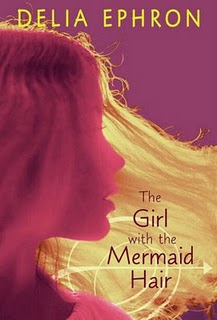
On adolescent angst and a girl with mermaid hair

HALLIE: Okay, just for the record, I do not think my mother ever had plastic surgery because back then, even if you were a woman Hollywood screenwriter hitting middle age, it was rarely done and certainly not talked about. But she was obsessed with her nose, and I can still see her sitting at the dinner table and pushing up the tip of it in a nearly unconscious gesture. As her daughter I was obsessed with with my nose, too (I'd inherited a combination of hers and my father's which was even worse), and jealous of youngest sister Amy who had miraculously inherited our grandfather's nose and looked, as my mother oh so often pointed out, "like a little Dutch doll."

My sister Delia
Ephron’s brand new novel for teens and preteens, “The Girl with the Mermaid Hair,” perfectly captures that excruciating self-consciousness of being an adolescent girl. Sukie Jamieson is young, beautiful, lonely, and so completely self-obsessed that she constantly taking selfies (cell phone photos of herself) and examining herself in every reflective surface. I so remember being that age and SO self-conscious. Sukie has an additional twist: her mother is about to get a facelift.

I love the moment in the book when
Sukie’s mother gives her a full-length mirror that once belonged to her grandmother “This mirror will be your best friend and worst enemy.”

DELIA:
That really says it all. A mirror is where you go for comfort and reassurance that you’re all right. As a teenager that means that you LOOK all right. You give it so much power, when in fact what’s inside has more power.

HALLIE: To make things worse, Sukie’s mother gets a face lift. How hard is that for a teenager already feeling inadequate and obsessed with her own looks?

DELIA: My niece Maia did research on girls and mirrors for me, interviewing teenage girls whose mothers had face work. What came up over and over was girls were so aware of how mothers were saying “Oh God, I look fat.” Or “Don’t make that expression you’ll get a wrinkle.” The mother starts to age and feel bad about herself and she’s not thinking about her teenage daughter who’s struggling to love her own body.

Don’t you think there’s a lot of narcissism in parents in general around around beauty. I was really interested in is this phenomenon of all these mothers at a certain age hating their looks and saying so, without even thinking of course that their daughter are painfully self conscious. The mom’s an adolescent and so’s the daughter.

HALLIE: Sukie is so beautiful and bright, she seems like she has everything. But she’s really so unhappy.

DELIA: I think when we’re young, we tend to think if you’re beautiful then your life is easy. I wanted Sukie to have this thing outwardly that everyone envies. Inside she’s miserable, she doesn’t now how to connect, she’s lonely, her parents are a disaster, and she relies on her looks because she can’t rely on anything else. She uses her phone to photograph herself but it never rings.

HALLIE: How do you manage to write what could be truly unsympathetic characters so sympathetically?

DELIA: When I write a character, my first question as a writer is: Why would you care about her? I knew that she couldn’t be the way she is if she had good mothering. So the question was: Who was her mother. The minute I knew her mother felt as inadequate as she did (she says her grandmother never gave her a compliment), so insecure and unhappy with her own life, I understood how Suki felt abandoned. And her father uses Sukie to team up against her mother. Once you understood her parents and the situation she’s in, you can forgive her for how she strikes out of her friends because comes out of so much self hate. It’s all about vulnerability.

HALLIE: I felt that. But this is a really funny book, too. I was laughing out loud when Sukie decides she “has ramp” because her nose is that particular shape that she sees in a magazine.

DELIA: When I dealt with pain as a kid, I always turned it into a funny story. And as a writer, I always want to scream Hey! This book is funny, even though it’s really serious.

THANKS, Delia - as a parting gift to us here’s the Jungle Red quiz...

Miss Marple or Hercule Poirot?
DELIA: Miss Marple

Sex or violence?
DELIA: Sex

Pizza or chocolate?
DELIA: Pizza but really both

Daniel Craig or Pierce
Brosnan?
DELIA: Daniel Craig but really neither.

Katharine Hepburn or Audrey Hepburn?
DELIA: Audrey Hepburn.

Your favorite non-mystery book?
DELIA: Reading Lolita in Teheran

Favorite book as a kid?
DELIA: Anne of Green Gables

Making dinner or making reservations?
DELIA: Making Dinner

And now, the Jungle Red Big Lie. Tell us four things about you that no one knows. Only three can be true. We'll guess which one is false!
DELIA: : This was hard. So I couldn't quite do it the Jungle Red Big Lie way. Please forgive me. Three of these things are false and one is true, and Hallie knows for sure.
1. When I was twelve I was a ball girl for a tennis match between Gonzalez and
Rosewall
2. I slept with a stuffed animal right through college
3. I'm a huge fan of Garth Brooks
I won the high school literary magazine poetry contest

HALLIE: Isn’t that the definition of a fiction writer? We’re better at making things up!)

Delia will be checking in today so please, share your thoughts...


Wednesday, December 23, 2009

On "Love, Loss, and What I Wore"


HALLIE: My sisters, Delia and Nora Ephron, have written a wonderful play that’s off-Broadway right now, “Love, Loss and What I Wore.” It’s based on the poignant illustrated book/memoir by Ilene “Gingy” Beckerman. To Gingy’s stories they added lots more, including some that I recognized (Nora and her bottomless purse, Delia and her hot pink Mexican wedding skirt). Even my daughter got into the act, collecting bra stories from her friends.

What is it about women and clothes?

DELIA: we start young. Really it's the first thing we get to chose -- what to wear. Even before we get to decide what we want to eat, our moms let us pick out what we are going to wear that day. So we define ourselves with clothes from the start. And we shop with our mom's and we rebel with clothes when we're teenagers. And don't forget dress-up -- I mean "play," pretending to be other people, clomping around in our mom's high heels.

HALLIE: We’re not talking about “fashion” here, right?

DELIA: Absolutely. Not fashion. This play is about the clothes we wore and the memories they trigger. We always remember what we were wearing when ... we fell in love, broke up, and so on and so forth. The stories of our lives told through our clothing.

HALLIE: Of course, our mother picked our clothes growing up. I don’t know why but the dress I remember you wearing as a child is a dark blue and white striped taffeta dress with a drop waist and a swishy skirt, and a red velvet bow at the neck. Do you remember that dress? I was so happy when I grew into it.

DELIA: Now that's interesting. I thought mom let us pick all our clothes. And that dress -- I die when I see myself in it. I was built like a stick, and that dress required someone with curves. And that bow!

HALLIE: What can I say? It was yours, so I coveted it!

The production features five actresses with a cast that rotates every six weeks or so. I went to see it with a half-dozen friends from college. We saw Rhea Pearlman and her daughter Lucy DeVito, Kristin Chenoweth, Capathia Jenkins, and Rita Wilson. They were so phenomenal and seemed to be having so much fun doing it. Do you get to work with the actresses, and how do you decide which one gets to perform which story?

DELIA: Yes and it is the most fun. We rotate in a new cast every month. Since the play is a collection of stories, with each new cast, we have to decide which actors are right for each piece.

HALLIE:
The audience I saw this with was rocking, from the minute the cast walked on stage. Do you get to watch audiences respond and talked with them after they’ve seen the show?

DELIA:
The actors love to do the show because the audience -- which is mostly women, since this is the story of women's lives -- are very interactive. What happens is that the show triggers your own memories -- so the audience is having a really personal experience. And often they don't want to leave the theater because they are so busy talking to their friends about their own experiences. But not all audiences are alike -- and no two performances are alike -- so there is always the excitement and anxiety, what will this show be like.

HALLIE: After the show I couldn't stop thinking about clothes. The date decision: whether or not to wear a padded bra. The California shoes that nearly dissolved in a New York City rainstorm my first day at college. Not knowing what to wear to my mother's funeral.

What are the clothes that meant something to you?

DELIA: My crocheted dresses that were so, so short and so so sexy that I used to wear everywhere, even to work, when I was in my twenties. My raspberry silk sweater -- I can see it so clearly -- I wore it on my first date with my husband. I was wearing it when the menu caught fire in the restaurant. Very symbolic.

HALLIE: How about you? Please, tell us about something special and what it meant.