Showing posts with label Golden Age mystery writers. Show all posts

Thursday, June 4, 2015

Martin Edwards--The Golden Age of Murder

DEBORAH CROMBIE: I had a huge treat when I was in London this past February. I was invited to the annual Detection Club dinner by my friend Kate Charles, who is a member.  The dinner was held at the Garrick Club in the West End, a most august institution, and was hosted by the current president of the Detection Club, Simon Brett. It was a "pinch yourself" occasion--so many brilliant writers, such fabulous atmosphere (and food), and such a wonderful slice of London history!


I caught up with a good many old friends that evening, but a special pleasure was visiting with writer Martin Edwards. Martin is from Cheshire (I always imagine that Martin sounds a bit like Duncan--or vice versa), and writes terrific English mysteries, one series set in Liverpool and another in the Lake District. But Martin is also a very accomplished writer of non-fiction, and when he told me about his latest project I knew he had to visit us on Jungle Red.

THE GOLDEN AGE OF MURDER is THE book on Golden Age mysteries. It's getting rave reviews on both sides of the Atlantic. Here's a snippet from the starred review in Publisher's Weekly: “A comprehensive and well-written narrative that combines biography with literary criticism... Along the way, he dispels numerous myths about Golden Age detective fiction: for example, that it was ‘an essentially British form of escapism... an effete counterpart to the tough and realistic crime fiction produced in the United States’...The trenchant analysis is coupled with revelations about the private lives of these very public authors, offering new information for casual fans and students of the genre alike.” 

Here's Martin to tell us more.


MARTIN EDWARDS:


Detective fiction from the “Golden Age” between the wars is enjoying a renaissance. The British Library’s Crime Classics series, for which I’m Series Consultant, has sold over a quarter of a million copies in paperback alone in rapid time. To everyone’s surprise – including mine, to be honest - Mystery in White, by the long-forgotten J. Jefferson Farjeon, was a surprise number one best-seller last Christmas. It even outsold Gone Girl!

So I’d like to think that the time is ripe for publication of my study of the genre between the wars, The Golden Age of Murder. The sub-title is: “The mystery of the writers who invented the modern detective story.” And they really were a very mysterious lot. Agatha Christie’s eleven-day disappearance is merely the best-known of the various puzzles surrounding her brilliant contemporaries such as Anthony Berkeley and Dorothy L. Sayers.

The narrative hook of The Golden Age of Murder is the story of the founding of the Detection Club in 1930 as the first ever social network of crime writers. It was a select band, with only twenty-six founder members. They prided themselves on the quality of their writing as well as on their facility for creating ingenious and unusual plots. The more I delved into the back stories of these authors, and their complex relationships, the more fascinated I became. Early reaction to The Golden Age of Murder suggests that many other people feel the same way.

The lives of the writers, and discussion about their books, which included many long-forgotten gems, are two of the four elements of The Golden Age of Murder. The third is the remarkable range of real life crimes which inspired so many detective classics. Some of the cases are well-known, but others are not. Among those which fascinated me was the still-unexplained death at sea of Frank Vosper, a famous actor and playwright; the people who were on board with him shortly before he disappeared overboard included a beauty queen, a gay bullfighter, and Ernest Hemingway...

The fourth ingredient of the book is the remarkable period of history during which so many classic mysteries were written. This was an age when people slowly recovered from the devastating consequences of one war, only to find themselves threatened by the prospect of another. The received wisdom is that classic mysteries tell us little or nothing about the times in which they were written. I disagree – in fact, my belief is that, if you read between the lines of the best books, you learn a very great deal about “the age of anxiety” as well as about the writers and their lives.


Above all, people love a good mystery, and there are plenty of Golden Age detective stories that have stood the test of time. Now so many books that were once almost impossible to find are available and affordable, supply is meeting a demand that, I suspect, has long existed. The wheel of fashion has turned in favour of Golden Age mysteries, at long last. And I couldn't be more delighted.

DEBS: This is a gorgeous book, a must-have for anyone who loves detective fiction!! And it's un-put-down-able from page one. Harper Collins is very kindly offering to give a copy to a lucky commenter (too difficult for Martin to ship from the U.K.) so get your name in the hat.

And then share you favorite Golden Age mystery! 

Martin Edwards was born at Knutsford, Cheshire and educated in Northwich and at Balliol College, Oxford University, taking a first class honours degree in law. He trained as a solicitor in Leeds and moved to Liverpool on qualifying. He published his first legal article at the age of 25 and his first book, about legal aspects of buying a business computer at 27, before a career as an equity partner of a law firm, where he is now a consultant. He is married to Helena with two children (Jonathan and Catherine) and lives in Lymm. A member of the Murder Squad (see the Links section) collective of crime writers, Martin is Vice Chair of the Crime Writers’ Association. In 2007 he was appointed the Archivist of the Crime Writers Association and in 2011 he was appointed the Archivist of the Detection Club.


Martin is recognised internationally as an expert on Golden Age detective fiction, and is the author of The Golden Age of Murder, a ground-breaking study of classic detective fiction written between the wars, published by Harper Collins in the UK and US.Len Deighton has described it as "illuminating and entertaining" and said it "provides a new way of looking at old favourites." American critic Sarah Weinman called it "this most delightful and necessary book" and British novelist Ann Cleeves described it as "a wonderful non-fcition book". The Times calls it "a richly rewarding study of the genre," while Mark Lawson described it in The Guardian as "an excellent work of detection...superbly compendious and entertaining."

REDS ALERT!!! Here are the winners of copies of Mark Pryor's Hugo Marston books. Instead of choosing three winners, Mark is sending a book to everyone who said they'd like to make Hugo's acquaintance!  So Mary Sutton, Susan b., Gail in Sequin, Deb Romano, Joan Emerson, and Diane Hale, could you send me your mailing addresses at deb at deborahcrombie dot com?  Hooray, Mark! You are so generous, and officially a JRW favorite!!!

Monday, May 16, 2011

Are You a Hoarder?

RHYS: Later this week I'll be interviewing Mary Jane Maffini, who writes about a professional organizer, so I'm painfully aware of the clutter in my own life. My office looks--well--lived in. Our house looks equally well lived-in. Our children have made threats along the lines of "don't you dare die and leave us with all this stuff."

The problem is that we're both hoarders. I'm not as bad as John, who keeps every letter he wrote to the local water board and even the programs from a track meet during his prep school days. But I do keep a copy of everything I've ever written, boxes of my kids' art work from kindergarten on, my college thesis, German and French literature I'll never read again, plus boxes of photos that never found their way into albums, even old vinyl LPs.

I come from a family who never saved anything. My mother threw away anything that was no longer useful. I still lament my lovely doll house she gave away one Christmas (It was to a family who had just lost their father, so I couldn't say anything,but she didn't ask me first). My parents would change their furniture when the whim took them. They even changed houses more frequently than most sane people. So things meant nothing to them.

But they do to me. When I've been lying awake at night, I worry over what items to save first in a fire. I have a big project to put all of my favorite family photos onto DVDs and to store them somewhere safe. But I confess I do feel overwhelmed by a plethora of possessions. One of the reasons I like going to our condo in Arizona is that it's simple and contains no unnecessary stuff. Other folk our age are downsizing. I know we should be thinking of it too, but I can't see it happening in the near future. And my linen closet actually looked like this after my new cleaning lady got at it!

So which of our Jungle Reds are fellow hoarders? Who are our neat freaks?

I'm hoping Mary Jane will give me some tips on how to throw stuff away.

JULIA: I'm not neat - far from it! - but I'm ruthless about tossing unused items. I suspect it's the legacy of growing up as an army brat, always moving. If it hadn't been played with/worn/looked at in the past year, out it went. Ross, on the other hand--don't get me started. If not for me, he'd be living like those eccentrics you read about, barricaded in with towers of newspapers.

DEB: One of the problems is that everyone's idea of too much stuff is relative. I think Rick has too much stuff--he wonders why on earth anyone needs four sets of china and all those BOOKS . . . But I find that too much clutter (at least by my standards) drives me crazy, and as I work at home, I find it distracting. I'm having a stay-at-home year, and one of my goals is to purge some of the junk and organize those closets!!!!!! It just makes me feel better and function better if I can find things, and if I can keep things clean and neat.

I'm very interested in hearing how a professional organizer deals with the emotional issues involved in helping people downsize.

JAN: I'm a binge and purge girl. I have a hard time throwing stuff away, and it collects, but then I go on a tear and will throw it all away whether it needs to go or not. But Deb, you are so right, It's much easier to throw my husband's useless junk away then my own junk which never seems quite as useless.

HANK: Oh, heavens, yes. Deb, can you please come over? I have...clothes. Yeesh. I've given away lots, but I could use someone tough. And my press clippings, of course, must have. And books. Got to go. GOT TO! We called in a person to go into our basement..he had a big big dumpster and everything just went into that. It was terrific. Nothing better than getting rid of stuff--it's so empowering.

When Jonathan and I merged households, I got rid of LOTS of his clothes. That was easy. I called it his "southwestern collection." You don't wanna know.

I have a rule that I can't buy any new clothes unless I get rid of three things I have. That kind of works.

ROBERTA: His southwestern collection--that totally cracks me up Hank!

JULIA: Pictures! Pictures!

ROBERTA: John had a dreadful polyester warm-up suit that he wore to play tennis a couple of times a week. I overlooked it while we dated, but then it got the heave-ho. Of course then he tried to throw out my aqua sweatpants--not so fast Mister!

RHYS: And my John still has bush jackets that he wore in Indonesia. He used to show up at the kids' swim meets and embarrass the heck out of them!

HALLIE: My husband has clothes he wore in junior high. Really. I have a particularly effective hissy fit where I declare that I will not will not will not end up married to the male equivalent of a bag lady. Sometimes I cry. If I get het up enough it usually works and a few things go out. Or moved around so I'll think they went.

I am so not a hoarder. One set of china... er, stoneware. All I collect are feathers found on hikes and Chinese fortunes.

RHYS: I'm afraid I collect things too: rocks, shells, antique paperweights, dolls from around the world, and John inherited his parents lovely antique things--Chinese plates, English swords..you name it,we've got it. And they are lovely but I've no idea what will happen to them when we die.

ROSEMARY: Husband's stuff is much more annoying than mine. And this from a woman who probably owns 100 tablecloths, 40 vases, 5 sets of china, gardening magazines from 10 years ago and more cookie cutters and tartlet pans than Martha Stewart. And bowls of shells and coral. But I'm not a hoarder. I love them all.
And I do try to donate or throw away something every time I bring something new into the house.

Jonathan as a cowboy? I don't see it. But then Bruce had a jacket he referred to as his Italian jacket - I thought it made him look like a sportcaster from the 70s. I was so happy when we said ciao to that one.

JULIA: Ross had a disco outfit when we met in the early eighties. He had also saved all his wide-collared shirts. Sadly, they somehow got lost when we moved him from Washington, DC to Maine. These things do happen.

ROSEMARY: Let me ask a question ...uh...how many sets of sheets do people have?

HANK: Ro, I love you, I really do. And I ain't answering that one. Although I,too, would be interested to hear from others.

JULIA: Two per bed. Our house is almost 200 years old, and closet space is very limited. We can store a ton up in the attic our out in the barn, but that doesn't help when it comes to bedding, does it?

RHYS: No, not into sheets. Just enough to change every bed. How about shoes, Hank dearest? Or black suits? How many black suits does one person need?
And now let's hear from you? What is essential in your life that would be called hoarding to others? Come on fess up now!

Friday, March 18, 2011

On Visualization


JAN: I've been practicing yoga a lot more diligently lately, and my instructor was trying to interest me in a teacher/training program. I really, really like my instructor, so I was mulling it over. But when I asked her how one makes the leap from teacher/training graduate to actual yoga instructor, she said, "Don't worry about that. If you think positively, it'll all work out. It's the Law of Attraction."

The Law of Attraction, for those of you who missed it, was the key concept of the bestselling book The Secret by Rhonda Byrne. Little did my yoga instructor know, I hated that book. I declined the teacher/training course.

Not that I'm against positive thinking, but The Secret was telling its readers that they could solve all their financial problems by just "visualizing" a big fat check being mailed to them for no apparent reason. And then their positive thoughts would "attract" the big fat check, and it would, for no apparent reason, turn up in their mailbox.

And yet...I know positive thinking works in some situations. For instance, I always play a better game of tennis when I visualize winning the point in advance. So the question is this: When is visualization useful, and when is it just plain balderdash?

My favorite blog, PSYBLOG, answered this question for me just this week, and I'm going to apply its findings to writing.

According to the study quoted in PSYBLOG, visualizing an outcome can actually screw you up. And fantasizing about wild success works against you. That's because it's a human characteristic to assume that everything is much easier than it actually is. Even with years and years of experience, we simply don't anticipate how much of any plan can go wrong or how much work may be involved. Just dreaming about the goal may actually reduce performance.

In other words, writers.... fantasizing about what you are going to say about your book on Oprah before you've actually finished the first chapter is counter productive. Accepting your Oscar while signing up for your first screenwriting course may make you skip important lessons.

BUT.... visualizing the process of getting to the goal can be useful. In one study (Pham and Taylor, 1999), students were asked to either visual the ultimate goal of scoring high in an exam, or visualize the steps they would take to get that high score. The students who visualized the steps scored way higher, partly because the visualizing helped focus their attention on what exactly needed to be done, and partly because the visualization helped reduce anxiety about the process. The students who just visualized the high score dreamed more and studied less.

So I think the moral of the PSYBLOG story for writers might go like this: We might spend our visualizing time more wisely if we visualized the parts of writing that we can actually control. This may mean visualizing ourselves writing through that impossible scene. Visualizing ourselves through the difficult middle, and after that is completed, feeling more confidant we will come up with a clever end. Visualizing the tough process of querying agents or dealing with questions or concerns from editors might help, too. And when the book comes out, we might visualize making time for all that promotion on the web and at bookstores, libraries and conferences.

As for me, I decided to visualize spending less time on yoga and more time on research for my next book. And right now I've got to about twenty difficult pages to finish what I hope is the last draft of my novel, so I'm off to visualize myself going over those pages with a fine tooth comb.

Anyone have any other ideas about what we might visualize?


Monday, January 19, 2009

On Libraries

" My library was dukedom enough " The Tempest

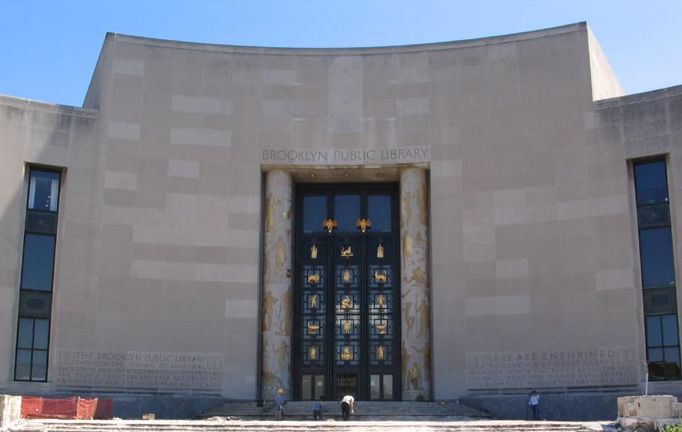
Brooklyn Public Library, Grand Army Plaza

RO: Anyone who knows me, knows how bullish I am on libraries. Perhaps it was all those days spent in the children's section at the Clarendon Branch of the Brooklyn Public library, before I graduated to the temple of knowledge at the library's Grand Army Plaza branch.
When I was in the first grade, I was a transfer student from a Catholic school in my former neighborhood (two months and I still have the scars..but that's another blog.) My name was put at the very bottom of a large chart in my classroom. Stickers were put next to our names for every book we read that year. Maybe there was a prize, I don't remember, but for me it was the honor - and I had some catching up to do. I wanted to have the most little stickies and be known as the best..even though I was the new kid. (Hank...how's that for competitive?)
I haunted the library and the librarian kept them coming..biographies, horse books, dog books, children's classics. I did eventually have the most stickies and more importantly, a love for reading that continues today.
This weekend I'll be in Denver for the MidWinter meeting of the American Library Association; I'll be spending one day at the St. Martin's booth and the other helping out at the Bouchercon booth.(If you're there, stop by,say hello, pick of an ARC of The Big Dirt Nap and some snazzy Jungle Red bookmarks.)
Librarians today can be a mystery writer's best friends. They don't care how big your marketing budget is, or how many days it's been since your pub. date. All they care about is that you've written a good book and are willing to visit their libraries. I've visited dozens in the last year and didn't do one event at a Barnes & Noble (not that I wouldn't, if you're out there..;-)
Anyway, on Wednesday Jane Murphy from the Westport, CT Public Library will be guestblogging here. She's one of the organizers of a new mystery event being held in Connecticut this April, Murder203, http://www.murder203.com Come back to see what Jane has to say, and in the meantime, how about telling us some of your best library experiences?
JAN: I loved bringing my kids to the library when they were little. The Westwood Library had (has) a terrific children's room and in the summer used to award the kids leaves to put on the tree mural for every book they read. My kids developed a love of reading that endured.
But most of all the library is what gives me the strongest sense of community. It's sort of like the Cheers bar -- where everyone knows your name.
ROBERTA: I spent a ton of time at my hometown library in Berkeley Heights NJ when I was a kid. We all hauled home stacks of books and then disappeared into our rooms to read. Last month, I was elected to the library board in my current home town. (My husband was the chair for eight years so I believe this could be a case of political nepotism...) On election night, we had a huge disappointment when the bond for major renovations was voted down by a slim margin. Some people--not many but enough--think we don't need libraries these days because we have the Internet. That sounds crazy to me!
RO: That's because the internet is so reliable and 100% accurate, right? (I'm joking, of course...)
RHYS: The public library was my first big adventure. It was the first place I was allowed to go alone in the evenings in my teens. And the first time I was allowed to prowl the adult section, unsupervised (yes, I did take a peek at Lady Chatterly and similar items, I guess, but I also discovered Dorothy Sayers, and all those wonderful Golden Age mystery writers). I spent so long there that my father was convinced I went there to meet a boy--he was very protective. At that stage in my life, twelve or thirteen, the books were more enticing than any boy.
Since being a writer I have done library events all over the country and love connecting with readers and librarians.
HALLIE: I remember getting my first library card, and reading a gazillion biographies (Clara Barton, George Gershwin, Marie Curie...) and all the Betsy, Tacy and Tib books. They didn't ALLOW children in the adult section back then, and what I remember is the momentous day when I reached whatever age it was that I could go upstairs and breathe the rarified air up there. I still don't know why they had that rule. Maybe to keep the noise down upstairs, or maybe to protect our fragile minds from the muck of Faulkner and Lawrence.
A little silver lining of the downturn in the book business has been a boom in library use. I love mine. YAY MILTON LIBRARY. And they're about to reopen a brand new library in a few months.
HANK: Yay NEWTON LIBRARY! It's beautiful, welcoming, relaxed, and the folks there are infinitely knowledgeable. And of course the Boston Public Library is the elegant lady of the city. Gorgeous, full of riches and full of wonderful secrets. I adore it.
RO: I just found out that I'll be doing an event there this March...I'm so honored to have been asked.
HANK: When I was growing up, waaaay in the exurbs, the nearest library was in my school. I treasured my library card, and somehow it made me feel like a part of something. I read the encylclopedia, volume by volume, sitting in that library. All those blue biographies when I was like, eight: Clara Barton, Girl Nurse? Or Dorothea Dix, Girl of the Streets? Something like that? ('Girl of the streets' doesnt sound exactly right...but you know what I mean.) On the school bus, I would lug home the limit, ten books. And not let my sisters touch them.
And you had to be really really really quiet. Scary quiet. Now, chatting with librarians, I know they're trying to change their image from stern disciplinarians into being wonderful guides through a fantastic new world. Maybe they need--superhero uniforms?
RO: Yes..all those biographies...Booker T. Washington and Luther Burbank were two that I remember reading when I was little...and something about someone who took care of lepers! (I was a serious kid..) Wonder what bios kids are reading today? Anybody know?