Showing posts with label Kincaid/James #16. Show all posts

Friday, April 4, 2014

What Debs is Writing--Just Make It Up

DEBORAH CROMBIE: I think I want to be Harlan Coben. Incredibly talented and successful. A really nice person. Tall. (Well, maybe as tall as Harlan would be stretching it a wee bit...) And there is the gender thing, which might be a slight issue.  All minor adjustments, I'm sure, none of which would be nearly as difficult as becoming the writer who says (as we mentioned earlier this week,) "Research? I just make things up."

Here I confess to being THE neurotic researcher. I have to check every single detail, and if I can't find something out, I will tie myself in emotional (and physical--just ask my back) knots trying to figure out what MIGHT be right.

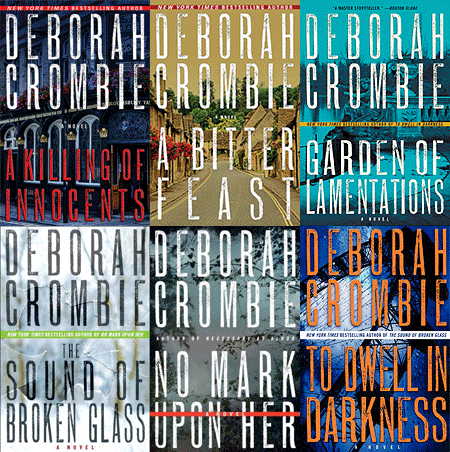
You would think that after fifteen books, it would get easier. But Kincaid/James #16, To Dwell in Darkness, has been (excuse my British) a real bugger. In some moment of madness, I decided I wanted to set off a bomb--well, actually an incendiary grenade--in the beautifully restored St. Pancras International Railway Station, which is now the Eurostar terminal, in the King's Cross area of central London. Why, you may ask? 

Because I was, and still am, smitten with St. Pancras. The original railway station was one of the marvels of Victorian design and engineering, and the station, and the accompanying hotel, are steeped in London history. After a long decline, St. Pancras came near to falling to the developers' bulldozers. But wiser, and probably more cash-savvy, heads prevailed, and the restoration is a thing of beauty and Gothic glory, teeming with human life and traffic. 

So why not murder? (You know all crime writers are a little warped, right?)

And then came the sticky stuff. Jurisdiction, procedure, all those little nit-picky technical details. (Do you know what happens to the British rail system nation-wide when you shut down a major terminus for even an hour???) Not to mention a very complicated plot that I could have set anywhere in central London, but chose to plop in the middle of St. Pancras. 

So, after months of reading and worrying, and multiple viewings of one of my favorite episodes of MI5 (that counts as research! Rupert Penry-Jones as Adam Carter, sigh...) in which there is a bomb threat in a major London railway station, I finally pretty much decided to... DO A HARLAN. I wrote what seemed logical, and to me, reasonable, considering what I'd learned AND the constraints of fiction. (Because nobody really wants to read about two-hundred detectives and all the tedious things that they do...)

Did this cure me of obsessive researching? Uh, no. Here is a little snippet from the beginning of Chapter Eleven of To Dwell in Darkness:


He left the dark blue Ford in the car park at Didcot Parkway Railway Station sometime before dawn. You weren’t likely to be noticed coming or going from a railway station car park at odd hours, nor was the car likely to be thought abandoned if left for a few days.

A few days… Who was he kidding, after what had happened at St. Pancras? Maybe forever. But he couldn’t think about that, not yet, and at least in a railway station car park it would be some time before the car was tagged and towed, and even then nothing in it should link to him.

After a quick check to assure there was no one else about, he stowed the supplies from the boot in his big pack. Then he wiped down everything he’d touched with a clean cloth, locked the car and pocketed the key.

He stood for a moment, adjusting the weight of his heavy pack on his shoulders, gazing at the deserted station platform. Even in the dark he could see the towers of nearby Didcot Power Station. Ironic, that, as he’d participated in the protests that had got Didcot A shut down. And what had it mattered, in the end?

A train horn hooted in the distance, the sound carried on the bitter wind. He shuddered. He couldn’t bear trains now.

He turned east, towards the Thames, and began to walk.

Is there really a Didcot Parkway Railway Station? You bet. I've been through it many times, but have never stopped. But I knew where I needed my mysterious unnamed character to be, in order to walk to where he is going, and Didcot was the perfect spot. Here is where Google maps becomes your
friend. And Google Earth. Is there really a Didcot Power Station? Yes, there is. And you can see it from the railway station. And Didcot A was shut down, in part because of the demonstrations of eco-protesters. It was one of the worst polluting coal-fired power stations in Britain. Didcot B is scheduled to close in the next few years.

So, readers, what level of verisimilitude do you expect from authors? Are you willing to go with "Learn as much as you can, and then make up what makes sense and keeps the story moving?"

Friday, February 7, 2014

Debs and the Unexpected Encounter

DEBORAH CROMBIE: I loved Rhys's post this week on flying by
the seat of her pants.  Readers-- and writers--are always fascinated by how writers manage to put books together.  Do they plot, or do they, like Rhys, fly by the seat of their pants?  (I've always referred to that as the "headlight method"--you only know as much as you can see by a car's headlights in the dark, but you keep going anyway.)

Frankly, it terrifies me.  I am a plotter. I have always been a plotter.  When I start a book, I know who the main characters are, what they did, why they did it, and pretty much what I want to happen at the end of the book.

And frankly, this is pretty terrifying, too, because you can't always figure out how to get from the beginning to what you envision as the end of the book. But one of the joys I've discovered of the plotted journey is the Unexpected Encounter.  In a crime novel, you know your detectives, either amateur or professional, have to find out things that will move the plot along.  So you invent people who will be helpful in some way--they give the detectives a snippet of something they saw or heard or knew.  And sometimes, these characters just jump off the page and insist on being something other than a convenience.

I've had two of these characters go on to feature as main characters in their own books and become incorporated into the series; Erika Rosenthal, who first appears in A Finer End to give Gemma bit of information about cults, and Andy Monahan, who was invented as a witness to a murder in Where Memories Lie, and immediately demanded his own book. He got it in The Sound of Broken Glass, and he seems determined to stick around for a while.

Here's a snippet from about midway through Kincaid/James #16, To Dwell in Darkness (I've had to try hard to find something that isn't too big a spoiler...) where Duncan simply goes to get a coffee and meets a gentleman named Medhi Atias. (And here is the real version of my fictional chicken shop.)


The building in the Caledonian Road looked even less appealing in the cold gray morning light. It had stopped sleeting, for which Kincaid was thankful, but the wind was still blowing down from the Siberian steppes as if Britain had become its designated funnel.
Nick Callery was waiting, stomping his feet and drinking coffee from a polystyrene cup. Beside him stood the uniformed PC who had been posted on the flat overnight, and a balding man wearing a heavy anorak and carrying a metal case.
“The chicken shop’s already open,” said Callery by way of greeting. He held up his cup. “The coffee won’t kill you, and at least it’s hot. This is Mel.” He nodded towards the other man.
“Locksmith,” said Mel. “Good to meet you.”
Kincaid took off his gloves to shake his hand. “Can I get you a cup? I take it we’re waiting on the SOCOs.”
“On their way, apparently,” answered Callery.
When Mel accepted the offer of coffee, Kincaid went into the chicken shop. Even this early, the odor of hot grease made his throat tighten. How did anyone eat fried chicken for breakfast?
But when he looked at the menu board, he saw that the place did bacon and egg sandwiches. With chips. The though of bacon reminded him that he had skipped breakfast. His stomach rumbled.
The man behind the counter was Middle Eastern, middle-aged, with a paunch that hinted he indulged in his own fare. But the apron over his expansive middle was clean, as was the serving counter and what Kincaid could see of the kitchen. “I’ll have the bacon and egg sandwich, no chips. And two cups of coffee.”
“I cook the bacon and egg fresh,” said the man. “Mind waiting a minute?”
Kincaid saw that there was a griddle in the back. “That’s fine.”
The man, who Kincaid guessed was the proprietor, put two slices of bacon on the griddle, cracked an egg onto the hot surface, then sliced a soft roll in half and added it. He then poured two cups of coffee into polystyrene cups and added snap-on lids. “Cream and sugar are over there.” He nodded towards a side counter as he handed Kincaid the cups.
Kincaid took his at it was. He hadn’t asked Mel, but the locksmith could come in and make his to his liking. “Cheers,” he said, accepting the cups. “Back in a tic.”
He walked outside and handed Mel his coffee. The locksmith took a cautious sip, then raised his eyebrows in surprise. “Not bad stuff.”
“There’s cream and sugar inside.”
Mel shook his head. “I like mine black as black.”
“Anyone else for a bacon and egg sandwich?”
When Mel and Callery both refused, Kincaid went back inside. There was no sign yet of the SOCOs, and he was glad of the respite from the cold.
“Good coffee,” he told the proprietor.
“We know coffee where I come from,” the man said as he deftly turned the eggs and bacon.
“Where’s that?”
“Morocco. But I’ve been in London for thirty years, and in this place for a decade.”
“Know anything about the group that lives upstairs?” Kincaid asked.
The man gave him a sharp look. “Cop?”
Kincaid nodded. “Detective.”
“I wondered what all the commotion was about last night, and the copper on the outer door all night. I gave him a cup of coffee on the sly when I opened up,” he added with a wink, then said, “They’re a quiet enough bunch. What have they been up to?”
“We’re not sure yet. Do you own this building?” Kincaid added as he took the wrapped sandwich.
“Me? No. Corporate landlord. KCD, Inc. Stands for King’s Cross Development, which means that when this building goes under the wrecking ball, I’ll have to find a new place. Or maybe retire.”
A corporate owner? Interesting. Kincaid typed a note into his phone before he opened his sandwich. Then, taking a bite, he said, “Um, delicious,” through a mouthful of perfectly cooked egg and bacon.
“Ta.” The proprietor wiped his hands on his apron and held one out over the counter to Kincaid. “I’m Medhi. Medhi Atias.”
Kincaid set down his coffee and shook Atias’s hand. “Duncan Kincaid. So, is this place slated for redevelopment?”
“Has been for years. But things haven’t progressed in King’s Cross as fast as the planners thought they would. Good for me, as I get business from the corporate offices that have gone into the area. There’s The Driver for upmarket meals, but not many places that serve decent ordinary fare.”
“I’d say it’s more than decent.” Kincaid popped the last bite of sandwich into his mouth and fished a card from his wallet. “I expect we’ll be coming and going from the upstairs flat for a bit.” Through the window, he saw the SOCO van pull up. “Hopefully we won’t disturb your business. If you do think of anything unusual going on upstairs, you can always give me ring.”
Atias took the card, his eyes widening as he read it. “You didn’t say you were a detective superintendent.” His tone was suddenly wary. “I hope something terrible hasn’t happened upstairs.”
“Not upstairs,” Kincaid said noncommittally. “At least as far as we know.”

 There is such fun in this--having a character come to life under your fingers as you type. I don't know that Medhi Atias will get his own book, but I realized as I wrote this that he will have a bigger part to play, and that he solved a plot problem I'd been wrestling with.

REDS, does the unexpected encounter happen to you, whether you are a plotter or a "headlighter?"