Showing posts with label Joni Mitchell. Show all posts

Wednesday, February 7, 2024

What We're Watching: The Grammys

DEBORAH CROMBIE: The lede here should be just one word–JONI. She is everywhere this week, and so deservedly so. But let's back up just a bit and talk about more than her stunning performance at the Grammys on Sunday.


These "What We're Watching" chats are more difficult than they used to be, because there are so few opportunities for a communal broadcast experience these days. As much as I love streaming, we don't all have access to the same shows, and there is so much to choose from!


But the Grammys are LIVE on broadcast TV, and music is something that touches all our experiences and associations. It connects us, and, boy, did it connect us on Sunday night. I know everyone will have seen clips by now of Joni Mitchell's iconic performance of Both Sides Now, interspersed with talking head chatter. But I hope you watched it as it happened, because it was a moment that those of us who did won't easily forget. I'm still buzzing two days later.


What a night for women!! (The guys might as well have stayed home…) And not just Joni. The fabulous Tracy Chapman! Annie Lennox. Miley!! Dua Lippa. Mariah. Billie Eilish. Brandi Carlisle. Lizzo. Zsa. boygenius. Celine.


And Taylor Swift, of course, winning her 4th Best Album, with such grace and generosity, and having an absolutely terrific time. What I loved most about all of this was the thread running between these artists, how they've inspired and supported one another, how their journeys have fed our journeys and woven themselves into the soundtracks of our lives.


And I have to wonder, if Taylor is performing on that stage when she's eighty, what that will mean to the generation that has grown up with her as an integral part of their lives...


How about it, REDs? Did you watch? Did you love it? Favorite moments?


JENN McKINLAY: For me, it was Tracy Chapman. 100%. I love all the other artists, as well, but Fast Car came out when I was 20 and just figuring out who I was and where I wanted to go with my life. To have it circle back and hit the top of the charts again with the recent respectful and reverent rendition by Luke Combs–especially when I am, weirdly, figuring out who I am once again as my children are out of the nest and my writing career is making another pivot–well, it was just incredible. I felt that performance all the way to my soul. 


DEBS:Tracy was mesmerizing, Jenn, I agree, and I was so glad that Luke Combs shared what the song meant to him. She was a touchstone for him, as Joni was for Brandi, and Taylor, and so it goes on. Kind of like the way writers build on one another, and support one another. I definitely felt the same sense of community.


Readers, were there special moments, or artists, for you?


Saturday, December 5, 2020

The Music That Puts Us In The Mood... for Christmas

 JULIA SPENCER-FLEMING: It’s beginning to look a lot like Christmas here in southern Maine, where we’re having our first snow storm of the season. That’s good because 1) the Guest Son brought most of the wood inside to the woodroom over the Thanksgiving weekend and 2) it’s been hard to feel like it’s “the most wonderful time of the year” with everything going on. Or more precisely, everything NOT going on. Not going out to stores, not attending parties, not going to church, not seeing The Nutcracker at the ballet or The Magic of Christmas at the symphony.


But we do have a few holiday stalwarts we can enjoy just as much this year as any other. One of them is music.


I enjoy the Christmas classics as much as anyone (or at least, as much as anyone not working retail during the holiday season) but my favorite music for this time of year is a bit melancholy. My favorite carols are medieval and early modern pieces, in minor keys and with lots of voices echoing on stone walls. 


My favorite album for the season is George Winston's classic "December," from Windham Hill. When Ross and I were dating in D.C, I dragged him to a George Winston Christmas concert at the Kennedy Center. I was sitting there, enraptured by the music, when I heard this sound like water backing up in the pipes from the seat next to me. It was Ross, sound asleep. (To be fair, he'd been pulling some pretty late nights as a law student at the end of the term.)


And the song I most love in this season - I feel it's one of the few secular Advent songs - is Joni Mitchell's River. It seems...uniquely right this year.


How about you, Reds? What tunes give you that festive feeling?


RHYS BOWEN:  Not going to the Nutcracker for the first time in 18 years is heartbreaking. My first song of Christmas is always Mannheim Steamroller. But I have been humming various Christmas songs as I bake today. Jolly old St Nicholas and All I want for Christmas is you! Not exactly highbrow. But this is one time of year when I love to play familiar music, from the choir at Kings College Cambridge to German folk carols to Bing Crosby. They put me in the mood. 


I’m wondering how much to decorate this year for just John and me?


JULIA: Rhys, my vote is for doing it up. Like music, the Christmas decorations we use - inside and outside, are one of the few normal touches we have this pandemic December.  


Jenn McKinlay: Back in the late ‘90’s when I had my first solo apartment in Phoenix with a vintage Merritt O’Keefe gas oven that I had to light with a match (not kidding!), I got really into cookie baking. Everyone one I knew got tons of cookies! I spent most evenings that December baking while listening to The Cambridge Singers which I had just discovered on NPR. This has remained my own personal holiday tradition ever since. As hard as this year has been (mercy!), if I listen to John Rutter’s “What Sweeter Music” while I bake cookies, I am eased. 


LUCY BURDETTE: One thing I will miss sorely this season is singing, and listening to groups of people singing. We’ve often gone to hear a small production of the Messiah in our church, and it’s so lovely and special. So that’s what I’ll listen to this year…


And one more truly astonishing performance would be Luciano Pavoratti singing O HOLY NIGHT. That might help me remember what the season’s about and hang on to some hope for next year!


HALLIE EPHRON: I’ll dig out Handel’s Messiah from our piles and piles of vinyl. Way back when, I sang in a choral group so I know the alto part. Which means I’ll want to sing along. Which means it’s a good thing the kids won’t be here because they HATE it when I do that. Then we might dig out our ancient Elvis Presley Christmas album. We’ll definitely tune into a Christmas Celtic Sojourn on Public Radio. And listen to Christmas poems -- The Night Before Christmas and A Child’s Christmas in Wales. (Did anyone listen to Alice’s Restaurant on Thanksgiving?)


JULIA: Hallie, yes! It was a favorite of Ross's, and it's a family tradition. "The twenty seven eight-by-ten color glossy pictures with circles and arrows and a paragraph on the back of each one..." 


I couldn't find a good video of the King singing "Santa Claus is Back in Town," but here's a great rendition by none other than Kurt Russell: 


DEBORAH CROMBIE: One of the musical treats of a normal Christmas for me is the Dallas Winds Christmas concert (especially as my friend Gigi is the Operations Director and if I'm really nice I get to go backstage!) They are actually doing a very limited seating, limited band show in the Meyerson Symphony, but they are also streaming, so I've got my ticket for that on the 18th.


Jenn, I LOVE John Rutter's Cambridge Singers. I'll have to dig out my CDs. I will listen to anything Christmasy, but some special favorites are Jewel's Christmas album, and, always, the soundtrack to LOVE ACTUALLY.


HANK PHILLIPPI RYAN:  Yes, The Love, Actually soundtrack. And yes, the Messiah, which I will sing at the top of my voice. All the parts. I try to sing ALL the parts. (And yes, Hallie, Alice’s Restaurant is a Thanksgiving tradition.)   My favorite carols, too, like Oh Come Oh Come Emmanuel. And God Rest Ye Merry Gentlemen. And as Pogo sings, Deck the Halls With Boston Charlie, Walla Walla Wash, and Kalamazoo. Very festive!


How about you, dear readers? What's playing on your record player to get you in the mood?

Saturday, April 11, 2020

The Beat of Black Wings

Today the Reds welcome Edith and friends to celebrate the amazing music of Joni Mitchell!

EDITH MAXWELL: Thank you, Lucy/Roberta, for helping us celebrate this week’s release of The Beat of Black Wings! We had hoped to have a grand release at Malice Domestic. Since that isn’t going to happen in a few weeks, it’s great to have an audience here to share it with.
This anthology of short crime fiction is a celebration itself – a bow to the genius and wonder that is Joni Mitchell and her music. Each story in the collection is inspired by a different song spanning her seventeen albums. The anthology was Josh Pachter’s idea and baby, and it hangs together beautifully because of his expert editing. 
Last year sometime I posted Youtube link to a Joni Mitchell song on my Facbook page. I talked about what a strong influence she’d had on my life. Josh saw my post and wrote to me, saying he was assembling this collection. He asked if I’d like to submit a story. Of course! I wrote back to tell him Joni’s music was the soundtrack of my young adulthood. 
I ended up writing a story inspired by “Blue Motel Room” from the Hejira album, which is one of my favorites of Joni’s albums. “A depressing blue Savannah motel room. A desiccated hand in a locked safe. A petty thief with the blues . . . and wanderlust.” But I could have selected any of dozens of others of Mitchell songs and picked out a tale.
I asked Josh about his inspiration to create the anthology.
Josh Pachter: For as long as I can remember, my favorite music has included the work of singer/songwriters. Joni Mitchell, Paul Simon, David Bromberg, Carole King, Marc Cohn, Van Morrison, Jimmy Buffett, Billy Joel, Harry Nilsson, Randy Newman, Cheryl Wheeler, Kenny White, many more — their work has provided the soundtrack for my life. A couple of years ago — for an oddball reason I've explained elsewhere — I wrote a story based on Joni's song "The Beat of Black Wings." Right around the same time, I became aware of the publication of several books of short crime stories based on song lyrics, such as Trouble in the Heartland: Crime Fiction Inspired by the Songs of Bruce Springsteen, and I thought: Why not do something similar with Joni's songs? The result was The Beat of Black Wings: Crime Fiction Inspired by the Songs of Joni Mitchell.
Edith: I asked Josh and a few of the other authors which of Joni’s songs resonated with them at a particular time. Here’s what they said:
Josh Pachter: I'm going to pick a song that's in The Beat of Black Wings, though the story was written by the great Brendan DuBois, not by me: "Free Man in Paris." The Court and Spark album came out in 1974, just as I was entering grad school at the University of Michigan and simultaneously beginning my first teaching job, a half-time position at Ann Arbor's Community High School. Joni's lyrics — "I was a free man in Paris / I felt unfettered and alive / There was nobody calling me up for favors / No one's future to decide" — reminded me how much I'd enjoyed my first trip to Europe, two years earlier, and made me hunger to return. Two years later, in '76, I finished my graduate coursework, quit my job, and took off to visit friends in Amsterdam. I bought a motorcycle and met a Dutch woman and spent eight months tooling around Italy and Greece with her. By the end of '77, we were married, and I didn't return to the US to live until 1991. We were divorced by then. I'm happily remarried now, to an American woman, and Laurie and I go back to Europe almost every summer, where we feel unfettered and alive. Sadly, it looks like this year's trip to Spain and Portugal will have to be delayed. But with The Beat of Black Wings coming out, we'll spend the summer immersed in Joni's music, if not in sangria and tapas....
Barb Goffman: The holiday season, from the lead-up to Thanksgiving all the way through New Years, often is hard for me. All the celebrations of family and love remind me that despite the many good things in my life, in a fundamental way, I'm alone. Sure, I have wonderful friends and my dog. But I've never been married. Haven't had a boyfriend in decades. No children. In December I often will listen to "River," both Joni Mitchell's version and the wonderful cover by Robert Downey Jr. The song doesn't make me feel better exactly, but it's comforting all the same.
Sherry Harris: I confess that I didn't listen to a lot of Joni Mitchell music when I was young. I was always more of a fan of rock and roll than folk singers. Of course I knew her biggest hits like “Both Sides, Now” and “Big Yellow Taxi.” But as I went through her songs to pick one for the anthology, it struck me how timeless her lyrics are and what an incredible musician and storyteller she is. Being re-introduced to her music has been so interesting.
Alison McMahan: It would have to be “Both Sides Now.” I knew the Judy Collins version from the Wildflowers album. I grew up an expatriate in Spain. In the early 70s, TV and even radio were limited, so LPs were our lifeline to North American culture. In 1974, when I was a teenager, “Both Sides Now” seem to sum up the angst of being an American teenager growing up in a fascist dictatorship. It was a great day for me when, many years later, I got to see Judy Collins live. I was an adult before I found out Joni Mitchell had written the song. (Remember, we didn't have internet). That led me to discover Joni Mitchell's other work. But that was much later, when I was back living in the US. To me the song summed up the tightrope walk I had to do, to be an American and believe in democracy and at the same time grow up in Franco's dictatorship.
Alan Orloff: When I was a poor college student, I would go to garages sales and swap meets to buy vinyl records on the cheap. So I got a copy of Joni Mitchell's Ladies of the Canyon, and I remember listening to that album, quite frequently, as a backdrop when I studied. I think I drove my roommates crazy with how often I listened to it (but it had some of her greatest hits on one album!). I went on to buy more of her albums, of course, but I think that one stands out as my favorite--or at least the most memorable in my mind.
Art Taylor: The first Joni Mitchell song I ever remember hearing was “Help Me”—junior year of college, sitting in my friend Mary Ruffin Hanbury’s room, sunlight pouring through open windows, a sudden burst of springtime and us eating triscuits and cream cheese. Even in the moment, college felt like a time of general romanticism about the world, rampant emotions in a hundred directions and a giddy and exciting helplessness to those emotions—and “didn’t it feel good?” (to quote the song’s lyrics). 

Years later, though, another of Joni Mitchell’s songs stood out: “Coyote” with that lyric about two lovers who "just come from such different sets of circumstance.” The relationship I was in at that time was troubled, doomed really, even as it felt very exciting in the moment—and something definitely resonated with me about the forward-moving motion of that song, along with lyrics which were both keen-eyed and accepting.

For a couple of years now, I’ve been tinkering with a story, potentially a series of stories, about a young woman who so loves Joni Mitchell that bits of lyrics keep popping into conversation—words of wisdom that have fashioned this character’s outlook on the world. All this talk reminds me I need to get back to it. 

Edith: (Art apologizes for going so long – but I loved his whole answer!) 
For me – a Californian – all of Joni’s early songs resonated. During college and after, I was hungry for adventure, love, and travel. After I started traveling, of course “California” pulled at my heartstrings, but “Carey” also called me to hedonism on a Greek island. “I was a Free Man in Paris” drew me, too. When my American boyfriend and I lived in Japan in the mid-seventies, we had cassette tapes of Hejira and Hissing of Summer Lawns. “Amelia, “Refuge of the Roads,” “Coyote,” and of course “Edith and the Kingpin” – so many songs gifted me with deeply etched memories.
We all hope you find a copy of The Beat of Black Wings. Please know 30 percent of the proceeds go toward brain aneurysm research. While they won’t benefit Joni directly, we hope your contributions further the understanding of the medical event that struck our favorite singer/songwriter. And think of all the intriguing stories you’ll have to distract you from the outside world!
Readers: What’s your favorite Joni Mitchell song, and why? If Joni’s music isn’t yours, who is your favorite female singer/songwriter? Edith will send one of you an ebook of the anthology.
Josh Pachter is a writer, editor and translator. Almost a hundred of his short crime stories have appeared in EQMMAHMM, and many other periodicals, anthologies, and year’s-best collections. Please find him at joshpachter.com.
Edith Maxwell, also known as Maddie Day, writes cozy and historical mysteries as well as award-winning short crime fiction. She hopes you’ll find her under both names on social media and at edithmaxwell.com.

Thursday, July 18, 2013

Muse in the Music: On the Poetry of Joni Mitchell

HALLIE EPHRON: It's hard to look at clouds without the lyrics from Joni Mitchell's "Both Sides Now" bubbling up, and with it the poetic images that are her trademark -- ice cream castles; feathered canyons; moons and Junes and Ferris wheels -- along with them the dark edginess that makes her lyrics as thought provoking as her music is inspirational. 


Now Lisa Sornberger and John Sornberger have put together "Gathered Light," an anthology of works by 56 contributors inspired by Joni's lyrics. We're delighted to welcome Lisa to Jungle Red. 


First I have to ask about the cover. It's a gorgeous watercolor of Joni, paddling away from a vivid, psychedelic sunset against horizon outlined by dark pines.

Lisa, tell us about that cover.


LISA SORNBERGER: I’m thrilled that you like Joni’s gorgeous painting that graces our cover. It fits in terms of the theme of our book, and the way we see Joni, a genuine explorer. Plus it's reflective of her First Nations heritage (Sami), which matters to her.

We hope readers like the way it ties in with the opening quote from Emily Carr, one of Joni’s favorite writers and painters, and our foreword. All of that came after the painting.

HALLIE: How did you connect personally to Joni Mitchell and her works?


LISA: Joni has had a profound influence on my life since I was fifteen years old. She opened my spirit to freedom, and helped validate the path of becoming a writer. She brought sustenance and joy, and, I think, taught by example, that (real) poetry serves an essential function in this world.

She writes her way through shadows and light, exploring the truth, about feelings and life, in ways that transcend the personal.

The idea of the project came to me on New Year’s Day, two and a half years ago, pretty much fully-formed: we needed to do this book, to honor Joni’s work as a poet.

HALLIE: What was Joni Mitchell's reaction to your project? 

LISA: She was happy, and gracious, and I think a bit surprised that we wanted to focus on her work as a poet. Also, that it wasn’t “mercenary”.


HALLIE: What do you think it is about her songs that have made them so iconic?


LISA:  Well, she is brilliant. She makes multi-level sensory connections. She has an incredible gift for translating visual images into artful, astute language.

Her poems are full of truth, and heart, and we believe anyone willing to take a look at themselves will find resonance in her words.

HALLIE: Who are some of your contributors, and can you give us a taste of what's in "Gathered Light "?

LISA: About half of our contributors are poets. Fred Wah is the Poet Laureate of Canada. Other prize-winning poets, including Cornelius Eady, Bessy Reyna, Patricia Smith, Colleen McElroy, Pit Pinegar, Beth Cuthand, Louise B. Halfe, Susan Deer Cloud.

We've got friends of Joni's, like her ex-husband Larry Klein, David Geffen, three of her female friends. Wally Lamb, the extraordinary novelist, is a contributor.

We love that our contributors are diverse -- age ranges from about 19-79; men, women; straight, LGB, T; Third Nations, Latina; white, black, red; Buddhist, Atheist, Jewish, Agnostic, Christian... The point being, Joni's poetry transcends artificial boundaries.

The “assignment” was to pick just one of Joni's poems (lyrics), and to write about how it sparked you, inspired you, spoke to you personally, politically, or from a societal viewpoint. Writers could respond in their genre, or another. Just write from your “heart and mind,” tell your truth.

HALLIE: Taking the cue from Joni herself. Thanks, Lisa.

Have Joni Mitchell's words and music touched your life? Of the artist whose music shaped you, whose poetry have responded to as much as much as the tunes? Joni Mitchell's on my list... along with Paul Simon and Bob Dylan and Carly Simon.


Lisa and John are offering a free book to one lucky commenter.

Thursday, July 22, 2010

On "Girls Like Us" The Music

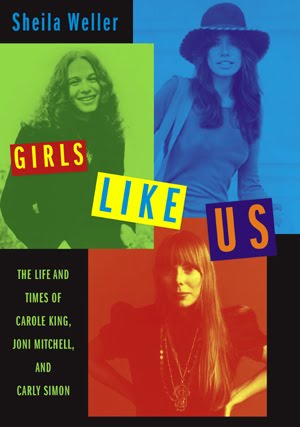
HALLIE: Almost exactly a year ago Jungle Red hosted Sheila Weller, author of Girls Like Us: Carole King, Joni Mitchell, Carly Simon -- and the Journey of a Generation. It's the inside stories of the three singer/songwriters who shaped and shaded a generation of women and beyond.

Now we get this update from Sheila:

SHEILA: A lovely thing has happened: Jodie Wright, who was formerly Carly's manager and is currently her archivist, took it upon herself (!) to painstakingly create this amazing website, GIRLS LIKE US THE MUSIC. No, no, it's not what you think -- it goes beyond the music these iconic artists created and gets at (and digs up, and lets you listen to) all the music that actually affected and influenced them, in their childhoods, on their journeys...and on ours. She did it because...she's terrific and generous...and also is perfecting her already-ample website-building chops. Mainly the former reason. Take a look and see how cool it is: http://www.girlslikeusthemusic.com/

HALLIE: I just spent some time grazing the site. It's still a work in progress, but such fun. Did you know Joni Mitchell's favorite song from high school (and for decades to come) was the Shirelles hit Will You Love Me Tomorrow. (This song was written by Carole King and Gerry Goffin.) Or that The Anderson family (Joni Mitchell's real last name) entertained itself by listening to the Andrews Sisters' and the McGuire Sisters' mellifluous close-harmonies piped through the console radio in the mid-40's. (The site has the clips of the Andrews Sisters singing "Sleepy Serenade" and "Begin the Beguine" and more.)

What a great way to take a break and take walk back through memory lane...

Wednesday, August 19, 2009

"Girls Like Us" -- Carole, Joni, and Carly

Sheila Weller is an unabashed feminist and her book, “Girls Like Us”, tells the stories of three singer/songwriters who shaped and shaded a generation of women and beyond. Sheila wrote for MS magazine when it was in its infancy, and has since authored six books including two New York Times bestsellers, won of numerous awards for journalism, and is a writer for Vanity Fair, Senior Contributing Editor at Glamour, and she blogs for the Huffington Post.

Welcome to Jungle Red, Sheila! I loved your book...it really sings to my generation of women who stormed the bastions of academe, frolicked at Woodstock, and wore flowers in the Haight. Joni and Carole and Carly...and Joan Baez and Judy Collins and Ronnie Gilbert and Holly Near and Buffy Sainte Marie...were our role models. We could not have made it through college without those women, and most of us can still sing every lyric of every song.

JRW: How did you pick Joni, Carole, and Carly?

SHEILA WELLER: For years I had been wanting to write a history of the women of my generation -- those of us middle class girls who were born in the 1940s and came of age in the late 1960s. It's almost worth getting older to have lived through such exciting times -- we were little girls when the image of American women was more stultifying and repressive and corny than it had been in decades (I mean: women in petticoated shirtwaists kissing refrigerators in TV commercials; the song "How Much Is That Doggie in the Window?" as a hit??) and we had no choice but to break the mold and transform the very idea of what a young American woman was.

We made young women into adventurers. In our childhood we acquired the first tools -- rock 'n' roll and r&b music; the civil rights movement. Then, coming into adolescence, the next tool -- the birth control pill. And finally, when we were becoming college-aged, the psychedelic movement, radical politics,the antiwar movement, and all the rest.

Then, as the '60s turned to the '70s, as both an extension and a corrective of all the exquisite madness, we came up with feminism, which changed everything. I could never think of that journey of ours without thinking of three singer-songwriters who wrote the soundtrack and lived it with us -- Carole King, Joni Mitchell, and Carly Simon.

Carole's "Will You Love Me Tomorrow?" was the first pop song in which a young woman contemplates sex, risks and all; her "Up On The Roof," "Natural Woman" and others were part of the love affair with urban life and soulfulness that was a pop-music ride-along to the Civil Rights Movement; and "Tapestry" defined a whole era -- the early '70s -- in which young adults lived in families-of-friends and prized authenticity, loyalty, a new kind of hominess.

Joni's long-thrift-shop-gowned bohemian artiste embodied the new kind of single woman of the (gentle) psychedelic era -- a mysterious, winsome, independent spirit who made a magical home ("Chelsea Morning") and took lovers at will but kept the upper hand with them ("Cactus Tree") and who had a "deep," wistful belief in the power of life experience ("Both Sides Now," "Circle Game") and who had a charismatic earthiness and spirituality ("Ladies of The Canyon"). She was who we were -- or desperately wanted to be -- from 1966 to 1969. And Carly?

Carly was the New Woman of the Early '70s: witty, urban, intellectual, Seven Sisters-educated (like fellow influential women Erica Jong, Jane Fonda, Ali MacGraw, etc.), analytic, and so "classy" she could be wildly sexy without feeling it brought her down a peg or compromised her or gave her "a reputation." She was the embodiment of early-Ms.-era, "sell-it-to-America" feminism. Her "That's The Way I've Always Heard It Should Be" was the first ballad in which a woman thought marriage would hem in her adventures; and "You're So Vain" was a jubilant feminist kick-ass rock song -- full of self-confident wit and mockery. We wanted to be her -- and many were indeed very close to that archetype she embodied.

JRW: Were they really "girls like us"?

SHEILA WELLER: Yes. They went through what we went through -- Carole, as a pregnant teenager in love at the cusp of the '60s, had a panicked shotgun wedding. Joni, in a fiercely proprietary place (central Canada) in the proprietary early-mid-'60 (where birth control was not widely used and abortion, illegal) was afraid to tell her proper parents that she was pregnant and unmarried -- she hid her pregnancy from them and was treated to contempt by moralistic nurses and nuns at the hospital where she gave birth, before giving up her baby for adoption. Carly fell in love with a sexy, brooding, soulful, educated drug addict (James Taylor) and struggled to try to get him off drugs through the ten years of their marriage during a time (the '70s) just before the concepts of "co-dependency" and "enabling" -- and a whole repertoire of family help -- taught families and loved ones how to deal with drug abuse.

In these and dozens of other ways, they were "like us": leaving marriages and love affairs that were unsatisfying and risking falling into subsequent ones which, while solving one interpersonal or romantic problem, only presented another. We were the first generation of serial-relationship-having women, and the risks and joys and conundrums of that life are written all over their songs, from Joni's "River" and "All I Want" to Carole's "Only Love Is Real" to Carly's "Coming Around Again" and "The Stuff That Dreams Are Made Of."

I chose middle-class women to write about because the identifiability was so strong. Janis Joplin and Grace Slick were too edgy and out there, each in her own different way. Carole, Joni and Carly were women you could run into in a department store fitting room.

JRW: How much harder did rock 'n' rolling women have it in the liberated ‘60s ‘70s?

SHEILA WELLER: Harder than their counterpart men? Or harder than now? I'll answer both. Harder than their counterpart men in every way.

Joni example: While Bob Dylan was forgiven for being much less interesting and edgy and "romantic" than he pretended to be (he was a middle-class fraternity boy who got his -- wonderful - folk songs from sitting in the NY Public Library and looking at old newspapers), Joni so had to hide her secret dramatic, heroically brave past (being a pregnant, unmarried, penniless fledgling folk singer in a rooming house), she was virtually blackmailed over it.

Carole example: There was no day care, there were no lightweight strollers, there were no "working mothers" -- no maternity leave, no work-life balance, no ANY of that -- in the very early '60s; so Carole shlepped her newborn baby (in a heavy, made-to-not-go-up-stairs pram) on the subway to the hit-factory where she cranked out # 1 songs. Carole's best friend and fellow songwriter, with whom she competed for hits, was delighted when Carole gave birth to her second child because during labor and delivery -- and ONLY then -- Carole COULDN'T sit down at the piano.

Carly example: After desultory years of being scoffed at as a "rich little girl" (male songwriters from wealthy homes didn't get that disdain), Carly finally got a break: Bob Dylan's manager had Dylan write a song for her and she recorded with the (just under the radar) new Dylan-championed group The Band. But the album was never mixed and released because the sound engineer told Carly: "I won't mix your album unless you sleep with me," and she refused to. None of these things would or could happen to guy rockers.

And harder than young women singer-songwriters today? Much harder. Today these women are businesswomen -- Alicia, Beyonce, Alannis, et al -- they have assistants, they have support teams, they have manages and publicists and stylists (Carole, Joni and Carly dressed themselves -- and each of them pioneered a distinct fashion look, with no outside help), they know how to produce and hold onto the rights to their music and parlay their careers. The natural, innocent, funky, anti-commercial '60s and '70s had an innocence and anti-careerism that could hurt both male and female artists, but, especially, females.

JRW: Were these women happy? Did they love their lives at the time? Did they know how much we all listened to their music and loved it, how pivotal it was?

SHEILA WELLER: Good questions. I happen to think they lived (and are still living such rich, big lives, why wouldn't they look back on those years and happily think, No regrets! But an amazing amount of people who read the book thought they were unhappy because, for one thing, they had so many different relationships. Well, stable monogamy does not a great rock-love-song-writer; and, at the risk of being '60s-babe-centric, I think to err on the side of "more" life experience than less is a happy choice.

Still, I don't want to be too rosy-glasses about it. They did feel pain in their time. Joni's masterpiece BLUE is all about pain. And though Carole -- the most tuneful (and gospel-y) but the least self-revealing writer of the three -- always wrote optimistic songs with sometimes slightly sappy lyrics (her early '70s collaborator-lyricist Toni Stern -- their masterpiece was "It's Too Late" -- beautifully de-sap'd her, she did suffer pain. She was married four times and her third husband, whom she deeply loved at the time, died of a heroin overdose; she spent a winter living ascetically and reflectively in the snowbound deep wilderness, mourning him. And Carly's emotions were all over her skin, and her music. She loved very deeply -- James and others. And she never made a secret of her bouts of melancholy and depression.

Finally, did they know much we loved them? All three but Joni know. Joni seems to be bitter that some of her fans abandoned her when she -- courageously, in a very Joni way -- switched from her very winning confessionalism to inaccessible, risky jazz in the mid '70s and she seems to feel she has been underappreciated. Tragically, this couldn't be further from the truth. Joni is widely regarded as one of THE best songwriters and musical artists of the era, right up there with Dylan.

Hopefully, in their heart of hearts, all three of them know not only how much their music is beloved, but how HEALING and resonant it has been for so many women and men of many generations.

JRW: Find Sheila Weller's "Girls Like Us" at your local bookstore or library and take it to the beach one of these last fine summer days.

Please, join our conversation -- what does their music mean to you?