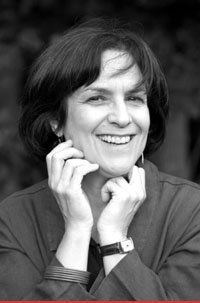
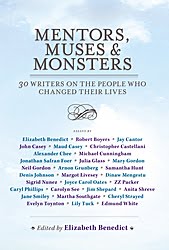
We all remember that special person who encouraged our writing and, of course, the one who shut us down. Then there was the individual whose work inspired us to reach higher. Author Elizabeth Benedict (photo by Emma Dodge Hanson) would call these our “mentors, muses, and monsters”Who influenced the amazing Joyce Carole Oates? Or Mary Gordon? Or Michael Cunningham? Or Jane Smiley? Readers can find out in Elizabeth’s new collection of essays, “Mentors, Muses & Monsters: 30 Writers on the People Who Changed Their Lives.” The collection also contains Elizabeth’s own essay, “Why Not Say What Happened?” in which she writes about her college tutorial teacher, esteemed woman of letters, Elizabeth Hardwick.JRW:
 Elizabeth, what inspired you to write this book?
EB: I was asked to write a remembrance of Hardwick after she died (December 2008) for Tin House magazine. The night I sent it in, I was floating around my apartment, feeling particularly good, not just that I'd finished it but that I got to express my appreciation for what she'd meant to me when I was a college kid with nothing but a crazy ambition.In that dreamy mood, I idly wondered if there was a book of essays about fiction writers and their mentors and went to Amazon to look - and there wasn't. An hour later, I'd cooked up the title -the 3 M's, as I call it - and the next day I invited
Mary Gordon. She said yes right away. So did most of the other people I invited. I was stunned by how many people said yes, sometimes even before they knew whom they'd write about.
JRW: What were some of the revelations in these essays that surprised you?
EB: First of all, I expected everyone to write about a person, but many people wanted to write about a book or an author, dead or alive, and some wanted to write about a place or a transformative period. When
Jane Smiley went to the Iowa Writers' Workshop in the 1970s, she was more inspired by her classmates than her teachers.

Her piece, about them and the mood in 1974, is a lovely piece of personal and social history.
Joyce Carol Oates wrote about what
"Alice in Wonderland" means to her. In the 1970s,
Sigrid Nunez was the girlfriend of
Susan Sontag's son and lived in an apartment with both mother and son, and has a particularly intimate view of Sontag. I was surprised by the incredible variety of influences, from
"Mrs. Dalloway" to
"Harriet the Spy."But mostly I was surprised by how seriously writers took the assignment. I knew the essays would be good, with this group of writers, but had no idea they would all give so much to these pieces. As you read, you can feel the engagement, the writers' determination to get every nuance right; it's exhilarating and very moving.
I came to understand that the relationship you have with a mentor is among the most powerful there is. That person noticed you when you were young and lost and said, "I think you've got talent, and here's what to do with it." We're lucky if that happens to us once! Falling in love and giving birth (so I've heard) are pretty powerful experiences. I think the mentor/influence connections - in their power to changes lives - are up there with those.
JRW: Were there any common threads?
EB: Writers are a cranky bunch who are prone to worry and complaining, but this subject seems to have opened the spigots of gratitude. For the most part, the writers were obsessed with their mentors.
Alexander Chee's piece about studying with
Annie Dillard at Wesleyan is so full of detail and dialogue - from twenty years ago! - that it's like taking a course with Dillard, and a course in obsession: "By the time I was done studying with Annie," he writes, "I wanted to be her."
Cheryl Strayed is obsessed from afar with
Alice Munro, in part because they both had mothers who died young. I've read this line in her essay a dozen times and it still breaks my heart with its vulnerability and longing: "I love Alice Munro, I took to saying, the way I did about any number of people I didn't know whose writing I admired, meaning, of course, that I loved her books.... But I loved her too, in a way that felt slightly ridiculous even to me."
JRW: Sounds like you've got more mentors than monsters.
EB: That surprised me too. The only full-blown one is in
Edmund White's portrait of
Harold Brodkey. There are a few other people whose behavior has monstrous moments, including a
wicked step-mother. I expected there'd be someone who said, "Writing well is the best revenge for having been treated badly," but even Edmund White felt that Brodkey had been helpful to him as a writer. These writers clearly wanted to accentuate the positive - because they feel immense gratitude to the person who showed them the way.
JRW: Will you be out and about, promoting the book?
EB: I'll be on the pavement and on-line. If you're in New York City, Cambridge, MA, or DC, there'll be an event near you in November or early December. For details, visit the blog at
http://mentorsmusesmonsters.blogspot.com/ where there'll also be some on-line chatting once the book comes out, and a few books to give away.
JRW: So, Jungle Red readers, tell us about your muses, mentors and monsters? Elizabeth will be responding to comments and questions. Please, join in the discussion.