Showing posts with label Leslie Wheeler. Show all posts

Thursday, March 12, 2026

Don't Even Ask Me This


HANK PHILLIPPI RYAN: I'm sure my memories are tinged with the bitterness that comes from abject rejection. Okay, I'm sure that's not exactly true, but if someone offered me ten million dollars to go back to high school--and without the wisdom I hope I now have--I might need to think about it.

There were some wonderful parts, and people who are lovely friends now. And teachers who completely changed my life, and for whom I am grateful every day. But basically: thanks, but no thanks.

That's why our dear friend Leslie Wheeler has such a perfect setting for her new mystery! 

And ooh, leave a comment and you could win a copy
of her brand new Wildcat Academy. SO much fun to go back to high school...if you don't actually have to go.


Back to School in a Mystery

By Leslie Wheeler

My mystery novels and short stories are what you could call place-centric.

I start with a place I find intriguing and the plot and characters grow from that.

In the first book of my Berkshire Hilltown Mysteries, that place is a hill (Rattlesnake Hill), in the second, it’s a road (Shuntoll Road), in the third, it’s a bog (Wolf Bog). For my fourth book, I chose a school, but not a regular public school.

Wildcat Academy is set at a private boarding school. I went to a private school myself and so did my son, and we both had good experiences—though my son probably didn’t think so at time. In any case, the type of private schools I decided to write were called therapeutic boarding schools, or schools for troubled teens, or tough love schools. This was because they resorted to punishments and restrictions they claimed would help students in the long run. Instead, these tactics only made things worse for some students, leading to lawsuits and closures of the schools, amid charges of abuse.

My first encounter with such a school happened shortly after I’d moved to the Berkshires. My husband and I went to see a musical comedy performance at a school in a different town from where we lived. The main building was a mansion at the far end of a huge lawn with a gated fence.

We were ushered into a screened-in porch before the performance began. There, a man wearing multiple gold rings on his fingers, who turned out to be the head of the school, relaxed in a lounge chair like the shah of a foreign country, while students milled around him waiting for the show to start. Sensing there was something different about this school, my husband asked a couple of students we were talking with what kind of school it was.

After exchanging glances, one of the students said, “It’s a place for kids who don’t always go with the flow.” And that was all they would say, although obviously there was more to it. Only later did we learn just how unpleasant that “more” could be.

Meanwhile, I discovered there was a similar school in our Berkshire town, and many residents were not happy about it. I attended an angry town meeting in reaction to an incident where a group of students from this school broke into a neighboring house, when the owners were away. They got drunk on the booze they found, stole a car and smashed it on their way into town. Tempers ran so high at that meeting that some people were ready to run the school owners out of town. That didn’t happen, but a few years later, the school shut down.


Given my town’s experience with that school, it wasn’t surprising that the townspeople were adamantly against another tough love school moving in. One person even put together a pamphlet, detailing all the awful things that had happened at the school in its current location. That pamphlet added grist to my fictional mill as I began to write Wildcat Academy.

Still, as I’ve learned, most things in life aren’t totally bad. There are glimmers of light in the darkness. While the headmaster of my fictional school is not a nice guy, nor are the school bullies, I’ve given it two good people in the characters of a student and a teacher. I was an English major, so naturally she’s an English teacher. The teacher and the “good” student help my main character, Kathryn Stinson, solve the mysterious death of another student, who happens to be the son of Kathryn’s sister-in-law.

Readers, what was your high school experience like: good, bad, or a mix, and why? One of the commentators will receive a free copy of Wildcat Academy.

HANK: Oh, I absolutely cannot wait to hear this. (I have a theory.) Tell all, Reds and Readers!


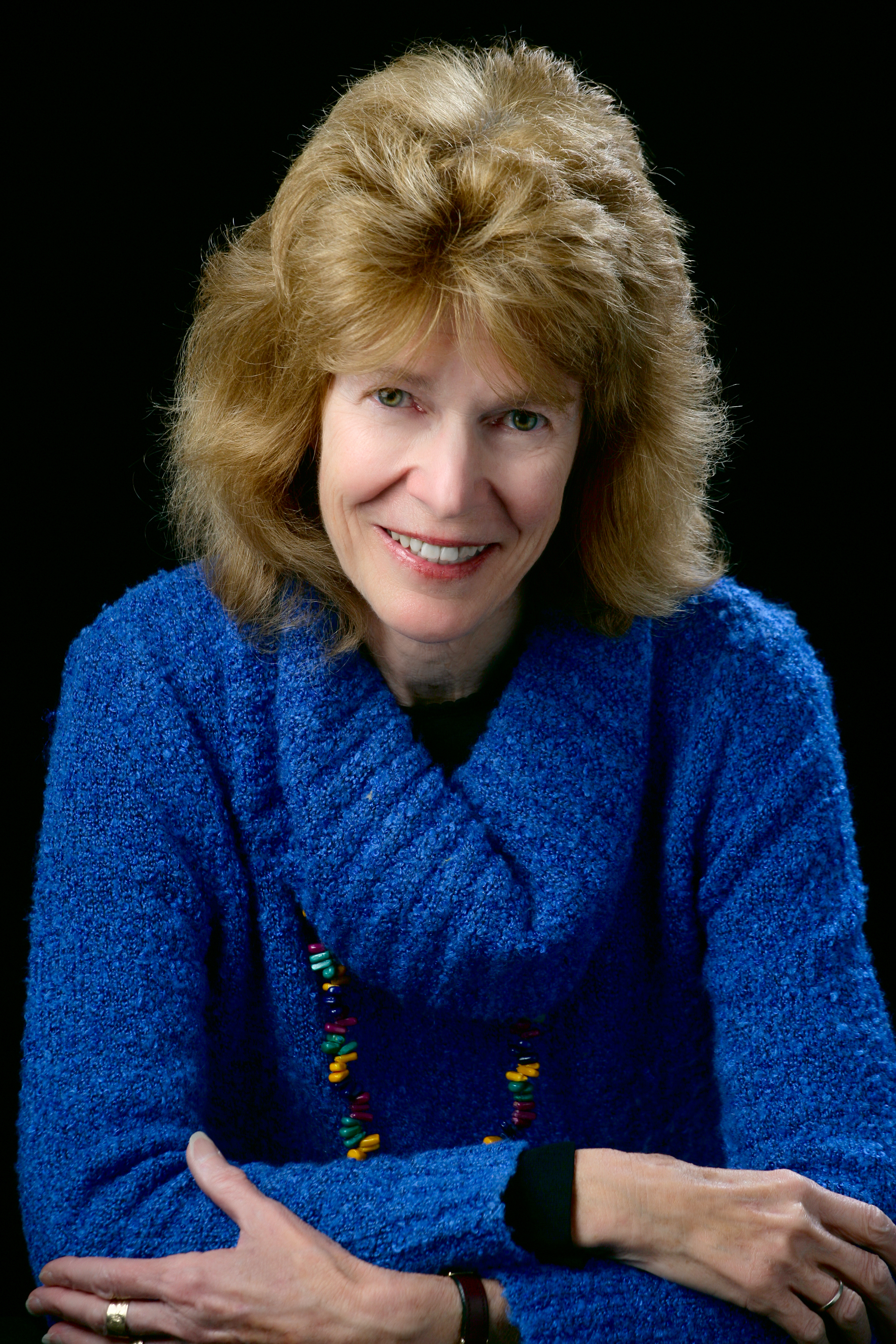
An award-winning author of books about American history and biographies, Leslie Wheeler has written two mystery series. Titles in the Berkshire Hilltown Mysteries are Rattlesnake Hill, Shuntoll Road, Wolf Bog and now, Wildcat Academy. 

Titles in the Miranda Lewis series include Murder at Plimoth Plantation, Murder at Gettysburg, and Murder at Spouters Point. Her mystery short stories have appeared in numerous anthologies, including The Best New England Crime Stories series, published by Crime Spell Books, where she is a co-editor/publisher. Leslie is a member of Mystery Writers of America and Sisters in Crime, serving as Speakers Bureau Coordinator for the New England Chapter of SinC. She divides her time between Cambridge, Massachusetts, and the Berkshires, where she writes in a house overlooking a pond.

Wednesday, November 9, 2022

The Wonderful Versatility of Crime Short Stories by Leslie Wheeler

LUCY BURDETTE: Today I'm happy to welcome one of our longtime JRW writing pals Leslie Wheeler, to introduce an anthology of crime fiction shorts which many of us have contributed to over the years. Welcome Leslie!


LESLIE WHEELER: Having just released Deadly Nightshade, the 2022 Best New England Crime Stories anthology with co-editors/publishers, Christine Bagley and Susan Oleksiw, I’m struck by the different shapes the short form can take. I’m not talking about subject matter or mood, but rather story structure. Here are two examples, taken from Deadly Nightshade. One is a lengthy, complex, and rule-defying story; the other, a masterpiece of minimalism.

The first story, “Playing God,” by Avram Lavinsky does two things that at least one short story maven lists as “don’ts.” The first don’t involves point of view: “A clear point of view. Whose story is this? Only one POV!!” While some crime stories juggle two points of view—this often occurs in stories where spouses are plotting to kill each other—“Playing God” has as many as five. And I thought I was being daring when I wrote a story with four points of view! 

The other don’t has to do with time frame: “A limited time frame (Real time) No long flashback’s please!” “Playing God” toggles back and forth between the present day and eight years earlier. With its multiple points of view and time frames, this story about two police chaplains of different faiths who must comfort the grieving relatives of suicides and murder victims, demands more from the reader. But it also offers more with well-crafted scenes in which the characters and settings are presented with cinematic precision. And by the end when the connections between the various pieces of the puzzle are revealed, I, at least, felt that it was more than worth the effort. “Playing God” is a prime example of a story where “More is More,” in the sense of more satisfying and powerful.

Still, the minimalist approach of “Less is More” can also result in a compelling story, as evidenced by Tilia Klebenov Jacob’s “By the Book.” This story of a kerfuffle in a library where a librarian is arrested by a policeman, whom she has known since he was a teenager, consists of a one-sided conversation between the librarian and the cop. It’s as if we, the readers, are in a room with the librarian while she’s on the phone with the cop, and we can only hear what she’s saying. Yet her dialogue is written in such a way that we can easily fill in the blanks, not only about what caused the current kerfuffle, but about the past events that led up to this moment.  The use of a single character’s dialogue to tell a story is both clever and economical, something that works well in a short story, but is hard to imagine doing in a novel, unless it’s a novella, and even then, it can be hard to pull off, requiring as it does a strong and distinctive voice to carry the narrative. 

As these examples demonstrate, there are more ways than you might think to pen a successful crime story. Do you have a favorite short story, mystery or not? If so, please share. One of the commenters will receive a copy of Best New England Crime Stories 2022: Deadly Nightshade.


Award-winning author, Leslie Wheeler, writes two mystery series: the Berkshire Hilltown Mysteries and the Miranda Lewis Living History Mysteries. Her latest release is Wolf Bog, the third book in the Berkshire Hilltown series. Her short crime fiction has appeared in numerous anthologies including the Best New England Crime Stories anthologies, published by Level Best Books, where she was a co-editor/publisher for six years, and now by Crime Spell Books, where she holds the same position. She divides her time between Cambridge, Massachusetts and the Berkshires, where she writes in a house overlooking a pond.

About the book: A man commits suicide for no apparent reason; the muscle for a mobster reviews his mentor’s life lessons; a longtime widow takes up a life of crime; a librarian proves formidable if occasionally oblivious; a young man escapes the nightmare of a future; and a killer is trapped—these and other tales of murder, deception, trickery, and rough justice fill the pages of the eagerly awaited annual anthology of Best New England Crime Stories.


Friday, July 8, 2022

The Face in the Photograph


HANK PHILLIPPI RYAN: Some time ago, I came into possession of a lot of old family photographs. Some of the people I recognized instantly, but some of them I had never seen in my life. That I remember at least.

And there was a moment when I realized there was no one alive I could ask. No one who could tell me who these people were. It was absolutely chilling. Dozens of story ideas, of course, swirled in my mind. Meanwhile, our dear friend of Jungle Red Leslie Wheeler was writing a story about the same kind of subject. Old photographs.

But a different take altogether.

Isn’t this the most fascinating thing?

A Photographer’s Daughter
   by Leslie Wheeler


In my first Berkshire Hilltown mystery, Rattlesnake Hill, an old photograph is central to the story. It’s Kathryn Stinson’s quest to learn the identity of a nameless beauty, her family’s “Dark Lady,” in a photo an ancestor carried with him from Massachusetts to California that brings Kathryn to the Berkshires in the first place. My third book, Wolf Bog, also revolves around photographs—a whole trove of them instead of a single shot.

These photographs document the gilded childhood and young adulthood of a girl whose wealthy, doting parents gave her everything she could possibly want. One box contains snapshots of the fabulous parties she threw as a teenager, where local boys mingled with the offspring of the wealthy. Yet the fairytale-like world ends tragically with the disappearance of a local boy, and the young woman’s death in a car accident soon afterward. Kathryn becomes convinced that the party photos hold the key to why things ended so badly.

Why so much focus on old photographs? For Kathryn, it goes with the territory. She is, after all, a curator of prints and photographs at a small private library in Boston (think the Boston Athenaeum, where a former neighbor of mine held a similar position). It’s also true that I grew up surrounded by family photos, many of them taken by my photographer mother, who in the early days did her own developing in a small room off my bedroom.

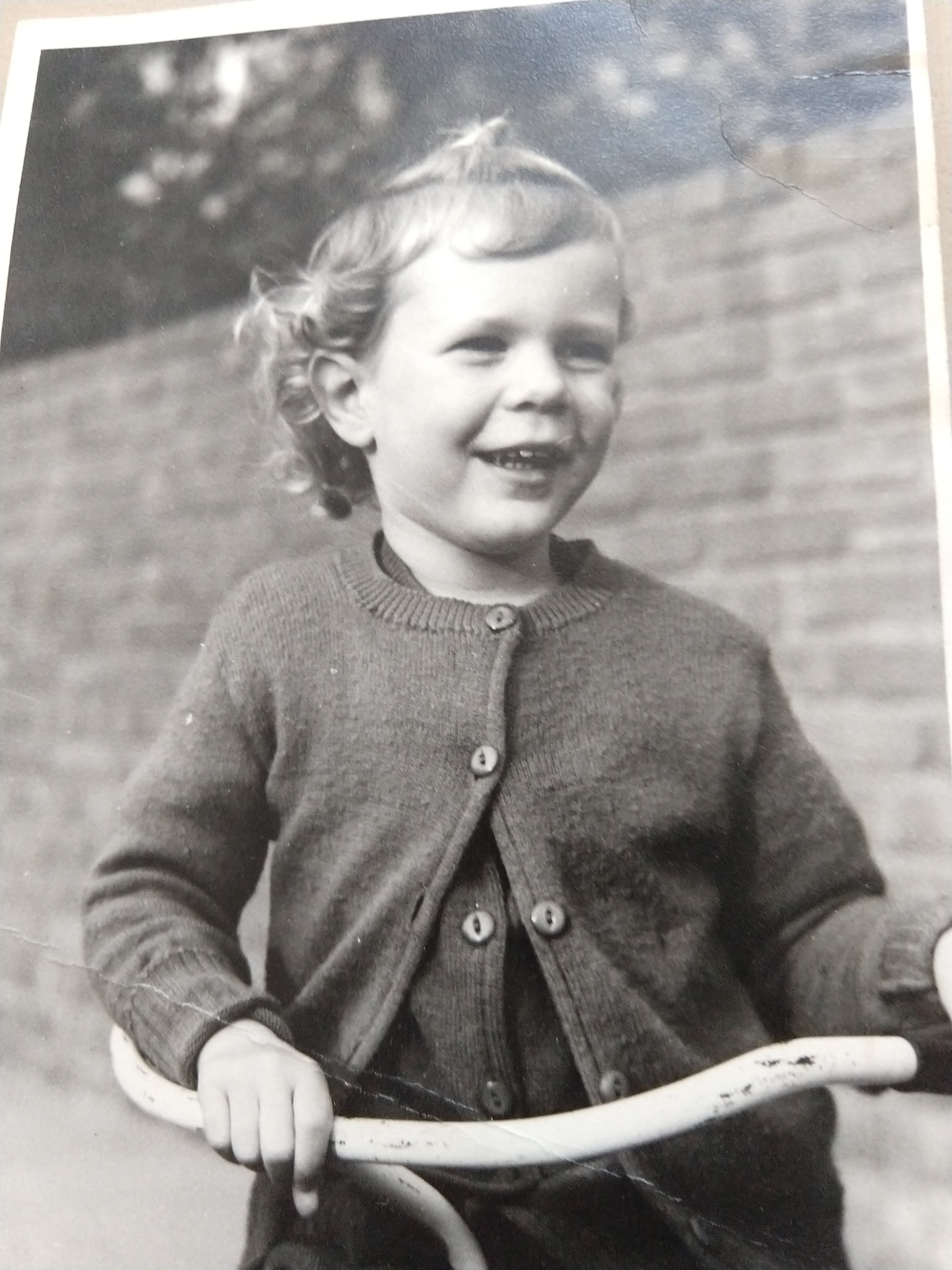
Young Leslie!

Mother had a strong artistic streak. An art history major in college, she became an interior decorator who created beautiful spaces in the various houses my parents occupied. Late in life, she turned to oil painting, but for most of my growing up years, she served as the photographer for family trips, birthday parties, graduations, weddings, and countless other occasions. She was a perfectionist, always striving for just the right shot, and was known to ask my father to suddenly stop the car when she spotted a bit of scenery she wanted to photograph.

Leslie's vintage holiday card

Mother’s need to have everything looking its best extended to my older sister and me. It turned the photo sessions for the annual holiday cards our parents liked to send into ordeals. She’d have us pose in the living room with the family dog, while she adjusted special lights and tried out different camera angles. This always seemed to take forever. By the time she was ready, our smiles had long since faded, and her telling us to “say cheese” fell on deaf ears.

Looking back, I think that a big reason Mother turned to photography was so she could hide behind the camera rather than be in front of it. A beautiful woman who, nevertheless, didn’t like the way she looked, she once went so far as to cut herself out of a photo with my father at a costume party.  

Leslie's mother's wedding photo

In the photos where she does appear, she’s rarely smiling, while my father often has a big grin on his face.

I take after my father: if someone points a camera at me, I’m going to smile.

Like my mother, though, I’ve continued the tradition of holiday photo cards with my own family, but I hope it’s not the ordeal for those involved that it was for me as a child. And family photos hang on the walls in my house, perch on my bureau and bookshelves, and fill scrapbooks and boxes I keep in the closet. I have my favorites that I never tire of looking at. 

One of them is a photo of my mother as a young woman. It was taken by a cousin of hers, and in it she’s actually smiling.

Readers, do you have favorite family photographs? One of the commenters will receive a copy of Wolf Bog!

HANK: It’s fascinating how many MORE photos we have these days, since everyone is always taking photos of everything. But in the past, they were scarce. And remember taking your film rolls to be developed? You never knew what you would get! What are your memories of old photographs? And do you smile when someone point a camera at you?  (And do you do holiday photos?)

And a copy of Wolf Bog to one lucky commenter!


LESLIE WHEELER

An award-winning author of books about American history and biographies, Leslie Wheeler has written two mystery series. Her Berkshire Hilltown Mysteries launched with Rattlesnake Hill and continue with Shuntoll Road and Wolf Bog. Her Miranda Lewis Living History Mysteries debuted with Murder at Plimoth Plantation and continue with Murder at Gettysburg and Murder at Spouters Point. Her mystery short stories have appeared in numerous anthologies. Leslie is a member of Mystery Writers of America and Sisters in Crime, and a founding member of the New England Crime Bake Committee. She divides her time between Cambridge, Massachusetts, and the Berkshires, where she writes in a house overlooking a pond. Visit her website .


ABOUT WOLF BOG

In the drought-ridden Berkshires a group of hikers that includes Kathryn Stinson discover the perfectly preserved body of a local teenager, missing for forty years, at Wolf Bog.


Who was he and what happened between him and Kathryn’s close friend, Charlotte Hinckley, to make her distraught and blame herself for his death? Searching for answers, Kathryn learns of the fabulous parties held at a mansion up the hill from her, where local teenagers like the deceased mingled with the offspring of the wealthy. Other questions dog the arrival of a woman claiming to be the daughter Charlotte gave up for adoption.


But is she really Charlotte’s daughter, and if not, what’s her game? Once again, Kathryn’s quest for the truth puts her in grave danger.


Wednesday, November 24, 2021

Taking another plunge: Leslie Wheeler on BLOODROOT short story anthology

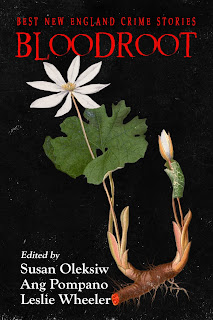
HALLIE EPHRON: It's a labor of love, and the final product is always astonishingly excellent. I'm talking about the short story anthology that is put together every year and makes its debut at the annual New England Crime Bake. This year's anthology, BLOODROOT: BEST NEW ENGLAND CRIME STORIES, is being published by Crime Spell Books.

Today we're thrilled to host Leslie Wheeler, one of the anthology editors, to talk about this terrific annual anthology in its new publishing home, and the power of the short story.
LESLIE WHEELER: “It’s Not Too Late to Back Out.” Those words and the smiley face below have graced my kitchen door for ten years now.

The message came with a hefty stack of mystery short story submissions, delivered to me by Mark Ammons, a member of my writers’ critique group, and a newly minted editor/publisher, along with Barbara Ross and Kat Fast, at Level Best Books, which had been handed off to them by the previous editors. They’d already signed on, but hesitated to ask me because as chair of the Crime Bake-sponsored Al Blanchard Short Crime Fiction Contest, I was already awash in short stories.

Yet, it was an offer I couldn’t refuse. My first published short story had appeared in a Level Best anthology, and during time I’d managed the Al Award, I’d grown to appreciate the power of short stories. My favorites were—and still are—the ones that either make me smile at their wickedly clever humor, or send chills down my spine. The contest also has a longstanding connection with Level Best, in that the award-winning story is published in the anthology for that year. I rejiggered the contest, and happily joined the Level Best team.

For the next six years we had a good run. It was hard work, but also a lot of fun. I enjoyed our often spirited in-person meetings to discuss, select, and edit the stories we’d publish, decide on the cover design, and arrange for publicity and sales at the Crime Bake, where the Best New England Crime Stories anthologies are always introduced. A few nights before Crime Bake, we’d have a book packing party at Mark’s. He’d serve his famous Cincinnati chili, and we’d devour it with side dishes and dessert, before getting down to work.

But most of all, I loved reading the stories and writing my own. For me, short stories offer an opportunity to approach perfection. Every word must matter for the story to become a little gem, in contrast to a novel, which resembles a necklace with strings of scenes, some stronger than others. I also like the way a writer can take something very small—an intriguing remark overheard in a crowd, or the sight of a woman in line who doesn’t look like she belongs there—and build a story around it.

Writing shorts gives me a holiday from the long haul of novel writing. Finally, as a reader of short stories, I’ve delighted in discovering new authors and watching their careers take off.

Still, despite all these positives, I hesitated to take the plunge a second time when the third team of Level Best editors decided to focus on publishing novels instead of anthologies. Was I too old to be doing this again? Could I work successfully with a new team, even though both Susan Oleksiw, a founder of Level Best, and Ang Pompano, an author whose stories we’d published, were well-known to me? And there was that sign on my door, tempting me with the possibility of withdrawal.

In the end, my determination to continue the Best New England Crime Stories tradition overcame my doubts. Things are different now. With the pandemic and the fact that the three of us don’t live nearby, our discussions have mostly taken place via Zoom or e-mail. Even so, the process has had its exciting moments, as when Susan gave us the name of Crime Spell Books for our new imprint. Ang created website before our eyes on Zoom. I came up with the title, Bloodroot, and an image of the plant with its delicate white flower and thick roots packed with orange poison flashed on the screen.

And the finished product is a joy to behold with its striking cover, and mix of stories from light to dark, written by both well-established authors and emerging writers. So, yes, I’m very glad I didn’t back out.

Readers: have you had times when you’ve been torn between moving forward with a project or abandoning it? If so, please share. One of the commenters will receive a paperback of BLOODROOT.

About Leslie Wheeler
Award-winning writer, Leslie Wheeler, is the author of two mystery series, the Berkshire Hilltown Mysteries, (Rattlesnake Hill and Shuntoll Road, with a third book, Wolf Bog, due out in July of 2022); and the Miranda Lewis Living History Mysteries (Murder at Plimoth Plantation, Murder at Gettysburg, and Murder at Spouters Point). Her mystery short stories have appeared in numerous anthologies including The Best New England Crime Stories anthologies, published by Level Best Books, where she was a co-editor for six years. She is delighted to return as a co-editor at Crime Spell Books, which now publishes these anthologies (www.crimespellbooks.com).


About BLOODROOT

Whether it’s an elderly woman facing a scam, a shipwrecked researcher trying to survive, a retired robber invited to join in one last fling, a farmer facing an escaped convict, or a group of kids in over their heads, with Bloodroot, Crime Spell Books continues the tradition of the annual anthology of Best New England Crime Stories by New England Writers.
Buy Link

Saturday, February 17, 2018

A Special Place by Leslie Wheeler

LUCY BURDETTE: Leslie Wheeler is an old friend of the New England contingent of Reds--and we're so thrilled that she has a new novel out! Today she's talking about the importance of her setting--and offering a book giveaway to one lucky reader. Welcome Leslie!

LESLIE WHEELER: A college writing teacher of mine said that we write about what we love and hate. In Rattlesnake Hill, I’ve written about a place that’s very close to my heart: the Berkshire Hills of Western Massachusetts. I love the area and the seventeen acres I own, especially the pond.

The pond was my father’s idea. Perhaps because he’d spent boyhood summers by a lake in northwestern Montana, he always wanted to live near fresh water. If there was no body of fresh water nearby, he created it. In Southern California, we had a swimming pool, as did many other families, but my father also installed a small Japanese pond, and at another home in Maryland, he built a miniscule waterfall.

My father picked the site for the Berkshire pond in a low-lying area behind the house, with tall pines at one end. Over the years, he showed such a keen interest in it that we dubbed him the Pond Master. Sometimes, he fussed over the pond. During one particularly dry summer, he extended a garden hose into it to raise the water level. But mostly, he enjoyed the pond. He could sit for hours in a chair, turned to give him a view of the water. He was a driven man in a demanding profession, and I think he found tranquility in that view.

Like my father, I feel duty-bound to preserve and protect the pond. I’ve battled beavers that tried to dam it, waged war on cattails and other weeds that threatened to overwhelm it, and when the pond filled with silt, I’ve had it dredged—not once, but several times.
The pond is also a source of great pleasure for me. I love watching how it changes from one season to the next, from spring green, spotted with tadpoles, to summer murky, fall crystal clear, and finally to winter frozen over. 

It serves as a barometer, too. If I want to find out how windy or rainy it is without going outside, I observe the pond’s surface. When its surface is so still that I can see the reflections of the trees in the woods beyond, I could sit for hours, like my father, taking in the beauty and peace.

A pond not unlike my pond figures in Rattlesnake Hill. It’s where Kathryn Stinson, my main character, goes when she needs a break. With all I put her through in the novel, I figured she needed a place where she could relax and regroup, if only for a little while.


Readers: Do you have a special place, indoors or outdoors, where you go when you want to get away from it all? Have you given your main character such a place, too? One of the commenters will receive an ARC of Rattlesnake Hill.