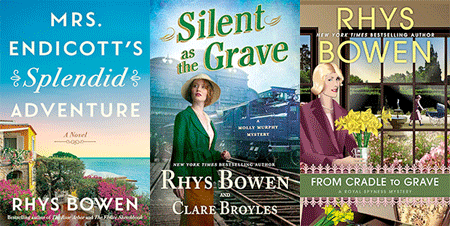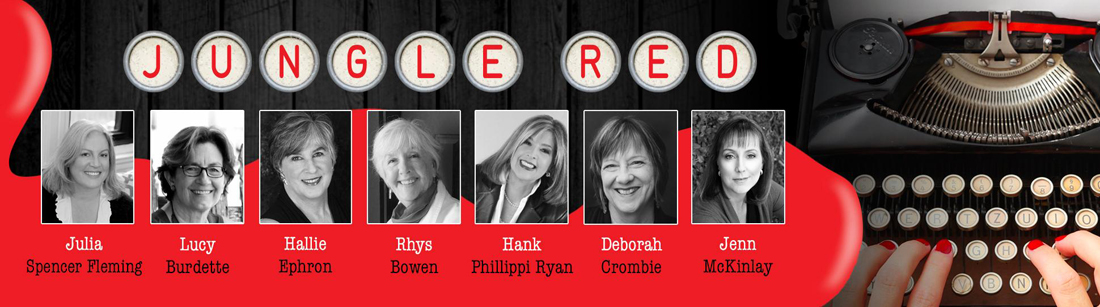
RHYS BOWEN: Big sigh of relief here. I've just finished the first draft of the latest Royal Spyness novel, called From Cradle to Grave. Actually I really enjoy writing these books. I suppose I like the characters and am interested in what they plan to do next, and I do like a good chuckle when Queenie does something awful or Georgie is clumsy. I think readers of the series will find this story particularly satisfying (I'm not going to say why, but you'll know when you read it).
I think I shared a snippet with you before about the arrival of the nanny from hell. This is only the beginning of Georgie's nightmares. Following the nanny her sister-in-law Fig arrives unexpectedly to make sure that nanny settles in properly and to give Georgie a few instructions on how to run her house. This does not go well.
I felt it was important to see how Georgie tries to balance motherhood with challenges of a life beyond the house--something so many of us have faced. And the pull of the outside world is extra strong in this book as she hears about a tragic death of a contemporary of Darcy's, then another. When there is a third death within a few weeks she starts to wonder if these were not accidents after all. Is somebody killing off he sons of the British upper class? Then the next question: Is Darcy on that list?
So it's quite a tense book, with a nanny who is infuriating her at home and cases she wants to help to solve, but Queenie's escapades create a side plot, including some fun moments like this one:
My former maid Queenie, now our assistant cook, burst into the room giving her usual impression of a runaway cart horse. The cups rattled alarmingly as she skidded to a halt, staring at the visitor open mouthed. “Oh blimey,” she said. “I didn’t realize you’d got company. I’d have put a slice of my lardy cake with the tea things.” Her cap was askew and one of the front buttons of her dress uniform had come undone or had split open, revealing a hint of rather gray and unappealing undergarment.
“That’s quite alright, Queenie,” I said. “This is Nanny Hardbottle. She has come to take care of master James.”
“But I thought you said you didn’t want no nanny,” Queenie went on in her usual tactless way. “You said no dried up old prune was going to raise your child. I heard you myself.”
“That will be all, Queenie,” I said. “Please put the tray down carefully on the little table.”
“I can be mother, if you like,” she said.
“No. I can manage, thank you.” My gaze told her that the sooner she left the better. Queenie was never quick on social cues. “I don’t mind at all,” she said. “I ain’t got nothing more to do since I already peeled tonight’s spuds and chef is making one of them Frenchie puddings tonight. He called it a po de crème.” She giggled at the mention of the word po. Cockneys seemed to find the mention of anything to do with lavatories or bodily functions highly amusing.
“You may go, Queenie,” I said.
“Bob’s yer uncle then.” She gave Nanny Hardbottle a big grin. “Nice to meet you, I’m sure.” The vases and statues rattled as she clomped out.
There was a silence as I poured two cups of tea.
“What an extraordinary woman,” Nanny Hardbottle said. “Who on earth is she? Surely not one of your maids?”
“My assistant cook,” I replied. “I’m afraid she’s a little unorthodox. But she does bake rather well. Usually we keep her safely in the kitchen, but I expect the other servants were occupied elsewhere, or, knowing Queenie, she took it upon herself to bring up the tea.”
“Extraordinary,” Nanny Hardbottle repeated. “Your housekeeper seems a competent woman. Can she not teach this person the rudiments of polite behavior?”
I had to smile. “She has tried, I’m sure. We have all tried. Either nothing sinks in or Queenie deliberately doesn’t want to learn.”
“Then why not give her the sack?”
“Because she was once my maid and she was awfully brave. She saved my life in Romania. I feel responsible for her. And as I said, she does make rather good cakes and biscuits.”
Nanny Hardbottle said nothing this time, merely shaking her head. I handed her a cup of tea. She sipped suspiciously, as if Queenie might have done something unmentionable to it.
It is always a juggling act when I write to insert humor to what is otherwise a tense story. It can never take away from the gravity of the situation but can relieve an overwhelming amount of tension. When I read I like this approach. The Lord of the Rings, one of my all-time favorites, has those sweet and gentle scenes with Hobbits being simple country boys amid terror and despair. This keeps it feeling human and relatable. Interestingly enough these scenes are lacking in the movie version, and the films are entirely fight or flight and thus not as appealing to me.
What do you feel about humor in mysteries? Would you rather the author just got on with the plot?