HALLIE EPHRON:Sometimes, you go back to a place you’ve visited before and it feels… completely new. I’d been to Chicago three times, but last week, when I visited again, it felt as if I was seeing it for the first time.
This time I’d decided to splurge on *location* and booked a room at the Palmer House, a historic hotel (now a Hilton) around the corner from Art Institute of Chicago, a stone’s throw from Millenium Park and Buckingham Fountain, nearby The Bean, and Lake Michigan.
The hotel itself is pretty fantastic, the public spaces are amazing, even if it is packed with tourists and our room had barely enough room in it to turn around.
It’s set in a magnificent neighborood, even if you do nothing but walk around and gawk. Between Lake Michigan, broad streets, and open plazas, you can really SEE magnificent architecture all around you.
It feels nothing like in Manhattan where it can feel as if you’re gazing up from the depths of a dark canyon when you crane your neck to glimpse skyscrapers towering above you. Even from dark corridors of downtown streets with the El running overhead, Chicago's sleek skyscrapers beckon from afar.
It’s as if the streets are designed to show off the buildings. More skyscrapers can be seen from the magnificent (and way over-the-top) Buckingham fountain at Lake Michigan’s edge.
Of course we had to visit Anish Kapur’s Cloudgate sculpture – aka The Bean. It’s a magnet for tourists. I’m somewhere reflected in this picture but I’ve lost track of where.
And beside it is the Frank Gehry designed Jay Pritzker pavilion, a performance center which looks for all the world like a gigantic tuna can that got attacked by a can opener.
And a side trip to the Chicago Botanic Garden has breathtaking sights like this.
Of course I had to eat (several) Chicago style Red Hots (all-beef hot dog in a poppy seed bun, topped with yellow mustard, neon-green sweet pickle relish, chopped white onion, tomato slices, a dill pickle spear, pickled sport peppers and celery salt). They're VERY colorful and surprisingly delicious.
Do you have a favorite city to go back to, one that feels new each time out?
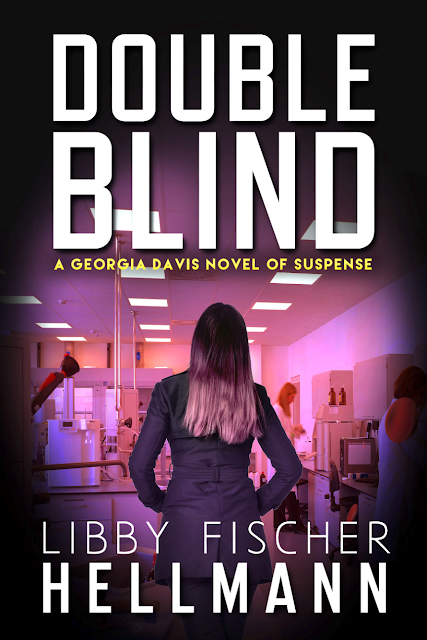
My latest Georgia Davis thriller, DoubleBlind, came out last month. It’s doing well, even though it’s the 6th in the series. I was going to write about keeping a series fresh, but decided to do that on my own blog. You can find it here, and I hope you’ll check out the book.
But today I wanted to write about something else. I’m going to a formal wedding tonight down at the Palmer House. Have you ever been there? The lobby ceiling is fantastic, and I talk about it—and its history in DoubleBlind.
In fact, the ceiling reminded me of a Chicago story that occurred soon after I moved from DC to Chicago in the fall of 1977. At the time I was looking for a job in broadcast news (Which turned out not to happen, but that’s another story). I’m still not sure who told me about it, but I stayed at the Belden-Stratford, an apartment-hotel in the middle of Lincoln Park, which at the time, housed one of the best Mandarin restaurants in Chicago, the Dragon Inn.
But I digress.
The Belden-Stratford wasn’t an assisted living facility, but you might have mistaken it for one. Formerly an elegant hotel, but it had faded into a dusty, dingy, place with frayed carpets, and cracked leather furniture. I booked it for a month, spending my time going on interviews, working freelance, and seeing the sights of Chicago. I would get back to the hotel around four, and would be greeted by a phalanx of senior citizens lounging on chairs and sofas in the lobby. They would stare at me as I swung through the door. Most of them looked vacant, some sad, and no one smiled. I would make a beeline for the elevator.
One day, though, one of the women did smile at me, and I decided to sit next to her. She must have been well into her eighties, she looked frumpy, and she walked with a cane. We started to chat about this and that… nothing important, just passing the time of day. She asked me why I was staying there, and I told her. I asked her how long she’d lived there, and she told me. I was about to say goodbye and go up to my room when she said. “You’re probably too young, but do you happen to know who Benny Goodman was?”
Now, you need to know my late father was a party animal. He was the guy everyone wanted to be around when the music started and the drinks were flying. Along with Frank Sinatra and Ella Fitzgerald, he had all of Benny Goodman albums. In fact, at least once a week, usually on Saturday nights, the strains of Benny’s clarinet or Ella’s perfect soprano or some other Swing/Big Band would float upstairs as I was trying to fall asleep. I told the woman.
She grinned. “Well, I’m Benny Goodman’s sister.”
Once I put my jaw back in alignment, she said, “Come with me, sweetie.”
We went up to her small, cramped apartment. Every available inch of wall space was covered with framed photos and newspaper clippings. Other mementos spilled onto end tables next to china figurine miniatures, lace doilies, and other tchotchkes. All of them were a memorial to her brother.
Photos of him playing with Gene Krupa and Harry James at the Blackhawk restaurant… album covers (some the same as my father’s)… family photos taken in the Maxwell Street area where they grew up – there were twelve siblings – and one photo of their father, who died before his time in a traffic accident.
I looked through everything. Then I asked if I could bring my camera down so I could take pictures of the pictures for my father.
“I have a better idea,” she said (To this day I can’t remember her first name… my bad). “How would you like a photo?”
She gave me a picture of Benny, Gene Krupa, and Harry James. It was a candid, and they were rehearsing. She didn’t know where. I do remember two of them (don’t recall which ones) had cigarettes burning.
I sent my father the photo the next day.
That was my first “Chicago” moment, not particularly exciting or memorable except to me. A piece of Chicago’s past had been shared with me, and I felt a bond with the city, its history, and the talent nurtured on the shores of Lake Michigan.
That was over 40 years ago. Benny and his sister are long gone. So is my father. But during the few moments I spent in her apartment, something registered—a sister who was inordinately proud of her brother and was able to tell the tale to a younger person who appreciated it.
It was a special moment, and I knew from that day forward that I belonged in Chicago. I was going to live here. Maybe I’d even tell this story one day.
HALLIE EPHRON: Chicago in the 1930s with the stock market crash in the recent past is the setting for a new series by Michelle Cox. A GIRL LIKE YOU introduces readers to a delightful pair of sleuths, and makes a convincing argument for mixing mystery and romance. Today I'm happy to welcome Michelle Cox to Jungle Red.
MICHELLE COX: Duncan Kincaid and Gemma James. Molly Murphy and Daniel Sullivan. Amelia Peabody and Radcliffe Emerson. We all have our favorite detective pair of
sleuths who, when not battling villains, just can’t seem to fight their
attraction for each other.
But wait a minute, the purist might interrupt, isn’t this
meant to be a mystery story? A theft, a
kidnapping, a murder—or worse? Why are
these two seemingly intelligent characters often ignoring very obvious clues in
the case before them in order to investigate each other, and often in an embarrassingly clumsy way? The answer, of course, is because they can’t
help it.
The mystery and romance genres fit seamlessly together in a
way no two other genres could. Can you
imagine what might happen if sci-fi attempted to blend together with a western,
for example? Something presumably
messy. Maybe an interesting one-off, but
not the sort of thing that would fill a whole section of any self-respecting
bookstore. No, romance, it seems, is the
universal donor, the “O negative” of the fiction world.
And why? Because
characters, even the most hard-boiled, are human and ultimately have the desire
for love etched deeply in their hearts.
And mystery, if examined closely, is the perfect universal receiver.
Why? Well, for one
thing because the romantic tension between the sleuths is a natural distraction
from the case at hand. Not only does it
give the characters something else to do or think about besides tracking down
the killer, but it is a great red herring for the reader as well. And it makes the characters more vulnerable,
which adds, of course, to the tension already brewing surrounding the
mystery. Not only are the characters
perhaps in physical danger, but now they are in emotional danger as well.
And let’s face it, the romantic prospects of the sleuths are
a form a mystery as well. A mini mystery
of “will they, won’t they?” inside the bigger case—an extra thrill, or
titillation, if you will, for those “rapt” up in it with them.
Certainly this is the “case” with the newest pair of sleuths
on the scene, Inspector Clive Howard and Henrietta Von Harmon in the debut
novel, A Girl Like You. The aloof Inspector is definitely not contemplating
a romance with Henrietta, the impoverished taxi dancer whom he encounters at a
dance hall in Chicago, circa 1935.
Instead, he hopes to convince her to use her stunning beauty and her ability to
disguise herself to go undercover for him to track a killer, a role she
hesitantly picks up for the money.
So
far so good on the mystery side, but it doesn’t take long before Henrietta
finds herself unfortunately falling for the Inspector. Clive meanwhile begins to piece things
together and uncomfortably discovers that Henrietta is not the woman of the world he originally thought she was, realizing
with a certain degree of dread that not only has he put a vulnerable young woman
in danger, but that he himself is beginning to be tempted by her charming
innocence. He struggles to restrain
himself from what would surely be an inappropriate relationship, even as she
longs for his love and protection, secretly taking on more and more risks to
impress him. But, Clive and
Henrietta! There’s a killer on the
loose! Remember?
There arethose,
of course, the purists mentioned above, who have no tolerance for this sort of
genre-blending. They like their
mysteries to only to be about the case at hand and not about Emerson’s wry
observations of Amelia’s disheveled hair, for example, nor do they want Molly contemplating
the particular shade of Daniel’s “alarmingly blue eyes,” or Clive softly
brushing the side of Henrietta’s cheek with his fingertips. They want facts and only facts.
But most of us are not so one-sided, so cold of heart. We don’t mind our mysteries with a side of
romance, or maybe even more. We like our
heart to beat a little faster, and not just because the villain has just jumped
out of the closet, holding a gun. And
joyfully for us, most mysteries can deliver the thrill, in more ways than
one.
Do you enjoy your mystery with a bit of romance or are you
more of a purist? And if you do enjoy a
romantic subplot, who are your favorite duos?
Jungle Red Writers has been named one of the top 101 Best Websites for Writers by Writers Digest, one of the top 50 mystery blogs by CourtReporter, and one of the top 100 creative writing blogs by Best Colleges Online