Showing posts with label genealogy. Show all posts

Saturday, March 7, 2026

Discovering Scottish roots with Kathy Chung


HALLIE EPHRON: Where do you come from, and how much of that place still beckons? Whose genes did you inherit?

These are fundamental questions that we mystery writers ask of our characters, and often of ourselves.

We travel to the places where our mysteries take place, all in an effort to get the details right. But traveling to the places that shaped our own ancestors or our characters' pasts is a special challenge.

Introducing Kathy Chung who makes that challenge a lot easier and so much more fun.

For two decades Kathy has been conference coordinator for the annual Surrey International Writers Conference in Vancouver, British Columbia. It's a fabulous several-day event (regularly featuring luminaries Diana Gabaldon, (until recently) Anne Perry and Donald Maas, just for example.)

Each year I so look forward to being welcomed to the conference by Kathy. She's lovely, competent, able to put out twelve competing fires at the same time.

What I didn't know is that Kathy is also a qualified genealogist specializing in Scotland, North America, and the rest of the United Kingdom. Today she's branching out, applying her organization and genealogical talents to a new venture that has me wishing I had ancestors from Scotland...

KATHY CHUNG: All the work I love best is some combination of puzzles, stories, and connection: researching and writing novels, genealogy, and planning conference and events to bring people together to learn, explore, and connect.

My own roots are Scottish, and I've been lucky enough to make several research trips to Scotland and to study family and local history at the University of Dundee. I've combined my love of bringing people together in a supportive environment to learn - and my years of experience planning the Surrey International Writers' Conference - with my love of genealogy and research in what to me is a dream job: offering supportive small-group research trips to Edinburgh.

At the end of 2025, I launched my new business, https://scottishgenealogy.ca, to offer small groups of amateur family historians from North America who have Scottish roots week-long research trips in Edinburgh. The first one is coming up in June.

The first trip is coming up June 13-20, 2026.


Explore your roots in the country of your ancestors or research your Scottish novel setting while getting a feel for the sights, sounds, and culture of Scotland. Connect with other people who love disappearing down research rabbit holes. I hope you'll join me!

HALLIE: This sounds so great and has me wishing my genealogical past wasn't rooted in Russian shtetls.

And asking: Are you interested in chasing down your own genealogical past and visiting the place(s) that are implanted in your DNA? If you could travel to discover your ancestors, where would you go (time? place?) and what would you want to know?

Wednesday, June 15, 2022

Ancestor Mysteries, a guest post by Sarah Stewart Taylor

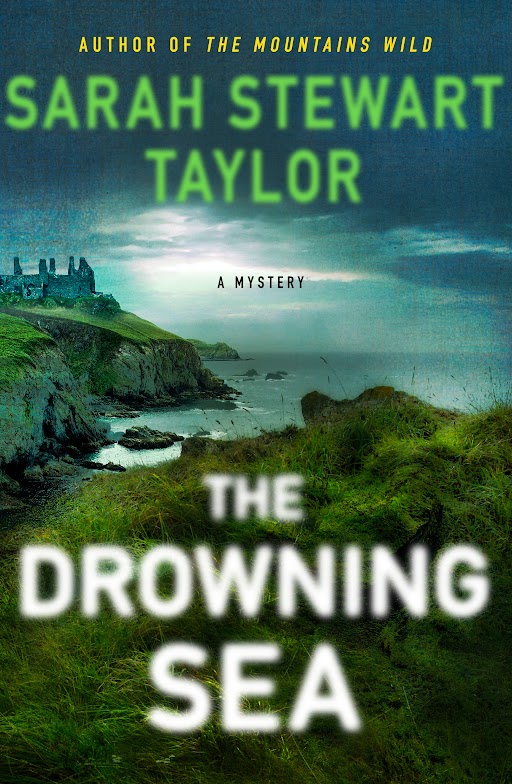
JULIA SPENCER-FLEMING:  When reviewers talk about Sarah Stewart Taylor's Maggie D'arcy series, they use words like, "lyrical," "tender," "atmospheric," and "intricately plotted." And there have been a lot of reviewers - the first in the series, THE MOUNTAINS WILD, appeared on almost every Best Of list in 2020. They're calling the third in the series, THE DROWNING SEA, "rich and gothic," "gorgeous" and "heartfelt."

I'd describe the Maggie D'arcy books as novels with mysteries in them, which isn't to detract from the cunning twists and turns that unfold organically throughout the story! Rather, I read them as much for the characters, and for what the books say about love, family, difficult relationships, and coming to terms with the past.

Which brings us to today's topic! Sarah has been thinking and researching and digging into the past, and has discovered some of the most compelling questions arise from our own family histories. Who were you? Where did we come from? And how did we get from there to here?


In my new Maggie D’arcy mystery, The Drowning Sea, Maggie, an American homicide detective who is spending the summer in Ireland with her daughter and her Irish boyfriend and his son on a remote West Cork peninsula, goes to see the place where her grandmother once lived before emigrating to America. She thinks about ancestors and legacies and mysteries and wonders why it was so important to her to stand on the piece of ground where one branch of her family tree began to grow.


Maggie’s experience mirrors my own visit to the spot in West Cork where my great-great grandfather and his family lived before he emigrated to Boston. My own visit was the reward at the end of a lot of genealogical sleuthing. I knew that my mother’s maternal ancestors were named McCarthy, and that her great-grandfather Michael had emigrated from Ireland, as a young child at the height of the Great Famine, I’d been told. But most of the details of his early life had been lost to the years. 


I discovered through newspaper archive research that Michael served in the Union Army in the Civil War, trained as a doctor, and married a Boston woman whose family had also immigrated from Ireland. He died young, only a few months after his only child, my great-grandfather Charles, was born. (Charles would go on to attend Harvard College and Harvard Law School and become Chief Justice of the Idaho Supreme Court. Another family mystery is how his widowed mother, a seamstress, marshaled the resources for his education.)


We didn’t know where in Ireland Michael came from or how he’d traveled to America. I spent almost a year following clues in documents on Ancestry.com, plugging in birth and death dates and one night, deep down a genealogy rabbit hole, I found a baptism record for Michael in the tiny townland of Shanacashel, Kilmichael Parish, West Cork. Eventually I was able to track down birth records for seven brothers and sisters. And I was able to find his naturalization records, which showed he actually arrived in Boston when he was twelve years old, in 1855, and not when he was four, as I’d been told.


I’ve tracked down threads of the family story on genealogical websites and in archives in Ireland and the U.S. But still hanging out there is the mystery of how he got to Boston and with whom. Ship records for the years he would have arrived are missing and the years between his arrival in Boston and his discharge from the Union Army after the Civil War are a complete mystery. I’m also fascinated by the idea of all of those brothers and sisters back in Ireland. Did any of them travel with Michael? Where are they now? While I’ve been able to locate some family members with whom I share DNA through the Ancestry.com and 23 and Me, I haven’t had any luck tracing McCarthy relatives in Ireland. But my visit to Shanacashel a couple of years ago was satisfaction of a sort. It was surprisingly meaningful to stand on the piece of Planet Earth where my great-great grandfather was born, but it also raised many new questions for me, as it does for Maggie in The Drowning Sea.


Speaking of DNA, chances are there are at least a couple of DNA mysteries lurking in my family tree, though I haven’t found them yet. With the sheer numbers of people contributing DNA to these databases, it makes sense that a growing number of crime novels center on genetic revelations. I’ve heard so many stories from friends about family mysteries uncovered through these sites, some with sad outcomes and some with happy ones. (I love SC Perkins’s genealogical mysteries and there are some other series that also take on secrets amongst the branches of family trees.)


As I’ve gotten older, I’ve found I’ve only become more and more interested in family history. I’ve also become more and more aware of my own privilege in being able to find and put together at least some of the pieces of the puzzle. For adoptees in closed adoptions, researching family trees can be difficult and can open up difficult family history or lead to joyful reunions. Many Americans can’t explore these family mysteries because their ancestors were brought here enslaved or came as refugees or seeking asylum. Records were left behind or have gone missing. So many stories have been lost to trauma. When we explore one half of my husband’s family tree, we run up against many lost threads representing his Lithuanian and German Jewish ancestors who came here fleeing discrimination, pogroms and the Holocaust.


One of the most interesting mysteries in my family involves my ancestor Mary Perkins Bradbury, who was tried and convicted as a witch during the Salem Witch Trials. She was sentenced to death but somehow escaped (this is where the mystery comes in, though there was likely an exchange of money for her freedom) and, according to some accounts, traveled to Maine with her husband, where she remained until the worst of the fervor had passed in Massachusetts. This summer I’m planning on traveling to Salisbury, Massachusetts, near Salem, to see the site of the Bradbury home.  


I’m looking forward to continuing to try to solve some of my family puzzles. What are the mysteries in your own family that you’ve been able to solve or are still exploring? 

JULIA:  I think Michael McCarthy's story would make a gripping historical novel, don't you, dear readers? Oh, and Sarah is giving away not one, not two, but THREE books - a signed copy of each of the Maggie D'arcy mysteries to three lucky commentors!


SARAH STEWART TAYLOR is the author of the Sweeney St. George series and the Maggie D'arcy series. Her most recent book, THE DROWNING SEA, will be out June 21st. Taylor grew up on Long Island in New York and was educated at Middlebury College in Vermont and Trinity College in Dublin. She lives with her family on a farm in Vermont where they raise sheep and grow blueberries. Visit her online at www.SarahStewartTaylor.com.


For the first time in her adult life, former Long Island homicide detective Maggie D’arcy is unemployed. No cases to focus on, no leads to investigate, just a whole summer on a remote West Cork peninsula with her teenage daughter Lilly and her boyfriend, Conor and his son. The plan is to prepare Lilly for a move to Ireland. But their calm vacation takes a dangerous turn when human remains wash up below the steep cliffs of Ross Head.

When construction worker Lukas Adamik disappeared months ago, everyone assumed he had gone home to Poland. Now that his body has been found, the guards, including Maggie's friends Roly Byrne and Katya Grzeskiewicz, seem to think he threw himself from the cliffs. But as Maggie gets to know the residents of the nearby village and learns about the history of the peninsula and its abandoned Anglo Irish manor house, once home to a famous Irish painter who died under mysterious circumstances, she starts to think there's something else going on. Something deadly. And when Lilly starts dating one of the dead man's friends, Maggie grows worried about her daughter being so close to another investigation and about what the investigation will uncover.

Old secrets, hidden relationships, crime, and village politics are woven throughout this small seaside community, and as the summer progresses, Maggie is pulled deeper into the web of lies, further from those she loves, and closer to the truth.

Sunday, August 9, 2020

S.C. Perkins--Decoding My Fascination with World War II and Spy Craft


DEBORAH CROMBIE: What could be more fun than genealogy, Texas, and WWII spy craft, all in one book?? I loved S.C. Perkins' first Ancestry Detective Mystery with protagonist Lucy Lancaster, a Texas genealogist, but when I read the description of this second book, my finger hit the BUY button faster than you can say family tree!


What a perfect summer read! Here's Stephanie to tell us how all these elements came together.

S.C. PERKINS: I was five years old when World War II became something I recognized, courtesy of two of my father’s favorite television shows. One was Baa Baa Black Sheep, staring Robert Conrad and featuring the exploits of a misfit band of World War II fighter pilots in the South Pacific. The other was reruns of the sitcom Hogan’s Heroes, about American POWs who became resistance fighters while in a German prison camp. 


Thanks to my movie-loving mother, more wartime-set classics came into my life, from musicals like South Pacific, comedies such as Operation Petticoat, and, when I was a bit older, excellent dramas that included The Bridge on the River Kwai, The Great Escape, From Here to Eternity, and The Longest Day.


My interest in espionage also came from when I was very young and from what I saw on television. However, there was one scene from an otherwise fuzzy memory of a black-and-white show—so fuzzy I can’t remember the name of it—that truly launched my fascination with spy craft. The scene was of a spy finding a microdot hidden in a book.

Image courtesy of Pinterest

I was absolutely, completely stunned when I saw this. Was it really possible to reduce crucial information to the size of a printed period and hide it almost literally anywhere? Apparently it was, and since that moment, in my eyes, not even the coolest gadgets Q thought up in the James Bond films matched the power of the microdot.

What about codes and ciphers, you might ask? Oh, they’re on a level all their own! I’m enthralled by cryptography—though I confess I’m only interested in those types created and broken by humans as opposed to computers. (In fact, I would like to believe that, had I lived during World War II, I would have made an excellent codebreaker.)

So, since my main character, Lucy, is a genealogist, if you’re thinking I’m a certified history lover, you’d be right. Then add in my interest with World War II, spies, microdots, and cryptography? You’d better believe it I would be champing at the bit to put all of my loves into one book—and I decided I wanted to do so when I introduced Lucy’s beloved grandfather in Lineage Most Lethal. His name is George Lancaster, but Lucy calls him Grandpa.

To be honest, I thought about waiting a couple of books to introduce Grandpa, but I knew I couldn’t for a couple of reasons. One, because I was simply too excited. And the other? Well, sadly, it’s because members of the Greatest Generation are in their nineties now and passing away at an alarming rate. If Lucy were to conceivably have a World War II-era grandfather, I needed to introduce him now—and, boy, am I glad I did, because he was an absolute delight to write.

But there’s another reason I wanted Grandpa to be a World War II veteran, and that lies in the secret he’s kept from his family for over seventy-five years.

If you read my first book, Murder Once Removed, you might recall a small detail about the desk Lucy uses in her office located in downtown Austin, Texas. The desk belonged to Grandpa, a former reporter, and it has a large crosshatch carved into one corner.

I remember when I wrote that bit about the crosshatch, that it just sort of came out onto the page, unbidden. Lucy believes it was for Grandpa and his reporter buddies to play tic-tac-toe for beer money back in the day when things were slow. Yet, as soon as I wrote it, I knew it hadn’t been for tic-tac-toe—or, not usually. I now knew what secret Grandpa had been keeping:  he was an OSS spy, and that crosshatch was used to decipher a type of coded message called a Pigpen Cipher.

Also known as a Freemason’s Cipher, the Pigpen Cipher is a type of substitution cipher where symbols formed from the grid are used to represent letters in a secret message. This type of code goes back possibly to ancient times and has been used in one form or another by many groups, including the Knights Templar and Civil War soldiers.

 Image courtesy of Wikipedia

I also had great fun using two other types of code in Lineage Most Lethal, including Morse Code and a book cipher—where a book is used as the key text to both create and decode a message. And the book I chose as the key text for my book cipher? Well, let’s just say I had a great time deciding on another piece of espionage history for that plot point.
When it came to the specifics of the microdot and how and where Lucy would discover it, I considered paying homage to my fuzzy memory of the spy finding the microdot in a book. That was, until I happened to be perusing the International Spy Museum website while researching microdots. There, I saw a little notation about fountain pens becoming a spy gadget. I won’t give my plot away by saying how, but as soon as I read this, I knew I had to use it (though I did have to fudge the timeline just a bit).

There’s one fact that doesn’t need decoding, though:  I had as much fun researching and writing all the World War II and spy-craft information in Lucy’s second adventure as I did the genealogy. I hope you’ll enjoy reading it just as much!

Fun fact:  I actually used the real key text to create the book ciphers you’ll see in Lineage Most Lethal. I figured, if I were going to put all my favorite spy stuff in one book, I was going to go whole hog!


S.C. Perkins is a fifth-generation Texan who grew up hearing fascinating stories of her ancestry and eating lots of great Tex-Mex. Her first book, Murder Once Removed, was the winner of the 2017 Malice Domestic Best First Traditional Mystery competition, and an Agatha Award Nominee. She resides in Houston and, when she’s not writing, she’s likely outside in the sun or on the beach. You can find her at scperkins.com or on Twitter, Instagram, Goodreads, and Facebook at @SCPerkinsWriter.

DEBS: Oh, my, wasn't Robert Conrad dishy? And you know I absolutely could not resist a book that had a microdot hidden in a fountain pen! Tell us in the comments if you are fascinated by spy craft, and Stephanie will give a way a copy of Lineage Most Lethal to one lucky commenter!