Showing posts with label how to write. Show all posts

Monday, August 31, 2020

Writing fiction? Where to start?

HALLIE EPHRON: Last month I had the great pleasure of talking to aspiring writers about their goals and aspirations and projects underway as part of the Willamette Writers annual conference. It was a brilliantly run Zoom affair, showcasing so many features of Zoom that I’d never realized existed. (It helped that the folks in charge knew what they were about. Teamwork!)
During one of my one-on-ones, a writer who was moving from writing personal essays and nonfiction to her first fiction asked: When you’re writing fiction, how you figure out what to write about?

It’s a great question, because theoretically, once you’re unmoored from reality, you could write about virtually anything.

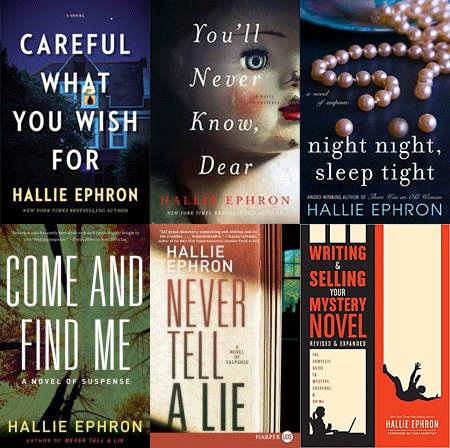
I shared with the writer that my books always always always start from a personal place. My first suspense standalone, NEVER TELL A LIE, grew out of my feeling isolation as I waited to go into labor with my first child. COME AND FIND ME is about a woman whose world has imploded until it’s just her and the Internet.

My advice: Write from a personal place. Get out a mirror and figure out what you love/hate/care about. That’s your starting point.

What advice would you give?

RHYS BOWEN: One thing I always say when addressing beginning writers is never to write what you think will be popular or will sell well. For one thing by the time the book is published the IN thing will no longer be in. For another you have to spend many months with those characters and in that environment. You have to love being there, to look forward to sitting down at the computer every morning. I have to be excited to see what my characters will do next or my reader won’t be excited.

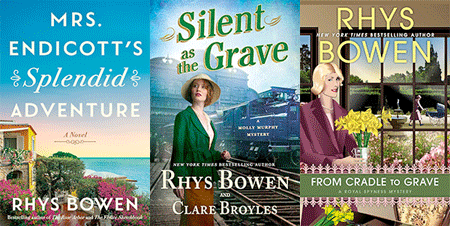
I always start from something that fascinates me or has touched me emotionally in some way: stories about Tuscany in WW2 that I learned about when I was there. Questions about my spinster aunt and her time in Venice. Lady Georgie was born because I wanted to create the
most unlikely sleuth and I wanted to have fun. Molly Murphy was born from an emotional visit to Ellis Island.

You don’t feel compelled to write about something then don’t write about it!

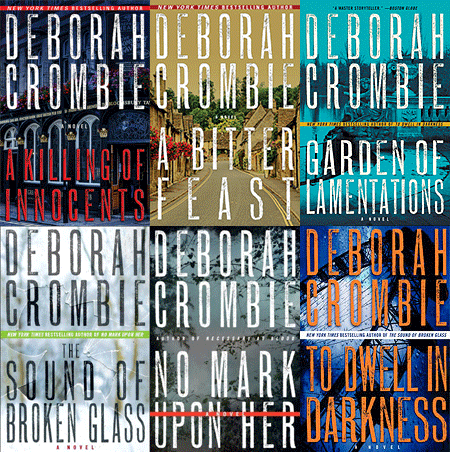
DEBORAH CROMBIE: Seconding what you and Rhys have said, Hallie. Books take a long time (I should know!) and you absolutely have to LOVE what you're writing. You write the book you want to read, not the book that someone says is trendy. 

I started my Duncan and Gemma series partly because I loved British detective novels, and partly because I was missing England dreadfully and wanted to be there in my imagination. And I think you have to figure out what matters to you emotionally, because that's how you create characters who feel genuine.

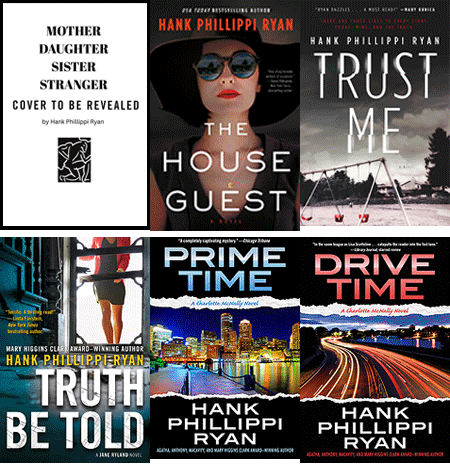
HANK PHILLIPPI RYAN: Number one--you have to care. Find out why YOU care, and then the reader will care. There’s also a blink reflex, I think, that maybe, in me, evolved from my reporting brain, that pings on “oh, that's a good story!” It’s like--if an idea is a pebble, some you toss into the pond and they sink to the bottom. Others, somehow, create ripple after widening ripple. When I test an idea in my mind, I see if it makes ripples. Or even waves. 

The First To LIe came out of what I learned emotionally going undercover as a reporter. How does it feel to be someone else--and lying as you do it? And then I realized we all do that, every day. Oooh. What might happen? (In that same book, I also had a separate good idea about structure. But that I cannot reveal.)

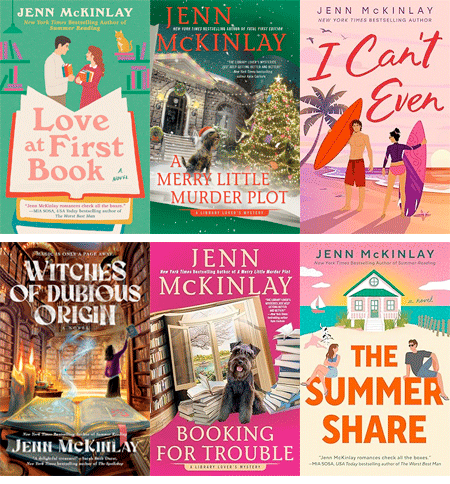
JENN McKINLAY: I write comedy in both mystery and romance, so I always go for the joke, the pun, the pratfall, or the shenanigans. Why? Because life is hard, tragedy abounds, and I need something to laugh at or I just don’t see the point in getting out of bed.

That being said, I find that writing fiction allows me to ponder my fellow human beings and try to figure out why they do the things they do. I can people watch all day. I find others endlessly fascinating. Whether I’m writing a story about falling in love or finding a body, I enjoy taking all of my observations and twisting them into something completely new. Where to start? For me? Usually with a joke.

HALLIE EPHRON: So it's all about following your gut, not the market. So, if you were writing a novel, where would YOU begin?

Monday, December 18, 2017

How We Write (or don't!) #amwriting @junglereds


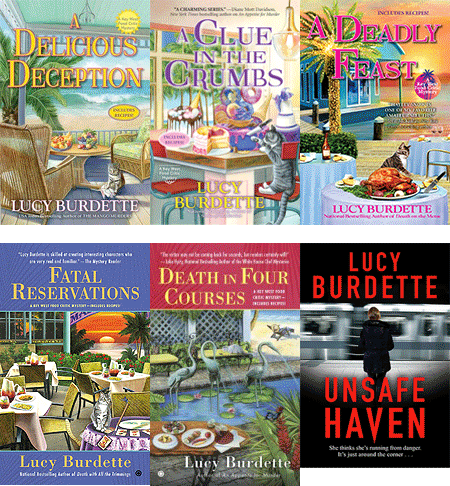
LUCY BURDETTE: Last month I participated in a mini National November Write More exercise with several of our darling Reds and friends. The idea of Nanowrimo is to write 50,000 words over the month. 50,000! We weren't going for that, we were trying to move ahead with our projects and support each other. At the beginning, we posted our personal goals for word count for each day, working in some leeway for weekends, Thanksgiving, trips, laziness, writer’s block…. (Except sharing goals was supposed to defeat writers block.) 

And we posted results most days in a Facebook group, the idea being that being held accountable would keep us writing, and that the group would provide cheerleading. I shot for 1000 words a day, most days. The first day I eked out only 200, and I really wrestled about whether to lie. Honestly, I was very close to fibbing to my dear friends. But I was also interested to be reminded about the quirks of my own writing process. Here's an example: I am much faster and more productive when I’m writing scenes at the end of a book. Put me in the middle, and I am a disaster! Everything sounds boring. And if it's boring to me, I know it will be boring to you. Maybe I have to learn to write endings only...

Reds, tell us about a quirk of your writing and how you get past the problem, if you know how it happens. 

HANK PHILLIPPI RYAN: Working working working working..I missed my 32,000 words (cumulative total for last week) goal yesterday by 50 words. Dumb, but at that point I couldn't even think of 50 bad words, let alone good ones. 

The 1000 words a day goal is really successful--because it's a doable thing. BUT. I'm still telling myself I only have to do 540 words a day, and when I reach that, I push myself to 1000. It's seems to work for me to have a two-tiered goal. So the first one is definitely doable. And I feel so virtuous. Then I press on if I can. If I fail to get 1000, I haven't failed--because I made the first goal!  So ridiculous how I have to trick myself. EVERY day.

And it really helps to look at the manuscript every day. Even on a day when for some reason I can't write, I still--as I explain to Jonathan--have to say goodnight to the book.  Wallace Stegner has a great quote: "You have to at least give the muse a CHANCE to visit."  I think of that all the time.

INGRID THOFT: Hank, I love the idea of setting two goals for
yourself.  I can be rigid about word count, and then find myself frustrated even if I did make some progress.  Your two-tiered goal sounds like a great way to make progress and feel good about that progress, even if you don't hit the ideal every day.  Like Hallie, I have some of my best ideas in the murky space between being asleep and being awake.  I always have pen and paper by the bed to catch those ideas, which hopefully, make some sense when I’m fully conscious!  And NaNoWriMo?  Nope.  Never.  That sort of deadline adds unnecessary stress to the process, but my hats off to anyone who participates!


HANK: Yeah, Ingrid. Might as well succeed! 

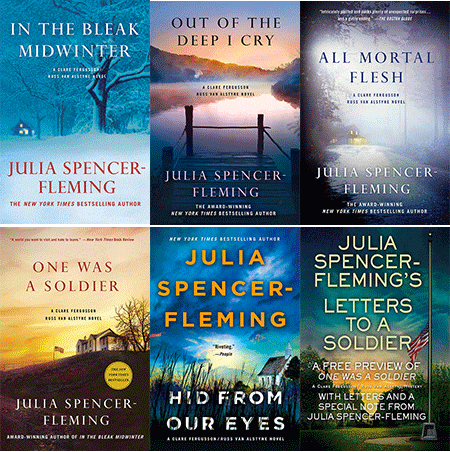
JULIA SPENCER-FLEMING: Excellent advice, Hank. I was supposed to be doing the NaNoWriMo and got about three days in when I realized I wasn't ready to pick my ms up where I left off. I've been rereading and editing what I have to get back into the story. When I caught myself thinking it would be easier to simply start a whole new book, I realized I needed to do something different. So I'm trying a writing hack from the fabulous Jennifer Crusie: I'm going to start writing scenes I already have in mind from later in the story and worry about stitching them together later. 

My usual writing quirks? I always drink hot tea while writing. It gives me something to do with my hands when I'm thinking. Also, I find having a dog in his bed next to me is a very nice way to work (and makes me get up and go outside occasionally!)

HALLIE EPHRON: I was supposed to be doing NaNoWriMo, too, and got about one day in and realized I just can't write fast. Nope. Uh uh. No can do. I *need* to second-guess myself and go back and change, because my first impulse is rarely my best. And often my best impulse then requires that I go back and insert (or delete) to establish the foundation for whatever I wrote. I call it "iterative" but it could also be called chaotic.

I get my best ideas falling asleep and waking up in the morning. And if I have an idea, it'll fuel me through the next day. So I keep a piece of paper and pencil by the bed and try to write legibly. 

HANK: Oh, I change everything dozens and dozens and dozens of times. Just because you type it doesn't mean you have to keep it. But I find that just writing something is better than writing nothing. Then I'll think--what if it were this way? What if it were that way? Do I have enough setting here? What's the reason for this?  And often just having my brain feeling like it's editing rather than writing gives me ideas. 
But I think the point of NaNoWriMo is  NOT speed. Not speed at all.  It's forward motion.  

JENN McKINLAY: Lucy, the middle is the worst. It's where I stumble on every single book. I have no idea why but the relief when I realize I have pulled out of the middle and am cruising toward the end is like an endorphin rush for me. I don't really have any quirks, at least I don't think so. I'm just a plow horse, happy to be in the field, watching the butterflies while I put my shoulder into it and haul the rig. Sometimes the the writing is effortless and other times it's a strain, but I know if I just keep putting one word after another, the story will come.

RHYS BOWEN: Hank, my mantra is always NOTHING IS WRITTEN IN STONE. I try to be objective enough to let go of a scene that I love because it slows the action or simply doesn't move the story in the direction I want it. For me the first fifty pages are always agony. I start a new book knowing nothing, or almost nothing. I begin with, "Wouldn't it be fun if Georgie has to gate crash an important conference in Italy with Nazis?" and then I send her there and hope that good things will happen. So the first chapters are like always fraught with angst. What if this story doesn't work? What if it's not as good as the other books? Then I see a glimmer of light and by page 100 I know where I am going and then it gallops along to the end. I aim for 1500 words a day. That way I know I can finish a first draft within three months. But I make myself write those 1500 words even if I feel totally dry and I think they are the worst 1500 words ever written. Usually when I examine them the next day they are not as bad as I thought and I can polish them and forge ahead.

LUCY: Oh I am right there Rhys, in the "what if this isn't as good as the others?" stage. It IS agony!

DEBORAH CROMBIE: Oh, Rhys and Lucy, me, too!!! What if this book was a terrible idea? What if no one will like it? What if it's not anywhere near as good as the previous books???? Ack. It's amazing we ever get through that. The only way we do is to struggle on to the point where the story takes over, and you stop worrying about what other people will think...

I was an absolute failure at our Mini Nano, and it was my idea! I got off to a decent start, but then I got the flu, and then it was Thanksgiving, etc., etc., etc. But the biggest problem (other than my lack of discipline) is that I just don't write fast in the first half of a book. The closer I get to the end, the more words in a day. But I'll be back at Mini Nano word goals the 1st of January!!!!

I usually drink tea while I write, like Julia. But, Julia, how on earth do you write in bed without your back killing you? I must have my Aeron chair!

HANK: But it's math, you know? Addition addition addition.  If you just keep doing it, it will get done. And then you can fix it. 

HALLIE: Aeron chair? Going to look it up right now. If you rub it does the magic writing genie appear? 

RED READERS: Writing tips or quirks or questions?

Thursday, July 13, 2017

Which are you: By-the-book? Or Goodbye-to-the-book?

HANK PHILLIPPI RYAN: We were JUST talking about this! Quickly—I had plugged in my Kindle to an outlet on our second floor. I bought a few books. I wanted to sync the Kindle. The Kindle said: To sync, please connect to wireless. I connected to wireless.  Instantly, every fire alarm in our house went off.

What what what?  Is there a fire? I raced upstairs, then downstairs, then down to the basement. NO fire. The fire alarm is shrieking: fire fire FIRE. (It talks.)  No fire.

How do I turn off the fire alarm, I wondered. Where are the instructions?
 
What instructions?  There are no instructions. We never had instructions. Ah. Why aren’t there instructions?

Anyway, the wonderfully talented Claire Booth has the good news about that.  (Have you read her first book, THE BRANSON BEAUTY? It's terrific.)

 And, happily, she has a brand new book in her series--and she's giving a copy away to a lucky commenter! See below for how, um, instructions on how to  win  ANOTHER MAN'S GROUND.


CLAIRE BOOTH:  Life is more fun when you don’t read the instructions.

Sure, it’s resulted in some lopsided IKEA furniture and perhaps some sketchy-tasting cookies.


But it’s also results in hilarious card games that follow no rules at all and detours through fantastic neighborhoods I otherwise wouldn’t have seen. It means the quicker hookup of all manner of electronics (try a few outputs until one works and voilà! You’re all set without having to wade through pages of tiny-print manual).

Where my anti-instruction attitude serves me best, however, is with my writing. I don’t have a mapped-out plot, or a manual of character backgrounds. Now, I’m not knocking these at all. They make a lot of sense. Just not for me. I’m in awe of writers who plot out an entire book before they start it. It’s like watching an astronaut train for a year on the International Space Station. Dazzlingly impressive, but not something I’m interested in doing.

When I write, I prefer to just get started. I sit down at my computer with a beautiful blank document, and I just go for it. This definitely means that I’m not a fast writer – there’s a fair amount of staring into space and wondering what the heck happens next? This can lead to panic, but I’ve learned to live with that. Because the trade off is the surprise. Getting surprised by my characters or the sharp turns my plot takes is the best thing in the world.

And I admit, I take a great deal of satisfaction in the fact that this works for me. Take that, rigid high school English classes! Did anyone else have to “brainstorm” assignments before they were allowed to start? Remember clustering? Outlining? I remember always thinking, “What if your brain doesn’t work that way?” Now I don’t have to follow those rules. Or a lot of other instructions, either.


Now, I’m certainly not advocating for ignoring traffic signs, or the dosage directions on prescription medications, or a diagram illustrating how to hold a power saw. I’m just encouraging the selective disregard of a map during a road trip or the ten-page rule booklet that came with the new board game.

What about you? Do you read the instructions before starting something? In what kind of situation could you see yourself choosing to not read the directions?

HANK: Well, I will confess I never—EVER—read the instructions. If there are indeed instructions. I just try to figure whatever it is out. Besides, the instructions never answer the questions you really have, am I right?

(And easy answer on the power saw. Don’t use a power saw.)


What do you think, Reds and Readers?  Are you a go—by-the book? Or goodbye-the-book?

And a copy of Claire's brand new ANOTHER MAN'S GROUND to one lucky commenter!

Claire Booth spent more than a decade as a journalist, much of it covering crimes so strange and convoluted they seemed more like fiction than reality. Eventually, she had enough of the real world and decided to write novels instead. Her Sheriff Hank Worth mysteries take place in Branson, Missouri, where small-town politics and big-city country music tourism clash in – yes – strange and convoluted ways. www.clairebooth.com.


ANOTHER MAN'S GROUND
It starts out as an interesting little theft case. Branson, Missouri’s new Sheriff Hank Worth is called out to look at stands of trees that have been stripped of their bark, which the property owner had planned to harvest for the booming herbal supplement market. At first, Hank easily balances the demands of the investigation with his fledging political career. He was appointed several months earlier to the vacant sheriff position, but he needs to win the fast-approaching election in order to keep his job. He thinks the campaign will go well, as long as he’s able to keep secret the fact that a group of undocumented immigrants – hired to cut down the stripped trees – have fled into the forest and he’s deliberately not looking for them.
But then the discovery of a murder victim deep in the Ozark backwoods sets him in the middle of a generations-old feud that explodes into danger not only for him, but also for the immigrants, his deputies, and his family. He must rush to find a murderer before election day and protect the vulnerable in Branson County, where politicking is hell and trespassing can get you killed.

Friday, May 12, 2017

What's Your (Creative) Type?

HANK PHILLIPPI RYAN:  How did you think of that? Where did that idea come from? How often have we wondered about that or been asked that? How often have we tried to untangle and understand our own thought processes? How do the successful people do it?

Those of us who do something creative—writing, or painting, or music, whatever it is—why are we the ones who feel compelled to do so?  If we understood our own creativity, could we-- be better at it?

The brilliant Meta Wagner has thought about this—not only for herself, but for all of us. And because we all love to take quizzes (and believe the answers,) she studied the human mind, and created a structure of “creative types.” 

And she suggests, in her fascinating new book WHAT’S YOUR CREATIVE TYPE? we all fit into one of them. All we have to do is take her quiz to find out which one! (And then get her book to find out what it means--and how it can help!)

Which one are you? Turns out I’m a—well, first, let’s hear more from Meta.  

HANK: Can you remember a time when you were completely engrossed in a creative activity as a child? How has that memory shaped you as a writer?

MetaWagner: When I was a kid, I’d wake up on Sunday mornings way earlier than my parents or my sister. Still in my PJs, I’d sit on my bedroom floor and write little poems and stories during those hours of solitude and put them in a shoebox that I kept in a secret hiding place. I don’t really know why I felt the need for such secrecy! There was something about the early morning quiet that allowed me to just be in the moment, without anything else to do. It was pure.

It’s harder for me to find that pure experience now. But I think where I come closest is when I’m on deadline and there’s no time for distractions – I’m focused and there are just my ideas and my words and my desire to make the writing sharp, mostly for my own satisfaction.

Hank: You’ve developed the concept of the five creative types. How did you come up with it, and what are the types?

Meta: I teach a class at Emerson College that asks the question, “Why do people create?” I looked into hundreds of famous creators in all the arts, from Ernest Hemingway to Meryl Streep to Lin-Manuel Miranda, and I discovered that they have such a clear understanding of their reasons for doing creative work. At the same time, I, personally, kept coming up with new book ideas that I’d be really excited about but then abandon out of fear or doubts. Sound familiar to anyone?

I wondered, what if we all could become motivated like the masters? And so I grouped their motivations into five categories and translated those into creative types: A-Lister, Artisan, Game Changer, Sensitive Soul, and Activist. Once people identify their type and become aware of their strongest motivations, they can return to these motivations anytime they have trouble getting started or breaking through creative blocks.

Hank: In honor of Mother’s Day, what advice to you have for moms who want to write or paint or do anything creative but can’t seem to find the time?

Meta: If you’re a mom who’s pulled in multiple directions with barely a moment for yourself, creativity might seem like a low priority or a luxury you can’t afford. But, I believe if the creative urge is strong in you, you’ll find a way.

Creative expression is also important—study after study shows that it’s good for your mental health! Maybe you could spend ten minutes a day doing creative writing exercises or plotting your novel. Maybe once a month you could go to a reading at a bookstore to get inspired. And, then, as your kids get older, you might finally have the time to write the novel you’ve been “training” for all these years.

Jungle Reds, tell us why writing (or any creative activity) is so important to you? What are your motivations for doing it?

HANK: And as it turns out—my quiz results were very different from what I predicted! Whoa. Now I have to see what that means.  And Reds and readers--what's your type?

To figure out your creative type, take this fun quiz and post the results  in the comments--and on Facebook and Twitter if you’d like! http://snapp.to/2lHVOEY
And read more about the book and Meta below!


How do the world’s greatest creators produce such amazing works despite experiencing the same doubts and fears as the rest of us? What’s Your Creative Type? cracks the code, revealing that legendary artists don’t just possess talent, they also understand their motivations for creating. Whether you write, paint, film, act, dance, develop software, or even play the ukulele as a hobby or a profession, What’s Your Creative Type? can teach you to identify your creative type (A-Lister, Artisan, Game Changer, Sensitive Soul, or Activist) and discover your motivations so you can break through blocks to finally fulfill your creative potential.
 
Meta Wagner is the author of What's Your Creative Type (Seal Press). She is a contributor to Boston Globe opinion pages, was a columnist for PopMatters, and has written for Huffington Post, Chicago Tribune, Salon, and Wall Street Journal custom studios. She was also a 2017 TedxBU speaker. Meta teaches creative and communications writing at Emerson College and Boston University and also teaches a seminar on creativity that served as the basis for her book. Her background is in public relations and marketing. To connect with Meta, visit www.metawagner.com.