Showing posts with label memories. Show all posts

Sunday, November 2, 2025

The Fish Bowl by Heather Webber

JENN McKINLAY: I'm thrilled to have a long time friend Heather Webber join us today to talk about her latest book THE FORGET-ME-NOT LIBRARY. I've been a fan of Heather's work forever and particularly enjoy her magical realism novels, with her latest being particularly poignant. Here she is to tell us more about what inspired her.

HEATHER WEBBER:

On a shelf in my office sits a fish bowl.

It doesn’t contain fish.

It holds memories.


I’ve been dealing with memory issues for a long time now. Most of my childhood memories are gone, with only a handful remaining. My teen years are slipping away as well. All my medical tests are fine, so I figure my brain can only hold so much. If something new comes in, something has to go out. Decluttering at its worst.

Fortunately, every once in a while, a long-lost memory returns to me, sparked by a song, a scent, a photo, a dream, a conversation.

I consider those memories as gifts.

Treasures, really.

The warm, wonderful feeling that comes with a returned memory is what inspired the idea for The Forget-Me-Not Library, my newest novel, due to be released this week. The story takes place in a small Alabama library where long-forgotten, treasured memories are hidden within the books. Memories that bring about peace and comfort and happiness.

Oh, how I wish it were a real place.

I’m doing everything I can to hold on to the memories I’ve been able to keep, which is where the fish bowl comes in. It holds mementos that I’ve been collecting for the past thirty years or so. Bits of my life that have been important to me for one reason or another.

Along with many other things, in that bowl are the first library cards of my children (who are now in their 30s!). The kids were each five years old when they signed up for their cards and had to print their names on them. Seeing those cards with those carefully-crafted, shaky letters always brings a smile and helps me to remember how excited they were to check out as many books as their tiny arms could hold.

Definitely memories to treasure.

Do you have a way of holding on to memories? Or recall your first trip to a library? I’d love to hear about it. One commenter will win a copy of The Forget-Me-Not Library.

ORDER NOW

A detour. A chance encounter. Two women who alter the pages of each other’s story.


Juliet Nightingale is lucky to be alive. Months after a freak accident involving lightning, she’s fully recovered but is left feeling that something is missing from her life. Something big. Impulsively, she decides to take a solo summer road trip, hoping that the journey will lead her down a path that will help her discover exactly what it is that she’s searching for.


Newly single mom Tallulah Byrd Mayfield is hanging by a thread after her neat, tidy world was completely undone when her husband decided that their marriage was over. In the aftermath of the breakup, she and her two daughters move in with her eighty-year-old grandfather. Tallulah starts a new job at the Forget-Me-Not Library, where old, treasured memories can be found within the books―and where Lu must learn to adapt to the many changes thrown her way.


When a road detour leads Juliet to Forget-Me-Not, Alabama, and straight into Tallulah’s life, the two women soon discover there’s magic in between the pages of where you’ve been and where you still need to go. And that happiness, even when lost, can always be found again.


HEATHER WEBBER is a national bestselling author known for crafting stories that celebrate the power of family, friendship, and community. Her novels, including Midnight at the Blackbird Café and At the Coffee Shop of Curiosities offer comforting tales of love, hope, and personal redemption. Heather loves to spend time with her family, read, drink too much coffee and tea, bird-watch, crochet, and bake. She currently resides in southwest Ohio.


Saturday, October 31, 2015

Tell Us One Wonderful Thing!

HANK PHILLIPPI RYAN: It’s been a rollercoaster week for the Reds. Each us of us has had wonderfully amazing things happen—and had deep sorrows and losses and illness. And that is life, I guess, and I am so honored to be part of this dear Reds family. And a big question for you coming up below.

My week? Along with my ridiculous cold and pre-event hideous allergy attack (but all fine and show went on just swell, thanks to  goodness and allergy pills) WHAT YOU SEE is getting AMAZING reviews: “superb,” says Oline Cogdill,  “Flawlessly done” says Aunt Agatha’s Bookstore, “With echoes of Dennis Lehane at his level best,” says the Providence Journal, and “Drop everything and pick up this book!" says Associated Press. (You can do that here.)

So I am on the road, and HAPPY and crazed. Audiences at my signings are FABULOUS and I am so grateful. (Sunday at Book Carnival in Orange County, and Tuesday at Poisoned Pen! See you there?) 


Thursday I headlined with Tess Gerritsen and BA Shapiro.


 Lookit the crowd!


 And last night Susan and I had a signing together at Jabberwocky Books in Newburyport! It was fantastic.


(We seem to employ similar gestures. Love that!) And it was an amazing night. Thank you, owner Sue Little! And the terrific Connie Hambley and Donald Bain's daughter Laurie were in the house!

But here’s one thing I could not have predicted.  This was the signing in Indianapolis.

See the woman in the front row, in kind of the middle, in a gray jacket with a scarf? That is my High School home ec teacher! In 1966!  Mrs. Teeter came to my event at the Carmel Library, and joined about 65 others to celebrate WHAT YOU SEE.  But I celebrate Mrs. Teeter. She must be what, 90 now? And she remembered me totally. Aw.

I said to her—I loved home ec! But, I confessed, I can tell you now, fifty years later, I did not really enjoy the baked bean burgers you taught us to make. Nor was I a big fan of your tuna pizza.

She allowed as how they weren’t her favorites either.

But you taught me how to sew! I cried. And really, almost cried.

And  then I remembered my skirt. We had to make skirts, and Mrs. Teeter had told us a gathered skirt was the easiest.

So I decided to do pleats. Of course.

She also warned us not to choose a fabric that was plaid, or had any kind of one-way-only design, because it was really difficult to match the seams.

 HA! I thought. No problemo.

Problemo! Mrs. Teeter and I reminisced about the skirt I made, which was beautiful, and the pleats actually worked, EXCEPT the one-way pattern (which included little fringe) was right side up on the front, but wrong side upon the back.  Sigh. Can you imagine? Don't, actually.

I will never forget that, and from the look on her face, she hadn’t forgotten either! I guess I was a lesson for her future classes.

But how sweet is that moment? And how amazing of her to come.
  
So let’s focus on the great things, the sweet things, the memorable things.

What wonderful thing—one wonderful thing!—happened to you this week?


Sunday, November 18, 2012

A Time of Inocence, A Time of Confidences


HANK PHILLIPPI RYAN: If you play bridge, you know James Montgomery Jackson--he's an expert who's written an acclaimed book about the game. If you're a Guppy, you know James Montgomery Jackson--he's the Guppy Website liaison.       If you like mystery authors, you'll soon know James Montgomery Jackson--his BAD POLICY (which is really really good) will be out in early 2013.

But right now Jim is handling another part of his life.  And he has a question for you. About

MEMORIES AND THINGS 
    by Jim Jackson
    
My father passed away mid-September. He had a good life spanning 87+years. I’m thankful that as deaths go, his was not too bad. He left us our memories and his stuff. I’ve been helping my mother understand her changed finances and figuring out what to do with Dad’s possessions.

 Some things were easy: Clothes went to a men’s shelter; scores of railroad books went to the local railway historical society. Since I have the room, the family history and genealogy records came to me for safe keeping.

What my father chose to keep had twice gone through a winnowing process. My parents had already downsized, first moving from the house my sisters and I grew up in to a smaller condo. More recently they moved to a two-bedroom independent-living apartment. The hundreds and hundreds of books Dad owned were reduced to those he was using for research on a book about the Erie Railroad he had recently finished, a rotating group of new acquisitions, reference books and those with family history attached. In recent years Dad sold some of his collections on eBay, converting former passions and memories to cash.

 Sometimes it takes me three blows to the head before something sinks in.

The process of sifting through Dad’s stuff got me thinking (third whack) about what each of us values as evidenced by what we keep. This is personally tough for me (and why I need multiple wake-up calls). 

I come from good New England stock—you know, the kind of people who build an addition to the family barn to store the current generation’s excess. Our two rules to live by are “never invade the principal,” (i.e. live off the interest and dividends, not the principal), and “don’t throw anything out because you never know when you’ll need it.”

In 1993 I had to move to Cincinnati for a new job before my house in New Jersey sold. I moved only a few things: kitchen necessities, a table and chairs, a reel-to-reel tape player for music, a bookcase with favorite books and a sleeping pad and bag. For exercise I brought my road bike. I was very happy for the year I lived that minimalist living style. But as soon as my house sold, I bought a large Victorian near the University and brought everything I owned from New Jersey. I even had room for more stuff.
 
My protagonist in Bad Policy (Barking Rain Press, 3/1/2013 publication), Seamus McCree, is a financial guy. Although he grew up in Boston, he was common-man Southie, not blue-blood Brahmin. He recognizes that not invading the principal is an artificial constraint only the very rich can afford. However, he has not faced the necessity of downsizing, so when his Cincinnati house is partially destroyed he loses all his possessions. The bad guys were responsible in his case, but the how and why don’t really matter. Thousands just lost their homes due to Hurricane Sandy, and thousands before have lost theirs to other hurricanes or tornadoes or floods.

As an author, what interests me is how each individual responds to his personal disaster. What do they most miss?

I had a boss whose house burned to the ground. He told me he most regretted losing his family pictures. That resonates with me. Pictures are triggers to my memory. With them I can recall vast swaths of my life; without them, I remember very little. I do not claim this as a virtue; in fact I see it as a flaw that I need pictures as a crutch. I shared my flaw with Seamus.

Today it appears that many, many Americans are like my New England ancestors: unwilling to dispose of any possession, regardless of its current usefulness. Off-site storage areas have sprouted throughout the country like mushrooms the year after loggers clear-cut a hardwood forest. Our American creed is apparently that rather than make a decision about what possessions we can pass on to new owners to appreciate, we’ll pay monthly fees to store our excesses. Most of what we store we do not really value. Our children hope we dispose of them before we die.

What interests me is which possessions we most want to hold on to and why we make the choices we do. I have the hardest time throwing away any book—even those I think are poorly written and boring. Only after I retired did I pitch most of my college text books.

Yet, like my boss of thirty years ago and my protagonist Seamus McCree, I would gladly give up every book I own for access to my pictures.

With digitizing and cloud storage, I should be able to safeguard those memories—but I have left them at risk. As I write this I am feeling the vibrations of the bell tolling in my head for the third time. When I quiet the ringing, I sing to myself Paul Simon’s song, “Old Friends” from the Bookends album. The closing stanza reads:

Time it was and what a time it was, it was
A time of innocence, a time of confidences.
Long ago, it must be, I have a photograph.
Preserve your memories.
They’re all that’s left you.

We’ve all probably played around with those hypothetical questions about which books (songs, historical people, whatever) you would take with you to the mythical island where you’ll be isolated until rescue. Instead, fast forward your life to when you are (say) 93 and have to live in a single room. What do you choose to keep with you? What are you doing to protect that now?

For me it’s photographs, and I’ve set myself the task to digitize and secure them as quickly as I can.

Sunday, December 23, 2007

ON HOLIDAY MEMORIES


Someday soon, we all will be together,

If the fates allow

Hang your brightest star above the highest bough..

HANK: I'm a sap. And I embrace it. That song always make me teary, and it's not only because I'm often wrapping presents on Christmas Eve. My pals know to expect New Years cards. It's not because I'm Jewish, it's more because I'm behind.

At the urging of my siblings and me, my family actually celebrated every holiday you could get presents for. My mom drew the line at live Easter chicks, as any wise mom would do. But otherwise, we attempted to cash in at every opportunity.

One year, though, when I had just turned 16, my mom drew the line. We're Jewish, she said. No more Christmas trees. Which seems logical now, but didn't, then. My sibs were 14, 10, 9 and 8. And I knew they wanted a tree.

I had just gotten my driver's license, so The Night Before Not-Christmas, my sister Nina and I said we were going to the movies. We took the car, and we did go to the movies. But just to the concession stand. We got popcorn. Then we went to the grocery, the A and P, and got cranberries. And we also purchased the last of the scrawny old Christmas trees, not even good enough to be a Charlie Brown tree.

We hid the tree behind our barn, then scurried upstairs with our popcorn and cranberries, and stayed up for hours stringing them. (Is there a trick to this, by the way? The cranberries got very mushy.)

Then late late late, we sneaked outside and brought in the tree. Everyone else was, um, snug in their beds. We set it up, and decorated it, and put the presents underneath it. (Oh yeah, we still had presents. It was just the tree that was prohibited. Go figure.) Anyway, all finished, we scampered back upstairs.

The next morning--we got up early early as usual, and hid in the living room. It worked perfectly. We got to see the shocked and surprised looks on our parents faces. "Santa came!" Mom said. (And I guess that's how they felt when they saw our faces as little kids.) And to this day we still remember "the year without the tree."

Memories, anyone?

RO: My gosh, that sounds wonderful. Christmas Eve was always the big celebration in my family - the day itself was anti-climactic. On Christmas Eve we'd all gather at Grandma's house - my mother was one of eight, so I have a zillion cousins, and yes, being Italian, most of the males are named Anthony, or some version.

(It's even more complicated now that one cousin Pam, whose father was Anthony, and who has a sister named Toni, has married a Tony, and they have a son named Anthony. Another cousin Anthony had a son named Anthony and he married a Pam.)
Anyway my grandmother would make an antipasto that was a work of art, and god help you if you picked at anything before everyone saw it. She also prepared seven different types of fish, it's a Neapolitan thing, including bacala, which we kids never touched.


My mother would make zeppole and struffoli, two of the most fattening things on the planet. It was an orgy of eating.


There was always one aunt who gave great presents, and another who gave us all the same thing - usually a boring, practical gift like an umbrella, which is the last thing you want when you're seven - so after the first cousin opened his gift, we all knew what we got, and had to fake being excited. Other than that, it was big fun...and I still make struffoli.

So did you have an official tree the next year?

HANK: You know, I think we didn't. I was a senior in high school, then, way too cool for such things. Nina was probably on a date. The other kinds were older. And way too knowledgeable for such things. As will happen. Which makes it all the sweeter. I'm off to look up struffoli.

ROBERTA: Oh my gosh, I wish I'd been at Ro's house for Christmas Eve! Especially that antipasto! I can't even remember what we ate CE, because my mother was busy shopping for stocking stuffers. We were all crazy for stockings. She'd go out the day before Christmas to Two Guys, a discount store that must have been insanely busy, just to be sure each stocking was crammed to the top. My aunt had knitted all of us a two-footer with our names on it, plus Santa's head with an actual fuzzy white beard, leaping reindeer, and so on. It's hanging up by the chimney with care right now!

JAN: Once I heard about the seven fish dinner, I wanted to be Italian. The half-Polish, half-Irish thing didn't many Christmas rituals, except that we always had to have Kielbasa and horse radish on little rye breads for every holiday. (Luckily, the horrible Irish food was reserved for St. Patrick's Day.) Probably my best Christmas memory is just after college. My room-mate Beth was Jewish, with limited Christmas experience, so I got this inspiration to fill a stocking full of little presents for her. She was so tickled by this that the next year, she handknitted me a stocking with my name on it.I still hang that stocking by the chimney and for years, Beth and I exchanged stocking stuffers for Christmas. Once we had kids, we made Christmas ornaments together. We still have them and put them up on the tree.

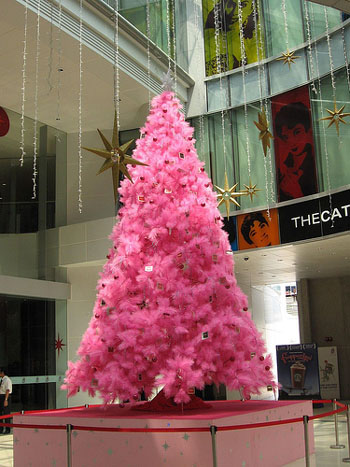
HALLIE: The thing I remember most fondly about Christmas, growing up in Los Angeles, was the night BEFORE the night before Christmas, going out to bag a tree. Every year, my mother would beg my father to bring home a small tree, just about this tall (her size). We'd pile into the family wagon and cruise through Westwood and Santa Monica where, on vacant street corner lots (there were such things back in the olden days), the tree vendors would be set up for the season. We'd hold our noses at the pink Christmas trees, the silver ones, and the ones laden with fake snow (did the rest of the world have those back then?). Invariably we'd be drawn to the monster trees (what was usually left by that late date) and my father would haggle and we'd all have to squeeze in the front seat for the drive home because the tree would take up the whole back of the wagon, filling the car with that lovely pine smell. And when we got home my mother got her person-sized tree, because that was about the size of the top my father had to cut off to get the thing into the house.


HANK: Yes, decorating the tree is another whole blog. There was the year Mom wanted all red bows. Then we'd all sneak on our favorite ornaments, just one, and eventually the red bows were overtaken by the family treasures.

So--how about you? Traditions and memories? Did you put out milk and cookies? Read The Night Before Christmas? Hang stockings? Make struffoli?