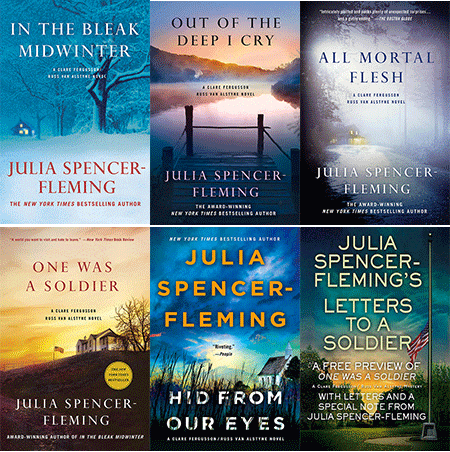
JULIA SPENCER-FLEMING: I owe my discovery of Thomas Pluck to my husband. I was  at the bar at last year's Albany Bouchercon when Ross came up with a tote bag full of novels from the book room. "Look at this," he said, thrusting BLADE OF DISHONOR into my hand. "This has got to be the best book ever."
"What's it about?" I asked.
"Who cares? Look at that cover!" Ladies and gentlemen, behold the power of connecting the right cover to the right audience. As it turned out, BLADE OF DISHONOR was a terrifically fun read; pulpy, page-turning and action-packed. Thomas Pluck is going to tell us how he put together the pieces to create the book he wanted to read.
at the bar at last year's Albany Bouchercon when Ross came up with a tote bag full of novels from the book room. "Look at this," he said, thrusting BLADE OF DISHONOR into my hand. "This has got to be the best book ever."
"What's it about?" I asked.
"Who cares? Look at that cover!" Ladies and gentlemen, behold the power of connecting the right cover to the right audience. As it turned out, BLADE OF DISHONOR was a terrifically fun read; pulpy, page-turning and action-packed. Thomas Pluck is going to tell us how he put together the pieces to create the book he wanted to read.
Of all the writing advice
out there, my favorite is "Write the book you want to read."
When writing BLADE OF DISHONOR, I took this to heart.
Growing up in the late '70s,
I was bombarded by over the top pulp, adventure, and exploitation
films, my favorite of which is Raiders of the Lost Ark. It has
crazy action, a brisk storyline that moves so fast we never have time
to question it, and it introduces us to rich characters we want to
see again and again. It continues to make us think today. For
example, did Indiana Jones actually have to do anything, when the Ark
would kill the Nazis all along? (more on that later).
When Beat to a Pulp's David
Cranmer came to me with the idea of an MMA fighter named Reeves
fighting ninjas over a legendary sword, I dived into research. When I
learned that perhaps the most legendary of all Japanese swords, the
Honjo Masamune, disappeared at the end of World War II, I had my story. Masamune was the most famed swordmaker throughout Japanese
history, and that particular sword was handed down among the Shoguns
of the Tokugawa family. Shrouded in rumor, its last appearance had it
with an American soldier, confiscated during the occupation. And then
it vanished.
ninjas over a legendary sword, I dived into research. When I
learned that perhaps the most legendary of all Japanese swords, the
Honjo Masamune, disappeared at the end of World War II, I had my story. Masamune was the most famed swordmaker throughout Japanese
history, and that particular sword was handed down among the Shoguns
of the Tokugawa family. Shrouded in rumor, its last appearance had it
with an American soldier, confiscated during the occupation. And then
it vanished.
Where would such a sword go
and not be found? Collectors are notorious braggarts, so if it was
sold into a collection, it would be shown enough that eventually
someone would blab. What if it were disguised as a simple officer's
sword, the common trophy of American soldiers who fought in the
Pacific? It could be right under our noses in Grandpa's attic… now
I needed a grandfather to give the sword to, and a reason to protect
it. Grandpa Butch practically wrote himself. I internalized a lot of
grumpy old WWII vet personality from my great-uncles, and I dedicated
the book to them. The story fell into place. Reeves would learn that
Grandpa Butch had that legendary sword, sworn defend it from a clan
of ninja and Yakuza who wanted it for their own nefarious ends.
 I grew up surrounded by
great-uncles who all served in World War II. I wanted to write an
adventure tale that would tell a realistic and human story, to share
their experiences in the war. I've been to Tokyo, where I filmed my
friend Peter's first shooto fight, and I trained at a dojo and fell
in love with the city's constant flow of energy. But I also saw
Nationalists blaring messages from their black vans, wanting to
recapture the greatness their Empire had before the war. The locals
don't take the Nationalists (uyoku dantai) seriously, but the
groups have become more intertwined with the Yakuza, and the more I
read, the more they reminded me of that staple villain of '40s pulps:
The Black Dragon Society.
I grew up surrounded by
great-uncles who all served in World War II. I wanted to write an
adventure tale that would tell a realistic and human story, to share
their experiences in the war. I've been to Tokyo, where I filmed my
friend Peter's first shooto fight, and I trained at a dojo and fell
in love with the city's constant flow of energy. But I also saw
Nationalists blaring messages from their black vans, wanting to
recapture the greatness their Empire had before the war. The locals
don't take the Nationalists (uyoku dantai) seriously, but the
groups have become more intertwined with the Yakuza, and the more I
read, the more they reminded me of that staple villain of '40s pulps:
The Black Dragon Society.
The
Black Dragons are based in reality, and were a quasi-governmental
group of spies who infiltrated Korea and China prior to the invasion,
and believed that Japan was destined to rule Asia. And what better
symbol to rise back into power than the sword of the Tokugawa
Shogunate? The name alone conjures images of a shadowy martial arts
organization dedicated to evil, the perfect bad guys for martial arts
adventure films and pulp paperbacks such as The Destroyer and The Rat
Bastards. Those super fast reads with cartoon villains and ridiculous
plots that throw us right into the action.
 The books are often guilty
pleasures, because they were written to be a quick read, not to be
lasting. But we readers ate them up anyway. I wanted to combine the
sense of fast-paced fun those novels gave me, but deliver memorable
characters and write fight scenes that my trainers and fellow
fighters would enjoy and find believable, that were still exciting
for folks who don't watch boxing, much less get in the ring
themselves. Having trained in Kachin Bando, a martial art developed
by the Kachin tribesmen of Burma, I was lucky enough to have a fight
gym full of enthusiastic fellow wackos who were happy to choreograph
fights with me, and a teacher- Phil Dunlap- who was glad to answer
questions like "what's the fastest way to break someone's
clavicle?"
The books are often guilty
pleasures, because they were written to be a quick read, not to be
lasting. But we readers ate them up anyway. I wanted to combine the
sense of fast-paced fun those novels gave me, but deliver memorable
characters and write fight scenes that my trainers and fellow
fighters would enjoy and find believable, that were still exciting
for folks who don't watch boxing, much less get in the ring
themselves. Having trained in Kachin Bando, a martial art developed
by the Kachin tribesmen of Burma, I was lucky enough to have a fight
gym full of enthusiastic fellow wackos who were happy to choreograph
fights with me, and a teacher- Phil Dunlap- who was glad to answer
questions like "what's the fastest way to break someone's
clavicle?"
Another
thing that those guilty pleasure pulp paperbacks often lack is strong
female characters. And by that I mean characters who matter to the
story, have their own designs and desires, and aren't puppies
following the main character around. Between Tara the hot-rodding
ambulance driver and Jean-Marie Dundee the Montana rancher whose land
abuts the training grounds of the Devil's Brigade, the 1st Special
Service Force of commandos from the U.S. and Canada, I had that
covered. And in Japan we've got Yumi the journalist in deep cover,
and Oki the deadly commando assassin…
So when MysteryPeople called
Blade of Dishonor  "the Raiders of the Lost Ark of pulp
paperbacks," I do declare, I felt I might be overcome with the
vapours. The book accomplished what I wanted it to do. And when one
of my literary heroes, Andrew Vachss said, "You want interwoven
plots running parallel between WWII and Right Now? You want violence
mixed with romance? You want sacrifice, courage, and honor?
Truth-based fable? Or maybe you just want hardcore-clean writing
delivered at warp speed. Look no further—it’s all here," I
did in fact faint and my wife had to revive me with smelling salts
and a smack upside the head, because she's from Louisiana, and says
that we Yankees can't really get "the vapours."
"the Raiders of the Lost Ark of pulp
paperbacks," I do declare, I felt I might be overcome with the
vapours. The book accomplished what I wanted it to do. And when one
of my literary heroes, Andrew Vachss said, "You want interwoven
plots running parallel between WWII and Right Now? You want violence
mixed with romance? You want sacrifice, courage, and honor?
Truth-based fable? Or maybe you just want hardcore-clean writing
delivered at warp speed. Look no further—it’s all here," I
did in fact faint and my wife had to revive me with smelling salts
and a smack upside the head, because she's from Louisiana, and says
that we Yankees can't really get "the vapours."
Personally, I think any
writer can get the vapours. And as for Indiana Jones, Spoiler Alert!
If he hadn't been there when the Ark did its melty-face lightning
show, it would have fallen into Nazi hands again, instead of being
secreted away to the famous vault at the end. Or the Allies would
have tried to use it, and maybe Ike would have been a pool of melted
Ike-cream.
So there!
In penance for that awful
pun, I'm giving away one digital copy of Blade of Dishonor to a lucky
commenter. What's your favorite adventure story?
Thomas Pluck writes unflinching
fiction with heart. He lives in New Jersey with his wife and two
cats, where he powerlifts and trains in mixed-martial arts. He's a
computer geek now, but has worked on the docks, at construction
sites, and has flipped burgers, washed dishes, and even cleaned the
bathrooms of the Guggenheim museum. His work has appeared in The
Utne Reader, [PANK] Magazine, Needle: A Magazine of Noir, Criminal
Element, and numerous anthologies. He is also the editor of
Protectors:
Stories to Benefit PROTECT,
which includes "Runaway" by Dave White, which was chosen as
a distinguished story in Best American Mystery Stories 2013. You can
find him on the web at www.thomaspluck.com and Twitter as
@thomaspluck