HALLIE EPHRON: At a recent mystery conference, a very well-liked guy who writes bestselling thrillers was asked to talk about writing in the voice of the “other” - he’d written at least one book with a woman main character/narrator. The moderator asked what kind of work he’d done (or thought one had to do) in order to get that character's (female) perspective right.
 He said he’d talked to women friends, especially focusing on areas that were a mystery to him: how women put on makeup and get dressed.
I think he was joking. But it took me back to one of my first books in which the main character was a man. Every time someone had an issue with him, he apologized his way out of it. That’s what *I* do.
I cringe now at how little I thought I needed to do to realistically conjure a male viewpoint. In particular, how would he feel/think and what would he do if his authority were questioned by a man? By a woman? In private? In public? How would he feel walking through into a park at night and hearing rustling in the bushes? And so on…
So my question: What’s your advice to male writers trying to get it right, writing in a woman’s voice, allowing from the outset that “a woman’s voice” varies so much from individual to individual. Still… what questions would you think they’d want to ask?
RHYS BOWEN: My first series, The Constable Evans novels, featured a male protagonist. I made every effort to put myself into Evan’s head, and would run the book by my husband who would sometimes say “No man would ever say that.” This made me retort, on occasion, “You forget, Evan is a sensitive man, unlike you.”
 But I believe that women understand men much better than men understand women. This is because our nature compels us to make connections, show empathy, help other people with their problems. We all know too well that a man can be rude to a woman and if she responds with anger he’ll immediately say she is moody because of the ‘time of the month’. So advice I’d give to any male writer, writing in a woman’s point of view, is to run the manuscript by several women and take their comments to heart. We probably do more internal agonizing than men do. We are more observant of the emotions of others. We pick up small signals that men don’t. And most of us care little about lipstick and make-up.
LUCY BURDETTE: I’ve yet to have a published novel with a male lead character, though I’ve done my best to show male characters truthfully and realistically. I realized when struggling with a book that had multiple POV that I tended to make the default reaction from a man angry. I’m sure this isn’t accurate or fair!
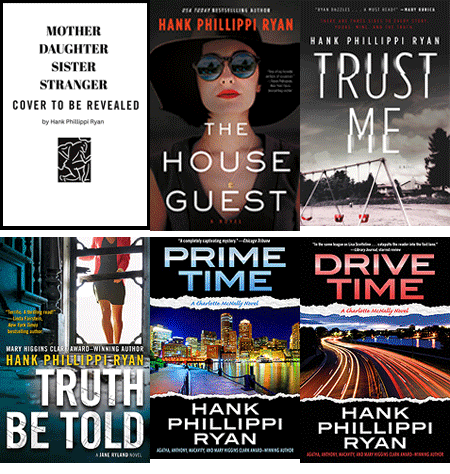
 HANK PHILLIPPI RYAN: Oh, gosh, I don’t think about that. I don’t. .I think about what does this person want, and who are they--a cop or a teacher or a banker?--and what do they know and what would they really do. I suppose..if I had to list one difference, I would say it’s how men and women are different in listing specifics. A woman might say: an ivory chiffon Vera Wang tea-length cocktail dress and a man might say--a white dress. But see how that would still depend? It’s the individual, not the gender.
Advice? AH, well, through a woman’s eyes--is that even a thing? Huh. There are experiences that women have that men don’t, and I guess that’s what he meant by makeup--if you don’t wear mascara, you wouldn't know what it felt like to get a clump of it in your eye just as you finish your whole face and the whole thing is ruined. Or how uncomfortable tights can be (or not) or how it feels to think: why do I have to be the one to decide what’s for dinner?
Stll. I think it’s about the individual character. So I’d say--ask what the woman wants--and WHY.
JULIA SPENCER-FLEMING: I’ve written nine books with pretty much equally split male and female POVs, and can honestly say I’ve never had any character putting on make-up. Sounds like the sort of scene someone might include of the male protagonist shaving, the purpose of which is to look into his soul via the mirror. It’s just bad writing, male or female, and no one should do it.
 In fact, I suspect a lot of “men writing bad female POVs” is simply bad writing, period. She looks into a mirror and admires her abundant red hair and pert breasts - really, does any human being behave like that? Or the classic female vamp/bad girl - a one-dimensional antagonist is always a writing fail. The converse might be his buddy asks him what’s wrong and he spills his emotions for three pages. Show, don’t tell, and that includes what people are feeling.
The one huge real difference male writers need to absorb is the one Rhys and Hank already mentioned - the feeling of vulnerability every woman walks around with every day and in almost every situation.
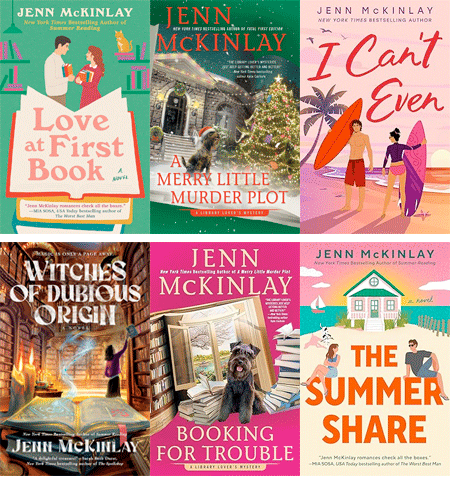
JENN McKINLAY: Oooooh, great question! I write in the male POV in most of my rom-coms. My dudes are cinnamon rolls, a comfort food, if you will. Personally, I have never understood the attraction to the alpha male. The second a man tells me what to do, our relationship is over. I’ll take the supportive, smart, funny guy in the back, please.
As for writing females if you’re a man, I think the same rule applies. You have to write a woman you understand completely, what makes her tick, what she cares about, and what pisses her off. She has to be more than a mane of hair and a cup size, this seems to be where male authors fall down judging by some of the bad writing that’s been shared on Twitter.
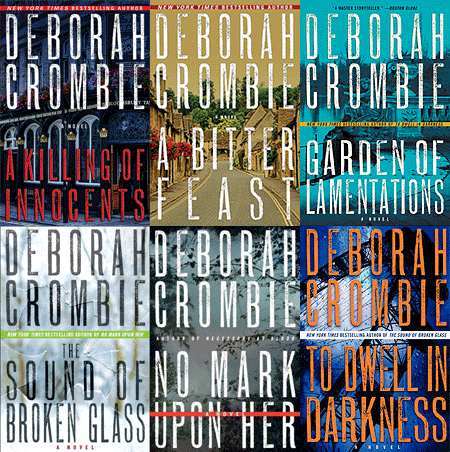
DEBORAH CROMBIE: I've written in both male and female viewpoints all through my career and honestly I've never really thought about it that much. Duncan's was the first voice I almost literally heard in my head, and it never occurred to me that there was anything odd in writing from a male viewpoint. I see as my characters as whole people, each with their own needs, likes, dislikes, and vulnerabilities. We are all so much more complicated and complex than our gender.
I do agree, though, that women have an advantage in writing from a male viewpoint, as we are wired to be observant and to pick up emotional cues from everyone around us, male or female.
DEBORAH CROMBIE: I've written in both male and female viewpoints all through my career and honestly I've never really thought about it that much. Duncan's was the first voice I almost literally heard in my head, and it never occurred to me that there was anything odd in writing from a male viewpoint. I see as my characters as whole people, each with their own needs, likes, dislikes, and vulnerabilities. We are all so much more complicated and complex than our gender.
I do agree, though, that women have an advantage in writing from a male viewpoint, as we are wired to be observant and to pick up emotional cues from everyone around us, male or female.
HALLIE: So what about you? What do you think male authors need to pay attention to when they try to write from the viewpoint of a female character?