
LUCY BURDETTE: Some of us have been having a discussion on and off about whether it's possible to write fast and well--and if it is, how to do it. So I thought it was time to have our pal Peter Andrews back, with his tips on becoming more productive as a writer. Take it away Peter!
 PETER ANDREWS: Sometimes, you have to do it your own way. My grandfather loved golf so much, he built a two-hole course on his farm. He taught me and all the other kids the basics -- how to hold the club, how to swing fluently, how to stand, etc. When I was 14, I came up with a trick that got me from tee to green in one shot every time. I lined myself up, twisted my legs, locked my knees together, and smacked the ball.
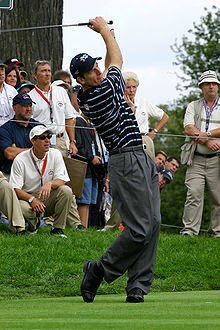 My approach looked absurd, even crazy. It did not please my grandfather, but it allowed me to beat everyone I played (including him). I did it my way, and I reached my goals.
How you write is a very personal decision, intimately related to the experience you want to have and the goals you want to reach. The “right” way for one person may be a disaster for someone else. Dictating how someone else should write? That’s crazy.
But I do share tips on how you might become a more productive writer, improve your chances of achieving your goals, and, perhaps, write more effective prose and better stories.
Being more productive means increasing your output of final copy. This isn’t the same and writing more words per minute. It’s possible to double your word count and halve your productivity if the methods you use lead to sloppiness or frustrate you at the editing stage or encourage you to take on too many projects. Or just feel wrong. (After giving a new approach a fair chance, if it hurts, stop doing it.) But, usually, if you can turn your inner editor off and compose at a faster speed, you can increase your productivity. Here are a few tips I have for doing this:
Use a timer. Starting the clock can be like firing a gun for a race. I usually set my timer for forty minutes and try to get a set amount of words in the time period. I don’t rewrite at all. I ignore misspellings. I don’t do research. And, when the best word doesn’t come to mind, I insert the word “bagel,” and clean the bagels up later.
 Don’t dither. If you have more than one project, set your goal for what you will work on the day before. I write a full sentence, e.g., “Mike will blow up the submarine.” The next day, I can write whatever else I want, but I must keep the promise to myself to write forty minutes on the work in progress, so Mike must blow up that submarine. Oh, and I must write a new sentence for the next day. “Mike must escape the cyborg sharks.”
Don’t loop. Looping is going back to rewrite (repeatedly and obsessively) during the composition time. This is, for most people, a bad habit that is very difficult to break. It kills productivity. Whatever the arguments are about right brain/left brain, I have no doubt that the inner editor wrecks the work of the creative half. And it is exhausting to switch back and forth.
Finding a way to charge forward even as the urge to fix everything grows within you is likely to lead to stories that come more easily and are more fun to read. Sometimes, a way to build this capability is to make a small promise to charge forward for just ten minutes without interruption. (This can be difficult for some people, but most can do it.) Then, each week, add ten minutes per session of “no editor” time until you’ve learned to shut it off most of the time during composition. For some people, a faster way to shut off the editor is to use a dictation program. It usually takes about a week to get comfortable with dictation.
Those are just a few key tips. Many more can be found in my blog. (I also teach an online course and will have a book out in October.) I have two caveats. The first is not all tips will work for you. Some won’t be a good fit, and that’s okay. The second is don’t try to change your approach to writing all at once. Trying and mastering one technique at a time is more than enough. You are developing your own way to work and that way will serve you through a lifetime of writing.
Writing more productively can help you reach goals, and may be essential if you hope to be a commercial writer, given market demands. At a workshop I attended recently, Liz Pelletier of Entangled said writing quickly can also help you uncover your voice – and distinct voices are what editors and agents are always on the look out for.
You may, however, be a delicate flower whose art would be damaged by interference. Or a crazy, twisted golfer with your own idea of what success means. If so, please ignore the tips. But before you decide, consider this.
There is a story that, at one point, Salman Rushdie, a great prose artist, was the fussiest of writers. If he found that the pencil at his writing station had moved to sit at a slant, he would find it impossible to work. The whole day was lost. Then the fatwa was declared on him, and he was forced to live on the run, dodging from safe house to safe house. He made a discovery – once he was forced to forsake his concept of ideal conditions or quit writing, he could write in wretched conditions. And his new approach to writing didn’t hurt his work.
LUCY: Thank you so much Peter! (I sure would like to see that golf swing...) Last time you visited, I became motivated to try dictation, which I love for many reasons, though it drives me crazy too. This time, I love the tip about writing a note stating what you'll accomplish the next day.
How about you Reds? Any of this strike a chord? Or leave you cold? Other tips that work for you?
Peter Andrews teaches How to Write Fast and is the author of a forthcoming book by the same name. He has worked as a speechwriter, teacher, chemist, and radio producer, and he is the co-author of Innovation Passport. He can be reached at forgingthefuture at gmail.com.








