
Tuesday, February 23, 2010


RHYS:

Today I'm delighted to welcome my frequent signing partner Cara Black, creator of the justifiably acclaimed Aimee LeDuc mysteries, set in Paris.

So welcome Cara. What inspired you to write about Paris?

CARA: I grew up in Francophile family in California and attended a French Catholic school. My uncle went to France and studied with artist George Braques, so talk at our dinner table was a lot about France. In 1984, after living in Basel, I returned to Europe and visited my French friend Sarah. One beautiful day, she showed me the Marais, a district of narrow streets and 17th-century mansions. When we encountered a square, the Place de Vosges, I felt like I was home. On Rue de Rosiers, she stopped, pointed to a window, and told me that her mother had lived there during the German occupation of Paris. Sarah’s mother, then 14, had come home from school one day in 1943 to find an empty apartment. All of the family’s bags—one packed for each member—were gone. She lived by herself for a year, with the help of the concierge, a Christian woman. After Liberation in 1944, she met a woman who had seen her sister get off the train at Auschwitz. She knew then that her family had saved her by taking her backpack when they were picked up, so police would think they’d left no one behind. So here I was, at this apartment with so much history, and it touched my heart deeply. I never forgot Sarah’s story.

Ten years later, in 1993, my husband and I did a house exchange in Provence. We had one night in Paris before our flight home. We stayed in the Marais, near the Place de Vosges, and it was moonlight, and that shiver hit me again. I thought about Sarah’s mother. If only the cobblestones could talk…When I began writing I never thought I’d finish a book much less set it in Paris or write a series. Now I’m on my tenth book Murder in the Palais Royal but it’s taken awhile to get there. I was a mom, a preschool teacher and had old friends in Paris. The total sum of my qualifications apart from reading and loving mysteries. Yet friends have friends, and their introductions in Paris opened doors. In my case doors to private detectives, retired police, and local cafe owners.

RHYS: And what about Aimee LeDuc--is she an alter ego?

CARA:Well she’s taller, thinner and much better with computers than I am.
(from Rhys--and she wears higher heels and knows how to tie her scarf!!)
RHYS: tell us about this latest book.

CARA: In Murder in the Palais Royal, just as Aimee is about to leave for New York City to follow up on a lead about a possible younger brother, her partner in Leduc Detective, Rene Friant, is wounded by a near fatal gun shot. Eyewitnesses identify Aimee as the culprit. At the same time, a large mysterious sum of money appears on their firm's bank account and the tax authorities descend on Aimee. The police suspect her but it appears someone is impersonating her. Someone who wants revenge. But for what?

Murder in the Palais Royal takes place in October 1997 two months after Princess Diana’s death in Paris. The event’s still in the headlines and Papon, a wartime Vichy collaborator is on trial for war crimes in Bordeaux. That’s the backdrop. This story is one I’ve wanted to write for a long time, touching on family, loss and secrets from the past. Aimée’s journey in this book takes her back to her first investigation, Murder in the Marais, and parallels aspects of her life. And what better location than in the Palais Royal with it’s decayed aristocratic arcades?
RHYS: You go to Paris regularly to do research( and we feel for you, suffering for your art at those outdoor cafes and boutiques)--tell us how you decide where to set the next book and what interesting things have happened to you.

CARA: Ok so many writers kill people on the page, often for a living, but in my case it supports my habit of going to Paris for research. In Paris walking on the cobblestoned street, or in the Metro I get a spark of a story, a detail, overhear a conversation I’d never hear otherwise. Research takes me to the darker side of the city of light into the world of my detective Aimée Leduc. I interview tired police after a stakeout, chain smoking PI’s in dank clubs, Ministry officials with aching bunions. Climbing into the rat infested sewers, old quarries under Montmartre, the holding cells in police stations, even shooting a Sig Sauer at the police firing range. But my research took a more pleasant turn when I met Didier Ludot, a boutique owner who specializes in vintage little black dresses. I needed an education to clothe Aimée as a fashionista with a fondness for couture found in flea markets. Didier tutored me in his boutique under the Palais Royal arcades one autumn afternoon. His bulldog, Winston, hunched at his feet in the nineteenth century shop lit by chandeliers.In his boutique with red velvet upholstered chairs, the white walls showcased the vintage couture of Givenchy, Dior, Schiaparelli and Chanel. I felt content to drink in the atmosphere. I needed a dress Aimee would wear to a cocktail party. And then I saw it, the perfect little black dress by Chanel on the rack. Albeit one Aimée would wear with a leather jacket and boots.


But then there’s other kinds of research that sparks a story. Over the years I’ve built up connections, nourished relationships over dinner and run possible scenarios by these experts, some of whom have become friends. ‘I want you to get it right,’ a female private detective once told me. True. Writing a book set in Paris, a real city I need to get the details correct.
But it depends on asking the right questions. Even after all this time, I still miss things. Little did I realize, three years ago, that my big scoop sat next to me at a cafe. Retired Police Commissaire Mulés who I met every time I go to Paris over a bottle of wine. This happened in 2007 one afternoon at an outdoor cafe. He looked at me with tired eyes. “I’m so tired of speaking English,” he said, ‘five hours today in London. Today we only speak French.” I groaned. “You were in London?” He nodded. “Just got off the Eurostar.” “But why?” “Eh ten years and it’s over...the investigation finally.” “But what investigation?” I asked wishing he’d get to the point. “Those funny British judges with their wigs,” he sighed again, “they ask so many questions.’ “What do you mean?” “After ten years and now I gave my final testimony in Princess Diana’s case.” My ears perked up. “But why you?” “Me? but, I was in charge of the investigation. Ten long years.’ (This was in 2007 ten years after Princess Diana’s death in the car crash in the Paris tunnel). I spilled my wine. “You never told me.” He grinned. “You never asked.’ A story gold mine, a Commissaire in charge of Princess Diana’s investigation and I didn’t know? But now I knew I had to write a story against the backdrop of that time. Could furnish the details from Commissaire Mulés a primary source.. So that became the background for Murder in the Latin Quarter.

RHYS: Cara, as always fascinating stuff. You seem to run into incredible stories around every corner in Paris. And bonne chance for the new book, in stores this week, I believe. I look forward to signing with you next week. Check out our websites for details.



Sunday, February 21, 2010

What's in a Name


RHYS: Ever since early people realized the need to choose grunts to differentiate between a sabre toothed tiger and a squirrel what we name things is of vital importance. Studies have been done on our initial perception of people with popular names versus those with nerdy names. Until recently we'd always choose an Ashley over a Hermione (not any more, however which shows that our perceptions can be influenced by popular culture).
The same is true of the names we pick for characters in our books. The name has to be just right for the person. I have had problems with a character when I am writing. His scenes are just not going well. I don't have a real grasp on his motivation. And then suddenly in the middle of the book he'll look at me and say, "I know you keep calling me Anthony but actually my name is Ron." And as soon as I change his name, everything flows perfectly. I'm sure other writers have experienced this.


For this reason it is always with some trepidation that I auction off characters in an upcoming novel in the big charity auction at conventions. What if the name is hopelessly out of place for my historical period? What if it's just a difficult name and carries negative overtones? So far I'm always managed to do it, but I'm always apprehensive--especially since I've just volunteered to do so again at Malice Domestic and even promised to make the person royal or noble.

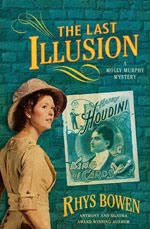
I'm writing about names today because on March 2 my new Molly Murphy mystery, THE LAST ILLUSION, comes out. It is the ninth in this series and the first in which I have deviated from a theme in the titles. The first books (Murphy's Law, For the Love of Mike etc) were all Irish sayings. With O Danny Boy the titles moved to Irish songs, then to popular songs of the early Twentieth Century. But this book is more thriller than mystery in many ways--Molly is hired to find who is trying to kill Houdini and finds herself caught up in the world of international espionage. So I wanted to make the title crisper and more thriller-like. The Last Illusion really describes the pivotal scene in the book and I think it captures the flavor well.

It is really important that the book title fit the tone of the story. If you see a catchy pun, you expect light hearted cozy. I made the mistake with the Constable Evans series of using puns for all my titles. As the series became meatier and darker they weren't really cozy any longer and I think I put off many people from trying my books. When one was nominated for the Edgar, I know quite a few people were surprised at the content.
So now I try to get the titles exactly right. And I'm wondering--how much are you influenced by a book title? Are you attracted to a thriller that has 'bone' or 'blood' in the title? Would you have found The Da Vinci Code as compelling if it was called A Murder at the Louvre? Look how many thrillers now have those buzz words: secrets, chamber, Templars etc in their titles.


If the publisher is not going to spend half a million on publicity and marketing for a book, our title and cover are the only things that can attract new readers. I've been lucky in that I've loved all my Molly Murphy and Royal Spyness covers (especially this one!) but I have writer friends who have felt that their covers were wrong and could do nothing about it. Also I've been lucky in being able to keep my titles. I know of writers who hated the titles their publishers came up with. The only title I have ever really, really hated was back in the days when I wrote YA books. A German translation of one of my books (which was about mountaineering) was calle "First Love Tastes like Strawberry ice Cream." Now if that's not misleading, I don't know what is!

If you go to my website, http://www.rhysbowen.com/, you will find a trailer for The Last Illusion as well as the opening chapter to read. It's a fascinating glimpse into the life of Houdini, Illusionists and early espionage.

HALLIE: Love your title, Rhys! And I'm completely fascinated by Houdini etc. I've read just about every book there is about him. Can't wait to read your new one.
I do think titles are so important, but I confess to being less than brilliant about recognizing a good title when I see it. I wanted to call my last book "Baby, Baby" (it's about two very pregnant women) but the publisher felt it wouldn't convey the creepy suspensey-ness of the the book. So we went with "Never Tell a Lie" - which turned out to be a wonderful title though I was fairly lukewarm at first.

RO: It is a good title. I feel like I wasted almost two years of my life because my publisher changed the title of my second book..and of course had to change the cool image on the cover. It really broke my heart. The few reviews I got were better than they were for Pushing Up Daisies...but the title didn't roll off the tongue the way Daisies did, and the cover...well, you know what a camel is? A horse designed by a committee. That's what I got...a camel. Not the designer's fault..just happened. So, the book didn't get out there much. I never should have let them change it, but I was so new, I figured they knew best.What was it supposed to be called instead of The Big Dirt Nap? Corpse Flower. And the cover would have been gorgeous, we already had images. Maybe when I'm famous someone will reissue with the original title.
Now, I LOVE this year's title and cover. Fingers crossed other people will too!
I have a hard time with character names. I usually go through 3-4 names for each character before I settle on the right one. I've even taken to saving Playbills because of all the donor names in the back.
The auction name that I got at Bouchercon 2008 was fabulous. I may make her a recurring character. Her name is Nina Mazzo and it's absolutely perfect. Nina's a P.I. who specializes in philandering husbands. Uh...Nina's in Dead Head.

ROBERTA: Corpse Flower was a good name Ro:). But there's no telling really why one book takes off and another doesn't. I suspect the first in a series always has a better chance of hitting the big time. I've had several titles changed by the publisher, almost always for the better. And as my agent has said, the cover fairies have been good to me too!
I'm afraid I'm not too imaginative with names. Lots of times I catch myself using the same names over and over. "Michael" for example, shows up a lot. The folks who've bought names for my books in auctions have almost always turned into recurring characters. They get their money's worth. My favorite story was a man in town who was bidding in a silent auction at our library. He was very worried that the cost would shoot up out of his price range. But then his bidding rival had to leave the party early, so he won the prize--a character in DEADLY ADVICE. He was so pleased with the result. Sadly, he died of cancer not too long after the book came out, but his character lived on in the series. I'm so glad it worked out that way!

HANK: My favorite name I got in an auction: Urszula Mazny-Latos. I must say, I freaked for a moment. Then voila, she became Zuzu Mazny-Latos, a chic European fashion designer. Merci, Urszula! And at the next auction, by chance, I got Luca Chartiers! Perfect. (I thnk auction names are a real gift. And I love using them.)Titles? I'm haunted by titles. I'm always thinking of them. Always writing them down. And I'm always astonished that there's always another good one! Sending good vidbes for THE LAST ILLUSION, Rhys! Love it. And Dead Head, RO, is brilliant. And you have both truly scored with those covers! Go Jungle Red.


RHYS: So is it the title or the cover art that makes you pick up a book and ry and new author?

Friday, February 19, 2010

Everyone needs a bad guy!

JAN: I admit that I was lured in at first. Even though I wasn't a fan of Donald Trump, I gave the first couple of seasons of The Apprentice a shot and liked it. Not only did I gain respect for the Donald, I also learned some interesting marketing lessons.

It might have been my third season of The Apprentice when I realized that Omarosa, the villain, was being coached to say nasty things. And that the director had to be encouraging all the other contestants to hate her. And after that, I saw it in every reality show, from America's Top Model (viewed with my daughter against my will) to Joe Millionaire to Project Runway. It didn't matter what contestants were competing for, the whole point was to see them break bad. They became catty. And underhanded. And there was always someone, like Omarosa, who was the worst.

According to Psyblog, a blog that collects research about how our minds work, (www.spring.org.uk) reality shows make good use of narcissists in the cast. Apparently, we just can't help being drawn to a narcissist's self-absorbed and arrogant behavior. They tend to be confidant, fashionable and witty We are fascinated by their entitled behavior.

At first.

Quickly we come to despise them. Contestants and TV viewers alike. And we want to see them "knocked down," and get whats coming to them. It all makes for great TV.

So do you think bad behavior is the appeal of Reality Shows? And if so, why? Are these people just strangely charming, or do they somehow make us feel better about ourselves??

RHYS: An insider told me that they are scripted just like any TV drama. Lines are cut and used out of context to hint at fights that never happened. Look at The Bachelor or Bachelorette when the most likely candidate for his heart suddenly has to go away or lose her job. Yeah, right. The only difference between TV drama and reality shows is that the latter are playing with pe
ople's lives and psyches. I suppose if they pick narcissists and unpleasant people then they deserve what happens to them. Actually I'm a fan of The Amazing Race, which is often won by nice and genuine people, and, I have to confess, Project Runway which is a fascinating insight into the creative process.

I think we watch, hoping that the unpleasant people get what they deserve. What I find fascinati
ng is that The Truman Show foreshadowed exactly what is happening in real life.

RO: I really do need to see The Truman Show again..this is the third time it's come up in a week. I was on St. John last week and stayed at a resort which had kayaks for guests, but only if they stayed in the small bay right near the hotel. We'd just come back from 5 days of kayaking all over the BVI and thought it was ridiculous to have to stay in one small area as if it was the kiddie pool. We watched one guy take a kayak out and ..it was like the The Truman Show..it was as if there was an invisible screen making him return to shore. Too funny. But I digress.

About a million years ago there was something called The Louds: An American Family on public television. I barely remember it..will have to google, but it followed this middle class family and I think the daughter wanted to be a dancer..and it turned out that the son
was gay, and that was a big thing in the 70's, and then the couple split up. I have not felt the need to watch another reality show since then.

HANK: Oh, I rmember the Louds. Here's the thing about reality TV. It's NOT live. So some producer has taken hours and hours of video, and edited it into one hour. Do you know how easy it is to make that one hour into anything you wnat? And also--the producers know the end result. So they put the puzzle pieces of the show together to make the most interesting or conflict-ridden 45 minutes leading up to the end. The end that they KNOW will happen. See? So we're being completely manipulated along the way.

That said (anyone see that episode of ..was it Curb?) that's the reason I think its fun to watch s
ome of these shows. Rhys, yes, I love Amazing Race (it's almost--inspirational, and you can pretend it's educational) and I love Project Runway (so creative! and I love fashion, and I'm hyper-competitive anyway).

But what makes it the most fun is that the editors know how the shows turn out.

ROBERTA: Hank, that's such an interesting description of how the shows are made. Doesn't it sound something like what we do as we're writing novels? (I mean the most conflict we can imagine...)

I watch NO reality TV. I may be the only one in America. We were watching the Olympics last night and kept seeing the ad for Jerry Seinfeld's upcoming show, in which TV stars intervene in couples' fights. How bizarre is that?? At least Dr. Phil has a little bit of training in the field:)

HALLIE: Oh, I remember the Louds. That was before they figured out how to pare down to the conflict. And of course there were Andy Warhol movies like "Sleep" where his camera watches
some poet sleep for 6 hours.

Like Rhys, I watch is Project Runway and I am completely addicted to it. And my daughter got me hooked on So You Think You Can Dance.

JAN: Lannie and I watched So you "Think you Can Dance," which was "Vous croyez vous pouvez danser" in Aix en Provence last summer because it was the only thing we could follow in French. (They dubbed over the English but competition is the same in any language). My French skills weren't strong enough to pick up any inter-contestant sniping. But I also couldn't always figure out why one contestant was so much better than the other.





