Saturday, February 25, 2023

Too Long? James R. Benn Goes Short

LUCY BURDETTE: We always love having Jim (aka James R.) Benn visiting to talk about his Billy Boyle series, but I promise you'll love this blog about short stories. It may even bring a tear to your eye, so read on...


JIM BENN: I never thought I’d be a short story writer. As an author, I tend to write long. I don’t mind taking my characters in the Billy Boyle series off on a tangential hunt, as long as I return them safely to the story line. In a world where a “standard” novel runs to eighty thousand words, mine routinely exceed one hundred thousand. I’ve always said I like to give my readers a good bang for their buck, but in truth I do blather on.

And it’s nothing new. In 1963, when I was a freshman in high school, Mr. Gillan — fifth-period English class — thought so too. I recently unearthed a folder of short stories I wrote in his memorable course. What was the first comment I saw, a full sixty years later?

TOO LONG


The saving grace was his next comment: “good description” accompanied by a check. I don’t recall if that was the best mark or if I missed a double check, but I certainly learned the lesson that a good description can overcome excessive length. I also learned a good bit, at the age of fourteen, about movie tie-ins. The Great Escape, the classic WWII prison break film, had premiered that summer. I enjoyed it, and I figured Mr. Gillan would, therefore, enjoy my POW escape story.

Dodging the searchlight, he clambered over the wall . . .

GOOD

In red pencil. I was on to something.

Grabbing inspirations as they fell into my lap, my next piece was Story of a Spy. Snappy titles were still, obviously, in my future. I’d seen The Longest Day the year before, and that film about the D-Day invasion had stayed with me. My version concerned an American soldier sent ashore in advance of the invading troops. Take that, Darryl F. Zanuck.


On the morning of June 6, 1944, Normandy was invaded by Allied Forces. But on the night of June 1, five days earlier, it was invaded by Sergeant William Lane.

GOOD OPENER

Yes! Mr. Gillan was impressed! This story was for a full grade, not just a measly check mark. Looking back after six decades, it isn’t a bad read. I should have edited out “five days earlier,” though. Unnecessary. People can count, after all.

I read on, drinking in his positive comments as the story continued. Our hero scores some vital intelligence about German defenses, and he hooks up with the airborne forces who radio his information to headquarters. He’s a hero, and I thought I was too. Then I turned to the back page.

B+. A PROMISING STORY. POSSIBLY TOO EASY FOR THE SERGEANT — BUT INTERESTING.


B+? Not having been the most studious of high school freshmen, I normally would have been happy with anything above a C. But I was disappointed, except for the fact he had written “but interesting” at the end. However, I have benefitted more from that comment than I could ever have imagined.

I never forgot it. Actually, I’d misremembered it, recalling instead that he’d written “Next time make it harder for the sergeant.” Perhaps that was how I internalized the lesson. There would be a next time, and when that came, it would have to be harder for the sergeant. Obstacles. It was a lesson in obstacles.

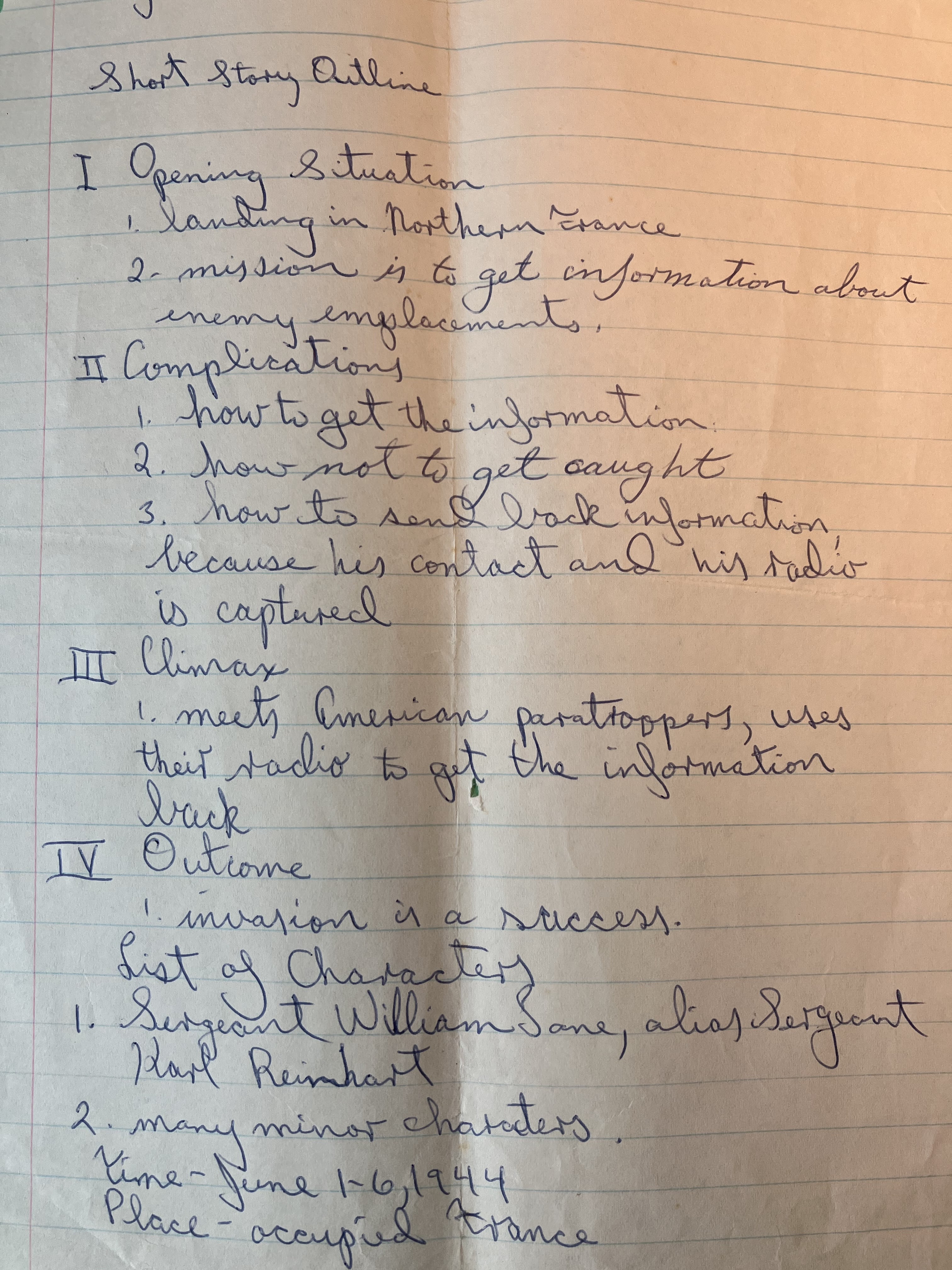
The fact that I hadn’t grasped the concept was evident in the outline we’d been assigned to create prior to writing the story. Under Complications, I’d written “How not to get caught.” Brilliant. This is the first and only outline I’ve ever written. After that fiasco, I was going seat of the pants all the way.


The constant flow of stories required by Mr. Gillan demanded creative measures. The Twilight Zone television series was widely popular at the time, and one haunting episode features three astronauts who crash-land on a desert-like asteroid. Short of water, the three fall to fighting over scarce resources. One man murders the other two and takes off with their water. Hiking to the top of a hill, he finds they are still on Earth. Outside of Reno, no less.

Well, if it was good enough for Rod Serling, it was good enough for me. Swap out the spaceship for a B-17, and the story wrote itself. In my version, one of the three survivors of the bomber’s crash gives up hope after wandering in the scorching desert and shoots himself. His comrades climb the next ridge and see their own airbase in the distance.

GOOD CONCLUSION


Whew. Mr. Gillan hadn’t seen that episode.

It was a long time until I took up writing fiction again, but I remembered the lessons from fifth-period English. I began my first novel in 1999, but it wasn’t until 2018 that I submitted my first short story. After being intimidated by the short form, I finally had found a way into that style of storytelling. This time around, the ideas are my own, and I wish Mr. Gillan was still here to thank.


A GOOD STORY — PLOT WELL DEVELOPED. YOU HAVE DONE VERY WELL.


As have you, Mr. Gillan. As have you.


Question: Tell us, is there a favorite teacher who influenced your life?
Give them a shout-out here!


James R. Benn is the Dilys, Barry, and Sue Federer Historical
Mystery-award nominated author of the popular Billy Boyle WWII mystery series and three stand-alone works. His novel The Blind Goddess was long listed for the 2015 Dublin IMPAC Literary Award. Benn is a graduate of the University of Connecticut and has an MLS degree from Southern Connecticut State University. He worked in the library and information technology fields for over thirty-five years before leaving to write full-time. Benn and his wife Deborah Mandel live on the Gulf Coast of Florida.

Friday, February 24, 2023

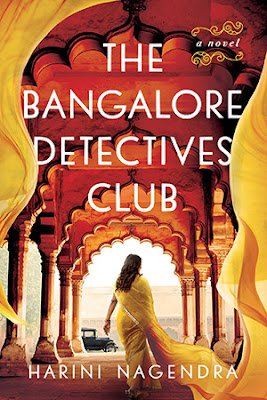
Fighting for suffrage in 1920s India By Harini Nagendra

LUCY BURDETTE: I loved our guest's first mystery, set in Bangalore, India--and I wasn't the only one. It made a huge splash. I'm delighted to welcome Harini to talk about the background for book two, coming this spring. Welcome Harini!


HARINI NAGENDRA: Mary Poppins was one of my favourite movies as a child. I love musicals (always have). It’s been years since I saw the movie, but I remember the song “Sister Suffragette” so well. For a young girl growing up in India in the 1970s, its message was heady and hilarious. Soldiers in petticoats, these women sang defiantly, “Our daughters’ daughters will adore us.” 

That’s why it was such a thrill for me when I dived into documents about 1920s Bangalore, for book 2 in my colonial Bangalore cosy mystery series, The Bangalore Detectives Club – and found a treasure trove of documents about women fighting for the right to vote in India. Why had I never heard these stories before? 


Reading more, I learnt that although Britain granted the rights for women to vote in 1918 (though only for women who held property), the same rights did not extend to other parts of the British Empire. Women across India organized to demand change, arguing for the right to vote, and to be voted to power. 

Their fight was dismissed by many prominent men, but supported by others. In a long debate in the 1922 Mysore Representative Assembly (colonial Bangalore belonged to the Mysore State), one member argued that “my sisters are as intelligent as my brothers” – a fact that should have been self-evident. Another man rejected his argument, saying that it would be an insult to women to ask them to take on outside responsibilities, exposing them to the indelicacies of the public eye. Women were goddesses of their homes. In short, the ‘right’ place for women was in the kitchen, taking care of their families. 

Undeterred by such specious arguments, women in India continued to fight for suffrage. Since they were not allowed into the assemblies where such matters were debated, it was not easy to make their voice heard where it mattered. The Women’s Indian Association held protest meetings across British India. Their leaders communicated with counterparts in Sri Lanka, Britain and the USA, exchanging news and encouragement.  

The suffrage movement in India and Sri Lanka was more restrained than in the UK and USA. Public protests were rare, and protestors refrained from public acts of dissent like chaining themselves to carriage wheels. Indian suffragists were aware of the need to respect the social mores of the times. Instead, they linked themselves with the Indian Nationalist Movement, thereby gaining wider support, and working strategically within each province. In 1919, the movement obtained its first victory, when the Madras City Council allowed women to vote (but not to stand for elections). From there on, they made steady inroads across the British Provinces and Princely States. 

In April 1922, after the series of debates in the Legislative Council that I described, women in Mysore State were given the right to participate in elections. 19 year old Kaveri Murthy, the heroine of my series, would have been thrilled. A strong feminist with a supportive husband, Kaveri struggles to deal with the strictures passed by her judgmental mother-in-law Bhargavi in the first book of the series, The Bangalore Detectives Club. Bhargavi disapproves of everything Kaveri does – studying mathematics, swimming in a public pool, sleuthing to solve crimes, everything. To simplify the plot and let Kaveri get on with her sleuthing, I sent Bhargavi to visit a sick relative part-way through book 1, keeping her off-stage.


But you can’t escape your mother-in-law forever. In Murder Under A Red Moon, the second in the series, Bhargavi is back – and Kaveri wants to figure out a way to make peace with her. She’s not willing to change her character and become meek, mild and compliant, though. Drawn into investigating another murder, Kaveri gets to meet a number of strong independent women, including a suffragist. Coffee Pudi Sakamma, a child widow who reinvented herself as a coffee entrepreneur, establishing a prominent coffee powder business in Bangalore in 1920, was the first woman nominated to the Mysore Representative Assembly. I was so inspired by Sakamma that I had to work her into my second book – she is the inspiration for one of the main characters in Murder Under A Red Moon. 

I had loads of fun following up on the research for this book, even though it took me down a number of fascinating rabbit holes and I wasted far too much time on it. Winifred Banks was spot-on when she sang in Mary Poppins that “Our daughters’ daughters will adore us”. We do, we do!  

Questions for Harini? She’ll be visiting us when the time difference allows!


Bio:

Harini Nagendra is a professor of ecology at Azim Premji University. She is internationally recognized for her scholarship on sustainability, with honors from the US National Academy of Sciences and the Indian National Science Academy, among others.

Her non-fiction books include Nature in the City: Bengaluru in the Past, Present and Future, and Cities and Canopies: Trees in Indian Cities, which received the 2020 Publishing Next Awards for best English non-fiction book in India.

The Bangalore Detectives Club, her first crime fiction novel, is a New York Times Notable Book of 2022, nominated for an Agatha and a Left Coast Crime award.

Harini lives in Bangalore with her family, in a home filled with maps. She loves trees, mysteries, and traditional recipes. She can be reached via her website, www.harininagendra.com, on twitter @HariniNagendra, Instagram @harini.nagendra and Facebook. 


About Murder Under A Red Moon: 

The latest novel in the acclaimed Bangalore Detectives Club series finds amateur sleuth Kaveri Murthy uncovering a new murder during the blood moon eclipse.

When new bride Kaveri Murthy reluctantly agrees to investigate a minor crime to please her domineering mother-in-law—during the blood moon eclipse, no less—she doesn't expect, once again, to stumble upon a murder.

With anti-British sentiment on the rise, a charismatic religious leader growing in influence, and the fight for women's suffrage gaining steam, Bangalore is turning out to be a far more dangerous and treacherous place than Kaveri ever imagined—and everyone's motives are suspect.

Together with the Bangalore Detectives Club—a mixed bag of street urchins, nosy neighbours, an ex-prostitute, and a policeman's wife— Kaveri once again sleuths in her sari and hunts for clues in her beloved 1920s Ford.

But when her life is suddenly put in danger, Kaveri realizes that she might be getting uncomfortably close to the truth. So she must now draw on her wits and find the killer . . . before they find her.


Thursday, February 23, 2023

Cheers and Jeers (aka Check-in!)

LUCY BURDETTE: Today is check-in day--we'd love to hear how things are going for you too!

CHEERS: It’s our busy season in Key West because everyone wants to get away from winter. This week we have two special guests in town—Hallie is here teaching and Debs arrives on Saturday as she’ll be our speaker for the Friends on Monday. A mini-Jungle Reds reunion. Yay!

JEERS: I am taking a French conversation class 3-4 times a week and I wish I knew where all my French vocabulary has gone! 


CHEERS AND JEERS: I’ve gotten so many ideas for Key West mystery #14 from the police academy and from a book club at the Big Pine library, but precious few words have been added to my manuscript…

HANK PHILLIPPI RYAN:

CHEERS: Yay! THE HOUSE GUEST has gone into second printing! Just six days after publication. I am absolutely floating. And!  As I type this, it’s Amazon number 2 in genre new releases! SO fabulous! (Can we somehow get me to number one? Like Debs in her genre?)  I am still counting blessings like mad.


JEERS:  Oh argh. I have the edits for my next book ticking away until the due date. I love the new book, but I cannot focus until I am off of book tour. I have flown, gosh, thousands of miles in the past two weeks. Can that be? And that little nagging feeling of ‘YOUR EDITS ARE DUE”  is flying along with me. But I have time.

CHEERS AND JEERS: What do I do next? I have a title and NO PLOT for the next book, book 16.  So weird. And– I also have a great idea for something totally new. What would my world think of something totally new?  I cannot decide what to do, so maybe that means it’s not time to decide.

JULIA SPENCER-FLEMING: Hank and Lucy, those are some amazing cheers to nab! Mine aren’t nearly as exciting.

CHEERS: Youngest’s car dropped dead, throwing her into crisis, since her business - dog care - depends on her having reliable transportation. Last Friday she did her research, took the bus down to Portland, and in one long day we found a new-to-her car, test drove it, got it inspected by my mechanic, and made the purchase, title, tags and taxes before the town hall closed for the evening. She didn’t even have to stay the night! That felt like a real accomplishment.

JEERS: I've been so bogged down in taxes, grading, health insurance paperwork and more of Dad’s estate stuff, I’m getting almost no writing done. I keep feeling if I can only get these one-time-only things out of the way… but then more one-time-only things fall onto my to-do list!

CHEERS AND JEERS: My invitations to speak at conferences, libraries, etc. are starting to get back to pre-pandemic levels, which is very nice. But I’m finding planning and executing travel when there’s no one else at home is much more complicated than it was when I had the Maine Millennial or Samantha living here. So…hmmm.

RHYS BOWEN: 

CHEERS: My only cheers this week are for Hank and Debs and their brilliantly successful new books. I’ll bask in your glory!  

JEERS: This should have been my Jungle Reds week but I swapped with Lucy because I should have been on a cruise in the Caribbean. Alas John and I both came down with a horrible virus that has laid us low and we had to cancel the cruise. So I’m at home, staying away from people because we’re still infectious, coughing like La Dame au Camelias and feeling sorry for myself.


CHEERS AND JEERS: But I am making myself move ahead with the next book so I can finish early and plan a lovely vacation somewhere, sometime.

HALLIE EPHRON: 

CHEERS: I’m in Key West where I get to hang out with Lucy and go to events at the wonderful Key West Library and teach a class at The Studios of Key West to a stellar group. So good to work out someone ELSE’S plotholes!

JEERS: I’m recovering from a mysterious virus that made me itch all over. Gaaaa.

CHEERS & JEERS: Being in a warm place in February is grand, but who invited all these other people?!?

JENN McKINLAY: 

CHEERS: On the stroke of midnight last night I turned in the manuscript for FATAL FIRST EDITION (LIbrary Lovers #14) *and* the copy edits for SUGAR PLUM POISONED. Hallelujah!


JEERS: My house is a revolting wasteland of pet hair and unopened mail. It’ll take me a week to get it clean and then I’m back on deadline. Wah.

CHEERS AND JEERS: I nurtured a small black mission fig tree back to life. Yay! Now I have to figure out where to plant it. Ugh!

DEBORAH CROMBIE:

CHEERS: Lots of cheers here! I'm so looking forward to my upcoming visit to Key West, where I will get to see Lucy, Hallie, and Barb Ross, and speak to the wonderful Friends of the Key West Library. And A KILLING OF INNOCENTS is doing really well. The reviews have been lovely, it made #8 on the Wall Street Journal Bestsellers list, and it just had a fab tweet from ANN CLEEVES!

@AnnCleeves

My most recent crime read was A Killing of Innocents by

New to the series but got pulled in immediately by the interesting plot and engaging range of recurring characters.

JEERS: I've made some real progress on the plot for Kincaid/James #20, but I still don't have a title, and very few words are getting on the page.

CHEERS AND JEERS: Loving all this promoting and travel (although not a fraction of what Hank is doing!) but it's really hard to concentrate on writing until things calm down a little.

P.S. A KILLING OF INNOCENTS is out in the UK today!

Now it's your turn Red readers!