Friday, February 5, 2010

On adolescent angst and a girl with mermaid hair

HALLIE: Okay, just for the record, I do not think my mother ever had plastic surgery because back then, even if you were a woman Hollywood screenwriter hitting middle age, it was rarely done and certainly not talked about. But she was obsessed with her nose, and I can still see her sitting at the dinner table and pushing up the tip of it in a nearly unconscious gesture. As her daughter I was obsessed with with my nose, too (I'd inherited a combination of hers and my father's which was even worse), and jealous of youngest sister Amy who had miraculously inherited our grandfather's nose and looked, as my mother oh so often pointed out, "like a little Dutch doll."

My sister Delia
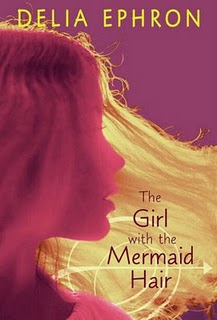
Ephron’s brand new novel for teens and preteens, “The Girl with the Mermaid Hair,” perfectly captures that excruciating self-consciousness of being an adolescent girl. Sukie Jamieson is young, beautiful, lonely, and so completely self-obsessed that she constantly taking selfies (cell phone photos of herself) and examining herself in every reflective surface. I so remember being that age and SO self-conscious. Sukie has an additional twist: her mother is about to get a facelift.

I love the moment in the book when
Sukie’s mother gives her a full-length mirror that once belonged to her grandmother “This mirror will be your best friend and worst enemy.”

DELIA:
That really says it all. A mirror is where you go for comfort and reassurance that you’re all right. As a teenager that means that you LOOK all right. You give it so much power, when in fact what’s inside has more power.

HALLIE: To make things worse, Sukie’s mother gets a face lift. How hard is that for a teenager already feeling inadequate and obsessed with her own looks?

DELIA: My niece Maia did research on girls and mirrors for me, interviewing teenage girls whose mothers had face work. What came up over and over was girls were so aware of how mothers were saying “Oh God, I look fat.” Or “Don’t make that expression you’ll get a wrinkle.” The mother starts to age and feel bad about herself and she’s not thinking about her teenage daughter who’s struggling to love her own body.

Don’t you think there’s a lot of narcissism in parents in general around around beauty. I was really interested in is this phenomenon of all these mothers at a certain age hating their looks and saying so, without even thinking of course that their daughter are painfully self conscious. The mom’s an adolescent and so’s the daughter.

HALLIE: Sukie is so beautiful and bright, she seems like she has everything. But she’s really so unhappy.

DELIA: I think when we’re young, we tend to think if you’re beautiful then your life is easy. I wanted Sukie to have this thing outwardly that everyone envies. Inside she’s miserable, she doesn’t now how to connect, she’s lonely, her parents are a disaster, and she relies on her looks because she can’t rely on anything else. She uses her phone to photograph herself but it never rings.

HALLIE: How do you manage to write what could be truly unsympathetic characters so sympathetically?

DELIA: When I write a character, my first question as a writer is: Why would you care about her? I knew that she couldn’t be the way she is if she had good mothering. So the question was: Who was her mother. The minute I knew her mother felt as inadequate as she did (she says her grandmother never gave her a compliment), so insecure and unhappy with her own life, I understood how Suki felt abandoned. And her father uses Sukie to team up against her mother. Once you understood her parents and the situation she’s in, you can forgive her for how she strikes out of her friends because comes out of so much self hate. It’s all about vulnerability.

HALLIE: I felt that. But this is a really funny book, too. I was laughing out loud when Sukie decides she “has ramp” because her nose is that particular shape that she sees in a magazine.

DELIA: When I dealt with pain as a kid, I always turned it into a funny story. And as a writer, I always want to scream Hey! This book is funny, even though it’s really serious.

THANKS, Delia - as a parting gift to us here’s the Jungle Red quiz...

Miss Marple or Hercule Poirot?
DELIA: Miss Marple

Sex or violence?
DELIA: Sex

Pizza or chocolate?
DELIA: Pizza but really both

Daniel Craig or Pierce
Brosnan?
DELIA: Daniel Craig but really neither.

Katharine Hepburn or Audrey Hepburn?
DELIA: Audrey Hepburn.

Your favorite non-mystery book?
DELIA: Reading Lolita in Teheran

Favorite book as a kid?
DELIA: Anne of Green Gables

Making dinner or making reservations?
DELIA: Making Dinner

And now, the Jungle Red Big Lie. Tell us four things about you that no one knows. Only three can be true. We'll guess which one is false!
DELIA: : This was hard. So I couldn't quite do it the Jungle Red Big Lie way. Please forgive me. Three of these things are false and one is true, and Hallie knows for sure.
1. When I was twelve I was a ball girl for a tennis match between Gonzalez and
Rosewall
2. I slept with a stuffed animal right through college
3. I'm a huge fan of Garth Brooks
I won the high school literary magazine poetry contest

HALLIE: Isn’t that the definition of a fiction writer? We’re better at making things up!)

Delia will be checking in today so please, share your thoughts...


Wednesday, February 3, 2010

On writing groups, some expert advice

HALLIE: Authors depend on other writers to critique their work. Some of us belong to a writers group and swear by then; others not so much.

I was lucky with my first writing critique group, a mixed group that included a travel writer, a memoir writer, a novelist, and a short story writer. They were all terrific readers and gave the kind of supportive feedback that helped me get my first books published. Later, I moved into a writing group of published mystery writers and got a different level of feedback that helped take my writing to a new level.

Becky Levine
has just published a brand new book, a most practical guide to forming and getting the most out of a writing group, The Writing and Critique Group Survival Guide.

Becky, welcome to Jungle Red! Why do you think some authors are wary of writing groups?

BECKY:
You hear so many horror stories about too harsh criticism or being told that you shouldn’t be writing. I also think some people are afraid to critique; they think they’re not qualified. I say, step out there and start learning. Hopefully, my book will tell people how they can do this.

HALLIE:
How can you tell if you’re in a toxic group?

BECKY:
If you’re consistently feeling so drained that you can’t go home and write when you leave the critique group, then it’s probably not a good place. Any group that leaves you feeling tired or angry or frustrated and that keeps you from writing is the wrong group. Often, you and your partners can fix the problem, and it’s worth trying. There’s a whole section in the book about troubleshooting group dynamics.

HALLIE:
How to find the right group?

BECKY: First think about your goals. That will help you decide whether to join:
- a mixed group or writers working at the same level and in the same genre as you
- an online or in-person group
- a group that meets frequently enough to meet your needs

You can find other writers at local writing classes, regional meetings of writers’ groups, bookstores, and libraries. If you find an existing group, go to a few meetings before you commit. If you’re feeling intimidated or bored or frustrated or aren’t interested in what others are writing then maybe it’s time to start looking for a different group.

HALLIE:
How can you tell if the advice you’re getting is good or not?

BECKY:
One thing to look at is quantity. If two or three people tell you the same thing, then you’d better look closely at what they’re saying. That’s the advantage of a group rather than back and forth with one person. Sometimes, even if it’s the right thing to change, we’re resistant. That gut “I don’t like this” feeling may be just the change you need to consider. If you’re confused, you can talk to that critiquer or bring it up at next meeting and brainstorm around the problem.

HALLIE:
How big should a group be?

BECKY:
I like 4 to 6. Of course it depends on how much writing you’re turning in, but I get very uncomfortable with large groups - it’s too much work, and it can take away from your own writing time.

HALLIE:
Your book is full of wonderful tools. There’s an excellent tools for critiquing fiction and another for critiquing nonfiction.

BECKY:
Those worksheets and lots of other examples from the book are online at Writers Digest. Go to http://www.writersdigest.com/article/critique-survival-guide and download free worksheets and excerpts.

HALLIE:
Thanks, Becky! Now here’s the Jungle Red quiz...
Miss Marple or Hercule Poirot?
BECKY:
Miss M
Sex or Violence
BECKY:
Sex
Pizza or chocolate?
BECKY:
Pizza
Daniel Craig or Pierce Brosnan?
BECKY:
Pierce Brosnan
Facebook or MySpace?
BECKY:
Facebook
Katharine Hepburn or Audrey Hepburn?
BECKY:
Audrey
Your favorite non-mystery book?
BECKY:
The Secret Garden
Favorite book as a kid?
BECKY:
The Secret Garden :)
Making dinner or making reservations?
BECKY:
Making reservations

And now, the Jungle Red Big Lie. Tell us four things about you that no one knows. Only three can be true. We'll guess which one is false!
My first job was selling Jordache jeans to eight-year-olds.
I rode in a helicopter for my 21st birthday.
My dream car is a 1967 Jaguar XKE, British Racing Green.
I had an allergic reaction to my cellphone.

Becky will be checking in today so please, join in the discussion and tell us what you think about writing groups. Share your own experiences and one of you will win a copy of THE WRITER & CRITIQUE GROUP SURVIVAL GUIDE - winner will be announced tomorrow so check back for the Big Lie.

Monday, February 1, 2010

Luddites united...

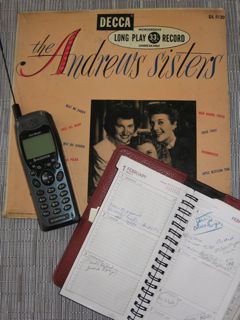
HALLIE: I must be one of the last people on the planet...or in Boston at least...who still uses a date book. It has a still spiffy red cover and fits in my purse. Every year for $6 I buy a new calendar to go into it and retire last year's calendar with my tax records. I know I've been using it a long time because the address book has phone numbers of people who I would swear to you are complete strangers.

There are early adopters and then there are those who upgrade only when other options run out. I just traded my 2001-vintage cell phone (with an aerial) for one that flips(!) open (someone who'd upgraded to an iPhone gave it to me). We still watch an unwide TV. Our twin Honda Civics just got their 100,000-mile tuneups.

When a local repair shop was going out of business we bought a dozen needles for our turntable. We're still going through them and picking up vinyl at yard sales -- like one featuring the Andrews Sisters (the album cover shouts * MICROGROOVE * LONG PLAY 33 1/3 RECORD * UNBREAKABLE) singing Beat Me Daddy, Eight to the Bar with the Jimmy Dorsey Orchestra and the original Broadway cast album of "The Pajama Game." Last year I finally got an iPod but mostly I listen to podcasts.

So do you have the latest eReader, Bluetooth smartphone, widescreen or other compound-word reason to throw away something else in perfectly good working order.

JAN: Now, see I consider myself the world's biggest Luddite. Not because I don't adopt new technologies, but because once I get them, I can't make them work

I thought of myself a relatively late technology adopter, but compared to you, Hallie, I think I might be on the vanguard. Mostly because of my husband. He's a gear head. Plus, he used to be in the computer business, So, yes, we have the biggest HD TV ever, also the latest Mac (also big screen -- are you seeing a pattern?), one iPhone, another on the way. We didn't have cable TV until 2004, though, and that was only because the Red Sox had made the playoffs and we had to see them win the World Series.

RHYS: I still have a date book that was given to me by my publisher in the 1980s (that was back when publishers still gave authors presents). I have all my contacts etc on my PDA and iPod but I keep a backup on paper in that book, just in case the world runs out of electricity. I also write a year plan at the beginning of every year and examine it on New Year's Eve to see what worked and what didn't.

I guess I don't adapt to change if I don't have to. I don't want a Kindle but I'm glad people buy my books for it. I'm quite savvy with my computer, but I don't choose to play with it when I don't have to. I've never played a computer game in my life. I do have an Ipod to keep me sane at airports. I have a cell phone but only for letting my husband know that my plane has touched down.

And Hallie, you should talk to John, who still has a stack of vinyl LPs. He has just bought something that will turn them into CDs or MP3 fils and plans to work his way through them. (I can't wait as it will keep him out of my hair for many months. And after that... cassette tapes to CD! Yipee)

HALLIE: I've had my eye on one of those vinyl-to-digital transformer thingies but never would I want to be the first on the block. That's how so many people ended up with Betamax technology when VHS would be the one to catch on. But if you report that it works great, I might have to get one.

ROBERTA: Nope Hallie we can't compete with that description! I'm in Rhys's camp--I pretty much know what I'm doing on the computer but I don't want to spend extra time on it. I may have said this before, but I don't understand why we need 5 remotes to run our TV/dvd/etc. If something dreadful happens to my John, I'll just have to watch TV upstairs where things are simpler.

I do know another fellow like you Hallie, my brother-in-law Jeff. He has a TV that belonged to his grandmother. It weighs about six thousand pounds and has a tiny screen. We razz him about it all the time:).

HALLIE: Tell your brother-in-law to throw a yard sale and invite me! Sounds like my kind of guy.

HANK: I have a paper date book! So funny. I get the same kind every year. They're small and flat and work perfectly. Sometimes I carry around this year's and last year's so I don't have to rewrite all the names and phone numbers in the back.

Which now, thinking about it, is silly, since the phone numbers are all in my cell phone,I suppose. But then, I hardly ever use my phone. When it rings, I freak. I think--what is that?? (My ring tone for Jonathan is the theme from Charlies Angels, I admit.)

I don't want an iPod because I don't want things in my ears. Although everyone who has one loves it.

And our basement is full of vinyl records. Another blog for another day.

Oh, Roberta! I'm so with you. I work in TV, and know all about the most elaborate of technical stuff. But know how to turn on our TV at home? Oh dear, no.

HALLIE: Yes, why do remote controls breed. It's almost like one appears every time a sock disappears.

Please, let us know - do you adopt early, late, or only under duress?

And by the way later this week...
Delia Ephron pays us a repeat visit to talk about her new powerful novel of truth, beauty, and the secrets about family and friends that lie beneath perfection.
Becky Levine joins us with her insightful "Writing & Critique Group Survival Guide.