Showing posts with label teaching. Show all posts

Tuesday, August 29, 2023

THE BUTTERFLY CAGE: an interview with Rachel Zemach

JULIA SPENCER-FLEMING: We're just a few days from September, Deaf Awareness month, and we have a wonderful guest to kick it off for us. Diana Todd, a/k/a Bibliophile, is a long-time commentor here who is also part of the Deaf community. She offered to interview Rachel Zemach about her critically-acclaimed memoir, THE BUTTERFLY CAGE.

Diana and Rachel are also giving one lucky commentor the chance to win a signed copy of THE BUTTERFLY CAGE. Thank you, Diana!


DIANA TODD: So excited to introduce Rachel Zemach here on Jungle Red Writers blog.  Rachel was living in England with her sisters and parents, themselves authors and illustrators of children's books, when she suddenly lost her hearing at the age of 10.  She learned Sign Language at school in America after her family moved back to the States. She has written a memoir, THE BUTTERFLY CAGE, about her experiences as a Deaf teacher in a Deaf classroom at a public school.  

Welcome, Rachel!

Your poignant memoir, The Butterfly Cage is about your experiences teaching Deaf children at a public school and at a residential school where all of the students are Deaf.

How did you come up with the title "The Butterfly Cage"?


Rachel:  I was looking for a title, and I had just written two chapters:  one titled "Blood" and one (that I later deleted), that had a description of a time in my classroom when we had some butterflies hatch from caterpillars then released them. To our surprise, when they first came out of their cocoons, we saw spots of blood.  We thought they were hurt, but it was a natural part of their growth process.

The title "Butterflies and Blood" suddenly hit me and I was excited.  The beauty and tragedy combination reminded me of my experiences in Deaf Education.  Though there were mixed reactions to the title.  While some loved the title, others hated it and I eventually changed it to "The Butterfly Cage".  The metamorphosis the butterflies go through is like my students learning American Sign Language. The "cage" is the mainstream school.  The title fits better and sounds less like a horror flick.


What kind of challenges, besides the lack of American Sign Language interpreters, did you face since publishing your memoir?


Rachel:  Oh my goodness. The hard part is hiring a publicist or a book marketer who knows about book marketing AND who knows the world of the Deaf community. (It’s icons, values, major institutions, and resources).  I have not been able to find that, so either I work with hearing people, who have no knowledge of Deaf Culture, or Deaf people who have limited experience with marketing.  For me hearing publicist, fighting for me, and for my friends in the Deaf community to have access, including when I am on the radio, is a new experience.   It is a steep learning curve for outsiders.  

Another tricky issue is deciding whether or not to use my voice.  I do not want to alienate Deaf people but I do not want to rely on an interpreter to voice for me either. The ability to speak is a privilege for sure, but the decision of whether to do that does not come lightly at all.  I myself had the gut punch experience of seeing someone I’d always signing, suddenly speaking with their mouth.  It is a disconcerting and alienating feeling.  


A recurring theme in your memoir is about ableism.  Can you tell us a bit about that?  


Rachel: I loved that quote "I read books, not lips" by Brendan Stern, that you shared with me.  

 First, there is the unconscious assumption that speech, hearing devices, and being mainstreamed in hearing classes makes the person smarter and better somehow than if they sign and are in a Deaf class, or proudly Deaf-identified.  

Second, that same assumption is applied to Deaf staff members.

Third, is the lack of accountability the Administration and staff have with evaluating problems.   The assumption is always that being Deaf, or knowing ASL is the problem.  When in reality, the root causes are language deprivation due to families not being encouraged and required to learn ASL early on in their child's infancy. Also, poor quality of education, and the dearth of Deaf teachers in public, mainstream schools, which 85% of our students attend.


Speaking of families, I read about a couple who found out their baby was Deaf before it was born.  The hearing couple decided to learn ASL before the child was born, and they also made friends with other Deaf people.

 Rachel: WOW, that’s fantastic!


As a Deaf Author, what have you learned since you published your memoir in April 2023?  


Rachel: I have learned that marketing is a full time job!  It is totally worth it, just like all of the work writing the book was.  Also, do not write a book with the expectations of making money.  There are other rewards, including stunningly passionate and powerful letters from readers telling me how my book impacted them.  One feels more connected to the human race, in very positive ways.  

As a Deaf Author, I learned that the Deaf community are absolute champs about spreading the word about my book.  Even though I wrote the book for hearing people, I held firm to my principles.  When hearing editors wanted to remove the Deaf POV, I refused to do that.  It's always been clear to me that if my book did not earn the respect of the Deaf people— whom I respect—then I would not have done my job. I treasure their opinions.


You are organizing a dinner party.  Which writers, dead or alive, would you invite?


Rachel: Wow.  Tears sprang to my eyes at this question.  All of your questions are great.  My answer is not hard.  Paddy Ladd, Mary Karr, Mark Drolsbaugh, Ayelet Waldman, Sara Novic, Michael Chabon, Joyce Maynard, Jason Rezaian, Raymond Carver and Anne Lamott. And there are many more! I would also invite an ASL interpreter (or two).  I would also like to invite all of my brilliant Deaf and Deaf-adjacent friends who want to, or have started, writing their own books.  I want everyone to write books now, especially those who can help get the word out about the Deaf experience; to help hearing people understand what it is and what it is not.  

One word of warning about this dinner though:  I am not much of a cook.


THE BUTTERFLY CAGE

Joy, heartache, and corruption: Teaching while Deaf in a California public school

This book is tender, funny, surprising, and disruptive. You'll be a fly on the wall in a Deaf classroom in a public school, watching a Deaf teacher struggle with staff, administration, and aides who sabotage the teachers at every turn. You’ll also see the children struggle with a principal who removes their textbooks, a vindictive, power-hungry speech therapist, and a system that leaves them defenseless against it.

You'll also meet a language-hungry boy who will capture your heart and run away with it and the political, fiercely intelligent elite members of the Deaf community who rally to change legislation after his life takes a shocking turn. Learn from these true stories of individual students and their quirky, fallible teacher, what the deepest feelings and dilemmas of Deaf and hard of hearing people are, and why 90% of our students around the country are being unnecessarily set up for failure.

Rachel Zemach was hearing for half of her childhood, until an accident left her Deaf at age ten.  But it was not until later, over a ten year period when she taught Deaf classes at a hearing public school, that she began to identify as Deaf with a capital D.  Rachel Zemach's parents were also authors and illustrators of children's books. 


You can find Rachel's memoir, The Butterfly Cage here. You can find out more about Rachel at her website, you can friend her on Facebook, follow her on Twitter as @rachel_zemach and enjoy her Instagram posts at @mezemach.

Saturday, May 27, 2023

What We're Writing Week: Structure and Scaffolding

 JULIA SPENCER-FLEMING: My writing for my college classes is thankfully over until next September, and, like the proverbial In spring, a young man's fancy lightly turns to thoughts of love, in May, a college instructor's fancy bemusedly turns to prepping other courses. 

In my case, I'm working up another one of my creative writing seminars. I've done them on creating suspense, on using setting to strengthen your writing, and on developing characters. Now I'm turning to story structure.

Not, mind you, outlining techniques. I'll leave that to authors far more skilled at them than I. But I'm someone who has long been fascinated by structure - by acts and scaffolding and playing with chronology. One of the first things that led me to writing a mystery, when I was a very unfledged novice, was the fact crime fiction had, as it were, a skeleton already provided, something I could drape muscle and skin over.

And yes, the fact that was literally the metaphor that presented itself to me all those years ago probably indicates I was choosing the right genre. 

Here's an example of how I worked on ONE WAS A SOLDIER, which had eight point of view characters (!) whose stories switched between the past and the present. 


I was very pleased with the book, and glad I was so creatively ambitious, but I do have to point out this was where I fell off the book-a-year cycle - this was published three years after the previous novel - and so far I haven't gotten back on that horse. Maybe simpler is better?

This is a fascinating look at screenwriter/director Christopher Nolan's process, which I can across while researching. I encourage anyone interested in structure to click through and read the whole thread, which also includes other examples of mapped story.


The amazing Jennifer Crusie, who is one of my writing goddesses, uses a story-creating technique so far from my comfort zone I wouldn't even know how to begin: she makes collages


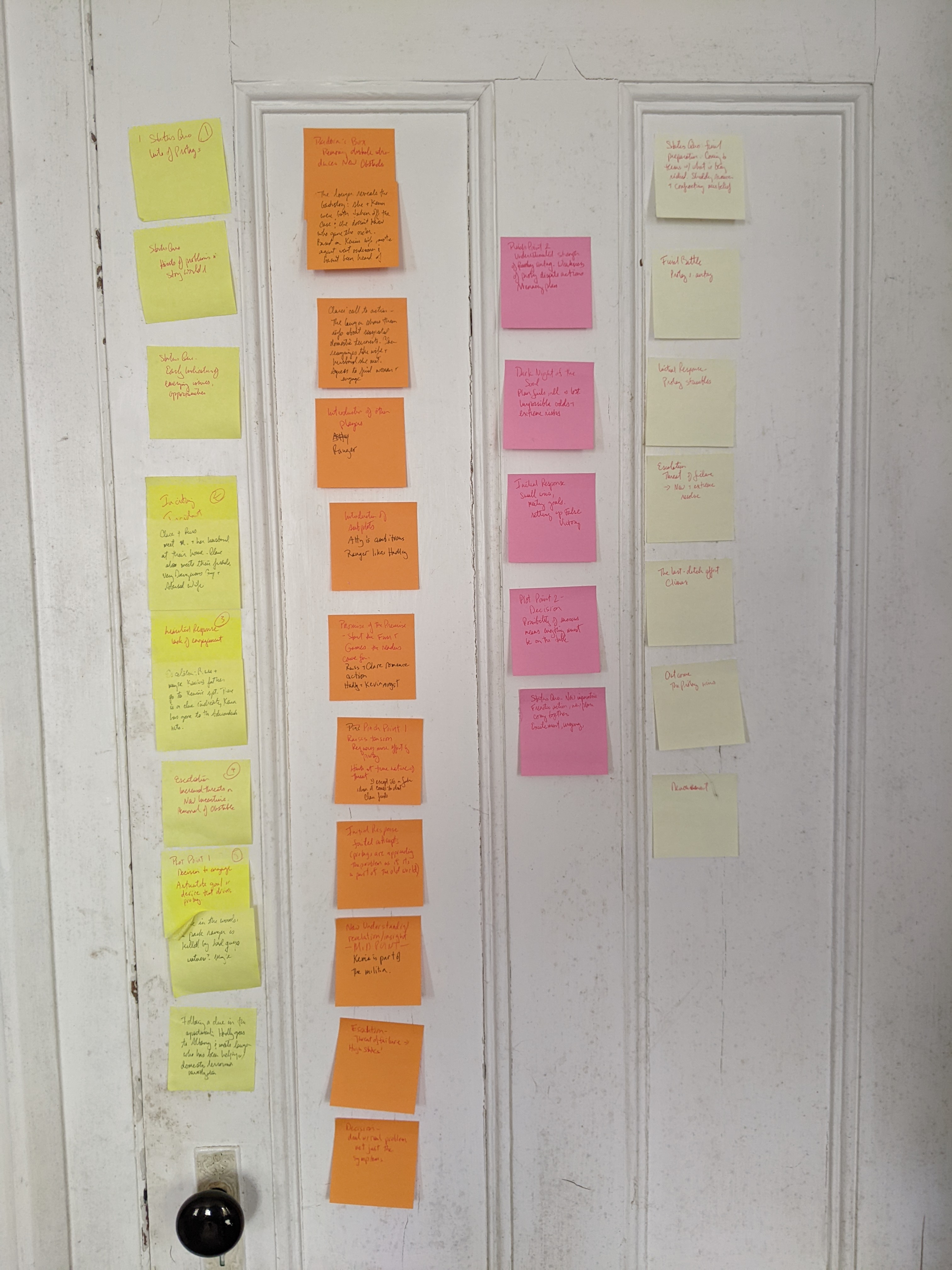
And here's what I'm trying out for my current work-in-progress, a combination of Jessica Ellicott's Post-It note plotting on the framework of a classical four-act structure. 


Also, I really need to scrub off that door to my office. Usually the only person who sees that side is me.


Do you notice story structure, dear readers? Or does it get lost in the flow of a good book? And if you're a writer, what scaffolding techniques do you use?


Monday, October 10, 2022

What we're writing - Hallie's classes and classes...


HALLIE EPHRON: Once again I get to kick off with our WHAT WE’RE WRITING week. And this week, for the first time in, what, two years? I’m pulling together materials for writing workshops I’ll be giving IN PERSON over the next few months.  


Zoom/teaching has been swell. But enough is enough. I’m ready for people! For a *conversation* about writing! I’m ready for people to ask questions, poke fun, and disagree. Moreover I don’t care if I get covid (again)… I’m going on a plane and eating in an airport and staying in a hotel, dammit.

First up is a conference in starting later this week – Surrey International Writers Conference. It’s near beautiful Vancouver where it is nearly guaranteed to be raining. I’m giving writing workshops, moderating panels, and my favorite: “blue pencil sessions” which are one on ones with writers where I get to listen and provide what advice and encouragement I can for their works in progress. It’s always a thrill when someone I counseled year earlier shows up to say they scored a book contract.

I also get to stay up late and be part of a SHOCK THEATRE! One year, Robert Dugoni played a memorable and terrifying werewolf... 

This year it’s a mashup of DRACULA and HOUSE OF WAX put together by the inimitable Michael Slade and featuring me and an incredible cast, including Diana Gabaldon, Bob Dugoni, Donald Maas, Susanna Kearsley, Anne Perry, Mary Robinette Kowal… and more. We get to stay up late and pumpkins will be smashed. See: died and gone to heaven.

Then the New England CrimeBake – our very own bash where I’ll get to hang out with Hank and Lucy and host Lynn Denley-Bussard who was a student in one of the first classes I ever gave for the Cape Cod Writing Center. William Martin, one of my favorite human beings in the world, will be this year’s GoH.

Then on November 14 it’s back to Zoom-speaking for a great group, the California Writers Club (South Bay Writers). I was thrilled to be invited. I’ll give a crash course in writing a mystery novel. We’ll disassemble the sausages.

Rounding things out in early December I’m hoping to be in St. Augustine, one of my favorite-est of places if only just for walking around. The amazing Michael Neff is hosting one of his Algonkian author-mentor workshops and I get to play mentor for a group of always talented, interesting, and highly motivated attendees.

And it’s not public yet, but in February I’ll be teaching a week-long class in Key West. And for members only, in April a virtual, two-week class for the Sisters in Crime On-line Chapter Guppies.

In the meanwhile… I really do plan to get back to writing-writing. Really I do.

Are you back to meeting with the world in person, too? 

Thursday, January 31, 2019

The Nutty (Happy, Nervous) Professor

JULIA SPENCER-FLEMING: Behold, I have done a new thing! Actually, it's something I've done before on and off, over the last fifteen years, but the form and setting are quite different. I'm teaching! I am an adjunct instructor at the Southern Maine Community College. Not in creative writing, as you might expect, but lecturing on Technical Communications, an interesting field of "soft skills" encompassing writing to audiences, running meetings, making oral presentations and creating documents and websites collaboratively.

"Julia," I hear you ask, "Haven't you been a full-time writer since 2001? What do you know about running meetings?"

Good question, astute reader. The answer is, I'm tapdancing as fast as I can to keep up. Now, a  lot of the ground covered by "Technical Communications" consists of plain common sense things most of us have learned by our fifties if we have any work or volunteer experience at all. For instance, I delivered an hour lecture last night on cultural variables to be aware of when dealing with people and businesses from different countries - something most of you would have been able to do if you'd A) been paying attention to the news over the years and B) seen the great Michael Keaton/Gedde Watanabe flick Gung Ho.

For the most technical subjects, I'm breaking a sweat reading ahead in the textbook and looking up articles online. I was expressing my worries to Jeff Cohen when we were setting up his blog visit yesterday. "I'm only one chapter ahead of my students!" I said. 

"Don't worry," he replied, from the vantage point of seventeen years teaching undergrads. "Your students are one chapter behind where you think they are."

My students are the other reason I'm able to carry this off. Southern Maine Community College is located in Maine's largest and most diverse metro region, the greater Portland area. Like a lot of community colleges, it has a large share of nontraditional students, older adults (older then the usual 18-22 year olds) who've been in the working world and are back in school to retool or add on to their occupations. I'm teaching two sections of technical communications, and in both classes I've got people who have been employed by (or are still at) large tech firms, high-end manufacturing companies, and regional corporations. 

They're adding their invaluable experience to our classroom discussions, and also helping to confirm to the rest of the students - largely engineering and comp sci majors - that squishy stuff like ethical standards, clear writing and generosity toward coworkers really, truly are important in the working world.

Having an actual job - as opposed to my work-from-home career - is good for me, I think. It's forcing me to be more organized and to stay focused. I'm juggling more than I've had to since I had  multiple kids in school, not to mention the novelty of actually having the meet *ahem* deadlines.

I got the job, more or less, when a friend who was retiring from the position asked me out to lunch last fall. "I want you to take over the class I teach," she told me over pizza and beer. "You need to do something to get out of the house now Youngest is away at university." She was right. I have the world's shortest work week - an hour Tuesday and Thursday afternoons and two hours Wednesday evening - but I genuinely enjoy being in the college environment. I like talking to my students. I've enjoyed meeting my department head and the faculty liaison, and I'm considering attending the monthly adjunct happy hour(!)

One of the most eye-opening aspects of all this has been how well I've taken the whole thing in stride. The last time I stepped back into the workforce after a long absence I was in my mid-thirties, looking for a job after being a stay-at-home mom for five years. I remember agonizing over how to apply, what to say, what to put in and leave out of my resume. I didn't think I had anything to offer the business or legal world. In the end, I joined a temp agency because they literally won't turn anyone down. It took a year of temping to build up my confidence to seriously approach law firms for a real, career-oriented position.

This time, I simply thought about what my friend said, agreed, and sent an email to the woman who ran the department. I pulled together a "resume" in less than an hour, and our face-to-face meeting was relaxed. I felt as if I was as much interviewing her about the position as she was interviewing me about my qualifications. What a difference two decades can make! I wouldn't mind being a redhead again, and I'd love to have my thirty-something knees back (oh, how I used to ski!) but I wouldn't give up the confidence I've earned since then for Jessica Chastian's hair and a pair of bionic joints.

How about you, dear readers? Have any of you jump-started your life with a new thing?

Monday, May 28, 2018

Why We Teach

RHYS BOWEN: As you are reading this I'm sitting outside an old farmhouse in Tuscany, amid the olive groves and vineyards and I am teaching a writing workshop I've called Novel In A Week. No, I don't expect them to write a novel in a week. The aim is to take an idea they have for a novel, an idea they haven't dared to tackle, or to take a stalled novel and give them the tools to structure it, to give them the bones to build upon so that they can go home and say "Now I see where I have to go."

Too often a beginning novelist has a brilliant idea but gets bogged down  in the middle of exposition and gives up in despair. So I'm looking forward to helping a group of writers turn their dreams into reality.

Someone at Malice asked me why I teach. Aren't my books now bestsellers? The answer is yes. I don't need the money, and in fact a lot the teaching I do hardly pays for my transportation. I teach because I enjoy sharing what I've learned. I guess it must be in the blood. I had a great aunt who was a teacher, my mother became a school principal, my aunt was a teacher and two of my children have been teachers. I have also run a pre-school and taught college--the broadest spectrum of teaching.
Of these I found the college writing classes I taught were challenging, stimulating and really beneficial to me. When I had to stop and think why a particular aspect of a story worked or did not work it gave me insights into my own writing.

Now I find that every time I teach a course I learn something. I am energized and can approach my own writing with enthusiasm. And I find it exciting when I see a new writer who has great potential. I've been on the faculty at the Book Passage writers conference for several years and at least two of my protegees have been published. One is my now good friend Susan Shea! I read her first three chapters and told her that her book actually began on page 19! She sold it!

So, dear Reds and Readers, how about you? I know Hallie and Hank teach all the time. How about the rest of you? Do you teach and if so why? Any experiences to share?

JULIA SPENCER-FLEMING: I taught for several semesters at the University of Southern Maine's creative writing MFA program, called the Stonecoast Program (after a spectacular Victorian-era stone house that has sadly been sold off.) And I've taught a number of quick two-hour seminars. I very much enjoy it, for much the same reason as you describe, Rhys - it helps me focus on the underpinnings of my own work when I have to dissect it (and other fiction) for my students.

There's also a great joy in helping someone find his or her voice and seeing them become a better writer. I believe there are some aspects to fiction writing that can't be taught, per se - for instance, you either have a writer's imagination, or you don't. But there is an enormous amount of technique and clarification that can be passed down, and we're all the better for participating in that process.

LUCY BURDETTE: Darn, I wish I was going to Tuscany! I have 2 books that are stalled, and that sounds like heaven. I don't teach as much as some of you others, but I agree, it always helps me see things in a new way. And it's so much fun to watch someone take a leap forward after getting feedback on their work. I have some very clear memories of classes and workshops I took as I was learning to write. Some of them nearly discouraged me completely, while others provided just the fuel and excitement I needed to forge ahead. I try to do the latter, always!

HALLIE EPHRON: As I write this I'm teaching at Pennwriters. There are two writers here whom Lucy and I taught at our own writing retreat (Ramona Defelice Long and Kimberly Kurth Gray. And other writers I've met at Crime Bake and Writers Digest conferences. And it's always a thrill to hear about their success. Teaching is FUN. And I never get teacher's block.

INGRID THOFT: I love teaching and find that it is a wonderful counterpoint to my own writing.  I think it’s essential for writers to, every so often, get up from their desks and interact with other readers and writers.  My goal when teaching is to get people reengaged with their work if the spark is gone and to also give them practical tools to get the story onto the page.  In December, I volunteered with a second/third grade class to help them write bedtime stories—in my pajamas!  It was a hoot and so gratifying to see kids excited about stories and language.  I’m inspired by the passion and enthusiasm of my students, whether they’re in elementary school or retired or somewhere in between.

JENN McKINLAY: I've taught workshops, mostly, at libraries and senior centers, and a few conferences. Usually, I am trying to kick start the people who want to write a book but don't know where to start. I find I'm mostly teaching them how to get out of their own way. Don't get hung up on selling the book before you write the book, don't sweat the font size. I like to say, "'I love your Fifty Shades of Girl with a Twilight Tattoo, but I'm passing on it because you used the wrong font,' said no editor ever." LOL. The hardest thing about deciding to be a writer is that you have to actually get your butt in the chair and write the book. It's always very rewarding to see students who get it. It reaffirms my own work ethic every time.

HANK PHILLIPPI RYAN: It is the joy of my life. And yes, I do it often, and with much delight.  When I think of how much I had to learn, and keep learning every day, and how many things I wish someone had told me..ah. And sometimes you see it, you know? That spark of recognition of the bit of advice or guidance that connects, and maybe changes a life--or a book at least. It is incredibly gratifying. Paula Munier and I just taught an intense, intensive and totally immersive weekend seminar on Cape Cod for WritersDigest. It was exhausting and exhilarating, and none of our lives will ever be the same. My goal is to have a "student" be at their computer, one day after the class--and say to themself: "Oh! That's what Hank meant!" And I always learn something when I teach.  SO rewarding.

DEBORAH CROMBIE:: I don't teach as much as some of you. I do enjoy it, but I enjoy being a student even more. My favorite part of going to writers conferences is the opportunity to listen to other writers and absorb their insights. I always come back full of ideas that I want to apply to my own books. I would absolutely LOVE to be in Rhys's class in Tuscany right now. I'm sure I would work out all my plot problems while eating delicious Italian food--and that it would be cooler than Texas.  Rhys, your students are so lucky!


RHYS: I was always told Those who can do, those who can't teach..Clearly this is not the case. Here we are.. eight well known, well respected writers and teaching is something we enjoy and look forward to. So do share your experiences: for the writers among us, do you enjoy teaching or have you taken workshops that have been an inspiration, changed the way you think about your writing?

Who teaches other subjects? What does it mean to you?

Thursday, May 17, 2018

The hardest job...

HALLIE EPHRON: We all like to complain about how hard writing is. And don't get me wrong. It IS! 

Howevah... it's not the hardest job I've ever had.

Lately I've been watching in admiration as teachers in West Virginia, North Carolina, Arizona, Utah, and Ohio stand up for themselves and demand not only a reasonable wage, but books and supplies and decent classrooms and buildings in which to work. Their struggle brings back my own memories of when I taught elementary school in the early 70's. 

I'm here to tell you teaching was the most challenging, most exhausting, and ultimately the most satisfying job I've ever had. And to all those people who think all we have to do is test our way to educational excellence, I say: spend a semester in the classroom and then tell me it's that easy.

Here’s me in 1974 teaching elementary school at PS 189 in Manhattan’s Washington Heights. By this time, four years into the job, I was starting to feel as if I knew what I was doing.


I remember arriving at PS 189, fresh out of graduate school, two days before school started. I'd just been hired. The old brick building was north of Harlem where I’d done my student teaching--so far north that it overlooked the East River from a West side address.


Its double front doors opened onto a lobby with a center staircase. Its brass doorknobs, embossed with NYC PUBLIC SCHOOLS, were worn smooth. The main office door had a knobless-socket where there should have been one of those knobs. Someone had pilfered it over the summer.


My classroom was three flights up. I remember looking around Room 405 in dismay. On that hot September day, half of the windows wouldn’t open. Thirty desks, lined up in rows of six, were nailed to the floor. There was no chalk in the chalk rail. The sliding doors of a long narrow coat closet on the side of the room were stuck half closed. A supply closet was locked and, when I eventually managed to get it open, turned out to be empty. The only contents in the massive oak desk at the front of the room were love notes from kids to a teacher named Miss Silverman.


I was probably making a list of tools to bring in from home to break into the supply closet and unbolt the desks when a woman came into the room. A pretty brunette in her thirties was my guess. She introduced herself as Susan Silverman. Ah, the previous tenant. She told me that the custodian would be up shortly to unscrew the pencil sharpener and move it to her new room, a floor down.


Pencil sharpener! I hadn’t noticed that there actually was that single useful item in the room. And I cursed myself for not having noticed it and removed it for safekeeping. 

I was already learning to think like a teacher.


All I can say it, thank goodness for the kids. That year I had a sixth-grade class of non-English speaking students, a mix of Dominican, Cuban, Greek, and a lone Albanian, most of them "fresh off the boat." Though I eventually discovered that there was a supply closet in the basement with chalk and construction paper and other basic supplies, there was no curriculum for sixth grade (or if there was, it was a well-kept secret). There were no textbooks in the building appropriate for nearly-adolescents learning English. I flew by the seat of my pants and the kids flew with me.

In my mind's eye, I can still see very one of those kids from my first class: Arturo, Roxanne, Evaristo, Eduardo, Maria, Janet, Ana, Angela, Roberto, Ephigenia, Xiomara, Frankie...


What's the hardest job you've ever had?

Saturday, October 19, 2013

A Tale of Two Kids, a guest blog by Tim O'Mara

                          -WINNERS-WINNERS-WINNERS-
Through the Evil Days ARC: Dotty Ryan, Lynda, Pat D.    Chance of a Ghost OR The Thrill of the Haunt: Bev Fontaine    Her Last Breath: Lora.  Please contact julia at juliaspencerfleming dot com with your info to collect your free book!

JULIA SPENCER-FLEMING: I first came across Tim O'Mara's work when I bought his debut, SACRIFICE FLY, for my husband, a special ed teacher.  Tim's protagonist, like Tim himself, is a teacher specializing in hard-to-reach, at-risk kids, and I knew Ross would find it interesting. He did; so much so that he thrust it into my hands and said, "You're going to want to read this." Tim has just released the second Raymond Donne mystery, CROOKED NUMBERS; readers, consider that I've thrust it into your hands. You're going to want to read this.

 R’s had a tough life. He came to our school last year as a sixth grader, and during our very first discussion about the rules in my Math class, he gave “the look.” The look that pretty much says: You are not going to tell me what to do.
I gave him one back, I’m sure he had no idea had to interpret. This was a look I had not given a student in almost a decade. My look said, You are going to Camp.
Camp” is where I got my start as an educator. I was kinda directionless the summer

before graduating from SUNY–New Paltz, and my girlfriend was heading off to work with special-needs kids at Camp. Having nothing much on my calendar and eager to earn a few hundred dollars for four weeks of fourteen-hour days, I followed. I eventually lost the girlfriend, but found a new love: working with kids.
I’m still involved with Ramapo For Children Camp—our seventh graders go there every year for their spring trip—and I try to incorporate what I learned from my five summers there into my job as a Special Education/Math teacher at NYC’s The Computer School. R is just the kind of kid I learned from. And after knowing him for all of half an hour, I knew he needed Camp.
I spoke with his foster mom—the kind of woman who makes you feel optimistic about basic human kindness—and she told me R had previously been thrown out of two camps due to behavioral issues. I told her I knew one camp he would not get thrown out of and after months of confusing paperwork and games of phonetag, R went off to Camp. At the end of the session, I went to pick him up—foster mom was expecting a baby any hour—and found that he’d been a superstar for the past three weeks.
He’s read more books than any other kid here,” his bunk counselor told me.
I didn’t know he was that into reading. When we got back to school in September, he told me that his foster mother wanted to read my book, Sacrifice Fly, whose hero, Raymond Donne, is a special education teacher who used to be a cop. The next day, I brought in a signed copy for her celebrating the birth of her son. R held it in his hands, turned it over like it was an undiscovered treasure, and I knew he’d be reading it before mom. Cool.
That was a Friday. On the following Monday, he came in and informed me he had read the entire book over the weekend.
What’d you think?” I asked.
He got a strange look on his face and shrugged.
What? You didn’t like it?” I didn’t even try to hide my feelings. This book was nominated for a Barry Award, and this kid was going to criticize it?
He gave me a rare humble look, squinted, and said, “I wanted more.”
The heck with the Barry nomination. R can blurb my next book and any that follow. And he’s going back to Camp next summer. We’re gonna start the paperwork earlier this year.
T is another tough kid.
Hard to reach, hard to teach, with a wall around him that would make the Chinese envious. He was in another of my math classes last year, and butting heads with him became an almost daily exercise. There were the occasional days where he let me glimpse over that wall, and what I saw was a kid who wanted to be brilliant but didn’t want the pressure that came with it. Another kid I could learn from.

Two weeks ago, T earned a one-day suspension for creative use of a belt. He spent an entire Thursday in the principal’s office. At the end of the day, the principal approached me and said that T was thinking of going to my Crooked Numbers book signing at the local Barnes & Noble. Having never said a word to me about my writing, it turned out he was perfectly comfortable telling my principal he was impressed.
Maybe you can use that,” my boss suggested.
Maybe.
The next day, I worked with T and had a very positive—wait for the intended Math pun—session with him on adding and subtracting integers. Afterwards, I took him into the hallway and presented him with a signed copy of my book referencing a brief talk we had had the day he was suspended.
To T,
This book has a lot to do with the choices people make — including the author’s.
He looked at the book and held it in a slightly different manner as R. Almost like he was afraid to break it. He didn’t say thank you—that’s not who he is. He put it in his book bag, and we both went off to lunch.
That was a week ago. He has not said a word to me about the book since. My fantasy is that T reads it, understands the hero’s motivations and wants, and becomes a more positive, confident student. I want him to show up at tonight’s reading and sit there in the audience with a look on his face that says, “That’s my teacher, man!” I want that wall to start coming down.
In reality, I’ll settle for a small crack. 

Do you have a teacher who made a difference in your life, dear readers? Let us know, and one lucky commentor will win a copy of CROOKED NUMBERS!
Tim O'Mara teaches math and special education in the New York City public schools. His debut mystery, SACRIFICE FLY was a Barry Award nominee. The novel introduces Raymond Donne, a former cop turned Brooklyn public schoolteacher. His second book, CROOKED NUMBERS, was just published. You can find out more about Tim and his books at his website, friend him on Facebook, and follow him on Twitter as @TimOMaraAuthor.