Showing posts with label plotting. Show all posts

Saturday, May 27, 2023

What We're Writing Week: Structure and Scaffolding

 JULIA SPENCER-FLEMING: My writing for my college classes is thankfully over until next September, and, like the proverbial In spring, a young man's fancy lightly turns to thoughts of love, in May, a college instructor's fancy bemusedly turns to prepping other courses. 

In my case, I'm working up another one of my creative writing seminars. I've done them on creating suspense, on using setting to strengthen your writing, and on developing characters. Now I'm turning to story structure.

Not, mind you, outlining techniques. I'll leave that to authors far more skilled at them than I. But I'm someone who has long been fascinated by structure - by acts and scaffolding and playing with chronology. One of the first things that led me to writing a mystery, when I was a very unfledged novice, was the fact crime fiction had, as it were, a skeleton already provided, something I could drape muscle and skin over.

And yes, the fact that was literally the metaphor that presented itself to me all those years ago probably indicates I was choosing the right genre. 

Here's an example of how I worked on ONE WAS A SOLDIER, which had eight point of view characters (!) whose stories switched between the past and the present. 


I was very pleased with the book, and glad I was so creatively ambitious, but I do have to point out this was where I fell off the book-a-year cycle - this was published three years after the previous novel - and so far I haven't gotten back on that horse. Maybe simpler is better?

This is a fascinating look at screenwriter/director Christopher Nolan's process, which I can across while researching. I encourage anyone interested in structure to click through and read the whole thread, which also includes other examples of mapped story.


The amazing Jennifer Crusie, who is one of my writing goddesses, uses a story-creating technique so far from my comfort zone I wouldn't even know how to begin: she makes collages. 


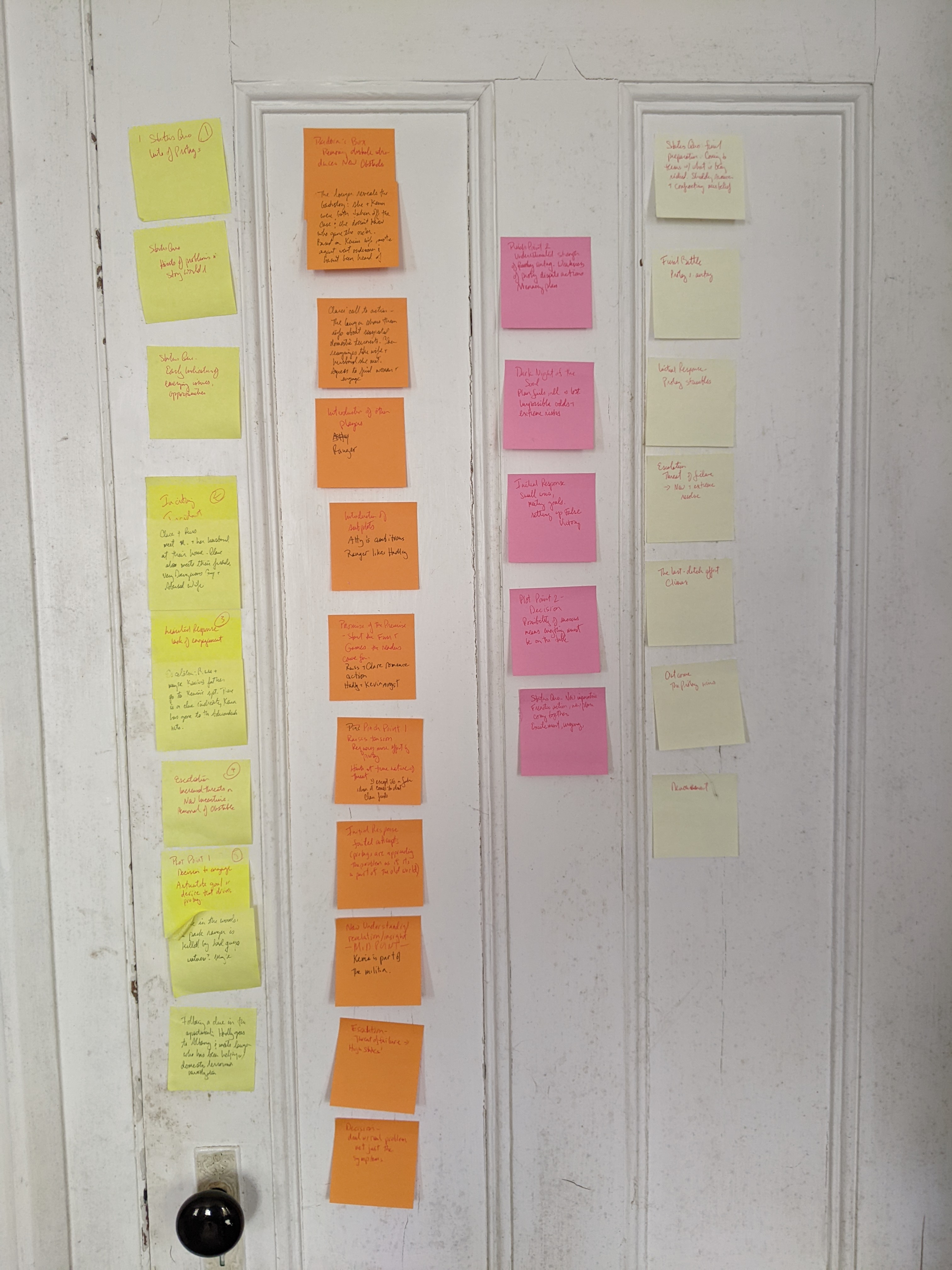
And here's what I'm trying out for my current work-in-progress, a combination of Jessica Ellicott's Post-It note plotting on the framework of a classical four-act structure. 


Also, I really need to scrub off that door to my office. Usually the only person who sees that side is me.


Do you notice story structure, dear readers? Or does it get lost in the flow of a good book? And if you're a writer, what scaffolding techniques do you use?


Friday, January 27, 2023

I Have An Idea! by Vicki Delany

Jenn McKinlay: As a huge fan of the Sherlock Homes Bookshop mysteries, I am just thrilled to welcome Jungle Reds friend and fellow author Vicki Delany. And today, she is letting us glimpse behind the curtain. 


Vicki Delany: “Where do you get your ideas?”

As writers we’re often asked that.  I’d love to get my ideas from the Idea Factory, or maybe Ideas-R-Us. But so far I haven’t found such a convenient place.


What is an idea anyway when it comes to a novel? What does that even mean?

The idea is the spark from which all else flows. Coming up with an idea is pretty easy.  I can give you the ‘idea’ behind one of my books in one sentence. That’s idea is the spark, the germ of the story.

The task now is to turn that one sentence, even one word, into 80,000 words. And that is not so easy.

What has me pondering the origin of an idea at the moment, is my current work-in-progress. I’m writing the fifth in the Tea by the Sea cozy mystery series.  I was in Italy in October with my good friend, the Canadian writer Barbara Fradkin. We were, as one is in Italy, overwhelmed with great art. We’d been to the Uffizi Gallery in Florence and were walking through the streets heading for either more art or more food when I told Barbara I was having some trouble coming up with an idea for the next Tea by the Sea book.  One of the paintings we’d most admired at the Uffizi was Judith Slaying Holofernes by Artemisia Gentileschi (1593 – 1656).  


(Incidentally, the story behind the famous painting is a mystery writers’ idea in itself.) Barbara laughed and said, “How about a beheading? The main character finds a headless body in a bed at the B&B.”

As I write cozy novels, that wouldn’t quite suit.  Barbara thought some more and said, “a headless doll then. A gift, given anonymously at a bridal shower.”

Bingo! I had my idea. A headless doll is rather creepy, but not out and out gory or repulsive.

What the idea does, in this case the decapitated Raggedy Ann doll given as a shower gift, is provide the inciting incident. The point from which all else that happens in the novel flows.  It also sets the scene for character revelations: obviously not all is well between the bride and her friends and family.

How not well?  Someone is murdered later on. Is the shower gift pertinent to the murder? It might not be, but it sets the scene, starts the action, and gives our amateur sleuth character a reason to ask questions.

And, most importantly, it gives me, the author, a jumping off point.

In the Sherlock Holmes bookshop series, the idea is even less than a sentence. It’s a word. In the latest book, The Game is a Footnote, the word is “haunted house”. Okay two words. In next years book, as yet untiled, the word is “séance.” In last year’s novel, A Three Book Problem it’s “country house weekend.”

The idea is the germ from which all else flows.

Another thing most writers can relate to is the experience of someone offering to tell them their great idea, and then suggesting the writer use that idea and they can split the profits from the subsequent bestselling book. Uh, sorry.  If someone provides one word or one sentence, and I provide the other 79,999 words I’m not sharing anything.

Because it’s not the idea, it’s all that flows from the idea.  And that’s the hard part.  Lay down the clues, build the plot, create the characters, put them in an attractive (or otherwise) setting, have a believable sub-climax when the protagonist is threatened or all seems lost. Build it all to a climax and the grand reveal.  Then wrap it all up. 

I have over fifty published books now, and I’ll admit, an idea for something vaguely original is getting harder to come by.  One of the things I’m most struggling with is a way of having the protagonist catch or trick the killer.  You can only have your character eavesdrop on conversations so many times and leap out from behind the curtains to say, “J’Accuse” with pointed finger.  She can only wrestle so much with a deranged killer at the edge of a cliff in a storm at night.

But I’ll get it, eventually, because I started with ‘an idea’.

I’d love to know how the Reds (who have so many fabulous ideas!) generate their own ideas for such amazing and original plots. And readers, any ideas you’d like to share with us?


Gemma Doyle and Jayne Wilson are back on the case when a body is discovered in a haunted museum in bestselling author Vicki Delany's eighth Sherlock Holmes Bookshop mystery.


Scarlet House, now a historical re-enactment museum, is the oldest building in West London, Massachusetts. When things start moving around on their own, board members suggest that Gemma Doyle, owner of the Sherlock Holmes Bookshop and Emporium, might be able to get to the bottom of it.  Gemma doesn’t believe in ghosts, but she agrees to ‘eliminate the impossible’. But when Gemma and Jayne stumble across a dead body on the property, they’re forced to consider an all too physical threat.  
 
Gemma and Jayne suspect foul play as they start to uncover more secrets about the museum. With the museum being a revolving door for potential killers, they have plenty of options for who might be the actual culprit.
 
Despite Gemma's determination not to get further involved, it would appear that once again, and much to the displeasure of Detective Ryan Ashburton, the game is afoot.
 
Will Gemma and Jayne be able to solve the mystery behind the haunted museum, or will they be the next to haunt it?


Vicki Delany is one of Canada’s most prolific and varied crime writers and a national bestseller in the U.S. She has written more than fifty: clever cozies to Gothic thrillers to gritty police procedurals, to historical fiction and novellas for adult literacy.  She is currently writing the Tea by the Sea mysteries, the Sherlock Holmes Bookshop series, the Year-Round Christmas mysteries, and the Lighthouse Library series (as Eva Gates).


Vicki is a past chair of the Crime Writers of Canada and co-founder and organizer of the Women Killing It Crime Writing Festival.  Her work has been nominated for the Derringer, the Bony Blithe, the Ontario Library Association Golden Oak, and the Arthur Ellis Awards. Vicki is the recipient of the 2019 Derrick Murdoch Award for contributions to Canadian crime writing. She lives in Prince Edward County, Ontario. 

Wednesday, January 4, 2023

Jessica Ellicott on the Mysteries of Plotting


LUCY BURDETTE: You may remember during my last "what you're writing" post that I mentioned how much easier plotting seemed to go after retaining Jessie Ellicott aka Crockett to help me brainstorm. I promised I'd try to get her here to explain her method, and hurray, she's here today! Carry on Jessie...please share your magic!

JESSICA ELLICOTT:  I know not all writers share my enthusiasm, but I adore plotting novels. I like it so much that a few years ago I began to work with other writers on plotting theirs too. I love coaching people who are stuck, either at the beginning of a novel or even part-way through and seeing their eyes light up as the ideas start flowing. 


The strategy I use with clients is really very simple. I believe that one of the reasons plotting can feel so painful and frustrating is that it is impossible to simultaneously generate ideas and also to sort out where the idea belongs in the story. Trying to do so feels like being stuck in a traffic jam with no hope in sight. It’s far more enjoyable to brainstorm a number of scenes that will be in a story first and then go about the business of slotting them into their proper places later. 

Usually, the client and I will meet via Zoom. I ask them to come to the meeting with any information they know, or think they know about the story they wish to tell. I ask them about the projected length of the manuscript and also for the average word count they naturally tend to write per scene.  If they wish to do so they email some thoughts to me ahead of time so that we can launch in straightaway. 

I have a large glass board mounted to a wall in my office and I use it to scrawl some notes during as the client answers some basic questions about the story, like the setting, the time period and any characters they know will appear in it. If it is a crime novel I ask if they have any thoughts about the circumstances around that. If they are writing a mystery series I will ask about the murder method, victim and perpetrator that appeared in the previous book.

Once we have a few bits of information to work with I pull out a pen 
and a stack of sticky notes and we begin to look at the notes on the board as potential scenes. If there is a murder, there needs to be a scene where the victim is introduced. So, I write “Victim Introduced” on a sticky note and place it on the glass wall at random. If there is a victim there has to be a perpetrator, and that character must also be introduced. I write “Murderer Introduced” on another sticky note and place it on the wall well away from the first one.

We repeat the process of adding small idea chunks that are parts of different scenes to the wall and I make certain at this stage to resist the urge to make any of it neat and tidy. I have generally found that the less organized it looks, the more at ease the clients tend to be. Before long, there is a satisfying number of sticky notes available to work with.

At some point the flow of ideas will taper to a trickle, and I know that it is time to switch tasks. This is where my earlier question about word count comes in. Based on the project length and the word count per scene it is easy to approximate the number of scenes necessary to tell the story. There is an underlying architecture to stories, and it is possible to use that framework to begin sorting the scenes into place. Many writers, either consciously or unconsciously, employ three act structure or the hero or heroine’s journey to craft their work. That strategy works a treat for arranging the chaos of scenes jotted on the notes.

As we place the character introduction scenes, clue dropping scenes, etc., I leave gaps for other ideas to appear. They may not arrive immediately, but eventually they always do. And since the gaps are present throughout the storyline feeling stuck is less likely to occur. There is no need to know what happens in a gap back in act one before a gap is filled in scene three. Creative brains seem to like to hop all over the place when generating ideas and a non-linear approach leans into that preference.

The process is easy to tailor to individual writers and even to different projects for the same writer. Some people like to plot the entire novel before they begin to write. Others like to swing back and forth between plotting forward a bit and then writing the scenes they know will be in the story. It isn’t even necessary to write the scenes in order and some people I have worked with discover they prefer to work on whatever feels interesting to them when they open the manuscript.

Many clients find that they like using the technique on their own after we have done a session or two together. Others prefer to have someone to bounce their ideas off and to ask thought-provoking questions. Either way, as long as they are happily able to make progress on their projects, I am tickled pink! After all, there is nothing better than new books to read, is there? Questions and comments welcome!


Agatha award nominee Jessica Ellicott loves fountain pens, red convertibles and throwing parties. She lives in northern New England where she obsessively knits wool socks and enthusiastically speaks Portuguese with a shocking disregard for the rules of grammar. She indulges her passion for historical fiction and all things British by writing the Beryl and Edwina Mysteries and the WPC Billie Harkness Mysteries.

Jessica’s books have received starred reviews from Publishers Weekly as well as one from Library Journal. Her first novel won the Daphne du Maurier award for mystery.


Thursday, December 8, 2022

Lucy is at the Beginning Again! @LucyBurdette #writing

 LUCY BURDETTE: Albert Einstein was once asked how he worked and was said to have answered “I grope.” That feels so familiar! I don’t know if all writers are like this, but I’m always searching for a new approach to getting good words written a little faster. My ears perked up a couple of months ago when Julia mentioned a session she’d had with a mutual writer friend, Jessie Crockett, a.k.a., Jessica Ellicott. She developed a system for brainstorming that worked to provide a book skeleton for even the most devoted pantsers. (A.k.a. those of us who try to write a book without an outline. The keepers of the black hole...)

This is for a different book, but you get the picture!


The tools for this project were simple: sticky notes, different colors for each point of view. Plus a big whiteboard. (Jessie wears headphones and dictates most of her own writing.) She asked me what I knew about the book so far. It wasn’t a lot. I knew exactly how it would open, what Hayley was going to get involved in. I knew that some of it would take place up the Keys in Big Pine Key. I knew there was a cold case. Jessie madly wrote possible scenes down on the stickies and pulled all kinds of information out of me that I didn’t know was there. Because they were on stickies, they could easily be moved around into better timelines. My writing pals Ang and Chris were there for the zoom session and had lots of good ideas, too.

Chris plotting her book


Here's a snippet from that opening chapter (no name for the book yet:)


I scrolled through my stuffed inbox, deleting all the messages from spam to junk to ‘sat on it too long to answer’. I paused over one email that arrived the night before from a name and address that I did not recognize. As my finger hovered over the delete key, the alluring subject line made me pause: Hemingway’s toxic love and an old story. I couldn’t think what kind of clever angle this spam might hold, so I opened it up to see.


Dear Ms. Snow, you don’t know me, and I apologize for intruding into your inbox. I have read a lot about you, both your restaurant criticism and your crime solving. I am hoping to interest you in talking with me, at your convenience of course. 

Below this introduction was pasted a screenshot of a yellowed newspaper clipping.


Monroe County Sheriff’s Department Investigates Report of Missing Woman. May 13, 1978. A 22-year-old woman approached the Sheriff's Department reporting that the friend she had traveled with several months ago from Michigan to the Florida Keys has disappeared. Deputies interviewed all available witnesses and investigated the area where the alleged victim was staying with her friend. There was no sign of criminal activity, although the alleged victim had been living in a commune-type encampment which was subsequently evacuated by the Sheriff’s Department. Several people familiar with the situation reported that the missing woman had been restless and eager to leave the Keys.

“I was the one who reported Veronica missing,” the email continued. “As you can read between the lines, the authorities brushed me off, insisting that she’d left the area of her own volution. But she never turned up in Michigan after I went back home, nor have I heard from her since. I even hired a private investigator. His trail ran ice cold once he hit the Keys.

You've had some experience solving mysteries and I’m hoping that you might help me look into this one.


LUCY AGAIN: One of the reasons that I think Jessie's system works is it doesn't give your brain a chance to say NO NO NO. And that keeps the ideas and possibilities flowing. I've invited Jessie to blog about plotting in January, but meanwhile, do you have ideas for keeping the creative juices flowing?

My stickies after Lottie got involved


Sunday, May 1, 2022

What We're Writing: Jenn's Idea Machine


Jenn: Okay, I am in full plotting mode, and I really wish I had an idea machine. Some big metal contraption with ominous looking buttons and levers, where I could just drop in miscellaneous junk like odd lengths of thread, a random thumbtack, child sized scissors that are too small but I can't manage to throw them out, business cards of people I don't remember meeting, you know...stuff. I'd like to drop it into the machine, hit a button or pull a lever, and have it whistle and hum, clank a bit, and then belch and chug, emit a loud bang with a plume of purple smoke and then spit out the plot to my next novel in a neatly typed document, bullet points optional.

That's what I would like. What I have is a stack of notebooks, one for each title that I am attempting to plot. I have two cupcake bakery mysteries, a women's fiction, and two more library lover mysteries, and an idea that I'm noodling with just because.

I use a pencil when I plot because I do A LOT of erasing, crossing out, and occasional stabbing :) I will admit that I find it very therapeutic to rip out a sheet, mutter some curse words, and crumple that paper and throw it on the floor. It also entertains the cats, so that's nice.


This is the one time in the writing process that I envy the seat of the pants writers. They don't torture themselves like this. They just sit down and away they go. Me? I need a map, a plan, a general idea of where the plot is going otherwise it's rewrite city and I hate rewriting.

So, that is what I am doing for the next month. Any tips and wisdom from you, Reds and Readers? What materials do you use to get the ideas flowing? White board? Post-Its? New file on the computer? How do you get your plot machine started? 


Tuesday, September 21, 2021

What We're Writing: The Score is Outline-1 Hank-0


First, yes, this has been a crazy week for "the book that is."  

 I spent last Monday night at the Brookline Booksmith virtual launch of  HER PERFECT LIFE life, and I have to tell you it was transformative.  There were 346 people!

 And so much love and joy that I was in tears much of the time. Thank you all who came, and thank you all who bought books, and I honestly have never had such a fantastic event. 

Below I am signing the pre-orders in the Booksmith's empty basement, and of course I put my mask back on right after the photo.

The wonderful reviews keep coming, including the Providence Journal saying "Her perfect life is as close to perfect as a psychological thriller can be." Which, I have to say, made my Monday.

(If you have not purchased HER PERFECT LIFE, this is the one time I will say to you. Please do :-) No pressure. It is just my career. Click here.


 A star from Kirkus and a star from Publishers Weekly and my endless endless gratitude. If you want a copy signed personally to you, I can tell you how. Just mention it in the comments.)

But of course, in my world of spinning plates, I am also trying to finish "the book that is to be," and I will tell you that the deadline for it is October 6.  (Ha. Ha.)

And here's the crazy thing that happened along the way.

So, you know me, a card-carrying pantser, or as George RR Martin described it, a gardener. He says some authors are architects, that they build the structure of their novels, and then weave and plaster their story onto that scaffolding. A plotter. Other authors, he says, are gardeners, who have a seed, and plant it, and cultivate it, and then watch their story grow. You know this. 

Anyway, for 13 books, I have been an inveterate gardener. I have no idea what comes next, you all know this, too, and so far, that has worked well for me. 

But one day, back in, maybe February, I was thinking about my new book, book 14, and suddenly, the whole thing appeared to me. WHAT?? 

I sat down with a notebook and a pencil, yes pencil, and wrote out four pages of outline. Beginning middle end. Everything! Everything that happened.  AN OUTLINE.

It took about half an hour.

Wow, I thought, this is awesome. This is sensational. This is the best thing that has ever happened to anyone in anyone’s conceivable entire life. 

I was ecstatic. I thought wow, why didn’t anyone ever tell me about this! And of course they have, Jeffrey Deaver has spent years trying to convince me to write an outline, and although it worked for him, I never quite believed it. 

But there it was,  four soon-typed pages revealing the entire story. EVEN THE END. I HAVE NEVER KNOWN AN END. Amazing. 

So I sat at my computer, gloriously happy, and started banging it out. What happens next, the question that always filled me with fear, this time it was a snap! I just looked at my pieces of paper, (which I bought a magnet board to display), and it told me what happen next. Incredible. 

I got to about 60,000 words. And slammed hard into the wall. It just wasn’t working. It just wasn’t working! People were doing things for no reason, they were saying things that were ridiculous, they were behaving  in insane ways, and I just sat and stared at it. What had happened to my beautiful story?

Time passed, and I stared at the page. I asked myself all the questions I always ask when I am stuck: what would really happen, what would someone really do, what time is it. I asked myself all those things. And nothing was working.

And time was going by.

Time. Was. Going. By.

I finally called my editor and said hey, wanna look at my manuscript? I’m about two-thirds finished with the rough draft, and I’m not quite sure of where this is going, can you just look at it and see where I may have hit some quicksand?

She read it in a day, maybe two, and we chatted. She said: this is a great story, really good, but it’s only the story. “There’s not enough…thinking,” she said.

Then she paused and said: I don’t mean a bunch of internal dialogue, but this is all plot and no depth. 

And I said yeah, but by word count I’m about  60 percent of the way through, but by the story arc, this should be almost finished. Is that why I can’t figure out what to do?

And she said: absolutely. Go back and open this up.

And, reds and readers, that is exactly what I am doing.

 Turns out, I knew how to make an outline, hilariously, but I did not know how to use it! 

Now, I am closing in on the ending, sort of, and don't know what it it, and it's NOT THE ONE IN THE OUTLINE, but at least I know what the book is about. More than story, it is about the characters. And gardening.

Yes yes, I obviously already knew this. It just took a minute to come back to me.

Book 14, underway.


And book 13, HER PERFECT
LIFE, is now happily in the world, thanks to all of you, and I am floating! (LOOK, Zibby Owens (gasp!) chose it as a top read for fall!) 

What do you think about what my editor told me? 

Monday, December 14, 2020

What we're writing week: Hallie assesses the mess


HALLIE EPHRON: Lately I've been writing *about* writing. Musing about something I heard when I was the panel moderator at a mystery conference. Walter Mosley drew a distinction between story and plot.

Story is what really happened. Plot is the order in which it's revealed to the reader.

I’ve been pondering that distinction ever since, because it perfectly captures why mystery novels are such fun to read, and why they can give you a brain cramp to write.

Here's an example from The Maltese Falcon. In the first scene, Detective Sam Spade meets a prospective client. He agrees to help the alluring Miss Wonderly find her missing sister who has run off with ne’er-do-well Floyd Thursby. Soon Spade (and the reader) will realize Miss Wonderly isn’t Miss Wonderly, there is no sister, and a bullet that takes down Spade’s partner who goes to investigate the missing sister was meant for Spade.

But the story begins long before Miss Wonderly set foot in Spade’s office. It involves the theft of a priceless artifact, a falling out among the thieves, with Spade’s affair with his partner’s wife thrown in to complicate matters. All of which is revealed to the reader by the end of the book.

One of the biggest challenges in writing a mystery involves reconciling the sequence of real events (Moseley's “story”) with the order in which they’re revealed to the reader (“plot”). The story should obvious and logically airtight, only in retrospect. The pleasure in reading a mystery comes from seeing past the characters’ lies and obfuscations, past the author’s clever misdirection, and sussing out each characters’ true motivations and actions an instant or two before the author reveals them.

Because I’m more of a pantser than a plotter, I often arrive at that glorious moment when I type THE END for the first time, only to find that my novel is riven with plot holes. I’d like nothing better than to pick up a blue pencil and start editing words and sentences, create more shapely paragraphs, more compelling beginnings and endings. But when I raise my head out of the weeds, print out the manuscript and read it through, I find inconsistencies and head-scratching moments. Sometimes, even I’m not sure how the villain pulled it off.

For instance, in the first draft of CAREFUL WHAT YOU WISH FOR, a murder victim misbehaves in a coffee shop after, it turns out, he’s already dead. I hadn’t worked out exactly how that happened without “Jiggery Pokery” or an “Act of God” which the Detection Club (formed in 1930) required their mystery-writing members to disavow. I had to assess the mess and make a million tweaks so that in the end it was physicall plausible and logically airtight, and yet the reader wouldn't see it coming.

READERS: Do you ever finish reading (or writing!) a mystery novel and find yourself muttering But but but... and reeling off the inconsistencies the author never properly addressed?

WRITERS; What do you do when you read your first draft and spot those gotchas and even you aren't sure how your character pulled it off?

Sunday, May 10, 2020

What We're Writing (or not) Week - Jenn McKinlay

First, Happy Mother's Day to all who mother two legged, four legged, finned or feathered! 

And, because this is also a day that can be difficult for many, here are hugs to those who wanted to be moms but life had other plans, those with complicated relationships with the ones who mom them, to those who've lost their moms, and to those whose active mom time was shorter than expected. Please know that you are beautiful, special, uniquely you, and you are loved.


Second, we have some winners!!!  From our coppersmithing author friend, Sara Dahmen, the winners are...


Celia Fowler for the book!
Susan Emerson for the copper straws!

You can email Sara at: housecopper at gmail dot com with your addresses and she'll send your prizes! Congratulations!

Jenn McKinlay: And now, what am I writing? Welp, I can start by saying it hasn't felt like writing. It's been more like driving alone in a white out blizzard in a Geo Metro from New London, CT to Worcester, MA -- a white knuckling, while really needing to pee, drafting in behind a trailer truck for the entire stretch of I-395 experience, ending when I landed at my brother's house, where I did a face plant in the snow but shot my hand up out of the snowbank to retrieve the tumbler of whiskey he held out to me. Good times!

Basically, I'm writing Wait For It, my second stand alone women's fiction rom-com, by the seat of my pants, which is exactly what driving through that blizzard felt like. I couldn't see where I was going and every mile felt like five hundred miles. I had no idea where I was or when I would get to my destination, if I arrived at all. Full disclosure, this is the first book I have written by the seat of my pants (NO OUTLINE!) since I started writing mysteries. I have no idea why. The world was on fire all around me and I just couldn't get it together to write an outline but the book was due either way, so I strapped in and away I went. Only time will tell if this was the stupidest/smartest thing I've done in writing to date. 

All I do know is that the book is due on May 15th, and IT WILL BE DONE. Because it's in no shape to be shared right now, I'm going to share a snippet of Paris Is Always A Good Idea, which I did have an outline for, thank God!

Excerpt: Chelsea Martin vs. Jason Knightley

“You’ve got some hidden talents, Martin,” he said. 
I knew he was trying to get a rise out of me and I should resist. Instead, I smacked his feet off the corner of my desk. 
“You’re mistaking my work space for the frat house you wallow in, Knightley,” I said. “Feet stay on the floor.” 
“You’re no fun,” he complained. 
It was exactly the sort of thing he could have said to me on any other day and I wouldn’t have thought anything of it. Not today. Today I felt as if he was speaking my truth, and it hurt. 
“Was there something you needed?” I snapped. “Because I really am busy.” 
He studied my face. Clearly, he’d been expecting a bit more of our usual back-and-forth. 
“Busy doing what exactly?” he asked. 
“Packing,” I said. I gestured to the box and my stuff going inside the box. I really thought I should get points for not adding duh to my answer. 
He heaved an exasperated sigh. “No kidding, but why are you packing?” 
“Because I’m leaving,” I said. “Not that it’s any of your business.” 
“Wait . . . what?” He rose to his feet, and I found myself staring up at him. “You’re serious? You’re leaving? For real?” 
“Yes,” I said. “In two weeks I’m gone.” 
Jason stared at me, slack jawed. He looked stunned, as if I’d just told him I was pregnant and the baby was his. 
“But . . . that’s . . . How . . . Why . . .” 
I took no small satisfaction in making the usually smooth-talking Jason stutter. I watched as he shook his head as if trying to realign his brain. When he finished, he crossed his arms over his chest and glared at me. 
“Martin, you can’t leave. You can’t leave me.” 
I stared at him. He seemed genuinely upset. Had I misjudged our heated rivalry as corporate fundraisers for the American Cancer Coalition all these years? I’d thought he couldn’t stand me. Had I been wrong? Maybe beneath his flagrant disregard for my organizational skills and his sarcastic asides at meetings when I was speaking, he actually liked me. Was our relationship the professional equivalent of the boy on the playground who showed a girl he liked her by pulling her pigtails or punching her in the arm? 
“I mean, who is going to make me look good at the weekly staff meetings if you’re not there to bore us all to death with your Power- Points, charts, graphs, and other assorted mind-numbing minutiae?” he asked. He uncrossed his arms and spread his hands wide. “I count on you, Martin, to make me shine.” 
So that was a negative on him actually liking me. I should have known. Jason Knightley was an arrogant asshat. If I could pick one thing I was not going to miss about working here, it would be him. 
“I’ll be sure to tell my replacement to load up on the statistical data,” I said. “I wouldn’t want your lazy little star to go dim.”  
“Lazy?” His eyebrows rose. “Are you calling me lazy?” 
He put his hands on his hips and looked incredulous. Clearly, I’d struck a nerve. Goody. 
“Truth hurts?” I asked.

“Truth?” he asked. “What truth? I work just as hard as you do.”

I snorted and held up a hand as if he were telling a joke that was too funny. “Please.”

“I do,” he insisted. “Just because I don’t bog it all down with number projections in Excel spreadsheets—”

“Bog it all down?” I gaped at him. “Those projections are what convince the corporations to pony up the major gifts, Knightley. They want to see how their money will be used, how it will impact their business and spread their mission.” 
“It’s all smoke and mirrors,” he said. He shook his head. “You make it more task driven than it needs to be. You like busywork because it makes you feel like you’re accomplishing something. News flash—you’re not. It’s the big picture that matters.” 
That did it! I really was going to brain him with one of my awards. 
“Busywork?” I hissed through clenched teeth. My right eyelid started to twitch. I could feel it throb in time to my heartbeat. I wanted to hold it still with my index finger, but I didn’t want to betray that he was getting to me. 
“Yup,” he said. He pantomimed typing on a keyboard with his hands. “Busy, busy, busy. No one wants to read those long-winded reports of yours. They want big ideas; they want something to get excited about; they want to have a campaign that goes viral and makes their company a global presence.” 
If he kept talking, I suspected my resting bitch face was going to become permanent, like a stone mask that nothing could crack. This. This was precisely why I couldn’t stand Jason Knightley. 
“Please don’t take this the wrong way,” I said. “But you’re an idiot. No corporation is going to sign off on a major gift for a ‘big idea.’” 
“No?” Jason asked. He gave me a superior look. “Then why did the sneaker company Soles jump in and match the millions in donations for my hot wing challenge for the Children’s Leukemia Society?” 
I closed my eyes. I drew in a long breath, held it, and then carefully let it out. So typical of him to bring up his one significant claim to fundraising fame. I stared at him across my barren desk. 
He grinned at me without humor. “It drives you crazy, doesn’t it?” 
I rolled my eyes. “It was lightning in a bottle.” 
“Bullshit. It was a well-thought-out campaign that people loved to participate in,” he said. 
“Well thought out?” I leaned back on my heels and crossed my arms over my chest, trying to look down on him, which was not easy, because he was several inches taller than I was. “Who are you kidding? You cooked it up while killing time at some bar for happy hour where the wings and beer were half price.” 
He didn’t even look embarrassed. He shrugged and winked at me and said, “Inspiration strikes where it strikes, plus it made millions. How much have you ever managed to wrestle as a major gift? One million? Five million?” 
“I’m sorry, are we comparing dick size here?” I asked. “Because I can assure you while my anatomy is different, if it’s a pissing contest you want, I’ll win.” 
“Admit it, Martin.” He leaned down so our faces were just inches apart. “You don’t have my reach.” 
“Ugh.” I curled my lip. That was it. I was leaving my job. Why was I even speaking to this Neanderthal? I turned on my heel and crossed to the open door of my office. I raised my hands and gestured for him to leave. “I think we’re done here.” 
“Is that how you deal with losing a debate?” he asked. He turned to face me. “You just throw the person out?” 
“First, this wasn’t a debate. It was a waste of fifteen minutes of my life that I’ll never get back,” I said. 
I reached forward and grabbed his arm, pulling him toward the door. Normally, I would never touch another employee, as I was hyper- aware of the rules put forth by our human resources person, Michelle Fernando, who was downright scary, about encroaching on my colleagues’ personal space, but at the moment, I had no Fs left to give. If Jason Knightley didn’t leave my office right now, I was going to put my foot in his backside and kick him out the door. 
 “Second, I’m not throwing you out but merely assisting your overly swollen head through the doorway so that it doesn’t get stuck,” I said. 
“Aw, sweet.” Jason chuckled as I propelled him forward. In an innuendo-laden voice, he wagged his eyebrows and asked, “So, you like my big frontal lobe?” 
“Get. Out.” I gave him a firm but what I hoped would be construed as friendly—it wasn’t—shove through the opening. I stepped back and grabbed the door, slamming it in his face. Then I huffed out an exasperated breath, trying to find my Zen. 
“I take it that’s a no on the sexy frontal lobe?” he called through the door. 
In spite of myself, my lips twitched. 

 And now for some awesome news... a Starred Review from

Publisher's Weekly for Paris is Always a Good Idea! YAY!!! 
Also, I'm getting a tattoo of the word "flawless" on something 
somewhere someday. LOL!
Dropping July 21st!!! 
Okay, then, Reds and Readers, who is a plotter and who is a seat of the pantser? It doesn't have to be just in writing. How do you live your life - planned or spontaneous? Has it ever switched on you? (Oh, horror!)