Friday, July 28, 2023

Hallie looks back at Chicken Marengo

HALLIE EPHRON: Decades ago, when I was newly married and inviting friends to dinner, in the days before you could search the Internet for recipes, my go-to cookbook was The Joy of Cooking, and my go-to dish was Chicken Marengo. (Chicken with wine, tomatoes, mushrooms, onions, and olives.) It's nearly impossible to screw up. And the Joy's recipe format (short, clear) is super accessible.

You can see from the stains on the page how many times I must have made it.

Then I got fancier with Julia Childs’s coq au vin (begin by rendering pork fat… and making my first acquaintance with shallots instead of onions).

On to Julia’s bouillabaisse (hello saffron threads), Michael Fields grilled butterflied leg of lamb with Greek lemon sauce (has to be marinated overnight), and on to the sublime New York Times lobster bisque.

All the while I have not been able to master the simplest things -- like fried chicken, and consistently crisp bacon, and brownies, and pie crust. Bread I've barely attempted. I'm sure it's because I had no one to watch in the kitchen (my mother didn't cook)... there are certain things you just can't get out of a book.

In your "salad days" did you have any go-to recipes for company, and how were you with the supposedly more straightforward stuff.

Thursday, July 27, 2023

Moving to mindfulness with Coralee Hicks


HALLIE EPHRON: It’s always a lovely surprise and a pleasure to hear from one of our regular commenters (who feels like part of our family) is having a piece of their writing published. Today, it’s HATS OFF to Coralee Hicks, one of the “mindfulness practitioners” who contributed to an anthology coming on Amazon October 10, 2023: Tears Become Rain: Stories of Transformation and Healing Inspired by Thich Nhat Hanh, Zen master who passed away a year and a half ago.

The essays explore themes of coming home to ourselves, healing from grief and loss, facing fear, and building community and belonging. Coralee is one of 32 “mindfulness practitioners” who write about their encounter with the teachings of Zen master. I asked Coralee to share with us how her chapter (“Becoming alive: Finding a sensible way to live with food") came to be.

CORALEE HICKS: In 2014, I found a community of meditators nearby, and visited. I was hesitant, but did feel welcomed. When I told them of my disability, they made an effort on my behalf, providing an assisted hearing device. (In the photo below, Coralee is in the red shirt.)

It was a few months before I asked what tradition they followed. To my surprise, they told me: “We follow the teachings of Zen Master Thich Nhat Hahn”.

“Oh, not me, I thought. I could never understand Zen. Truth be told, I could never understand any Buddhist text.

This was frustrating for me. I grew up with Buddhists, and was very involved with Tibetan Buddhism when I was a teenager. However I did know of Thich Nhat Hahn. The poet, the activist, the scientist, the bodhisattva.

I began to settle down and listen.

I was amazed with the kindness, and strength of purpose I found in this group of people. One of the first things that convinced me of their sincerity, was being advised that I did not have to give up my core religion in order to become a member of this community.

I was lonely, adrift, and nothing was working. Maybe I could renew myself here. I discovered why Thich Nhat Hanh was so loved.

Often called Thay, Vietnamese for ‘teacher’, he saw that Buddhism needed to become more in touch with lay people. Monks chanting in refuge, no longer could solve problems of today. While in Viet Nam, and continuing in exile, he began to develop the principles of Socially Engaged Buddhism.

However, Thich Nhat Hahn is best known for his teachings on the practice of living in the present moment.

For me, his modification of the Bodhisattva precepts in the Mahayana tradition, which led to the development of the 14 Mindfulness Trainings was a revelation. Reading them I knew that this was the way I wanted to live.

Four years after Thay’s catastrophic stroke, a group from the Washington DC Sangha proposed to create a book as a fundraiser for Thay. Notices were sent to all monasteries and Saghas requesting submissions.

Hearing Hallie’s words of encouragement, I thought why not? I submitted a piece.

The journey from idea to book took 5 years. There were many editorial changes over this time. My chapter heading changed several times, and now is listed as “What is eating me”. My piece is found in the final section: Being Here Now: the Wonders of the Present Moment.

We came from all over the world to write and celebrate Thay. All of the proceeds from the book's purchase will go to The Thich Nhat Hanh Foundation. I am deeply honored to be included in this endeavor. I owe so much to my friends on Jungle Red Writers. Without your support I would not have my very own ISBN.

I bow to you in deep gratitude.

HALLIE: Oh, Coralee, we bow back to you!!

I am so delighted to have been one of the voices encouraging you! Yes, the book can be pre-ordered. Congratulations, Coralee! And congratulations to the other writers who contributed to the anthology who were fortunate enough to be touched by Zen master Thich Nhat Hanh.

Wednesday, July 26, 2023

John Lescroart offers advice like: Don't be afraid to hang out in Idiot Mode

HALLIE EPHRON: This past weekend I taught at the annual Mystery Writers Conference at Book Passage in beautiful Corte Madera California.


If you’re in the Marin area, put Book Passage on your itinerary. It’s a gorgeous, rambling store and their events and classes are world class. They host events just about every night I’ve been going to teach at the conference since 2007 and it never disappoints.

The bookstore is owned by Elaine and Bill Petrocelli, and the conferences are run by their amazing daughter, Kathryn Petrocelli (I'm her #1 fangrrrl).
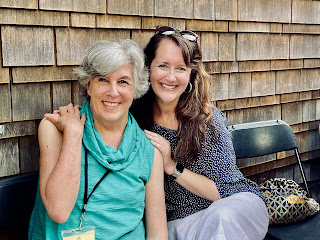


What’s especially nice is when a writer who was working on a manuscript comes back later with a PUBLISHED book. That’s what happened with Cara Black and Tim Maleeny (the authors who chair the conference) – they both came to the conference as participants and now, many published books later, they run it.

This year, a featured speaker was John Lescroart (pronounced Le-squaw – and we all love to say it.) His new book, THE MISSING PIECE, is the 19th in the New York Times bestselling Dismas Hardy series… but he didn’t talk about his book. (Because this was a writing event, not a book event!)


Interviewed by Tim Maleeny, he talked about writing, and it was fascinating. I furiously took notes and I only hope I can do justice to some of what he shared about his writing process.


  • In each chapter he sets the scene, “I put the characters on the page and get them interacting with each other. If you’re lucky, a little conflict arise. Something has to happen.” 
This sounds SO obvious, but let me tell you it is not and it’s absolutely fundamental. 

What about editing? Or is what comes out in rough draft close to the finished product?
  • He talked about writing in two modes: “Genius mode” and “Idiot mode” – genius mode is where he lingers when writing in first draft.
    “When I’m getting the story out, I cannot make a mistake. I don’t question it."
    But when he gets in to edit what he wrote, “I look at it and say, this is awful. I’m an idiot.”
    He gets into a rhythm, swinging from Genius to Idiot. 

What advice does he have for writers? 

  • Don’t be afraid to be terrible or good. - Try to make dialogue as real as possible (when you revise) 
  • Create unique voices in dialogue that are so distinctive that you don’t need attribution (so-and-so said) 
  • Get the FIRST SENTENCE written and that will lead you to the next. 

When does he let other people read his manuscript? 

  • Not until he’s done with ALL the revisions ("Otherwise you have other people saying you’re an idiot, and you don’t want that.") 

And by the way, when he started writing, it took 14 years before he submitted his first book to a publisher. 

A final word: 

  • "Sometimes you have to kill someone in a mystery. Most of the time I’m shocked when it happens, especially for a recurring character.” 

(And if you’ve somehow missed his wonderful series/writer, his advice on the first book to read is HARD EVIDENCE, the first in the Dismas Hardy series.) 

Have you ever found yourself trying something new and having to give yourself permission to be in Idiot Mode?